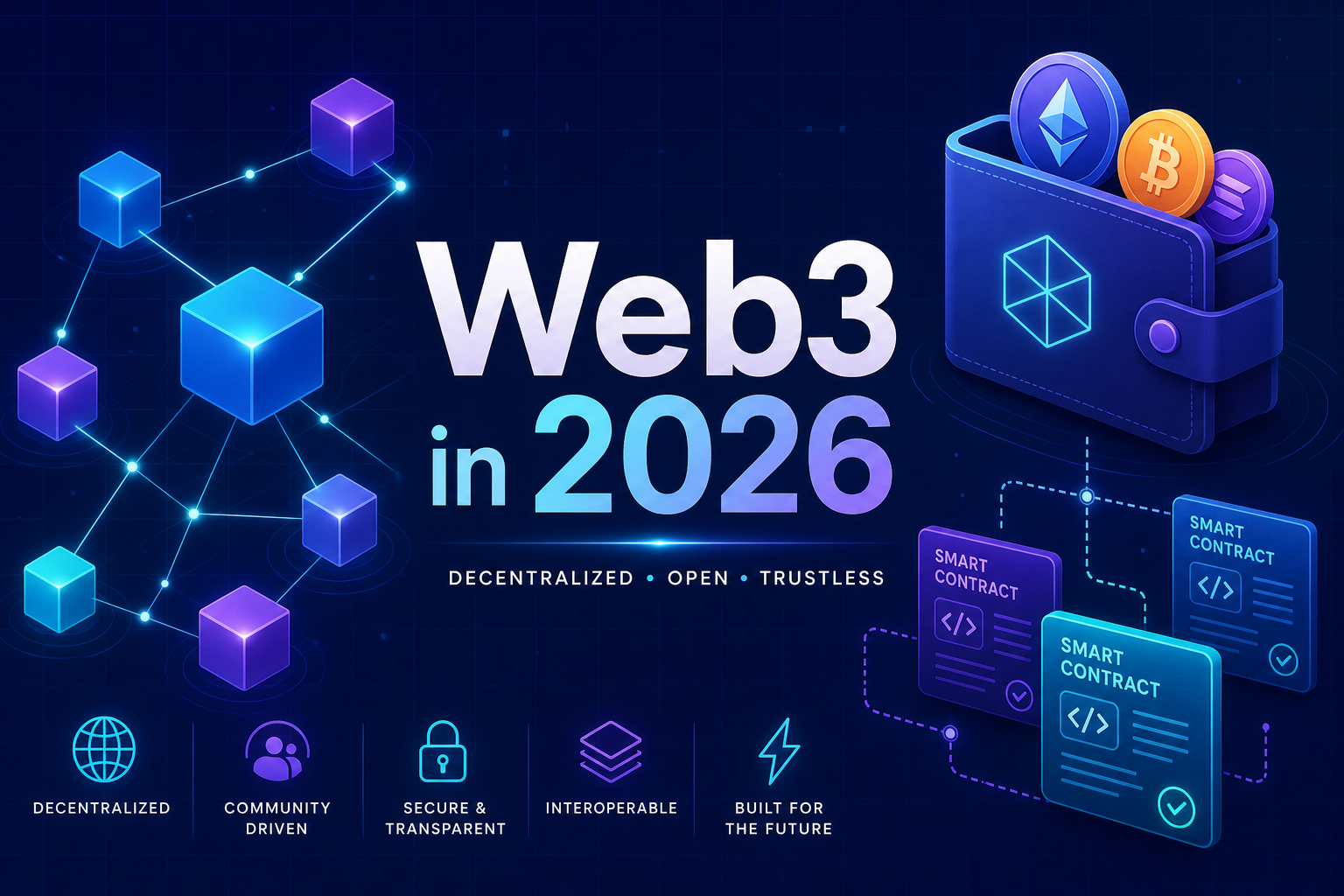
Remember when every other startup pitch deck had “decentralized” stamped across it, and your group chats were arguing about NFTs at 2 a.m.? That noise has mostly faded. So here’s the honest question worth asking in 2026: was Web3 a passing hype cycle, or did something real survive the crash? The short answer is that the speculation died down, but the underlying technology quietly matured — and understanding Web3 now matters more for builders than it did at the peak of the frenzy.
This guide cuts through the marketing. You’ll learn what Web3 actually is, how it differs from the web you use every day, what the core building blocks look like in code, where it genuinely solves problems, and where it’s still a solution looking for one. By the end, you’ll be able to judge for yourself whether it deserves a place in your skill set.
What Is Web3? A Plain-English Definition
Web3 is a vision of the internet where applications run on decentralized networks — primarily public blockchains — instead of servers owned by a single company. In Web3, users control their own data, identity, and assets through cryptographic keys rather than trusting a central platform to hold them. Ownership and logic live on a shared, tamper-resistant ledger that no single party controls.
That definition packs in a lot, so let’s unpack the word that matters most: decentralization. In the web you use today, when you log into a social network or a bank, a company’s database is the single source of truth. It can change your balance, suspend your account, or sell your activity. Web3 swaps that trusted middleman for a network of thousands of independent computers that agree on the truth through consensus rules. No one node can rewrite history on its own.
It helps to see Web3 as the third chapter in the web’s story rather than a clean replacement for everything before it.
Web1, Web2, and Web3: How We Got Here
The “3” in Web3 implies there were a Web1 and a Web2, and the progression actually explains a lot about why the technology exists.
- Web1 (roughly 1990–2004): The “read-only” web. Static HTML pages, personal homepages, and directories. You consumed information but rarely contributed.
- Web2 (2004–present): The “read-write” web. Platforms like social networks, video sites, and marketplaces let anyone publish — but the platforms own the data, the relationships, and the revenue.
- Web3 (emerging): The “read-write-own” web. You can still publish and interact, but you also hold cryptographic ownership of your assets, identity, and sometimes a stake in the network itself.
The Web2 model created enormous value, but it also concentrated power. A handful of companies became gatekeepers, and creators learned the hard way that an account ban or an algorithm change could erase their livelihood overnight. Web3’s core promise is to make those rules transparent and to give users portable ownership that no single platform can revoke.
The Core Building Blocks of Web3
Web3 is not one product. It’s a stack of technologies that work together. Understanding each piece is the fastest way to separate substance from hype.
Blockchains and Consensus
A blockchain is a shared database replicated across many computers, where new entries (“blocks”) are cryptographically chained to previous ones. Changing an old record would require redoing all the work after it across the majority of the network — practically impossible on a large chain. Networks reach agreement through consensus mechanisms like Proof of Stake, which has largely replaced the energy-hungry Proof of Work on major chains such as Ethereum.
Wallets and Keys
Instead of a username and password, Web3 uses a key pair: a public address you can share and a private key you must guard. Your wallet is the app that manages these keys and signs transactions. This is the foundation of “self-custody” — you, not a company, hold the keys to your assets.
Smart Contracts
A smart contract is a program deployed to a blockchain that executes automatically when its conditions are met. Think of it as a vending machine: put in the right input, and the agreed-upon output happens with no clerk required. Here’s a minimal example written in Solidity, Ethereum’s most popular contract language:
// SPDX-License-Identifier: MIT
pragma solidity ^0.8.20;

contract TipJar {
    address public owner;          // who can withdraw funds
    mapping(address => uint256) public tips; // tracks each tipper's total

    constructor() {
        owner = msg.sender;        // the deployer becomes the owner
    }

    // Anyone can send ETH to this function
    function tip() external payable {
        require(msg.value > 0, "Send some ETH");
        tips[msg.sender] += msg.value;
    }

    // Only the owner can withdraw the balance
    function withdraw() external {
        require(msg.sender == owner, "Not the owner");
        payable(owner).transfer(address(this).balance);
    }
}
This contract accepts tips from anyone, records how much each address has sent, and lets only the deployer withdraw the total. The key insight is that the rules are public and enforced by the network — no server, no admin panel, and no way for the owner to quietly change who is allowed to withdraw after deployment.
dApps and Tokens
A dApp (decentralized application) pairs a normal front end with smart contracts as its back end. Tokens — both fungible (like a currency) and non-fungible (NFTs, which represent unique items) — are how value and ownership move through these apps.
How a Web3 App Actually Works in Code
Talking about Web3 in the abstract is easy; seeing it connect is what makes it click. Most browser-based dApps use a JavaScript library to talk to the blockchain through the user’s wallet. Here’s how you might connect a wallet and read an address using the widely used ethers.js library:
import { ethers } from "ethers";

async function connectWallet() {
  // window.ethereum is injected by browser wallet extensions
  if (!window.ethereum) {
    alert("No wallet found. Install a Web3 wallet first.");
    return;
  }

  // Ask the user to grant access to their accounts
  const provider = new ethers.BrowserProvider(window.ethereum);
  await provider.send("eth_requestAccounts", []);

  // The signer represents the connected account
  const signer = await provider.getSigner();
  const address = await signer.getAddress();

  console.log("Connected as:", address);
  return signer;
}

connectWallet();
When this runs, the wallet pops up and asks the user to approve the connection. Nothing happens without their explicit signature — that consent step is the heart of Web3’s user-controlled model. Once connected, the same signer object can call functions on a smart contract, such as the tip() method from the earlier example, and the user approves each transaction individually.
The mental shift for Web2 developers: there is no central server you control. Your “back end” is a public contract anyone can read, and your users bring their own identity to your app.
Web2 vs Web3: An Honest Comparison
Neither model is universally better. The right choice depends on whether decentralization actually buys you something. This table lays out the trade-offs without the marketing gloss.
| Dimension | Web2 | Web3 |
|---|---|---|
| Data ownership | Platform owns user data | User holds keys and assets |
| Trust model | Trust the company | Trust open code and consensus |
| Performance | Fast, cheap, mature | Slower, costs gas fees |
| Censorship | Platform can ban or remove | Resistant to single-party control |
| User experience | Polished and familiar | Improving but still rough |
| Error recovery | Reset password, undo actions | Lost keys mean lost assets |
Notice that the strengths cut both ways. The same property that makes Web3 censorship-resistant also makes mistakes irreversible. Good engineering means picking the model that fits the problem, not forcing decentralization where a database would serve users better.
Is Web3 Still Relevant in 2026?
This is the question that brought you here, and the answer is more nuanced than the headlines on either side. The speculative mania around tokens and profile-picture NFTs has cooled dramatically. But several Web3 use cases have moved from hype to genuine, boring-in-a-good-way utility.
Here’s where Web3 is delivering real value heading through 2026:
- Stablecoins and payments: Dollar-pegged tokens now move billions in cross-border settlements, often faster and cheaper than legacy banking rails, especially in regions with limited financial access.
- Tokenization of real-world assets: Treasury bonds, real estate shares, and commodities are being represented on-chain by established financial institutions, making traditionally illiquid assets easier to trade and divide.
- Decentralized identity: Standards like verifiable credentials let you prove facts about yourself (age, qualifications) without handing over all your data to every service.
- Cheaper, faster infrastructure: Layer 2 networks have slashed transaction costs by orders of magnitude compared to a few years ago, removing the painful fees that scared away early users.
At the same time, plenty of Web3 promises remain unrealized. Fully decentralized social media is still niche, “play-to-earn” gaming largely collapsed, and many DAOs (decentralized organizations) struggle with low participation. So the honest verdict is this: Web3 is absolutely still relevant in 2026, but as a specialized tool for specific problems — ownership, value transfer, and trust-minimized coordination — not as a wholesale replacement for the internet.
Common Pitfalls and Misconceptions to Avoid
Whether you’re investing time learning Web3 or evaluating it for a project, a few mistakes trip up almost everyone.
- Assuming everything belongs on a blockchain. Public chains are slow and costly compared to databases. If you don’t need trustless ownership or censorship resistance, you probably don’t need Web3.
- Confusing “crypto prices” with “the technology.” Token speculation and the engineering value of decentralized systems are different conversations. Judge the tech on what it enables, not on a chart.
- Underestimating key management. “Not your keys, not your coins” is a real risk. Losing a private key means permanent loss, and there’s no support line to call.
- Ignoring smart contract security. Code is public and immutable once deployed, so bugs are exploitable forever. Always get contracts audited and follow established security patterns.
- Believing “decentralized” means “anonymous and unregulated.” Most public blockchains are fully transparent ledgers, and regulation has expanded significantly. Transactions are often easier to trace than cash.
Keeping these in mind separates people who understand Web3 from people who just repeat slogans about it.
How to Start Learning Web3 the Practical Way
If you’ve decided Web3 is worth exploring, you don’t need to gamble a cent to learn it. The most effective path is hands-on and almost entirely free.
- Get comfortable with the fundamentals of how blockchains and wallets work by reading the official Ethereum learning resources.
- Install a browser wallet and switch it to a test network, which uses free, worthless test tokens so you can experiment safely.
- Write and deploy a simple smart contract using an in-browser tool like Remix — no local setup required.
- Build a tiny dApp front end with ethers.js that reads from and writes to your deployed contract.
- Study real, audited open-source contracts to learn established patterns instead of inventing risky ones yourself.
Within a weekend you can go from zero to a working, wallet-connected app on a test network. That practical loop teaches you more than months of reading opinion threads.
Frequently Asked Questions About Web3
Is Web3 the same as cryptocurrency?
No. Cryptocurrency is one application of blockchain technology — a digital asset for transferring value. Web3 is the broader idea of a user-owned internet built on those same decentralized networks, which includes identity, applications, storage, and governance, not just currency.
Do I need to buy crypto to learn Web3 development?
Not at all. Test networks provide free tokens specifically for development. You can write, deploy, and test smart contracts and dApps end to end without spending real money, which makes Web3 one of the cheaper specialties to experiment with.
Is Web3 dead after the NFT and crypto crashes?
The hype is dead; the technology is not. Speculative trends faded, but practical uses like stablecoin payments, asset tokenization, and decentralized identity kept growing. Web3 in 2026 is quieter and more useful than it was at the peak of the noise.
What programming languages do Web3 developers use?
Solidity is the dominant language for smart contracts on Ethereum and compatible chains, while Rust is popular on other networks. On the front end, you use standard JavaScript or TypeScript with libraries such as ethers.js or viem to connect to wallets and contracts.
Is Web3 secure?
The underlying cryptography is strong, but security failures usually come from human error and buggy smart contracts rather than broken blockchains. Audited code, careful key management, and conservative design matter far more than the chain you choose.
Conclusion: Where Web3 Stands in 2026
So, what is Web3, and is it still relevant in 2026? It’s an architecture for a user-owned internet built on blockchains, smart contracts, and self-custody wallets — and yes, it remains relevant, just not in the way the hype cycle promised. The speculation washed out, and what’s left is a focused set of genuinely useful tools for ownership, payments, and trust-minimized coordination.
The smart move now isn’t to treat Web3 as a religion or a punchline. Treat it as one more powerful option in your engineering toolbox: brilliant when you truly need decentralization, and overkill when you don’t. Learn the fundamentals, deploy a contract on a test network, and form your own opinion from experience. That hands-on understanding of Web3 will serve you well no matter which way the next cycle turns.