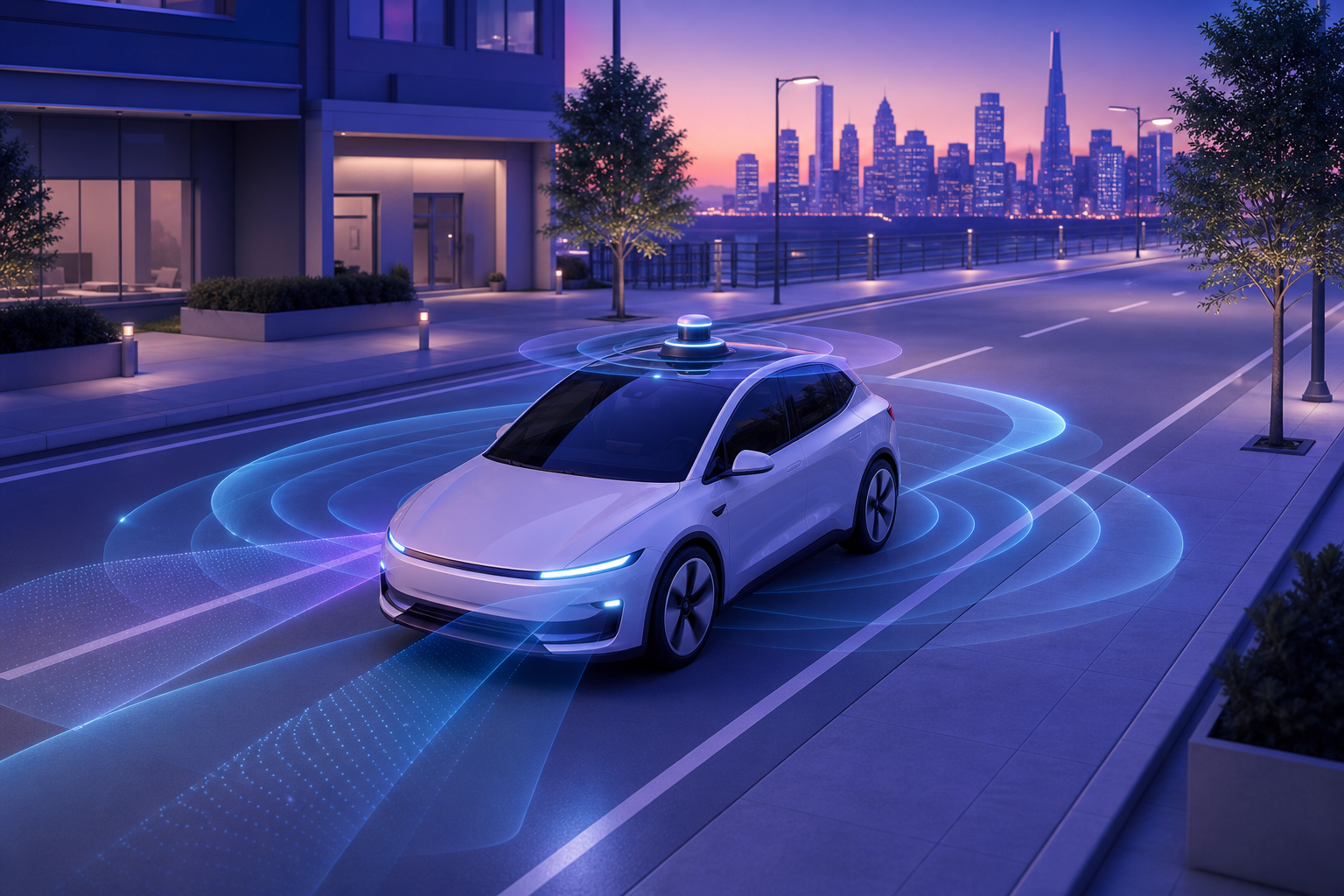
You open an app, tap a pin on the map, and a car with no one in the driver’s seat pulls up to take you across town. A few years ago that sentence read like science fiction. In 2026, it’s a regular Tuesday in Phoenix, San Francisco, Austin, and a growing list of other cities. The race to dominate robotaxi services has moved out of the lab and onto public streets, and the names leading it — Waymo, Tesla, and Zoox — are now competing for your fare.
But not every service is available where you live, and they don’t all work the same way. Some let you hail a fully driverless ride right now; others are still running with safety operators or limited to airport routes. This guide breaks down the ten most significant robotaxi services running in US cities in 2026, what makes each one different, and how to actually book a ride.
What Is a Robotaxi Service?
A robotaxi service is an on-demand ride-hailing platform that uses self-driving vehicles to transport passengers without a human driver in control. You request a trip through an app, an autonomous vehicle navigates to you using sensors and software, and it drives you to your destination — often with no human behind the wheel at all.
The technology that makes this possible sits at SAE Level 4 autonomy, meaning the vehicle handles all driving tasks within a defined operating area without expecting a person to take over. That last detail matters: today’s robotaxi services work inside carefully mapped zones called operational design domains, not everywhere a road exists.
Level 4 does not mean “drives anywhere.” It means “drives itself completely — but only inside the boundaries it was built and approved for.”
How Robotaxi Services Actually Work
Behind that empty driver’s seat is a stack of overlapping systems. Understanding them helps you judge which services are genuinely driverless and which are still assisted.
- Sensors: Most vehicles fuse lidar (laser distance mapping), radar, and cameras to build a 360-degree model of their surroundings. Tesla is the notable exception, relying on a camera-only “vision” approach.
- Localization: The car compares live sensor data against pre-built high-definition maps to know exactly where it is, often down to the centimeter.
- Prediction and planning: Machine learning models forecast what pedestrians, cyclists, and other cars will do next, then plot a safe path.
- Remote assistance: When a vehicle gets confused — say, a flooded intersection or an unusual construction setup — a remote human operator can provide guidance, though not joystick-style remote driving.
The combination of these layers is why a robotaxi can stop for a jaywalker it has never seen before, and also why it might pause awkwardly at a chaotic four-way stop. The software is cautious by design.
The Top 10 Robotaxi Services in US Cities in 2026
The list below is ordered by current public availability and scale, starting with the services you’re most likely to actually ride today. Coverage areas expand frequently, so treat city lists as a snapshot rather than a permanent map.
1. Waymo (Alphabet)
Waymo is the clear front-runner among robotaxi services and the company most people have actually ridden. Spun out of Google’s self-driving project, Waymo One offers fully driverless rides to the general public across Phoenix, San Francisco, Los Angeles, and Austin, with active expansion into additional metros. Its vehicles use a dense sensor suite with lidar, and the company publishes regular safety performance data comparing its fleet to human drivers.
If you want a driverless ride in the US today with the least friction, Waymo is the default answer.
2. Tesla Robotaxi
Tesla’s robotaxi push centers on its purpose-built Cybercab and a software-first, camera-only approach. After launching a limited service in Austin, Tesla has been scaling its ride-hailing footprint, leaning on its enormous existing vehicle fleet as a future supply pool. The bet is bold: no lidar, no expensive sensors, just cameras and neural networks. That keeps per-vehicle costs low but invites ongoing scrutiny over how it handles edge cases and poor visibility.
3. Zoox (Amazon)
Zoox builds something most rivals don’t: a ground-up purpose-built robotaxi with no steering wheel, no pedals, and bidirectional driving (it has no “front” or “back”). Owned by Amazon, Zoox runs public service in Las Vegas and San Francisco, with carriage-style seating where passengers face each other. It’s the most visible reimagining of what a car can be when you remove the driver entirely.
4. May Mobility
May Mobility focuses on smaller markets and partnerships with cities and transit agencies rather than blanket metro coverage. Its robotaxis often serve fixed or semi-fixed routes, filling public-transit gaps in places larger players overlook. It’s a reminder that robotaxi services aren’t only a big-city phenomenon.
5. WeRide
WeRide operates internationally and has pursued US permits and pilots, bringing a multi-vehicle approach that spans robotaxis, robobuses, and sanitation vehicles. Its strength is breadth of vehicle types and experience across diverse regulatory environments.
6. Pony.ai
Pony.ai is another global autonomy company with robotaxi and autonomous trucking arms. In the US it has historically run testing and limited pilots, with much of its commercial momentum overseas. Watch this one for technology partnerships as much as direct consumer rides.
7. Nuro
Nuro started with driverless delivery pods rather than passenger rides, but its mature autonomy stack is now licensed to automakers and partners building robotaxi-style services. If you order groceries that arrive in a small driverless pod, Nuro’s technology may be involved — and increasingly, that same brain powers passenger platforms.
8. Motional
A joint venture between Hyundai and Aptiv, Motional has developed driverless versions of consumer vehicles and partnered with ride-hailing networks. After restructuring its commercial timeline, it remains a serious technology developer even as its public-facing rollout has been measured rather than aggressive.
9. Aurora
Aurora’s headline business is autonomous freight trucking on highways, not city robotaxis. It earns a spot here because the Aurora Driver platform is explicitly designed to extend to passenger ride-hailing, and its highway-grade autonomy informs the broader industry. If you’re tracking where robotaxi services head next, Aurora’s truck-first strategy is worth understanding.
10. Cruise (legacy and licensed technology)
Cruise, once a leading General Motors robotaxi service, wound down its standalone driverless ride-hailing operations, with GM redirecting the technology toward personal autonomous-vehicle features. It remains historically important — and a cautionary tale about how quickly fortunes shift in this space — so any honest list of robotaxi services has to account for it.
Waymo vs Tesla vs Zoox: A Side-by-Side Comparison
The three companies most people compare represent three genuinely different philosophies. Waymo maximizes sensors and safety data, Tesla minimizes hardware cost, and Zoox reinvents the vehicle itself. The table below summarizes how the leading robotaxi services stack up.
| Service | Parent | Sensor Approach | Vehicle Type | Public Driverless Rides |
|---|---|---|---|---|
| Waymo | Alphabet | Lidar + radar + cameras | Modified consumer SUVs | Yes, multiple cities |
| Tesla Robotaxi | Tesla | Cameras only (vision) | Cybercab + existing fleet | Yes, scaling from Austin |
| Zoox | Amazon | Lidar + radar + cameras | Purpose-built, no controls | Yes, Las Vegas & SF |
| May Mobility | Independent | Lidar + cameras | Retrofitted vehicles | Yes, route-based |
The takeaway: there’s no single “best” robotaxi service yet. The right one depends on your city, your tolerance for newer technology, and whether you value Waymo’s safety track record, Tesla’s scale ambitions, or Zoox’s rethought passenger experience.
How to Book and Ride a Robotaxi
Riding one is simpler than the technology suggests. The general flow is consistent across most robotaxi services:
- Download the service’s app and confirm it operates in your city — this is the step that trips up most newcomers.
- Set your pickup and drop-off within the supported zone. Locations outside the operating area simply won’t be selectable.
- Unlock the car from the app when it arrives, and check that the displayed trip details match yours.
- Buckle up and press “Start Ride” on the in-car screen. The vehicle won’t move until everyone is belted.
- Use the in-car help button any time you need a remote support agent during the trip.
One genuinely useful habit: confirm the license plate or vehicle ID in the app before getting in, exactly as you would with a human ride-share driver.
Common Misconceptions and Pitfalls to Avoid
Robotaxi services attract a lot of myths. Clearing these up will set your expectations correctly and keep your first ride smooth.
- “They drive anywhere.” They don’t. Every service is confined to a mapped operating zone, and trips to the airport or city edge may not be supported.
- “More sensors always means safer.” Sensor count is one input, not a verdict. Validation data, software maturity, and real-world miles matter more than spec sheets.
- “There’s nobody watching.” Remote operators monitor fleets and can assist stuck vehicles, even though they aren’t driving in real time.
- “It’ll behave like an aggressive human driver.” Robotaxis are deliberately conservative. Expect cautious merges and full stops — not speed.
- Forgetting weather limits. Heavy rain, snow, or fog can pause or restrict service in some cities. Have a backup plan during bad weather.
Safety, Regulation, and What Comes Next
Robotaxi services in the US operate under a patchwork of federal guidance and state-level rules. Agencies like the National Highway Traffic Safety Administration set vehicle safety standards, while states and cities control where and how driverless vehicles can pick up passengers. That’s why a service can be fully driverless in one city and absent in the next.
The honest assessment for 2026: the technology works well within its limits and has accumulated tens of millions of driverless miles, but it is still an early commercial market. Incidents get heavy public attention precisely because expectations are high. Expansion will keep coming city by city, permit by permit, rather than in one nationwide switch-on. For a deeper background on the underlying technology, the overview of self-driving cars is a solid starting point.
Frequently Asked Questions About Robotaxi Services
Are robotaxi services available in my city?
It depends entirely on the provider. As of 2026, fully driverless robotaxi services concentrate in metros like Phoenix, San Francisco, Los Angeles, Austin, and Las Vegas, with steady expansion elsewhere. The fastest way to check is to download a service’s app and see whether it lets you set a pickup point near you.
Is it safe to ride in a driverless robotaxi?
Leading robotaxi services publish safety data showing fewer injury-causing collisions per mile than human drivers within their operating zones. No system is perfect, and edge cases still occur, but the public services running today have cleared regulatory approval to operate without a human driver.
How much does a robotaxi ride cost?
Pricing is broadly comparable to standard ride-hailing, set dynamically by distance, time, and demand. Some services run introductory promotions in new markets. Expect costs to fall over time as fleets scale and the per-mile economics improve.
What happens if the car gets stuck or confused?
The vehicle is designed to stop safely and request remote assistance. A human operator reviews the situation and helps the car proceed. As a passenger, you can press the in-car help button at any point to reach support directly.
Do I need to tip a robotaxi?
No. With no human driver, there’s no tipping. The fare you see in the app is the full cost of the trip.
Will robotaxis replace human ride-share drivers?
Not overnight. Robotaxi services are expanding city by city and still face geographic, weather, and regulatory limits. For the foreseeable future, they’ll coexist with human drivers, gradually taking on more trips in the areas where they operate.
Conclusion
The shift from concept to curbside has happened faster than many predicted. In 2026, robotaxi services are a real transportation option in a growing number of US cities, led by Waymo’s safety-first scale, Tesla’s camera-only ambition, and Zoox’s purpose-built reinvention of the car. Behind them, a deep bench of companies — from May Mobility to Aurora — is shaping where the industry heads next.
If you’re curious, the best way to understand these robotaxi services is to ride one. Check which provider operates in your area, download the app, and book a trip. You’ll get a firsthand sense of both how far autonomous driving has come and the practical limits that still define it. Just remember the fundamentals: confirm your vehicle, stay inside supported zones, keep expectations realistic in bad weather, and enjoy the strangely calm experience of a car that drives itself.