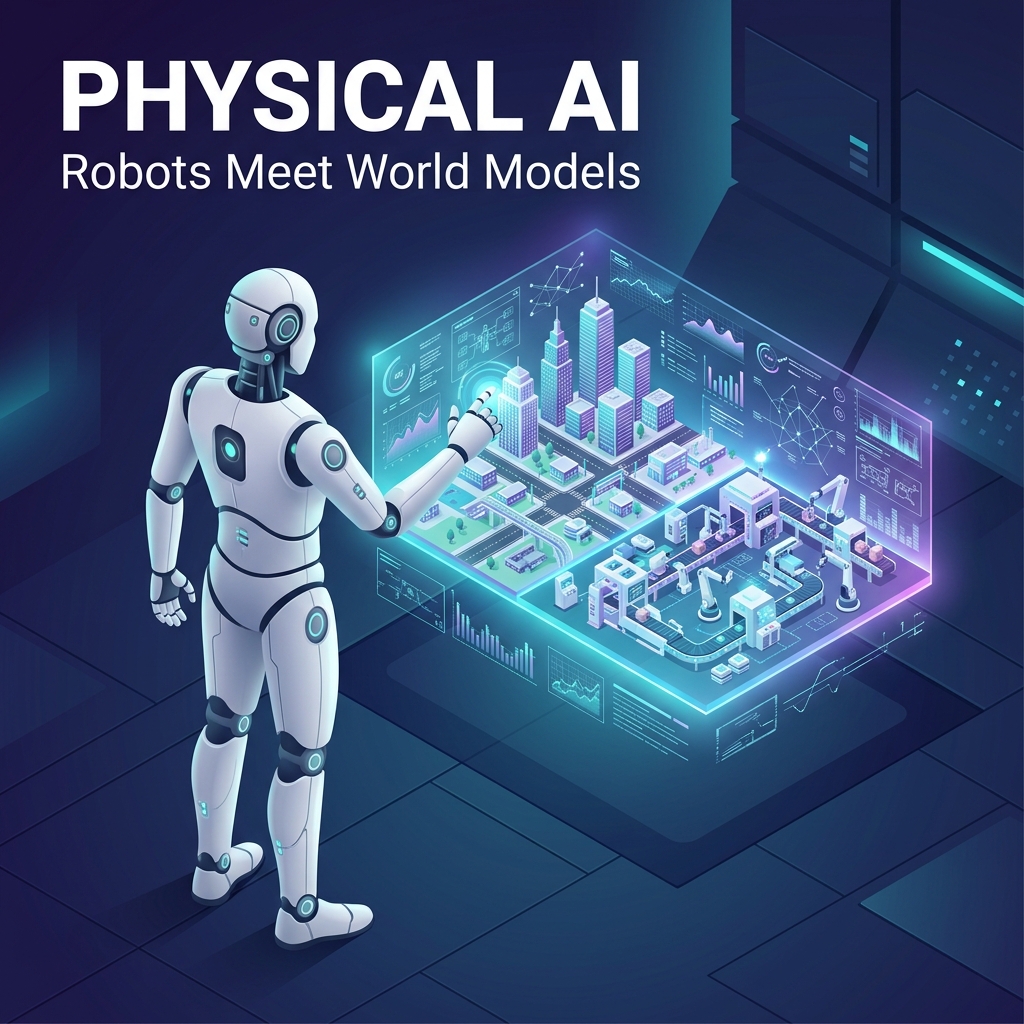
A large language model can write you a sonnet about gravity, yet it has never felt an object fall. That gap — between knowing about the world and acting in it — is exactly what Physical AI is built to close. In 2026, two research threads that grew up separately are finally fusing: robots that move through real environments, and world models that let machines simulate those environments internally before acting. If you write software for a living, this convergence matters to you, because the skills involved look a lot more like machine learning engineering than traditional robotics — and the tooling has never been more accessible.
Here is what Physical AI actually means, how world models work under the hood, why the two are merging right now, and how you can experiment with the core ideas using nothing more than Python and a laptop.
What Is Physical AI? A Clear Definition
Physical AI is artificial intelligence that perceives, reasons about, and acts within the physical world. It combines machine learning models with sensors and actuators so that machines — robots, vehicles, drones, industrial equipment — can understand real environments, predict the consequences of their actions, and perform useful physical tasks autonomously.
That definition hides an important shift in emphasis. Classical robotics treated intelligence as a control problem: engineers hand-coded kinematics, wrote explicit motion plans, and tuned PID controllers for each task. Physical AI flips the approach. Instead of programming behaviors, you train models on large amounts of sensor data, demonstrations, and simulated experience, and the behaviors emerge from learning — much like fluent text emerged from training language models on the internet.
The term gained mainstream traction when chipmakers and robotics labs began describing a “ChatGPT moment for robotics”: general-purpose models that could control many different robot bodies, rather than one bespoke program per machine. The key enabling ingredient is the world model.
World Models Explained: Giving Machines an Imagination
A world model is a learned, internal simulation of how an environment behaves. Given the current state of the world and a proposed action, a world model predicts what happens next. You can think of it as the machine equivalent of human intuition: before you pick up a full coffee cup, your brain has already simulated the weight, the liquid’s slosh, and the grip you’ll need. You don’t compute physics equations — you consult an internal model trained by years of experience.
The idea has deep research roots. The influential 2018 paper “World Models” by Ha and Schmidhuber showed that an agent could learn a compressed model of its environment and then train a controller inside its own dream — entirely within the learned simulation — before transferring that skill to the real task. Modern systems scale this concept dramatically: today’s generative world models are trained on enormous volumes of video and physics simulation, and they can generate photorealistic, physically plausible predictions of future frames conditioned on actions.
Why does a robot need imagination? Three reasons dominate:
- Data efficiency. Real-world robot trials are slow, expensive, and occasionally destructive. A world model lets the robot rehearse millions of scenarios internally, the way a chess engine explores moves without touching the board.
- Safety. An agent that can predict “if I swing my arm here, I hit the shelf” can reject dangerous actions before executing them, rather than learning from collisions.
- Generalization. A model that has internalized intuitive physics — objects fall, liquids spill, soft things deform — can handle novel situations that no hand-written rule anticipated.
How Robots and World Models Are Converging in 2026
For years, robot learning and world modeling advanced on separate tracks. Robots used model-free reinforcement learning or imitation learning; world models lived mostly in video-game benchmarks. Three developments pulled the threads together.
Vision-Language-Action Models
A vision-language-action (VLA) model is a foundation model that takes camera images and a natural-language instruction as input and outputs robot actions directly. Projects in this family demonstrated that a single network could fold laundry, clear tables, and manipulate objects it had never seen — across different robot bodies. VLAs gave robotics its transfer-learning moment: pretrain broadly, fine-tune narrowly, deploy widely.
Generative World Models as Training Grounds
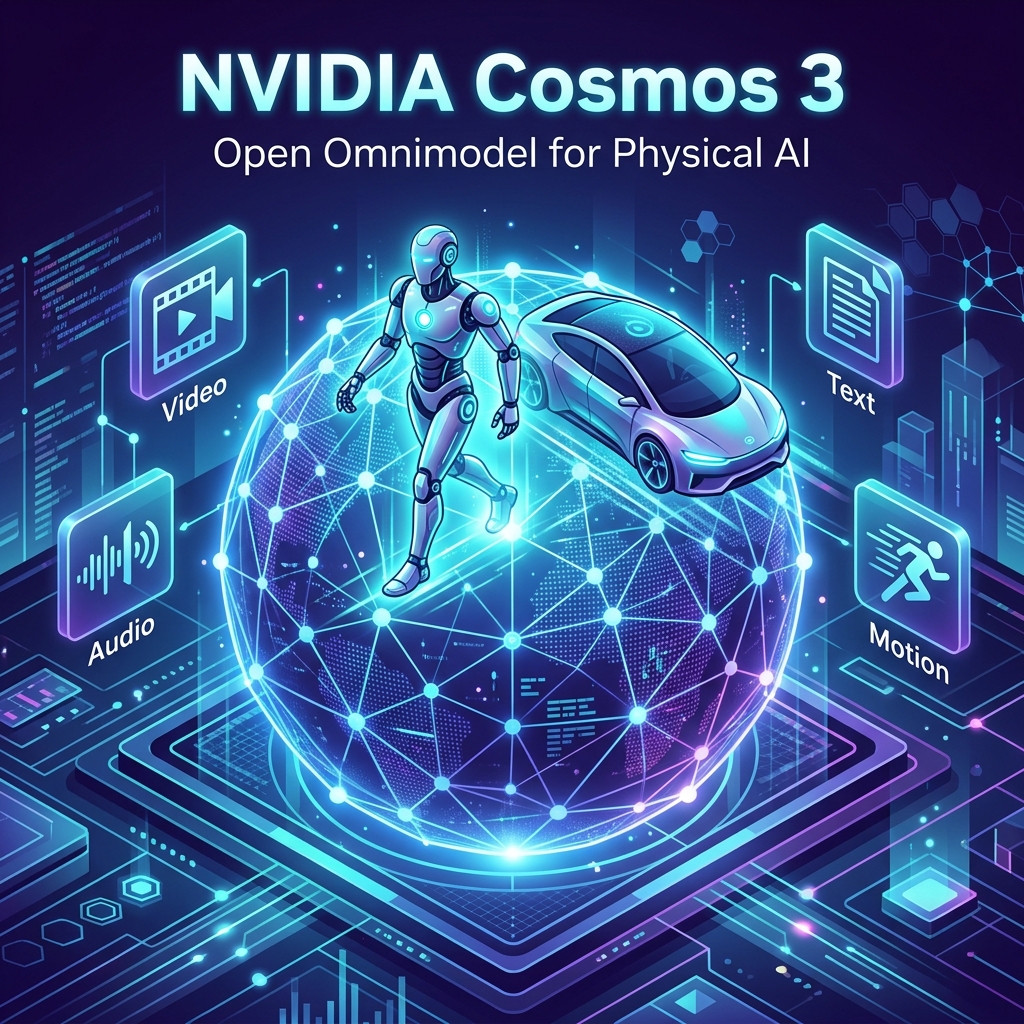
The second development is the rise of large-scale world foundation models — systems trained on millions of hours of video that can generate physically consistent synthetic footage on demand. Platforms such as NVIDIA Cosmos are explicitly positioned as world model platforms for Physical AI development: instead of collecting risky real-world data, developers generate endless variations of warehouse aisles, kitchen counters, or rainy intersections and train robot policies against them. The world model becomes a data factory.
Sim-to-Real Transfer That Actually Works
The third piece is sim-to-real transfer — moving a policy trained in simulation onto physical hardware without it falling apart. Earlier attempts failed because simulators were too clean; real sensors are noisy and real friction is messy. Techniques like domain randomization (training across thousands of randomized lighting conditions, textures, and physics parameters) made policies tolerant of that messiness. When you combine VLAs, generative world models, and reliable sim-to-real pipelines, you get the full Physical AI loop: imagine, rehearse, act, observe, improve.
Classical Robotics vs. Physical AI: What Changed
The contrast between the old paradigm and the new one is easiest to see side by side.
| Aspect | Classical Robotics | Physical AI |
|---|---|---|
| Behavior source | Hand-coded control logic and motion planning | Learned policies trained on data and simulation |
| Environment assumptions | Structured, fixed (cages, fixtures, known layouts) | Unstructured, changing (homes, streets, mixed workspaces) |
| Task scope | One robot, one task, extensive re-engineering to change | General-purpose models adapted via fine-tuning or prompting |
| Failure handling | Stop and alert a human | Predict, replan, and recover using the world model |
| Primary skill set | Mechanical and control engineering | Machine learning, data pipelines, simulation |
Neither column is “better” in absolute terms. A welding robot bolted to a factory floor doing the same motion a million times still benefits from deterministic classical control. Physical AI earns its complexity when the environment is unpredictable and the task list is open-ended — which describes most of the world outside a factory cage.
Build a Tiny World Model in Python
The best way to internalize the concept is to build a miniature version. A world model, at its core, is a function that predicts the next state given the current state and an action. The example below trains exactly that for the classic CartPole environment using Gymnasium and PyTorch. Install the dependencies with pip install gymnasium torch.
import gymnasium as gym
import torch
import torch.nn as nn

# A tiny "world model": predicts the next state from (state, action)
class DynamicsModel(nn.Module):
    def __init__(self, state_dim, action_dim, hidden=64):
        super().__init__()
        self.net = nn.Sequential(
            nn.Linear(state_dim + action_dim, hidden),
            nn.ReLU(),
            nn.Linear(hidden, state_dim),  # outputs the predicted next state
        )

    def forward(self, state, action):
        return self.net(torch.cat([state, action], dim=-1))

env = gym.make("CartPole-v1")
model = DynamicsModel(state_dim=4, action_dim=1)
optimizer = torch.optim.Adam(model.parameters(), lr=1e-3)
loss_fn = nn.MSELoss()

# Collect real transitions and train the model to predict the physics
for episode in range(200):
    state, _ = env.reset()
    done = False
    while not done:
        action = env.action_space.sample()  # explore with random actions
        next_state, reward, terminated, truncated, _ = env.step(action)
        done = terminated or truncated

        s = torch.tensor(state, dtype=torch.float32)
        a = torch.tensor([float(action)], dtype=torch.float32)
        target = torch.tensor(next_state, dtype=torch.float32)

        pred = model(s, a)          # what the model THINKS will happen
        loss = loss_fn(pred, target)  # vs. what ACTUALLY happened
        optimizer.zero_grad()
        loss.backward()
        optimizer.step()

        state = next_state
This code gathers experience from the real (simulated) environment and trains a small neural network to predict the next state — cart position, cart velocity, pole angle, and pole angular velocity — from the current state and the chosen action. The loss measures the gap between the model’s prediction and what the environment actually did, which is precisely how large world models are trained, just with video frames instead of four numbers.
Once trained, the model can imagine futures without touching the environment at all:
# "Imagine" 10 steps into the future without using the real environment
state, _ = env.reset()
state = torch.tensor(state, dtype=torch.float32)

with torch.no_grad():
    for step in range(10):
        action = torch.tensor([1.0])  # hypothetical plan: keep pushing right
        state = model(state, action)  # feed predictions back into the model
        print(f"Step {step + 1}: predicted pole angle = {state[2]:.4f}")
This rollout loop is the seed of planning: an agent can imagine the outcomes of several candidate action sequences, score them, and execute only the best one in reality. Scale the state from 4 numbers to camera images, the network from 2 layers to billions of parameters, and the horizon from 10 steps to full task sequences, and you have the architecture powering modern Physical AI systems.
Tip: notice how prediction error compounds in the imagination loop — each step feeds a slightly wrong prediction back in as input. Managing this compounding error over long horizons is one of the central open problems in world model research.
Where Physical AI Is Showing Up in the Real World
This is not a lab-only story anymore. Several deployment categories matured noticeably by 2026:
- Warehouse and logistics robots handle mixed-item picking — the long-standing nemesis of automation — because learned models cope with items in arbitrary positions and packaging.
- Humanoid robots entered pilot programs in manufacturing and logistics, chosen not for sci-fi appeal but because human-shaped robots fit human-shaped workplaces without retrofitting.
- Autonomous vehicles increasingly rely on world models to predict the behavior of pedestrians and other drivers seconds into the future, rather than reacting frame by frame.
- Surgical and lab automation uses learned fine-motor policies for tasks like suturing practice and high-throughput pipetting, where precision under variation matters.
- Agriculture and inspection drones apply embodied perception to identify crop stress or infrastructure cracks while navigating wind and clutter.
The pattern across all of these: the environment is too variable for hand-coded rules, and the cost of real-world trial and error is too high — exactly the conditions where world-model-driven learning pays off. The broader cognitive-science idea that intelligence is shaped by having a body, known as embodied cognition, has effectively become an engineering roadmap.
Common Pitfalls and Misconceptions About Physical AI
If you’re evaluating this field — as a developer, a founder, or a curious learner — a few misconceptions will cost you time. Here are the big ones.
Mistake 1: Assuming a Great Demo Means a Reliable Product
Robot demo videos are heavily selected. A humanoid that folds a shirt beautifully in one video may succeed at that task 60% of the time, in one lighting condition, with one shirt. Production deployments need 99%+ reliability across endless variation. When you assess Physical AI claims, ask about success rates, environmental diversity, and recovery behavior — not just whether the task is possible.
Mistake 2: Treating Simulation as Reality
A policy that scores perfectly in simulation can fail instantly on hardware because of unmodeled friction, sensor latency, cable drag, or battery sag. The sim-to-real gap shrank, but it did not disappear. Serious teams validate on physical hardware early and continuously rather than perfecting everything in simulation first.
Mistake 3: Ignoring Compounding Prediction Error
As the code example showed, world models drift when predictions feed back into themselves. A model that is 99% accurate per step can be badly wrong after 50 steps. Practical systems replan frequently against fresh sensor data instead of trusting long imagined rollouts.
Mistake 4: Underestimating the Data and Safety Engineering
The glamorous part of Physical AI is the model; the decisive part is the pipeline. Teleoperation data collection, synthetic data generation, dataset curation, evaluation harnesses, and hardware safety interlocks (e-stops, force limits, geofenced workspaces) consume the majority of real engineering effort. A model error in a chatbot produces a bad sentence; a model error in a 70-kilogram robot produces a liability incident. Plan accordingly.
Frequently Asked Questions About Physical AI
Is Physical AI the same thing as robotics?
No. Robotics is the broader engineering discipline of building machines that move; Physical AI is the approach of giving those machines learned intelligence. You can build a robot with zero AI (an assembly-line arm replaying fixed motions), and you can build Physical AI that runs in non-robot hardware, such as smart camera systems that reason about physical scenes.
What is a world model in simple terms?
A world model is a neural network that has learned to predict what happens next in an environment. Show it the current situation and a proposed action, and it forecasts the result — letting an AI agent rehearse decisions internally before acting, much like you mentally rehearse parallel parking before turning the wheel.
Do I need a physical robot to learn Physical AI?
No. Most of the skill stack — reinforcement learning, imitation learning, dynamics modeling, simulation tooling — can be learned entirely in software using free environments like Gymnasium, MuJoCo, or Isaac Lab. Affordable robot arms and quadrupeds exist if you want hardware experience later, but they are not a prerequisite.
How is Physical AI different from generative AI like ChatGPT?
Generative AI predicts tokens — text, pixels, audio — and its mistakes are cheap to discard. Physical AI must predict and produce actions with irreversible consequences under real-time constraints, noisy sensors, and safety requirements. Interestingly, the two converge in world models: generating a video of “what happens if the robot pushes the cup” is a generative task in service of physical decision-making.
Which skills should a developer learn to work in this field?
Start with Python and PyTorch, then layer on reinforcement learning fundamentals, a simulator (MuJoCo or Isaac Lab), and basic 3D math — transforms, rotations, coordinate frames. From there, study imitation learning and VLA architectures. Classical control theory helps but is no longer the entry gate it once was.
Are humanoid robots ready for homes in 2026?
Not for general-purpose home use. Current deployments concentrate in structured commercial settings — warehouses, factories — where tasks repeat and safety perimeters exist. Homes are the hardest environment in robotics: cluttered, unique, full of pets and children. Expect narrow home capabilities first, broad household help considerably later.
Conclusion
Physical AI is the point where machine learning stops describing the world and starts operating in it. The convergence driving the 2026 moment is concrete: vision-language-action models give robots general-purpose skills, generative world models give them an internal imagination to rehearse in, and matured sim-to-real techniques carry those rehearsed skills onto real hardware.
For developers, the practical takeaways are encouraging. The field now rewards machine learning skills you may already have, the core ideas can be prototyped in a few dozen lines of Python, and the hard problems — compounding prediction error, sim-to-real gaps, safety engineering — are exactly the kind of unsolved-but-tractable challenges worth building a career on. Train a small dynamics model, watch it imagine the future and drift, and you will understand the frontier of Physical AI better than any demo video can teach you.