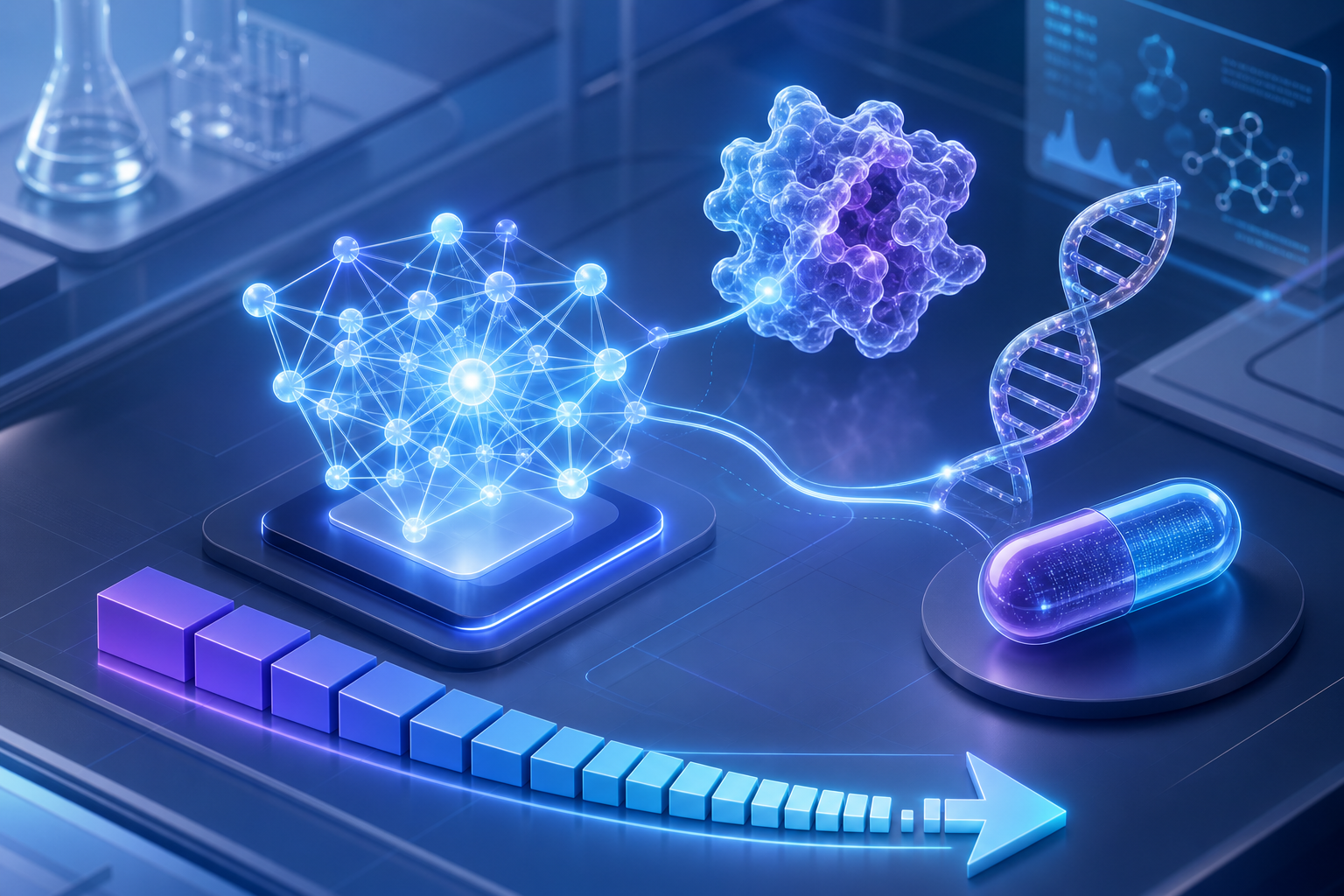
A traditional drug used to take around 10 to 15 years and cost more than a billion dollars before a single patient could take it. In 2026, several biotech labs are reporting candidate molecules moving from a blank screen to clinical readiness in roughly 18 months. That collapse in time is the headline story of AI drug discovery, and it is not marketing hype — it is the result of machine learning models that can read biology, predict chemistry, and simulate outcomes faster than any human team ever could.
You do not need a PhD in pharmacology to understand what changed. If you have ever waited for a slow build to compile, imagine that build taking a decade. Now imagine a system that runs thousands of those builds in parallel overnight. That is roughly what happened to pharmaceutical research, and this guide walks you through exactly how it works, where it breaks, and what the numbers really mean.
What Is AI Drug Discovery?
AI drug discovery is the use of machine learning, deep neural networks, and generative models to design, screen, and optimize new medicines. Instead of testing compounds one by one in a lab, scientists train algorithms on biological and chemical data to predict which molecules will bind to a disease target, stay safe in the body, and survive manufacturing — all before physical testing begins.
The shift matters because biology is a search problem. The number of drug-like molecules that could theoretically exist is estimated at around 10^60 — more than the atoms in the solar system. No human team can explore that space. A trained model can rank and filter it in hours.
Why the Old Timeline Took 10 Years
To appreciate the speed-up, you need to understand the bottlenecks. Classic drug development moves through stages that each take years and reject most candidates.
- Target identification: Finding the protein or gene that drives a disease.
- Hit discovery: Screening huge chemical libraries for molecules that interact with that target.
- Lead optimization: Tweaking promising molecules for potency and safety.
- Preclinical testing: Animal and lab-dish studies for toxicity.
- Clinical trials: Three phases of human testing.
The painful truth is the attrition rate. Roughly 90% of candidates that enter human trials fail. Each failure burns years and money. Most of those failures trace back to two early questions that were hard to answer cheaply: will this molecule actually bind, and will it poison the patient? AI attacks both questions before a beaker is touched.
How AI Compresses the AI Drug Discovery Pipeline
The 18-month figure is not one model doing magic. It is several specialized systems chained together, each removing a slow, manual step.
Protein Structure Prediction
Knowing a protein’s 3D shape used to require months of lab work with X-ray crystallography. AlphaFold and its successors now predict structures from amino acid sequences in minutes with near-experimental accuracy. When you know the shape of a target’s binding pocket, you can design a molecule to fit it like a key in a lock.
Generative Molecule Design
Generative AI does for chemistry what large language models do for text. Instead of predicting the next word, these models propose entirely new molecular structures that satisfy constraints — high binding affinity, low toxicity, easy synthesis. This flips the workflow: rather than searching existing libraries, you generate candidates on demand.
Virtual Screening and Property Prediction
Before any wet-lab test, models score millions of candidates for drug-likeness. A common first filter is Lipinski’s Rule of Five, a quick heuristic for whether a molecule can be taken orally. You can compute these properties in seconds with open-source chemistry libraries.
# Using RDKit to screen a molecule against Lipinski's Rule of Five
from rdkit import Chem
from rdkit.Chem import Descriptors

def passes_lipinski(smiles):
    """Return True if a molecule is likely orally bioavailable."""
    mol = Chem.MolFromSmiles(smiles)        # parse the molecule
    if mol is None:
        return False                        # invalid structure

    mw = Descriptors.MolWt(mol)             # molecular weight
    logp = Descriptors.MolLogP(mol)         # lipophilicity
    h_donors = Descriptors.NumHDonors(mol)  # hydrogen bond donors
    h_acceptors = Descriptors.NumHAcceptors(mol)

    # Lipinski thresholds
    return (mw <= 500 and logp <= 5
            and h_donors <= 5 and h_acceptors <= 10)

# Aspirin in SMILES notation
print(passes_lipinski("CC(=O)OC1=CC=CC=C1C(=O)O"))  # True
This snippet uses RDKit to read a molecule written in SMILES notation, calculate four key physical properties, and check them against well-established thresholds. In a real pipeline you would run this across millions of generated structures to discard poor candidates instantly, keeping only those worth expensive simulation.
Binding Affinity Modeling
The candidates that survive screening are scored for how tightly they bind the target. Modern systems use graph neural networks that treat a molecule as a graph of atoms and bonds, learning the patterns that predict strong, selective binding far faster than physics-based docking alone.
A Concrete Example: Scoring a Candidate Batch
To see how these pieces combine, imagine you have generated a batch of candidate molecules and want a single ranked shortlist. The logic below mirrors what an AI drug discovery triage step looks like in practice.
from rdkit import Chem
from rdkit.Chem import Descriptors, QED

candidates = [
    "CC(=O)OC1=CC=CC=C1C(=O)O",          # aspirin
    "CN1C=NC2=C1C(=O)N(C(=O)N2C)C",      # caffeine
    "CC(C)CC1=CC=C(C=C1)C(C)C(=O)O",     # ibuprofen
]

def score(smiles):
    mol = Chem.MolFromSmiles(smiles)
    if mol is None:
        return 0.0
    # QED = Quantitative Estimate of Drug-likeness (0 to 1)
    return round(QED.qed(mol), 3)

ranked = sorted(candidates, key=score, reverse=True)
for smi in ranked:
    print(f"{score(smi):.3f}  {smi}")
Here the QED.qed() function returns a single drug-likeness score between 0 and 1 that blends multiple properties into one number. Sorting by that score gives chemists a prioritized list, so human experts spend their limited time on the most promising molecules instead of reviewing thousands by hand. That prioritization is the real time saver — AI does not replace scientists, it focuses them.
Traditional vs AI-Driven Drug Discovery
The contrast between the two approaches explains where the months disappear.
| Stage | Traditional Approach | AI-Driven Approach |
|---|---|---|
| Target structure | Months of crystallography | Minutes via structure prediction |
| Hit discovery | Physical screening of libraries | Generative design and virtual screening |
| Lead optimization | Trial-and-error synthesis | Property-guided model iteration |
| Toxicity flags | Late preclinical failure | Early in-silico prediction |
| Typical early phase | 4-6 years | 12-18 months |
Notice the pattern: AI does not skip steps, it moves them earlier and runs them in parallel. Problems that once surfaced after years of investment now appear on day one, when fixing them is cheap.
The Limits: Why It Is Not 18 Months for Everything
Honesty matters here, because the headline number hides important caveats. The 18-month timeline usually refers to the discovery and preclinical phase — getting from concept to a strong, testable candidate. Human clinical trials still take years and are governed by safety regulations that no algorithm can shortcut.
AI can design a brilliant molecule in weeks, but it cannot rush the human body’s response or a regulator’s review. The compression is real, but it is front-loaded into the lab phase.
Regulators like the U.S. FDA are actively building frameworks for AI-assisted submissions, but approval still demands rigorous human evidence. The fastest part of the pipeline got faster; the safety-critical part stayed careful by design.
Common Pitfalls and Misconceptions
If you are evaluating this field — as an investor, a developer entering health tech, or a curious engineer — watch for these traps.
- “AI cures diseases by itself.” It generates and ranks candidates; biology and trials still decide outcomes.
- Garbage-in data. Models trained on biased or sparse experimental data produce confident but wrong predictions. Data quality beats model size.
- Ignoring synthesizability. A model can propose a molecule that no chemist can actually build. Good pipelines score synthetic feasibility, not just binding.
- Overfitting to benchmarks. A model that scores well on public datasets may fail on novel targets it has never seen.
- Treating predictions as proof. In-silico results guide experiments; they do not replace them.
Best Practices for Building in This Space
For developers and data scientists who want to contribute, the technical fundamentals are surprisingly approachable.
- Learn SMILES notation and a chemistry toolkit like RDKit before touching deep learning — you cannot model what you cannot represent.
- Start with property prediction, a well-defined supervised problem, before attempting generative design.
- Validate every model against held-out, real experimental data, not just public benchmarks.
- Always include a synthesizability and toxicity filter; a high-affinity molecule that is toxic or unbuildable is worthless.
- Keep domain experts in the loop. The strongest results in 2026 come from chemist-plus-model teams, not pure automation.
Frequently Asked Questions About AI Drug Discovery
Does AI drug discovery replace pharmaceutical chemists?
No. It removes repetitive screening and prediction work so chemists can focus on judgment, experiment design, and the molecules most likely to succeed. The role shifts toward interpreting model output rather than disappearing.
How accurate are AI predictions for new drugs?
Accuracy varies by task. Protein structure prediction is now near experimental quality, while toxicity and clinical-outcome predictions are useful filters but far from certain. Treat predictions as strong priors that must be confirmed in the lab.
What programming skills do I need to enter this field?
Python is the standard language, paired with libraries like RDKit for chemistry and PyTorch for modeling. A grounding in machine learning, graph neural networks, and basic biochemistry will take you a long way.
Why does it still take years to approve a drug if AI is so fast?
AI accelerates discovery and preclinical work, but human clinical trials measure safety and effectiveness over time in real patients. That phase is governed by regulation and biology, neither of which an algorithm can compress.
Is the 18-month claim realistic for all diseases?
It is realistic for the discovery-to-candidate phase in well-understood targets with good data. Rare diseases, novel biology, or poor datasets can still take much longer, because models depend on the quality of what they learn from.
Conclusion
The 2026 pharma shift is real, measurable, and grounded in concrete engineering rather than hype. AI drug discovery did not magically cure the hard parts of medicine — it relocated the slowest, most expensive guesswork to the start of the pipeline, where computers can iterate millions of times before a single physical experiment runs. Protein structure prediction, generative molecule design, and fast virtual screening together turned a multi-year search into an overnight one.
What should you take away? The compression is front-loaded into discovery, the clinical safety phase remains rightly deliberate, and the best outcomes come from pairing models with human expertise. If you are an engineer, the entry path is clearer than ever: learn molecular representations, master property prediction, and respect the biology. The labs winning at AI drug discovery in 2026 are not the ones with the biggest models — they are the ones that combined smart algorithms with honest data and patient science.