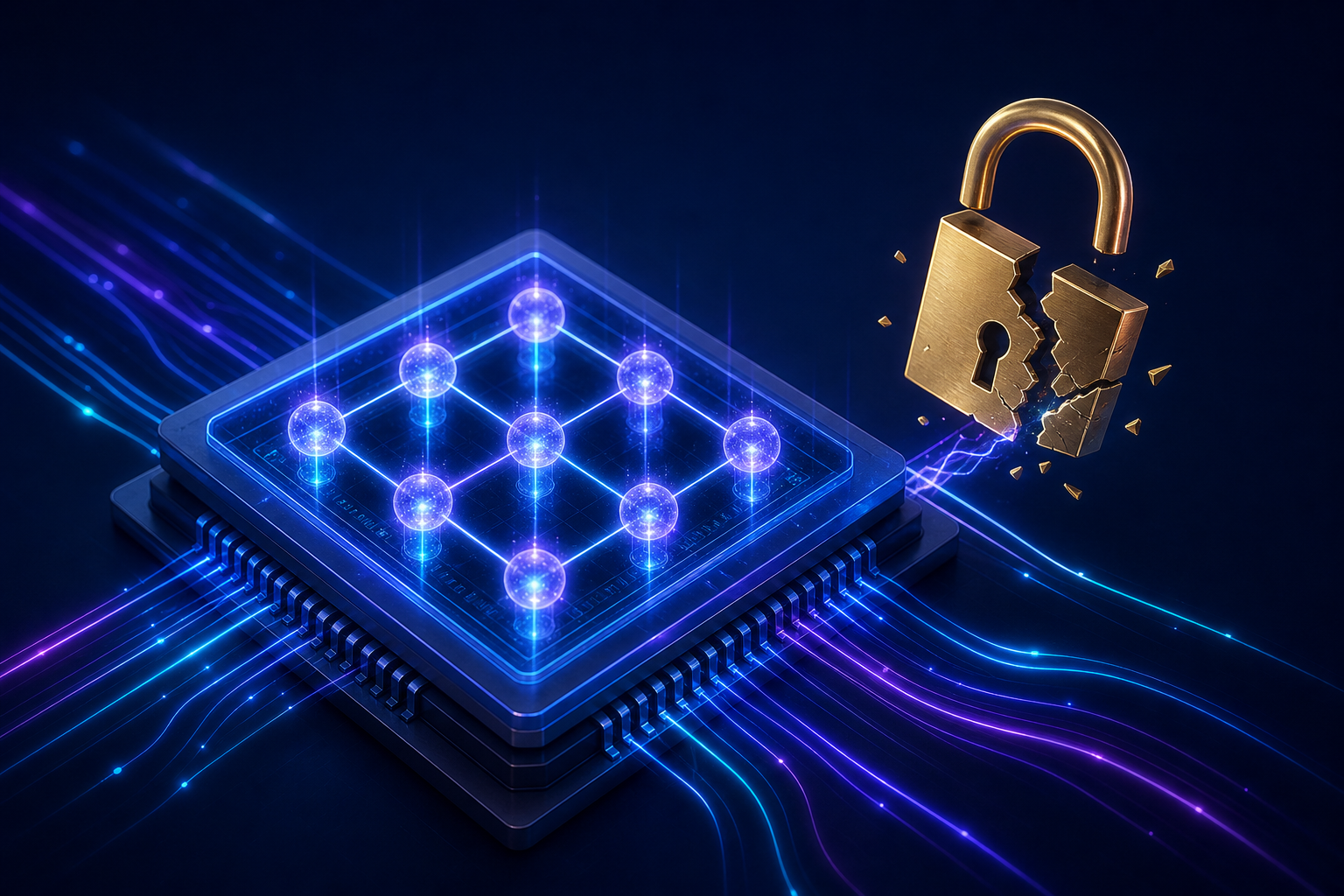
Imagine waking up to find that the padlock protecting your bank account, your medical records, and every encrypted message you ever sent could be picked open in an afternoon. That is the quiet anxiety behind the latest IBM quantum breakthrough, and the headline number driving it is staggering: a path toward 10,000 logical qubits. For decades, the math that secures the internet leaned on one comforting fact—classical computers would need billions of years to crack it. A machine with thousands of stable, error-corrected qubits changes that timeline dramatically, and it changes what you should be doing about your own security right now.
You do not need a physics degree to follow what is happening here. You need to understand three things: what a logical qubit actually is, why 10,000 of them matters for encryption, and what concrete steps protect data that has to stay secret for the next decade. Let’s work through all three.
What Is a Logical Qubit? A Plain-English Definition
A logical qubit is a single, reliable unit of quantum information assembled from many imperfect physical qubits working together to detect and correct their own errors. Because physical qubits are fragile and lose their quantum state in microseconds, dozens or hundreds of them are combined through quantum error correction to behave like one stable, fault-tolerant qubit you can actually compute with.
The distinction matters enormously. When you read that a quantum computer has “1,000 qubits,” that figure almost always refers to physical qubits—noisy, short-lived, and prone to flipping their values at random. A logical qubit is the cleaned-up, dependable version. Think of it like RAID storage: you stripe data across many unreliable disks so the array as a whole survives a failure. Quantum error correction does the same trick for information that, by the laws of physics, refuses to sit still.
The leap from physical to logical qubits is the single most important milestone in quantum computing. A million noisy physical qubits can be useless; ten thousand logical ones can break modern cryptography.
Inside the IBM Quantum Breakthrough of 2026
IBM has spent years publishing an unusually transparent quantum computing roadmap, and the through-line has always been the same: stop chasing raw physical qubit counts and start delivering fault tolerance. The 2026 conversation centers on scaling logical qubits into the thousands and eventually toward the 10,000 mark that cryptographers treat as a genuine danger zone for current encryption.
Two engineering shifts make this possible. The first is a more efficient error-correcting code—qLDPC (quantum low-density parity-check) codes—that protects a logical qubit using far fewer physical qubits than the older surface code required. The second is modular architecture: linking multiple quantum chips together with high-speed couplers so the system grows by adding modules rather than building one impossibly large processor.
Why the Number 10,000 Keeps Coming Up
Ten thousand is not a marketing figure pulled from thin air. Peer-reviewed estimates suggest that running Shor’s algorithm against 2048-bit RSA encryption needs roughly a few thousand logical qubits operating with very low error rates over billions of operations. A system in the 10,000 logical qubit range, with the gate fidelity to match, crosses from “interesting research” into “practical threat to deployed cryptography.”
That threshold is exactly why this IBM quantum breakthrough has security teams paying attention. The question stopped being whether large-scale quantum machines will arrive and became when—and whether your encrypted data will still need to be secret on that day.
How Quantum Computers Break Encryption
Most of the encryption you rely on every day falls into two buckets, and quantum computing threatens them very differently.
Asymmetric (public-key) cryptography—RSA, Diffie-Hellman, and elliptic-curve cryptography (ECC)—secures the key exchange behind HTTPS, VPNs, digital signatures, and software updates. Its security rests on math problems like factoring huge numbers, which classical computers cannot solve quickly. Shor’s algorithm, run on a sufficiently large fault-tolerant quantum computer, solves exactly those problems efficiently. This category is in real danger.
Symmetric cryptography—primarily AES—is far more resilient. Grover’s algorithm offers only a quadratic speedup, which effectively halves the key strength. The fix is simple: move from AES-128 to AES-256 and you are comfortably safe again. No exotic replacement required.
The “Harvest Now, Decrypt Later” Problem
Here is the part most people miss, and it is the reason you cannot afford to wait for the hardware to arrive. Adversaries can record your encrypted traffic today, store it cheaply, and decrypt it years later once a capable quantum computer exists. This strategy is called harvest now, decrypt later.
If a piece of data must remain confidential for ten or more years—think genomic data, state secrets, intellectual property, or long-lived financial records—then the quantum threat is effectively a present-day threat, not a future one. The clock started ticking the moment that data first crossed a network.
Quantum Resources Needed to Break Common Encryption
The table below summarizes how today’s widely used algorithms hold up. Treat the qubit figures as informed estimates from cryptographic research, not exact specifications—they shift as both algorithms and hardware improve.
| Algorithm | Type | Quantum Threat Level | Recommended Action |
|---|---|---|---|
| RSA-2048 | Asymmetric | High (Shor’s algorithm) | Migrate to PQC |
| ECC P-256 | Asymmetric | High (Shor’s algorithm) | Migrate to PQC |
| AES-128 | Symmetric | Moderate (Grover’s algorithm) | Upgrade to AES-256 |
| AES-256 | Symmetric | Low | Safe to keep |
| SHA-256 | Hash | Low | Safe to keep |
The pattern is clear: your public-key infrastructure is the exposed flank. Symmetric encryption and modern hashing survive with minor adjustments, but anything that depends on RSA or ECC for key exchange and signatures needs a migration plan.
Post-Quantum Cryptography: Your Real Defense
Post-quantum cryptography (PQC) refers to encryption algorithms that run on ordinary computers but resist attacks from both classical and quantum machines. They rely on math problems—like finding short vectors in high-dimensional lattices—that no known quantum algorithm solves efficiently. You do not need a quantum computer to use them, which is the whole point.
In 2024 the U.S. National Institute of Standards and Technology finalized its first PQC standards, and these are now the foundation for migration worldwide. The headline algorithms are worth knowing by name:
- ML-KEM (FIPS 203)—formerly CRYSTALS-Kyber, used for key encapsulation, the replacement for RSA/ECC key exchange.
- ML-DSA (FIPS 204)—formerly CRYSTALS-Dilithium, used for digital signatures.
- SLH-DSA (FIPS 205)—a hash-based signature scheme (SPHINCS+) offering a conservative, lattice-free alternative.
You can read the full specifications and migration guidance directly from the NIST Post-Quantum Cryptography project. These are not experimental—they are production standards that browsers, cloud providers, and operating systems are already adopting.
A Working Post-Quantum Example in Python
The easiest way to see PQC in action is the Open Quantum Safe project, whose liboqs-python bindings let you experiment with the standardized algorithms. The snippet below performs a quantum-resistant key exchange using ML-KEM-768.
import oqs

# ML-KEM-768 (formerly Kyber) is a NIST-standardized
# post-quantum key encapsulation mechanism (KEM).
kem_algorithm = "ML-KEM-768"

# The receiver creates a key pair.
with oqs.KeyEncapsulation(kem_algorithm) as receiver:
    public_key = receiver.generate_keypair()

    # The sender uses the public key to derive a shared secret
    # and a ciphertext to transmit back.
    with oqs.KeyEncapsulation(kem_algorithm) as sender:
        ciphertext, secret_sender = sender.encap_secret(public_key)

    # The receiver recovers the identical shared secret
    # from the ciphertext using its private key.
    secret_receiver = receiver.decap_secret(ciphertext)

# Both parties now hold the same secret, safe from Shor's algorithm.
print("Shared secret matches:", secret_sender == secret_receiver)
This code mirrors how RSA-style key exchange works today, but the underlying hard problem is lattice-based rather than integer factorization. The sender and receiver agree on a shared secret over an insecure channel, and a quantum computer running Shor’s algorithm gains no advantage against it. In practice you rarely call these primitives yourself—your TLS library or cloud SDK does—but seeing the flow makes the migration concrete.
How to Prepare Your Systems Before the Hardware Arrives
You cannot migrate what you cannot see, so quantum readiness starts with discovery, not deployment. Here is a practical sequence any team can follow.
- Build a cryptographic inventory. Catalog every place you use RSA, ECC, or Diffie-Hellman—TLS certificates, SSH keys, code-signing, VPNs, database encryption, and embedded firmware.
- Classify data by shelf life. Flag anything that must stay confidential beyond ~2030. That data is your highest migration priority because of harvest-now-decrypt-later risk.
- Adopt crypto-agility. Refactor code so the algorithm is a configuration choice, not a hard-coded assumption. You want to swap ciphers without rewriting application logic.
- Deploy hybrid encryption. Run a classical algorithm and a PQC algorithm together so you stay protected even if one is later found flawed.
- Test in staging. PQC keys and signatures are larger than their classical counterparts, which can affect packet sizes, latency, and embedded devices with tight memory.
A quick way to start the inventory step is to scan your certificates and note the signature algorithms in use:
# Inspect the public-key algorithm of a server's TLS certificate
openssl s_client -connect example.com:443 </dev/null 2>/dev/null \
  | openssl x509 -noout -text \
  | grep -A1 "Public Key Algorithm"
Running this against your own endpoints reveals where classical, quantum-vulnerable keys still live. Repeat it across your domains and you have the beginnings of the inventory that every migration plan depends on.
Common Misconceptions and Mistakes to Avoid
Quantum security attracts hype, and hype breeds bad decisions. Watch for these traps.
- “It’s decades away, so I’ll wait.” The harvest-now-decrypt-later threat means long-lived secrets are exposed today, regardless of when the hardware ships.
- Confusing physical and logical qubits. A press release boasting thousands of physical qubits is not the same as a machine with the logical qubits needed to run Shor’s algorithm.
- Assuming AES is broken. Symmetric encryption is largely fine—upgrading to AES-256 handles Grover’s algorithm. The crisis is in public-key cryptography.
- Rolling your own PQC. Use vetted, standardized libraries. Custom cryptography fails in subtle ways, and that risk does not disappear because the algorithm is post-quantum.
- Skipping hybrid mode. PQC algorithms are young. Pairing them with proven classical algorithms hedges against an undiscovered weakness.
Frequently Asked Questions
Does the IBM quantum breakthrough mean my passwords are unsafe right now?
No. As of 2026, no quantum computer can break the encryption protecting your accounts. The concern is forward-looking: data intercepted and stored today could be decrypted once large-scale fault-tolerant machines exist, which is why migration planning matters now rather than later.
How many logical qubits does it take to break RSA-2048?
Research estimates land in the low thousands of logical qubits, paired with very low error rates and the ability to run billions of reliable quantum operations. That is precisely why a roadmap pointing toward 10,000 logical qubits is treated as a cryptographic turning point.
Is AES-256 safe from quantum computers?
Effectively, yes. Grover’s algorithm only halves the effective security of symmetric keys, so AES-256 retains roughly 128 bits of quantum-resistant strength—well beyond any foreseeable attack. The urgent migration applies to public-key algorithms like RSA and ECC.
What is the difference between quantum cryptography and post-quantum cryptography?
Post-quantum cryptography runs on classical computers and uses math that resists quantum attacks—you can deploy it today. Quantum cryptography, such as quantum key distribution, uses quantum physics itself to secure communication and requires specialized hardware. For protecting normal systems, PQC is the practical answer.
When should my organization start migrating to post-quantum cryptography?
Now—at least with inventory and planning. Government agencies are already mandating PQC transition timelines this decade, and any data with a long confidentiality requirement should move first. Crypto-agility lets you adopt incrementally rather than in one risky overhaul.
Conclusion: Treat the IBM Quantum Breakthrough as a Deadline, Not a Headline
The march toward 10,000 logical qubits is genuinely exciting science, but for anyone responsible for data, the IBM quantum breakthrough is best read as a countdown. The encryption securing today’s internet—RSA, ECC, and the key exchanges they power—has a finite lifespan, and adversaries practicing harvest-now-decrypt-later have already started the clock on your long-lived secrets.
The good news is that you are not waiting on a miracle. Standardized post-quantum algorithms exist today, run on the hardware you already own, and can be adopted in hybrid mode with minimal disruption. Start with a cryptographic inventory, prioritize your longest-lived data, build crypto-agility into your systems, and test PQC before you need it. Do that, and the day large-scale quantum computers arrive becomes a milestone you read about—not a breach you have to explain.