Story points represent one of the most powerful yet misunderstood concepts in Agile software development. Unlike traditional time-based estimates, story points focus on the relative complexity, effort, and uncertainty of user stories, providing teams with a more flexible and accurate estimation approach.
What Are Story Points in Agile Development?
Story points are a unit of measurement used in Agile methodologies to estimate the relative effort required to complete a user story or feature. Rather than estimating in hours or days, teams assign numerical values that represent the complexity, risk, and amount of work involved in implementing a particular story.
The key principle behind story points is relative estimation. Teams compare stories against each other, asking “Is this story bigger, smaller, or about the same size as that story?” This approach eliminates many of the variables that make time-based estimation unreliable, such as individual skill differences, interruptions, and changing requirements.
The Fibonacci Sequence in Story Point Estimation
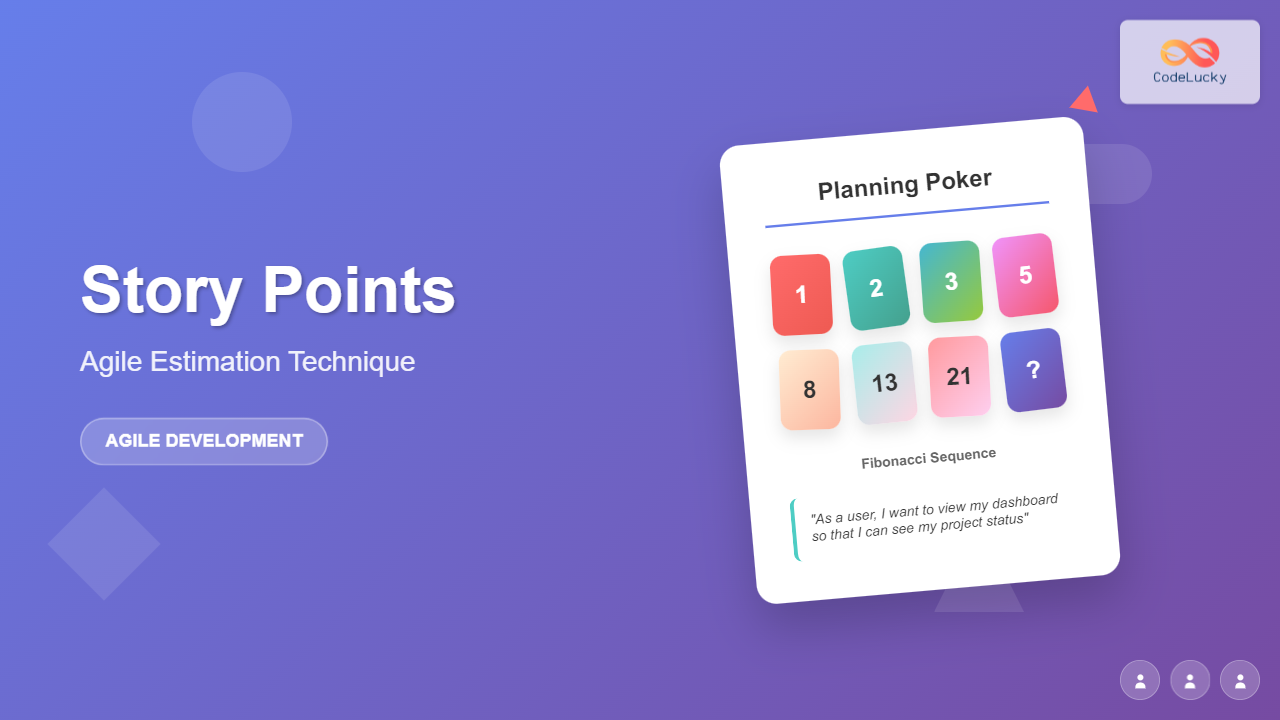
Most Agile teams use the Fibonacci sequence (1, 2, 3, 5, 8, 13, 21, 34) for story point values. This mathematical sequence creates natural gaps between numbers that reflect the increasing uncertainty in larger estimates. The larger the story, the less precise our estimate needs to be.
Here’s why Fibonacci works effectively for story points:
- Natural progression: Each number represents a meaningful increase in complexity
- Prevents false precision: You can’t assign 7 points when debating between 5 and 8
- Reflects uncertainty: Larger stories have more unknowns, so estimates become less precise
- Encourages splitting: Stories receiving high point values (13+) often need breakdown
How to Estimate Story Points: Step-by-Step Process
1. Establish a Baseline Story
Begin by selecting a simple, well-understood user story as your baseline. Assign it a small point value (typically 2 or 3 points). This baseline becomes your reference point for all future estimates. Every team member should understand what this baseline story entails and agree on its complexity level.
2. Use Planning Poker Technique
Planning poker is the most popular method for story point estimation. Each team member receives cards with Fibonacci numbers and simultaneously reveals their estimate for each story. When estimates differ significantly, team members discuss their reasoning, share insights, and re-estimate until reaching consensus.
3. Consider Three Key Factors
When estimating story points, evaluate these three dimensions:
- Complexity: How technically challenging is the implementation?
- Effort: How much work is required to complete the story?
- Uncertainty: How many unknowns or risks exist?
4. Compare Against Reference Stories
Always estimate new stories relative to previously completed ones. Ask questions like: “Is this story more complex than our 5-point baseline?” or “Does this feel similar to the 8-point story we completed last sprint?” This comparative approach maintains consistency across estimates.
Story Points vs. Time-Based Estimation
Traditional time-based estimation often fails in software development due to numerous variables and uncertainties. Story points offer several advantages over hour-based estimates:
| Aspect | Story Points | Time-Based |
|---|---|---|
| Focus | Relative complexity | Absolute duration |
| Accuracy | Improves over time | Often inaccurate |
| Team dependency | Team-independent | Individual-dependent |
| Pressure | Low psychological pressure | High pressure to meet deadlines |
Velocity and Sprint Planning with Story Points
Velocity represents the average number of story points a team completes per sprint. After completing several sprints, teams can calculate their velocity and use it for future sprint planning and release forecasting.
Calculating Team Velocity
To calculate velocity, sum the story points of all completed stories in recent sprints and find the average. For example, if your team completed 25, 30, and 28 points in the last three sprints, your average velocity is 27.7 points per sprint.
Using Velocity for Planning
Velocity helps teams determine how many story points they can realistically commit to in upcoming sprints. However, treat velocity as a planning tool, not a performance metric. Focus on delivering value rather than maximizing velocity numbers.
Common Story Point Estimation Mistakes
1. Converting Points to Hours
Many teams make the mistake of treating story points as a proxy for time. Avoid saying “1 point equals 2 hours” because this defeats the purpose of relative estimation and reintroduces the problems of time-based estimation.
2. Individual Assignment
Story points represent team estimates, not individual estimates. The same story might take different amounts of time for different team members, but the complexity remains constant. Always estimate as a team.
3. Perfectionism in Estimation
Teams often spend too much time debating whether a story is 5 or 8 points. Remember that estimation is an approximation. Spend more time on stories with the highest uncertainty rather than achieving perfect precision.
4. Ignoring the Definition of Done
Ensure all team members understand what “done” means before estimating. Story points should include all activities required to complete a story, including testing, code review, and documentation.
Advanced Story Point Techniques
T-Shirt Sizing
Some teams prefer T-shirt sizes (XS, S, M, L, XL) for initial estimation, especially during backlog grooming. This approach feels more intuitive and can later be converted to Fibonacci numbers for sprint planning.
Reference Story Matrix
Create a matrix of completed stories organized by point values. This visual reference helps maintain consistency when estimating new stories. Include brief descriptions of why each story received its point value.
Relative Sizing Games
Use games like “Buy a Feature” or “Speed Boat” to make estimation sessions more engaging. These techniques help teams think about relative priorities and complexity in different ways.
Story Points in Different Agile Frameworks
Scrum
In Scrum, story points are typically estimated during backlog refinement sessions and used during sprint planning to determine sprint capacity. The Scrum Master facilitates estimation sessions, ensuring all team members participate.
Kanban
While Kanban doesn’t require estimation, many teams use story points to forecast delivery times and identify bottlenecks. Focus on cycle time and throughput rather than velocity.
Scaled Agile Framework (SAFe)
SAFe uses story points at multiple levels, from user stories to features and epics. Teams align their estimation scales to ensure consistency across the organization.
Measuring Success with Story Points
Velocity Trends
Track velocity over time to identify trends and improvements. A gradually increasing velocity often indicates team learning and process optimization. However, focus on sustainable pace rather than velocity maximization.
Estimation Accuracy
Compare initial estimates with actual complexity after story completion. This retrospective analysis helps teams improve their estimation skills and identify patterns in estimation bias.
Sprint Goal Achievement
The ultimate measure of success is consistently meeting sprint goals and delivering value to customers. Story points should support this objective, not become an end in themselves.
Tools for Story Point Estimation
Several digital tools can facilitate story point estimation for distributed teams:
- Planning Poker Online: Digital versions of planning poker cards
- Jira: Built-in estimation features with story point tracking
- Azure DevOps: Estimation tools integrated with sprint planning
- Miro/Mural: Virtual whiteboards for collaborative estimation sessions
Overcoming Resistance to Story Points
Some stakeholders and team members resist adopting story points, preferring familiar time-based estimates. Address these concerns by:
- Explaining the benefits of relative estimation
- Starting with hybrid approaches that show both points and rough time ranges
- Demonstrating improved predictability over time
- Focusing on delivery outcomes rather than estimation accuracy
Best Practices for Story Point Implementation
Start Simple
Begin with a limited Fibonacci sequence (1, 2, 3, 5, 8) and expand as your team becomes more comfortable with relative estimation. This prevents analysis paralysis and builds confidence.
Regular Calibration
Periodically review completed stories to ensure estimation consistency. This calibration process helps teams maintain their estimation scale and identify drift over time.
Embrace Uncertainty
Accept that estimates will sometimes be wrong. Use these experiences as learning opportunities to improve future estimation accuracy rather than reasons to abandon story points.
Focus on Trends
Individual story estimates matter less than overall trends and patterns. Look for velocity stability, improved predictability, and consistent delivery rather than perfect estimation accuracy.
Conclusion
Story points provide Agile teams with a powerful tool for estimation and planning when implemented correctly. By focusing on relative complexity rather than absolute time, teams can achieve better predictability and reduced estimation overhead. Success with story points requires practice, team commitment, and a focus on continuous improvement.
Remember that story points are a means to an end—delivering valuable software to customers. Use them to facilitate better planning and communication, but don’t let the pursuit of perfect estimates overshadow the ultimate goal of creating great products.
Start implementing story points gradually, learn from your experiences, and adapt the approach to fit your team’s unique context. With time and practice, story points will become a natural part of your Agile development process, enabling more effective sprint planning and project delivery.
Related Posts

Velocity Gaming: Metric Manipulation and How to Prevent It in Agile Teams
Velocity gaming represents one of the most insidious threats to Agile team performance and organizational trust. When teams manipulate their...
Agile Metrics: Complete Guide to Measuring Team Performance and Productivity
Measuring team performance in agile environments requires a strategic approach that goes beyond traditional project management metrics. Agile metrics provide...
User Stories: Complete Writing Guide with Examples for Agile Teams
User stories are the backbone of Agile development, serving as simple yet powerful tools that bridge the gap between technical...

Velocity: Team Throughput Measurement in Agile Development
Velocity stands as one of the most critical metrics in Agile development, serving as the heartbeat of team performance measurement....
Quality Metrics: Defect Rates and Trends – Complete Guide for Agile Teams
Understanding Quality Metrics in Agile Development Quality metrics serve as the compass for Agile teams navigating the complex landscape of...
User Story Acceptance Criteria: Clear Requirements for Better Agile Development
User story acceptance criteria serve as the bridge between stakeholder expectations and development team deliverables in Agile projects. These detailed...

Planning Poker: Complete Guide to Agile Team Estimation Method
Planning Poker is a consensus-based estimation technique widely used in Agile software development to determine the effort required for user...

Velocity in Scrum: The Complete Guide to Measuring and Improving Team Performance
Velocity is one of the most crucial metrics in Scrum that helps teams measure their performance and plan future sprints...
Predictability: Consistency in Delivery Through Agile Methodologies
Predictability in Agile development represents the cornerstone of successful project delivery, enabling teams to establish consistent patterns that stakeholders can...
Sprint Backlog: Complete Guide to Creation and Management in Agile Development
The sprint backlog serves as the heart of Agile development, acting as a dynamic roadmap that guides development teams through...

Time-to-Market: Accelerating Software Delivery with Agile Methodologies
In today's hyper-competitive software landscape, time-to-market has become the defining factor between market leaders and laggards. Organizations that can deliver...
Agile Reporting: Complete Guide to Real-Time Dashboards and Performance Insights
Agile reporting transforms raw project data into actionable insights that drive successful software delivery. Unlike traditional waterfall reporting that focuses...