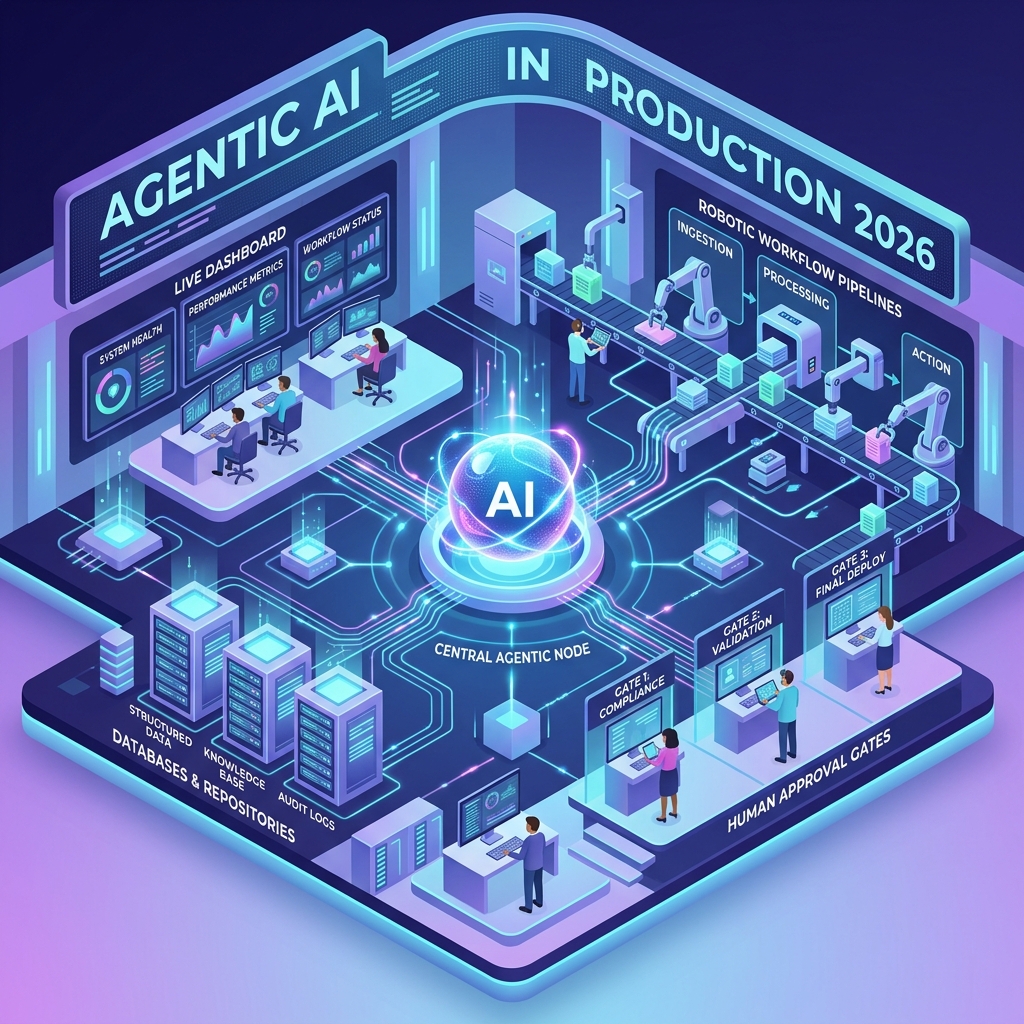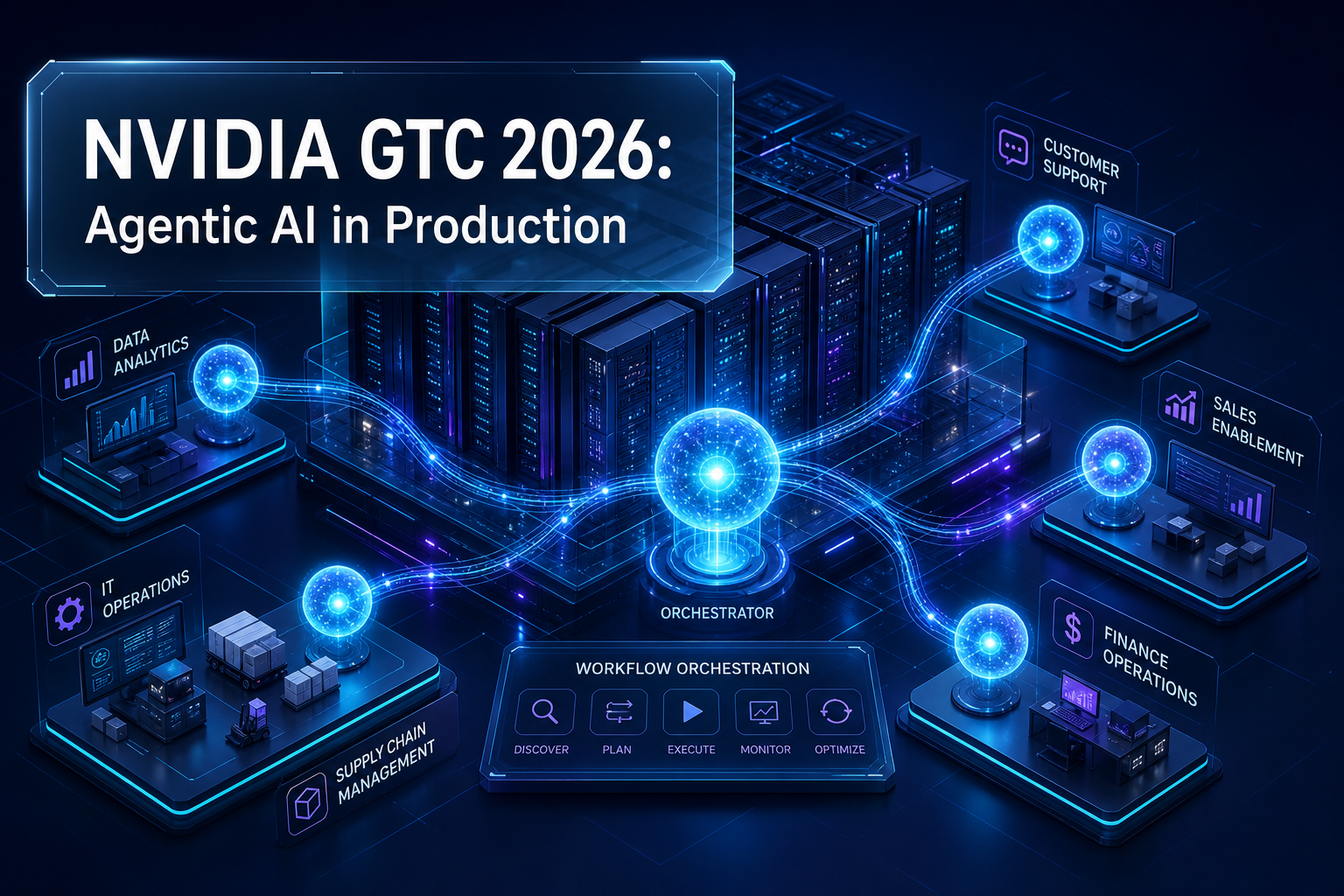
Two years ago, most enterprise AI projects ended with a polished demo and a slide deck. At NVIDIA GTC 2026, that pattern broke. Walk the keynote floor and you no longer see speculative roadmaps — you see Lloyd’s of London running underwriting agents on Blackwell Ultra clusters, Walmart routing supply chain decisions through agent fleets, and JPMorgan’s coding agents merging pull requests overnight. Agentic AI has crossed the chasm from prototype to production, and the Fortune 500 is the proof.
If you have been waiting for permission to take agentic systems seriously inside your own organization, this is it. The question has shifted from “will agents work in production?” to “how fast can you ship one without melting your infrastructure budget?” This guide unpacks what NVIDIA announced, why Fortune 500 adoption finally tipped, and how you can apply the same patterns whether you’re a solo developer or an enterprise architect.
What Agentic AI Actually Means in 2026
Agentic AI refers to systems where large language models autonomously plan, decide, call tools, and act on multi-step goals with minimal human intervention. Unlike a chatbot that returns text, an agent observes its environment, breaks down objectives, invokes APIs or other agents, evaluates outcomes, and self-corrects until the task is complete. Production-grade agents combine reasoning, memory, tool use, and orchestration.
The shift announced at GTC 2026 is not the existence of agents — those have been around since the early ReAct papers. It is the convergence of four things at once: cheaper inference, persistent memory, standardized tool protocols, and observability tooling that finally lets compliance teams sign off on autonomous workflows.
Why NVIDIA GTC 2026 Marks the Production Tipping Point
Jensen Huang’s keynote framed it bluntly: a typical Fortune 500 now has between 50 and 200 agentic workflows running in production, up from a handful a year ago. Three structural changes drove that explosion.
- Token economics flipped. Blackwell Ultra and the new Rubin-class accelerators dropped per-token inference cost for frontier-tier models by roughly an order of magnitude versus 2024 hardware. Workflows that used to cost dollars per run now cost cents.
- Reasoning models became reliable. Long-horizon tool-use accuracy for top reasoning models crossed the 90% threshold on multi-step enterprise benchmarks, which is the practical floor for autonomous deployment.
- Standards arrived. The Model Context Protocol (MCP) and NVIDIA’s NIM Agent Blueprints gave teams a common substrate for connecting agents to tools, data, and each other — eliminating most of the bespoke glue code that killed earlier projects.
The CEOs we met don’t ask whether agentic AI works anymore. They ask which of their fifty pilots to scale first.
The New NVIDIA Stack for Agentic AI
NVIDIA pitched a cohesive stack rather than isolated products at GTC 2026. Understanding the layers helps you map your own architecture.
Hardware: Blackwell Ultra and Rubin
Blackwell Ultra GPUs deliver substantially higher inference throughput at lower memory pressure, which matters because agentic workloads spike unpredictably — a single agent run might fire 30 tool calls and 12 reasoning loops. Rubin, previewed for late 2026, doubles down on long-context throughput, the bottleneck for agents juggling lengthy memory traces.
NIM Microservices and Agent Blueprints
NVIDIA Inference Microservices (NIM) package optimized model containers with pre-built APIs. Agent Blueprints layer on top: reference architectures for customer service, code generation, drug discovery, fraud triage, and supply chain optimization. You deploy a Blueprint, point it at your data, and customize the policy layer.
NeMo Agent Toolkit and Guardrails
The open-source NeMo Agent Toolkit handles orchestration, evaluation, and observability. NeMo Guardrails enforce policy at runtime — blocking unsafe tool calls, redacting PII, and rate-limiting expensive actions. For regulated industries, the audit log generated by Guardrails has become a compliance artifact.
How Fortune 500 Companies Are Actually Deploying Agents
The case studies showcased at GTC 2026 fell into a few repeatable patterns. Recognizing them shortens the path from “interesting idea” to “shipped feature.”
| Pattern | Typical Use Case | Time-to-Value | Risk Profile |
|---|---|---|---|
| Read-only research agent | Competitive intel, document summarization | 2–4 weeks | Low |
| Human-in-the-loop drafter | Insurance claims, legal contracts | 1–3 months | Medium |
| Autonomous transactional agent | Procurement, ticket resolution | 3–6 months | High |
| Multi-agent orchestration | Software engineering, supply chain | 6–12 months | Highest |
Most production deployments started in the top two rows and only graduated to autonomous transactional work after six months of telemetry. The mistake we see repeatedly is teams attempting multi-agent orchestration as a first project — the failure modes compound and observability is harder than any single team expects.
Building Your First Production Agent
You don’t need a Fortune 500 budget to apply the GTC 2026 playbook. Here is a minimal but production-shaped example using the Anthropic SDK with tool use, the same primitives the big players are scaling. Adapt the pattern to whichever model provider you prefer.
import anthropic

client = anthropic.Anthropic()

# Define the tools the agent can call
tools = [
    {
        "name": "get_inventory",
        "description": "Look up current stock for a SKU",
        "input_schema": {
            "type": "object",
            "properties": {"sku": {"type": "string"}},
            "required": ["sku"],
        },
    },
    {
        "name": "create_purchase_order",
        "description": "Submit a PO to the supplier system",
        "input_schema": {
            "type": "object",
            "properties": {
                "sku": {"type": "string"},
                "quantity": {"type": "integer"},
            },
            "required": ["sku", "quantity"],
        },
    },
]

def run_agent(user_goal: str, max_steps: int = 8):
    messages = [{"role": "user", "content": user_goal}]
    for _ in range(max_steps):
        response = client.messages.create(
            model="claude-opus-4-7",
            max_tokens=2048,
            tools=tools,
            messages=messages,
        )
        # Stop when the model returns a final answer
        if response.stop_reason == "end_turn":
            return response.content[-1].text
        # Otherwise execute requested tool calls and feed results back
        tool_use = next(b for b in response.content if b.type == "tool_use")
        result = execute_tool(tool_use.name, tool_use.input)  # your impl
        messages.append({"role": "assistant", "content": response.content})
        messages.append({
            "role": "user",
            "content": [{
                "type": "tool_result",
                "tool_use_id": tool_use.id,
                "content": str(result),
            }],
        })
    raise RuntimeError("Agent exceeded step budget")
This skeleton captures the production essentials: a hard step budget so a runaway agent cannot bankrupt you, explicit tool schemas so the model cannot hallucinate parameters, and a clean separation between reasoning (model) and action (your code). For a deeper dive on tool use mechanics, see the official Anthropic tool use documentation.
Orchestrating Multi-Agent Systems
Single agents handle most enterprise tasks well, but the most ambitious GTC 2026 demos used multi-agent orchestration: a planner agent decomposes the goal, specialist agents handle subtasks, and a critic agent evaluates results before commit. The pattern is powerful but unforgiving — debugging four agents arguing about a malformed JSON payload at 3 AM is not fun.
Recommended starting topologies:
- Supervisor pattern — one agent delegates to specialists and integrates their outputs. Easiest to debug.
- Pipeline pattern — agents run in fixed sequence, each transforming the previous output. Best for deterministic workflows.
- Swarm pattern — peer agents negotiate. Powerful but reserve for research-grade problems with strong evaluation harnesses.
For framework choices, the open-source LangGraph project and NVIDIA’s NeMo Agent Toolkit are the two most-cited at GTC 2026. Pick based on your team’s comfort with explicit state machines versus convention-over-configuration.
Observability, Evaluation, and Cost Control
The Fortune 500 teams that succeeded in production share one trait: they treated agent observability as a first-class system, not an afterthought. Three practices stand out.
Trace Every Decision
Capture the full message history, tool calls, latency, and token cost for every agent run. Sample 100% in early production and at minimum 10% once stable. Without traces you cannot diagnose why an agent decided to refund a customer at 4x the original purchase price — and that conversation will happen.
Define Evaluations Before You Ship
Agentic systems regress in subtle ways when you swap a model or update a prompt. Maintain an evaluation set of 50+ realistic scenarios with expected outcomes, and run it on every change. The testing discipline from traditional software applies — adapted for probabilistic outputs.
Cap Cost Per Task
Set hard token budgets per agent invocation and circuit-break runs that exceed them. The most expensive incident reported informally at GTC was a customer service agent that looped on a confused query for 14 hours, racking up five figures in inference. A simple step counter would have caught it in seconds.
Common Pitfalls When Moving Agents to Production
Most failed agent projects share predictable failure modes. Avoid these and you skip the costly lessons everyone else paid for.
- Skipping the human-in-the-loop phase. You learn what the agent gets wrong by watching humans correct it. Going fully autonomous on day one means you discover failure modes from angry customers instead.
- Underestimating tool reliability. Your agent is only as reliable as the APIs it calls. A flaky internal service that fails 2% of the time becomes the dominant error source once an agent makes 50 calls per task.
- Letting context windows balloon. Long-running agents accumulate noisy history. Without summarization or memory pruning, costs and latency grow until the run becomes unusable.
- Treating prompts as static. Prompts are code. Version them, review them, and run regressions on changes. A one-line edit can shift behavior across thousands of daily runs.
- Ignoring the policy layer. Without runtime guardrails, an agent will eventually do something it should not — refund a fraudulent order, send a confidential file, or call an unauthorized API. Build the policy layer before launch, not after the incident.
What This Means for Developers in 2026
The skills compounding fastest right now are not “prompt engineering” in the 2023 sense. They are the boring engineering disciplines applied to a new substrate: schema design for tools, evaluation harness construction, distributed tracing for non-deterministic systems, and clear API boundaries between deterministic code and probabilistic reasoning.
If you are a backend engineer, your existing instincts about idempotency, retries, and circuit breakers transfer directly — agents need them more, not less. If you are a frontend or product engineer, the highest-leverage move is designing the human-in-the-loop interfaces that let domain experts correct agents at scale, because that feedback loop is what compounds into a defensible product.
Frequently Asked Questions
What is agentic AI in simple terms?
Agentic AI is software that uses a large language model as its decision-making core to autonomously plan and execute multi-step tasks by calling tools, querying data, and adapting based on results. Think of it as the difference between a calculator that answers when asked and an accountant that closes the books on its own.
How is GTC 2026 different from previous NVIDIA conferences?
Earlier GTC events focused on training infrastructure and model performance. GTC 2026 centered on production agentic deployments at Fortune 500 scale, with hardware (Blackwell Ultra, Rubin previews), software (NIM, NeMo Agent Toolkit), and customer evidence converging into a single coherent stack.
Do I need NVIDIA hardware to build agentic AI applications?
No. Most developers build on top of hosted model APIs from providers like Anthropic, OpenAI, or Google. NVIDIA’s stack matters most when you are running open-weight models at scale, deploying on-premises for compliance, or optimizing inference cost on dedicated infrastructure.
What is the biggest risk when deploying agentic AI in production?
Unbounded action. An agent that can act on the world without strict guardrails, step budgets, and human oversight will eventually take an action you did not anticipate. The fix is engineering discipline: scoped tool permissions, hard limits, comprehensive logging, and staged rollouts.
How long does it take to build a production-ready agent?
A read-only research agent can ship in two to four weeks. A human-in-the-loop drafting agent typically takes one to three months. Fully autonomous transactional agents require six months or more, mostly spent on observability, evaluation, and policy work rather than the agent logic itself.
Will agentic AI replace software engineers?
It will replace specific tasks within software engineering — boilerplate generation, routine refactors, first-draft test writing — and amplify engineers who learn to design, supervise, and evaluate agent systems. The job is changing shape, not disappearing.
Conclusion
NVIDIA GTC 2026 made one thing unambiguous: agentic AI is now a production technology, not a research curiosity. Fortune 500 enterprises are deploying agents at scale because the economics, the reliability, and the tooling all crossed the threshold at the same time. The companies that will compound advantages over the next two years are the ones building agent-native workflows now, with disciplined observability and evaluation from day one.
You don’t need a hyperscaler budget to participate. Start with a single read-only agent that solves one painful task in your organization. Instrument it obsessively. Add a human-in-the-loop step. Then ship the next one. The Fortune 500 playbook from GTC 2026 is fundamentally a discipline playbook — and discipline scales down as well as it scales up.