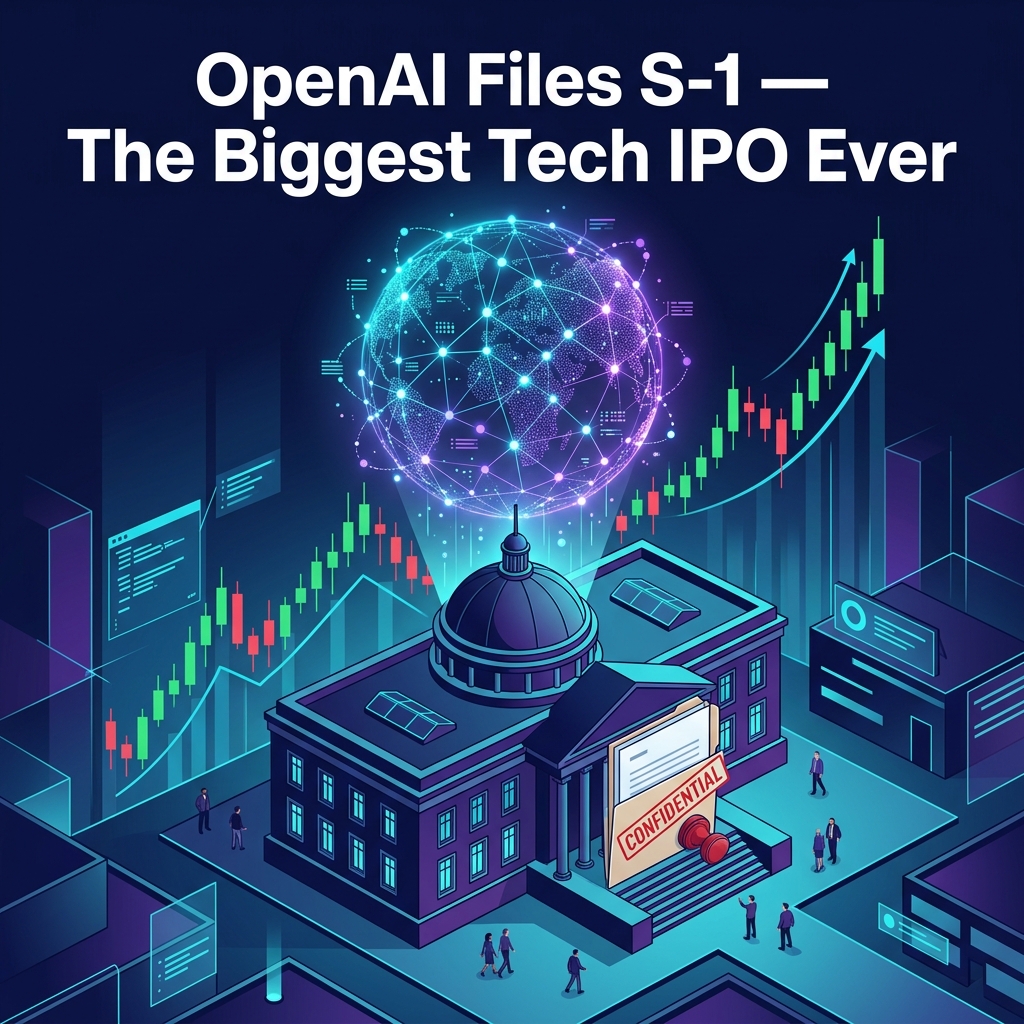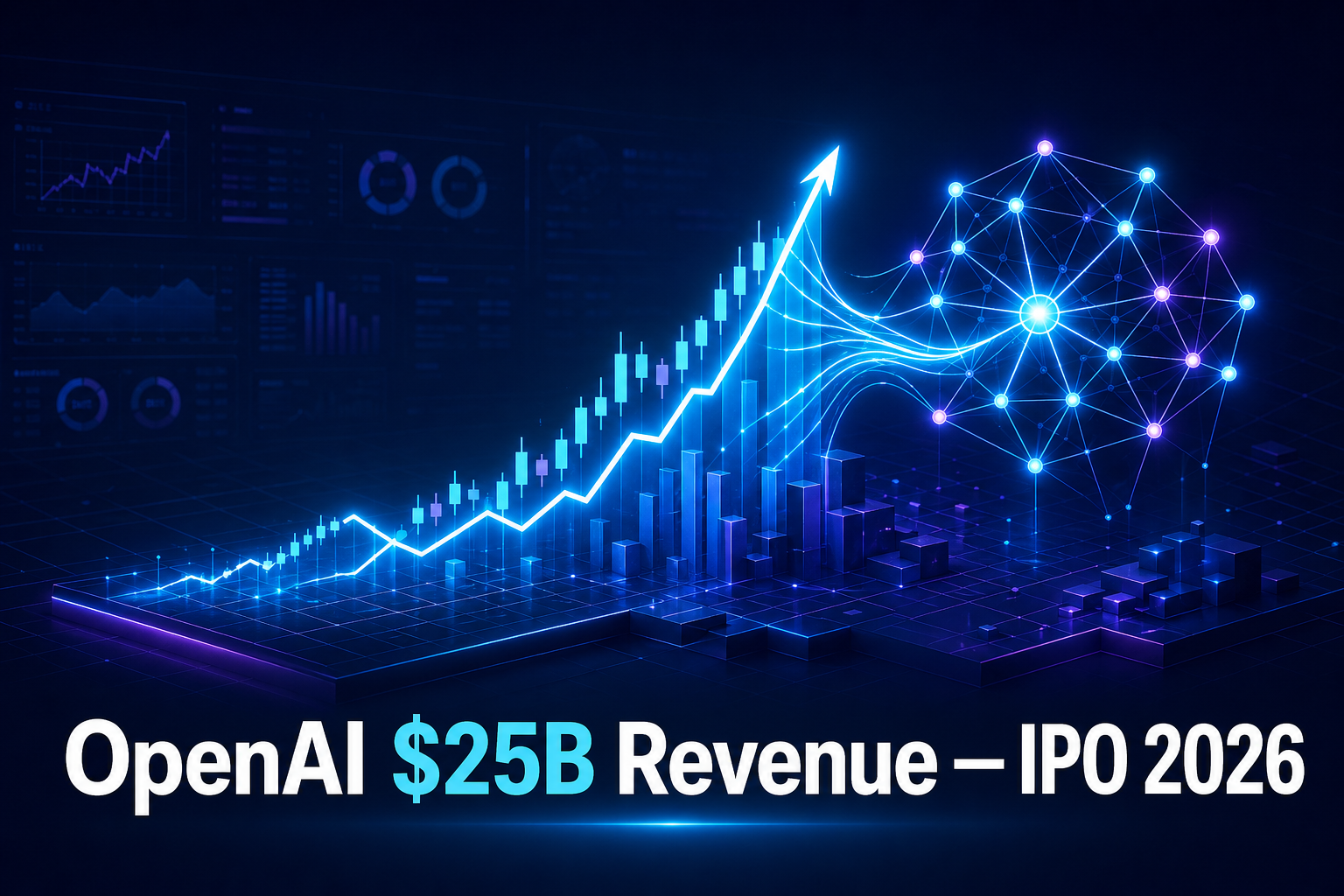
Three years ago, the idea that a research lab best known for a chatbot would be flirting with one of the largest technology IPOs in history sounded ridiculous. Now it’s a calendar item. OpenAI has crossed roughly $25 billion in annualized revenue and is reportedly preparing the groundwork for a public listing in late 2026 — a milestone that could reset how investors, regulators, and competitors think about the entire AI sector.
If you build software, invest in tech, or just try to keep up with where the industry is heading, the OpenAI revenue trajectory and its potential IPO are worth understanding in detail. This piece breaks down the numbers, the business model behind them, what a public listing would actually look like, and the risks that could still derail the timeline.
What the $25 Billion Annualized Revenue Figure Actually Means
Annualized revenue is not the same as full-year revenue. It’s a forward-looking snapshot: take the most recent month or quarter of recurring revenue and project it across twelve months. If OpenAI’s October run-rate sits near $2.08 billion per month, multiplying by twelve gets you to roughly $25 billion annualized. The number tells you where the business is right now, not what it booked over the past calendar year.
For context, OpenAI ended 2023 with a run-rate near $1.6 billion. Crossing $25 billion in 2026 represents a roughly 15x climb in under three years — a pace that almost no other software company in history has matched at this scale. OpenAI is now generating more revenue than companies like Snowflake, Databricks, and Stripe did at comparable points before going public.
Run-rate revenue is a momentum indicator, not a financial result. A company at a $25B annualized rate may still book significantly less than that for the calendar year, depending on when growth accelerated.
Where the Money Is Coming From
OpenAI’s revenue is no longer a one-product story. The mix has diversified meaningfully, and understanding the split explains why the public-listing conversation has become serious.
ChatGPT Consumer Subscriptions
ChatGPT Plus, Pro, and Team plans now account for the majority of revenue. The consumer business has scaled past 800 million weekly active users globally, with paid conversion improving as new features — voice mode, longer context windows, agentic browsing, and on-device assistants — push more free users toward subscriptions.
Enterprise and ChatGPT Business
The enterprise segment has been the fastest-growing line. Large organizations sign multi-year contracts that bundle ChatGPT seats, custom GPTs, fine-tuning credits, and dedicated capacity. Average contract values have climbed sharply because customers are deploying assistants across legal, finance, support, and engineering departments simultaneously rather than running isolated pilots.
API and Platform Revenue
Developers building on the OpenAI API — through models like GPT-5, the o-series reasoning models, and specialized embeddings — make up the third major bucket. This stream is more volume-sensitive: it grows when developers ship more apps, and it’s increasingly tied to agentic workloads, which consume far more tokens per task than traditional chat completions.
Licensing, Hardware Partnerships, and New Bets
Smaller but strategically important contributors include Microsoft licensing revenue, the Apple Intelligence integration, the Jony Ive hardware partnership announced in 2024, and emerging revenue from Sora video generation and OpenAI’s enterprise search products.
| Revenue Stream | Approx. Share of Annualized Revenue | Growth Driver |
|---|---|---|
| ChatGPT consumer plans | ~45% | Paid conversion + new feature tiers |
| Enterprise / ChatGPT Business | ~30% | Multi-seat rollouts, agent deployments |
| API and developer platform | ~20% | Agentic apps, reasoning model usage |
| Licensing, hardware, other | ~5% | Microsoft, Apple, Sora, search |
Why a Late-2026 Public Listing Now Makes Sense
OpenAI restructured into a for-profit Public Benefit Corporation earlier in 2025, which removed a significant structural barrier to going public. With a conventional capital structure in place, a path to listing on a major exchange becomes administratively feasible. Several factors are pushing the timeline toward late 2026.
- Capital intensity: Training next-generation models and building data center capacity requires tens of billions in additional spending. Public markets offer cheaper, more flexible capital than another private mega-round.
- Employee liquidity: Years of stock-based compensation have accumulated. Long-tenured employees and early investors need a path to liquidity that tender offers alone cannot sustainably provide.
- Strategic credibility: Public-company status would simplify large enterprise procurement cycles, where CIOs are still cautious about committing core workloads to a non-public counterparty.
- Macro window: Interest rates have normalized, the IPO market has reopened, and AI is the dominant narrative driving public-equity flows. Late 2026 lines up with what bankers consider a constructive listing window.
What an OpenAI IPO Could Look Like
Estimates of a potential listing valuation cluster between $500 billion and $1 trillion. The wider range reflects how much depends on revenue growth between now and the listing date, the path to GAAP profitability, and the multiple investors are willing to pay for AI infrastructure exposure.
If the company files in the second half of 2026, expect a structure that includes a dual-class share design giving leadership long-term voting control, a sizeable secondary component to deliver employee liquidity, and likely a Microsoft-related lockup or governance carve-out reflecting the existing partnership.
How It Compares to Other Landmark Tech IPOs
| Company | Year | Revenue at IPO (approx.) | IPO Valuation (approx.) |
|---|---|---|---|
| 2004 | $3.2B | $23B | |
| 2012 | $3.7B | $104B | |
| Snowflake | 2020 | $0.6B | $33B |
| OpenAI (estimated) | 2026 | $30–40B+ | $500B–$1T |
The comparison is striking: even on the conservative end, OpenAI would list at roughly five times the valuation Facebook commanded at IPO, with revenue an order of magnitude higher.
The Cost Side: Why Profitability Is Still the Open Question
Revenue growth is one half of the equation. The other is whether OpenAI can convert that revenue into operating income at scale. The compute bill is the elephant in the room.
Training frontier models, running inference for hundreds of millions of users, and building reserved data center capacity through partners like Microsoft, Oracle, and CoreWeave consumes tens of billions in cash annually. The company has signed compute commitments reportedly exceeding $300 billion across multi-year contracts — a number that is meaningful only if revenue continues to scale with it.
Three trends help on the unit-economics side:
- Inference costs per token are falling: Roughly 80% year over year for equivalent quality, thanks to better hardware utilization, smaller specialized models, and more efficient serving stacks.
- Higher-margin enterprise mix: Enterprise contracts carry better gross margins than consumer subscriptions because of usage caps, longer commitments, and reduced churn.
- Agent workloads command premium pricing: Long-running, tool-using agents bill more per session and create deeper product lock-in.
Reading the Numbers: A Quick Calculation You Can Run
If you want to sanity-check OpenAI revenue claims yourself, here’s the kind of back-of-the-envelope arithmetic financial analysts use. The example uses Python because it’s the most common tool for this work, but you could do it in a spreadsheet just as easily.
# Estimate annualized revenue from monthly run-rate
# and project a forward growth scenario

monthly_revenue_run_rate = 2_080_000_000   # $2.08B per month
annualized_revenue = monthly_revenue_run_rate * 12
print(f"Annualized revenue: ${annualized_revenue / 1e9:.1f}B")

# Project forward assuming 60% YoY growth (plausible if mix shift continues)
yoy_growth = 0.60
projected_2026 = annualized_revenue * (1 + yoy_growth)
print(f"2026 projected revenue: ${projected_2026 / 1e9:.1f}B")

# Apply a representative software multiple to estimate valuation
# 15x revenue is conservative for a high-growth AI leader
valuation_low  = projected_2026 * 12
valuation_high = projected_2026 * 25
print(f"Valuation range: ${valuation_low/1e9:.0f}B - ${valuation_high/1e9:.0f}B")
The script multiplies a monthly run-rate by twelve to land on the headline annualized number, then applies a growth assumption to estimate where revenue could sit at IPO time. The final block applies a revenue multiple range — the same heuristic public-market analysts use when there is no profit history to anchor a price-to-earnings calculation.
What an OpenAI Public Listing Means for the Broader AI Industry
An IPO at this scale is more than a single financing event. It would set benchmarks that ripple across the entire ecosystem.
Pricing Pressure on Competitors
Once OpenAI’s gross margins, churn rates, and customer concentration become public, every competing AI lab — Anthropic, Google DeepMind, xAI, Mistral — gets compared against the same disclosure standard. Private valuations either re-rate to align with what public markets pay, or they decompress.
A Wave of AI-Native Public Companies
A successful listing typically opens the window for follow-on IPOs. Expect companies like Anthropic, Perplexity, Cursor, and several specialized infrastructure providers to consider their own listings within 12–18 months if OpenAI prices and trades well.
Regulatory Scrutiny Intensifies
Public-company disclosures bring transparency the AI industry has actively avoided. Expect more granular detail on training data sources, safety evaluations, content moderation costs, and copyright-related liabilities. Useful background on emerging policy is documented at NIST’s AI Risk Management Framework and the EU’s AI Act portal.
Risks That Could Still Derail the Timeline
Late 2026 is a target, not a guarantee. Several risks could push the listing later — or kill it entirely.
- Litigation overhang: Ongoing copyright cases brought by publishers, authors, and image-rights holders could produce unfavorable rulings that materially affect training-data economics.
- Compute supply constraints: If OpenAI cannot secure enough GPU and power capacity, revenue growth caps out regardless of demand.
- Margin disappointment: If inference costs stop falling at the current pace, the path to GAAP profitability stretches out.
- Competitive disruption: A genuinely cheaper or substantially better open-weights model from a rival lab could compress pricing power.
- Macro reversal: A risk-off market in 2026 could push the listing into 2027.
What This Means If You Build, Sell, or Invest in AI
Different readers should take different lessons from the OpenAI revenue story. Here is a quick orientation.
- If you’re a developer: Plan for a more competitive, more transparent platform. Expect aggressive pricing on commodity capabilities, but premium pricing on agent infrastructure and multimodal features.
- If you sell to enterprises: AI buying decisions are moving from CIOs to CFOs. ROI documentation, not benchmark scores, is now the main gating artifact.
- If you invest: Watch the gross margin trajectory more closely than the headline revenue number. Run-rate is exciting; sustainable economics are what survive a public listing.
- If you’re a competitor: The $25 billion bar resets what counts as credible. Your fundraising story now needs to project a clear path to a similar order of magnitude — or to a defensible niche too small for OpenAI to chase.
Frequently Asked Questions
Is OpenAI actually profitable at $25 billion in revenue?
Not yet on a GAAP basis. The company is reportedly cash-flow positive in the consumer segment but spends aggressively on training new models, securing compute, and expanding research headcount. Most analysts expect operating profitability sometime between 2027 and 2028, depending on inference cost curves and capex pacing.
How does the $25 billion compare to last year’s revenue?
OpenAI’s reported run-rate climbed from approximately $3.7 billion at the start of 2024 to around $13 billion in mid-2025, and now sits near $25 billion in late 2025 — an exceptional pace driven primarily by enterprise expansion and improved consumer conversion.
What exchange would OpenAI list on?
Nothing has been confirmed publicly, but the New York Stock Exchange and Nasdaq are the obvious candidates given the company’s size and US incorporation. A US listing also aligns with the regulatory and capital-market profile most large institutional investors prefer.
Will Microsoft still own a stake after the OpenAI IPO?
Almost certainly yes. Microsoft’s investment converted into a substantial equity position in the restructured for-profit entity earlier in 2025. Public listing wouldn’t unwind that stake; it would simply make it tradeable subject to lockup provisions standard in major IPOs.
Could retail investors buy OpenAI stock at IPO?
Direct allocation at the IPO price typically goes to institutional investors. Retail buyers usually get access on or shortly after the first day of trading through standard brokerage accounts. Some brokers may offer pre-IPO access through directed share programs, but allocations tend to be small.
How risky would owning OpenAI shares be at IPO?
Historically, very high-multiple AI and software IPOs have shown sharp post-listing volatility. Expect significant price swings driven by quarterly disclosures, regulatory news, model release cycles, and competitor moves. Position sizing and a long-term horizon matter more than market timing in cases like this.
Conclusion
The combination of OpenAI’s $25 billion annualized revenue and a credible late-2026 public listing path marks a turning point for the AI industry. It signals that frontier AI is no longer a science project funded by private patience capital — it is a category-defining commercial market with established product-market fit, scaled enterprise adoption, and the kind of growth profile public investors haven’t seen since the early cloud era.
Whether you’re shipping AI products, evaluating vendors, or watching the market for entry points, the lesson is the same: the OpenAI revenue and IPO trajectory has rewritten the baseline assumptions for what a successful AI company looks like. Track the gross margins, the enterprise mix, and the regulatory backdrop carefully. The headline number is impressive, but the durability of those numbers — through the IPO and beyond — is what will decide whether late 2026 becomes a milestone or a top.