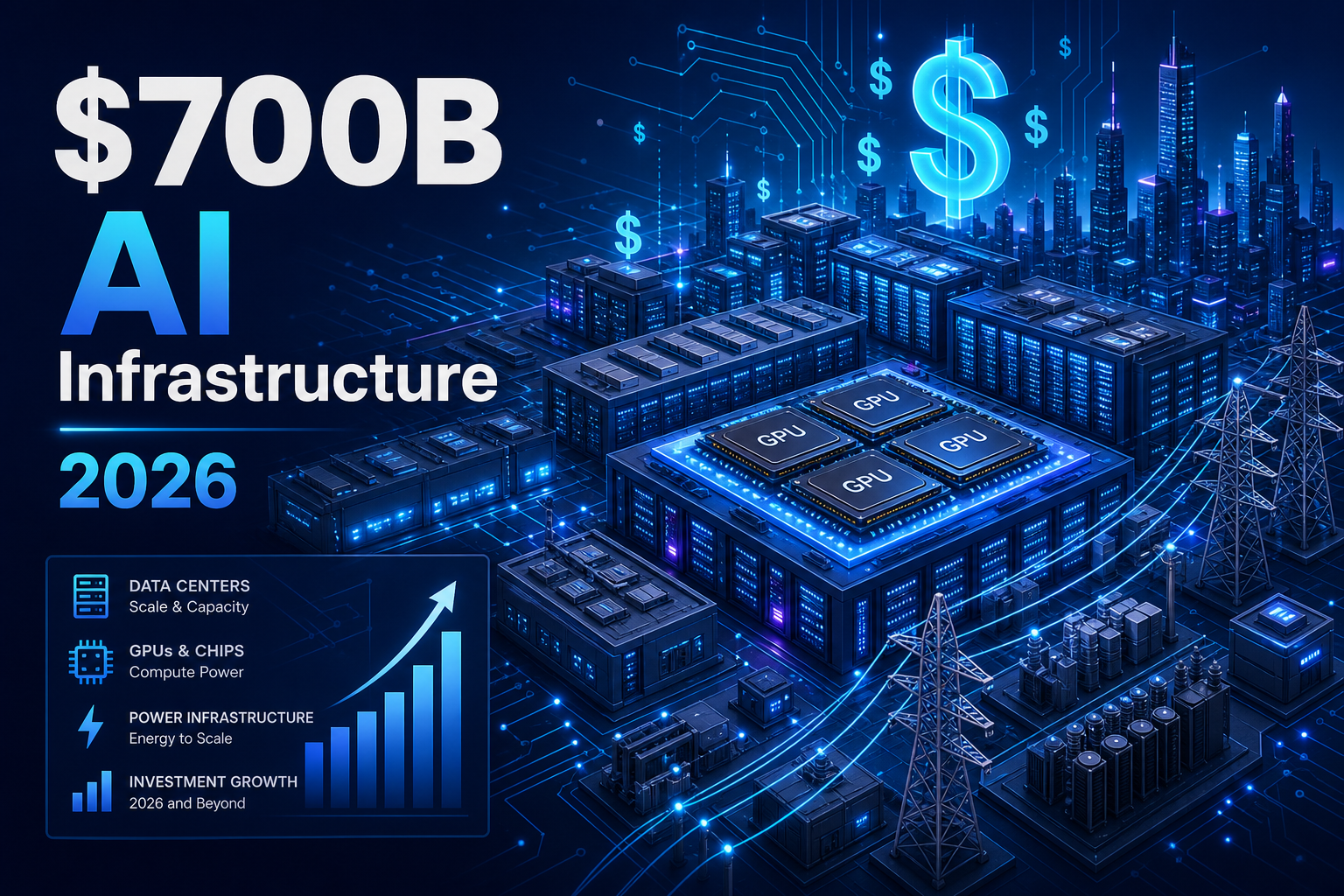
Imagine taking the entire annual GDP of Switzerland and pouring it into building warehouses full of computer chips. That is roughly the scale of what Microsoft, Google, Meta, Amazon, and a handful of other hyperscalers are preparing to do in 2026. Combined capital expenditure projections now point to roughly $700 billion in AI infrastructure spending across the industry next year — and according to executives on recent earnings calls, the spending curve is still pointing up.
If you build software, run cloud workloads, manage budgets, or simply watch the tech sector, this number matters. The $700 billion AI infrastructure wave is about to reshape data center geography, electricity markets, GPU pricing, and the unit economics of every product you ship. Here is what is actually being built, who is paying for it, and what it means for the people writing the code on top of it.
What “AI Infrastructure” Actually Means
AI infrastructure refers to the physical and software stack that trains and serves modern machine learning models — including data centers, accelerator chips (GPUs, TPUs, custom ASICs), high-bandwidth networking, liquid cooling systems, power generation contracts, and the orchestration software that ties it all together. When analysts say Big Tech will spend $700 billion in 2026, they are tallying capex across all of these layers, not just servers.
To put the figure in context, the entire Apollo program cost roughly $260 billion in today’s dollars across more than a decade. The 2026 AI buildout will spend more than two and a half times that amount in a single calendar year. And unlike Apollo, this is private capital, with no end state declared.
Where the $700 Billion Is Actually Going
The headline number hides a striking concentration of spending. Roughly four-fifths of the total flows through five companies, with the remainder split among Oracle, Tesla, xAI, CoreWeave, and a long tail of sovereign and enterprise buyers. Public guidance and analyst models suggest the rough breakdown looks like this:
| Company | Estimated 2026 AI Capex | Primary Focus |
|---|---|---|
| Microsoft | ~$160B | Azure AI, OpenAI compute, custom Maia chips |
| Alphabet (Google) | ~$140B | TPU v7 fleets, Gemini training, Cloud AI |
| Amazon (AWS) | ~$150B | Trainium2, Bedrock, Anthropic partnership |
| Meta | ~$110B | Llama training clusters, MTIA accelerators |
| Oracle | ~$45B | OCI superclusters, Stargate joint venture |
| Others | ~$95B | xAI Colossus, Tesla Dojo, sovereign clouds |
Within each company’s budget, the dollars split roughly into three buckets: silicon (Nvidia GPUs and custom accelerators), buildings and power (the data center shells, substations, and cooling), and networking and storage. Silicon eats the largest slice — often more than half — which is why Nvidia’s data center revenue has become the cleanest single proxy for how the buildout is tracking.
Why the Spending Is Still Accelerating
For three years now, every quarter has come with predictions that AI capex must be peaking. It has not. Several forces keep pushing the curve higher.
Inference Has Surpassed Training
For most of 2023 and 2024, the spend was justified by training ever-larger frontier models. By 2026 the dominant cost is inference — the compute used every time someone asks a model a question. Reasoning models that think for thirty seconds before answering can burn 100x the tokens of a 2023-era chatbot reply. Multiply that by hundreds of millions of daily users and inference becomes a recurring, growing line item rather than a one-time training bill.
Agents Multiply Compute Demand
An agent that browses a webpage, reads documents, calls APIs, and verifies its own work might consume 50 to 500 times more tokens than a single chat turn. As products move from “chatbots” to “autonomous workflows,” the per-task compute footprint grows by orders of magnitude. Hyperscalers are sizing 2026 capacity for an agent-heavy world even though most agentic products are still in early rollout.
The “Take or Pay” Cloud Contracts
Companies like OpenAI, Anthropic, and xAI have signed multi-year compute commitments worth hundreds of billions of dollars. Microsoft, Oracle, and Google must build the capacity to honor those contracts whether or not consumer demand materializes on schedule. Once a customer signs a 10-year, $300B compute deal, the cloud provider has to break ground on substations, not write a blog post.
The Geopolitical Race
The U.S. government, the EU, the UAE, and Saudi Arabia have all framed AI compute as a strategic asset. Sovereign clouds, export controls on advanced GPUs, and subsidized data center campuses are pulling additional capital into the sector that would not exist in a purely commercial market.
The Hidden Constraint: Electricity
The biggest threat to the $700 billion plan is not money — it is megawatts. A single modern AI training cluster can pull 500 MW to 1.2 GW, roughly the output of a mid-sized nuclear reactor. The International Energy Agency projects data center electricity use will more than double by 2030, with AI as the primary driver.
That is why you are seeing announcements that look more like utility company press releases than tech news:
- Microsoft signing a 20-year deal to restart Three Mile Island Unit 1
- Amazon acquiring a nuclear-powered data center campus in Pennsylvania
- Google committing to small modular reactors with Kairos Power
- Meta requesting proposals for up to 4 GW of new nuclear capacity
- Oracle and OpenAI’s Stargate sites being sited next to gas turbines and substations rather than fiber backbones
If you want to predict where the next wave of AI infrastructure goes, follow the transmission lines and the cooling water rights, not the tax incentives.
Why This Looks Different From the Dot-Com Bubble
Skeptics keep reaching for the dot-com analogy: massive capex, hype-driven valuations, eventual crash. The comparison is tempting but imperfect. A few structural differences are worth understanding.
| Factor | Dot-Com Era (1999-2000) | AI Infrastructure (2026) |
|---|---|---|
| Funded by | IPO proceeds, junk debt | Free cash flow from profitable monopolies |
| Asset depreciation | Fiber lasted 20+ years (became glut) | GPUs depreciate in 4-6 years |
| Revenue attached | Mostly speculative | Tens of billions in signed contracts |
| Buyer concentration | Thousands of startups | Five hyperscalers + sovereigns |
| Repurposability | High — fiber is fiber | Lower — H100s become e-waste |
The good news for the sector is that today’s spenders are throwing off real cash. The bad news is that depreciation cycles are short, so a demand pause hits the income statement faster than a fiber overbuild ever did.
What This Means If You Build Software
Even if you never touch a GPU, the $700 billion AI infrastructure spend is shaping the platform you ship on. A few practical implications worth tracking:
Inference Costs Will Keep Falling
Per-token pricing for frontier models has dropped roughly 10x per year for three years running. A query that cost $0.06 in 2023 costs fractions of a cent in 2026. That price curve is a direct consequence of the buildout — more capacity plus better silicon plus competition between hyperscalers. Plan product economics around continued deflation, not the current sticker price.
Caching Is the New Performance Engineering
When inference is expensive, prompt caching, response caching, and context reuse become first-class concerns. Most modern APIs now expose explicit cache controls. Here is a minimal example using the Anthropic SDK with prompt caching:
from anthropic import Anthropic

client = Anthropic()

# Cache a large system prompt that you reuse across many requests.
# The first call writes the cache; subsequent calls within ~5 minutes
# read it for roughly 10% of the input-token cost.
response = client.messages.create(
    model="claude-opus-4-7",
    max_tokens=1024,
    system=[
        {
            "type": "text",
            "text": LARGE_SYSTEM_PROMPT,  # e.g. 20K tokens of policy + examples
            "cache_control": {"type": "ephemeral"},
        }
    ],
    messages=[{"role": "user", "content": "Summarize ticket #4821."}],
)

print(response.usage)  # check cache_read_input_tokens vs input_tokens
The block above marks a long, stable system prompt as cacheable. On a high-traffic endpoint that reuses the same instructions, this single change can cut input costs by 70-90% — the kind of optimization that becomes essential when your product runs millions of agent steps per day.
Region Strategy Is Power Strategy
The fastest-growing AWS, Azure, and GCP regions in 2026 are the ones with abundant power: northern Virginia, central Ohio, west Texas, Quebec, and a cluster of new sites in the Nordics. If your workload is GPU-heavy and latency-tolerant, the cheapest capacity will increasingly live in non-traditional regions next to power plants. Bake region selection into your deployment manifests rather than hardcoding us-east-1.
Vendor Lock-In Is Quietly Returning
Each hyperscaler is pushing developers toward its own custom silicon — Trainium, Maia, TPU, MTIA — with proprietary toolchains. The framework abstractions help, but the lowest prices are reserved for code written against the vendor’s stack. Decide consciously whether you are buying portability or price.
Common Misconceptions About the Buildout
- “Most of the money is for training GPT-style models.” No. By 2026, inference workloads consume the majority of GPU-hours. Training gets the headlines; serving pays the bills.
- “Nvidia is the only winner.” Nvidia still captures the largest slice, but custom ASICs from Google, Amazon, and Meta are now meaningful percentages of internal workloads. Broadcom, Marvell, and TSMC are the quieter beneficiaries.
- “This bubble will pop and prices will collapse.” Even in a sharp demand slowdown, signed multi-year contracts keep utilization high through 2027. A correction is more likely to look like flat capex for a year or two than a 90% crash.
- “AI infrastructure is just data centers.” The real bottleneck is the upstream supply chain — HBM memory, advanced packaging, optical transceivers, and electrical substation transformers, which now have multi-year lead times.
How to Track the $700 Billion AI Infrastructure Story
If you want to follow the buildout without relying on hype-cycle journalism, watch a small set of leading indicators rather than headline announcements.
- Hyperscaler 10-Q filings. The capex line and forward guidance are the cleanest signal. Earnings calls are where Microsoft, Google, Amazon, and Meta first telegraph next year’s number.
- Nvidia data center revenue. A single quarter of flat sequential growth would be the loudest possible warning that the curve is bending.
- HBM and CoWoS capacity at TSMC and SK hynix. Memory and advanced packaging are the actual constraint on shippable GPUs.
- Utility interconnect queues. Public utility commission filings reveal where new gigawatts are being requested and approved — typically 18-24 months ahead of the data center going live.
- Power purchase agreements. When a hyperscaler signs a multi-decade nuclear or geothermal PPA, treat it as a forward indicator of compute capacity in that region.
The companies that win the next decade of software will not necessarily be the ones with the biggest models. They will be the ones who learned to ride the cost curve down — caching aggressively, picking the right regions, and treating inference as a real engineering discipline rather than an API call.
Frequently Asked Questions
Is the $700 billion AI infrastructure figure realistic or hype?
It is grounded in published guidance. Microsoft, Google, Amazon, and Meta have collectively guided to over $560 billion in 2026 capex on their most recent earnings calls, with the bulk earmarked for AI. Adding Oracle, xAI, Tesla, CoreWeave, and sovereign cloud investments brings the total comfortably into the $680-720 billion range. The number could move 10% in either direction, but the order of magnitude is solid.
Will all this AI infrastructure spending lower the cost of using AI APIs?
Yes, with caveats. More capacity and better silicon continue to push per-token prices down — roughly 10x per year for comparable model quality. However, frontier models keep getting more expensive to train, and reasoning models burn far more tokens per task, so total spend per user can still rise even as unit prices fall.
Could the AI infrastructure boom collapse like the dot-com bubble?
A correction is possible, but a 2000-style collapse is unlikely in the near term. Today’s spending is funded primarily by free cash flow from profitable platforms, and a meaningful share is backed by signed multi-year contracts. The bigger risk is a 12-24 month plateau in capex if enterprise AI adoption disappoints, which would still hit GPU suppliers hard.
Why does AI infrastructure need so much electricity?
Modern AI accelerators run hot — a single Nvidia GB200 NVL72 rack can pull around 120 kilowatts. A training cluster with tens of thousands of these racks easily reaches gigawatt scale. Add cooling overhead, networking, and storage, and a large AI campus rivals the electricity demand of a small city.
What jobs does the AI infrastructure boom create?
Beyond ML researchers, the largest hiring categories are electrical engineers, mechanical engineers, network engineers, site reliability engineers, and skilled trades — electricians, pipefitters, and HVAC technicians for liquid cooling. Many of the highest-leverage roles for the next five years are not in model development at all; they are in the physical layer underneath it.
Should small developers worry about being priced out?
Not really. Inference prices on open APIs continue to fall, and open-weight models keep closing the quality gap. The practical risk for indie developers is not cost but lock-in — picking a stack that ties you to one hyperscaler’s economics. Architect for portability where it is cheap to do so, and concentrate where the price advantage is large.
Conclusion
The $700 billion AI infrastructure spend planned for 2026 is not a single bet — it is a compounding industrial buildout that touches power grids, semiconductor supply chains, real estate markets, and the cost structure of every digital product. Whether you view it as the foundation of the next computing platform or the largest capex experiment in corporate history, the practical reality is the same: cheaper inference, more capable models, tighter power constraints, and a software stack that increasingly rewards engineers who understand the layer beneath the API.
The smart move is not to predict the peak. It is to build products whose economics improve as the curve continues — using caching, region awareness, and honest cost engineering — so that whatever Big Tech spends in 2026 turns into leverage for the work you ship in 2027.