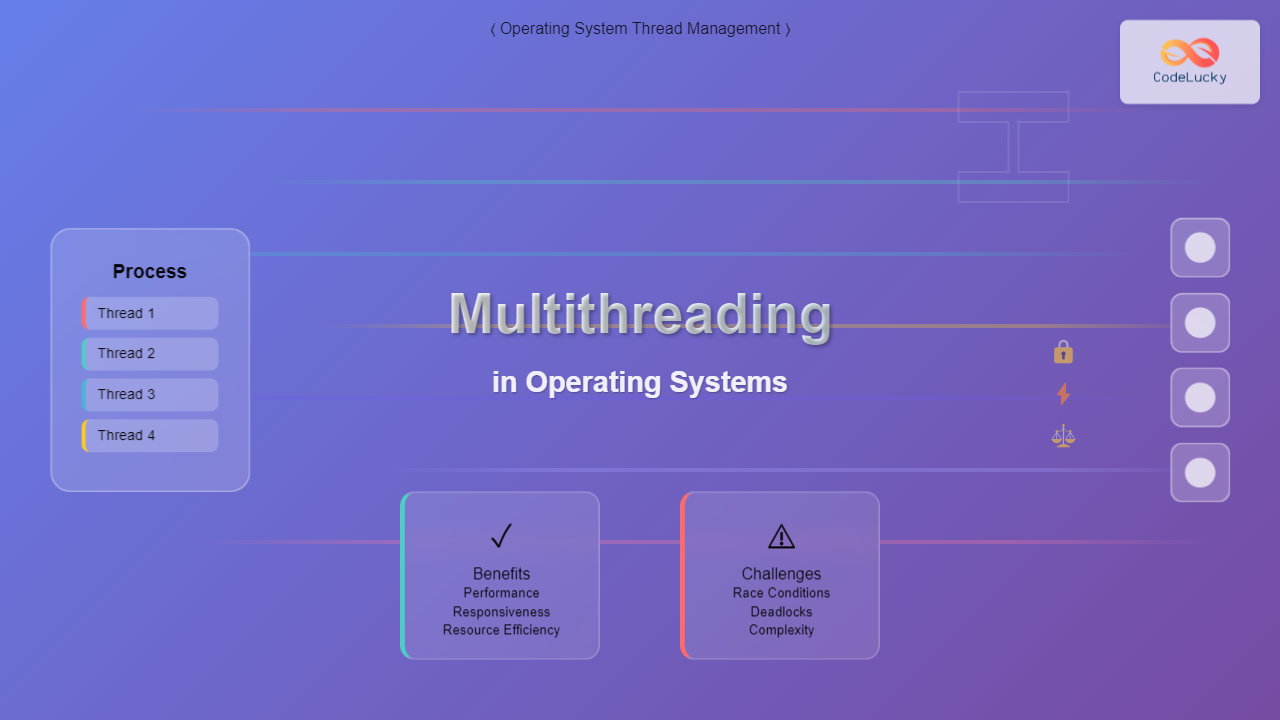
What is Multithreading in Operating Systems?
Multithreading is a fundamental concept in modern operating systems that allows a single process to execute multiple threads of execution concurrently. Unlike traditional single-threaded processes that execute instructions sequentially, multithreaded processes can perform multiple tasks simultaneously, leading to improved performance and resource utilization.
A thread is the smallest unit of execution within a process. While processes are independent entities with their own memory space, threads within the same process share the same memory space, file descriptors, and other system resources. This shared environment enables efficient communication between threads while maintaining the ability to execute different parts of a program simultaneously.

Key Benefits of Multithreading
1. Improved Performance and Responsiveness
Multithreading significantly enhances application performance by allowing multiple operations to execute simultaneously. While one thread handles user interface interactions, another can perform background calculations or file I/O operations without blocking the entire application.
Example: In a web browser, one thread renders the webpage, another handles network requests, and a third manages user input events. This parallel execution ensures the browser remains responsive even when loading heavy content.
2. Better Resource Utilization
Modern processors feature multiple cores, and multithreading enables applications to leverage this parallel processing power effectively. Instead of leaving CPU cores idle, multithreaded applications can distribute work across available cores.

3. Reduced Context Switching Overhead
Creating new threads within an existing process is significantly faster than creating new processes. Thread creation requires less memory allocation and system overhead compared to process creation, making multithreading an efficient approach for concurrent execution.
4. Enhanced Modularity and Code Organization
Multithreading promotes better code organization by allowing developers to separate different functionalities into distinct threads. This modular approach makes code more maintainable and easier to debug.
Common Multithreading Models
User-Level Threads (ULT)
User-level threads are managed entirely by user-space libraries without kernel involvement. The operating system kernel is unaware of these threads and treats the entire process as a single execution unit.
Advantages:
- Fast thread creation and switching
- No kernel mode transitions required
- Platform independence
Disadvantages:
- Cannot utilize multiple CPU cores effectively
- Blocking system calls can halt all threads
- No true parallelism on multicore systems
Kernel-Level Threads (KLT)
Kernel-level threads are created and managed directly by the operating system kernel. Each thread is a separate entity that the kernel can schedule independently across available CPU cores.
Advantages:
- True parallel execution on multicore systems
- One thread blocking doesn’t affect others
- Better system integration
Disadvantages:
- Higher overhead for thread operations
- Slower thread creation and context switching
- Limited by kernel thread limits
Hybrid Threading Model
Many modern operating systems implement a hybrid approach that combines user-level and kernel-level threads. This model maps multiple user-level threads to fewer kernel-level threads, balancing performance and resource efficiency.

Major Challenges in Multithreading
1. Race Conditions
Race conditions occur when multiple threads access and modify shared data simultaneously, leading to unpredictable results. The final outcome depends on the relative timing of thread execution, making bugs difficult to reproduce and debug.
Example of Race Condition:
int counter = 0;

// Thread 1
void increment() {
    for (int i = 0; i < 1000000; i++) {
        counter++;  // Not atomic operation
    }
}

// Thread 2
void decrement() {
    for (int i = 0; i < 1000000; i++) {
        counter--;  // Not atomic operation
    }
}
In this example, the final value of counter is unpredictable because the increment and decrement operations are not atomic. Multiple instructions are involved in each operation, creating opportunities for interference between threads.
2. Deadlocks
Deadlocks occur when two or more threads wait indefinitely for each other to release resources, creating a circular dependency that prevents any thread from proceeding.

Four Conditions for Deadlock:
- Mutual Exclusion: Resources cannot be shared simultaneously
- Hold and Wait: Threads hold resources while waiting for others
- No Preemption: Resources cannot be forcibly taken from threads
- Circular Wait: A circular chain of threads waiting for resources
3. Synchronization Overhead
Coordinating access to shared resources requires synchronization mechanisms like mutexes, semaphores, and condition variables. These mechanisms introduce overhead and can become performance bottlenecks if not used efficiently.
4. Debugging Complexity
Multithreaded applications are significantly more difficult to debug than single-threaded ones. Issues like race conditions and deadlocks may only occur under specific timing conditions, making them hard to reproduce consistently.
Thread Synchronization Mechanisms
Mutexes (Mutual Exclusion)
Mutexes ensure that only one thread can access a shared resource at a time. They provide a locking mechanism that prevents race conditions by serializing access to critical sections.
#include <pthread.h>
#include <stdio.h>

pthread_mutex_t mutex = PTHREAD_MUTEX_INITIALIZER;
int shared_counter = 0;

void* thread_function(void* arg) {
    pthread_mutex_lock(&mutex);

    // Critical section
    shared_counter++;
    printf("Counter: %d\n", shared_counter);

    pthread_mutex_unlock(&mutex);
    return NULL;
}
Semaphores
Semaphores control access to a finite number of resources. Unlike mutexes that allow only one thread, semaphores can permit multiple threads to access resources simultaneously up to a specified limit.
Condition Variables
Condition variables enable threads to wait for specific conditions to become true. They work in conjunction with mutexes to provide efficient thread coordination.
Thread Scheduling Strategies
Operating systems use various scheduling algorithms to determine which threads should execute and when:
1. Preemptive Scheduling
The operating system can interrupt running threads and allocate CPU time to other threads. This prevents any single thread from monopolizing system resources.
2. Cooperative Scheduling
Threads voluntarily yield control to allow other threads to execute. While this reduces overhead, it requires well-behaved threads that don’t monopolize resources.
3. Priority-Based Scheduling
Threads are assigned priorities, and the scheduler gives preference to higher-priority threads. This ensures critical tasks receive adequate CPU time.

Performance Considerations and Best Practices
1. Thread Pool Management
Creating and destroying threads frequently can be expensive. Thread pools maintain a collection of reusable threads, reducing the overhead of thread lifecycle management.
// Thread pool example structure
struct ThreadPool {
    pthread_t* threads;
    int thread_count;
    TaskQueue task_queue;
    pthread_mutex_t queue_mutex;
    pthread_cond_t queue_cond;
    bool shutdown;
};

void* worker_thread(void* pool) {
    ThreadPool* tp = (ThreadPool*)pool;

    while (!tp->shutdown) {
        pthread_mutex_lock(&tp->queue_mutex);

        while (is_queue_empty(&tp->task_queue) && !tp->shutdown) {
            pthread_cond_wait(&tp->queue_cond, &tp->queue_mutex);
        }

        if (!tp->shutdown) {
            Task task = dequeue_task(&tp->task_queue);
            pthread_mutex_unlock(&tp->queue_mutex);
            execute_task(&task);
        } else {
            pthread_mutex_unlock(&tp->queue_mutex);
        }
    }
    return NULL;
}
2. Load Balancing
Distributing work evenly across threads prevents some threads from becoming overloaded while others remain idle. Effective load balancing maximizes resource utilization and application performance.
3. Minimizing Lock Contention
Excessive locking can serialize thread execution, negating the benefits of multithreading. Strategies to reduce lock contention include:
- Using fine-grained locking instead of coarse-grained locks
- Implementing lock-free data structures where possible
- Reducing the time spent in critical sections
- Using read-write locks for data that’s read more often than written
Real-World Applications and Examples
1. Web Servers
Modern web servers like Apache and Nginx use multithreading to handle multiple client requests simultaneously. Each incoming request is assigned to a separate thread, allowing the server to maintain high throughput and responsiveness.
2. Database Management Systems
Database systems utilize multithreading for query processing, transaction management, and I/O operations. Different threads handle read operations, write operations, and background maintenance tasks.
3. Multimedia Applications
Video players and audio editors use separate threads for decoding, rendering, and user interface management. This separation ensures smooth playback while maintaining responsive controls.
4. Gaming Engines
Game engines employ multithreading for graphics rendering, physics calculations, AI processing, and input handling. This parallel execution enables complex, real-time gaming experiences.
Modern Trends and Future Directions
1. NUMA-Aware Threading
Non-Uniform Memory Access (NUMA) architectures require careful thread placement to minimize memory access latency. Modern operating systems provide NUMA-aware scheduling to optimize performance on multi-socket systems.
2. Green Threads and Coroutines
Lightweight threading models like green threads and coroutines provide concurrency with minimal overhead. Languages like Go and Rust implement these concepts to enable massive concurrency with reduced resource consumption.
3. Hardware Transactional Memory
Hardware support for transactional memory simplifies parallel programming by providing atomic execution of code blocks without explicit locking mechanisms.
Conclusion
Multithreading represents a powerful paradigm for improving application performance and system resource utilization. While it introduces complexity through challenges like race conditions and deadlocks, proper understanding and implementation of synchronization mechanisms can help developers harness its benefits effectively.
Success with multithreading requires careful consideration of thread design, synchronization strategies, and performance optimization techniques. As hardware continues to evolve with more cores and specialized processing units, multithreading skills become increasingly valuable for developing efficient, scalable applications.
The key to effective multithreading lies in balancing concurrency benefits with complexity management. By following established best practices, using appropriate synchronization mechanisms, and understanding the underlying operating system support, developers can create robust multithreaded applications that fully utilize modern computing resources.
Related Posts

Thread in Operating System: Lightweight Processes and Multithreading Explained
What are Threads in Operating Systems? A thread is the smallest unit of execution within a process that can be...
Thread vs Process: Complete Guide to Differences and When to Use Each
Understanding the fundamental differences between threads and processes is crucial for system programming, application design, and performance optimization. While both...

C++ Threads: Basics of Multithreading
In today's world of multi-core processors, understanding and implementing multithreading is crucial for developing efficient C++ applications. This article delves...

C Thread Programming: Introduction to Multithreading
In the world of modern computing, efficiency is key. As processors become more powerful and capable of handling multiple tasks...

Java Threads: Basics of Multithreading
In the world of modern computing, multithreading has become an essential concept for developers to grasp. Java, being one of...

Thread Synchronization: Mutexes, Semaphores and Deadlocks in Operating Systems
Introduction to Thread Synchronization Thread synchronization is a fundamental concept in operating systems that ensures multiple threads can safely access...

Process Synchronization: Critical Sections and Race Conditions in Operating Systems
Introduction to Process Synchronization Process synchronization is a fundamental concept in operating systems that ensures multiple processes can safely access...
Process Creation in OS: Fork, Exec and Process Spawning Complete Guide
Introduction to Process Creation in Operating Systems Process creation is one of the fundamental concepts in operating systems that enables...

Operating System Functions: Core Components and System Responsibilities
An operating system (OS) serves as the fundamental software layer that manages computer hardware resources and provides essential services to...

Message Passing: Complete Guide to Inter-Process Communication in Operating Systems
Message passing is a fundamental inter-process communication (IPC) mechanism that enables processes to exchange data and synchronize their activities in...

Process in Operating System: Complete Guide to Definition, States and Lifecycle
What is a Process in Operating System? A process is a program in execution that consists of the program code...

Python Multithreading: Concurrent Execution in Python
Python multithreading is a powerful technique that allows developers to execute multiple threads concurrently within a single program. This approach...