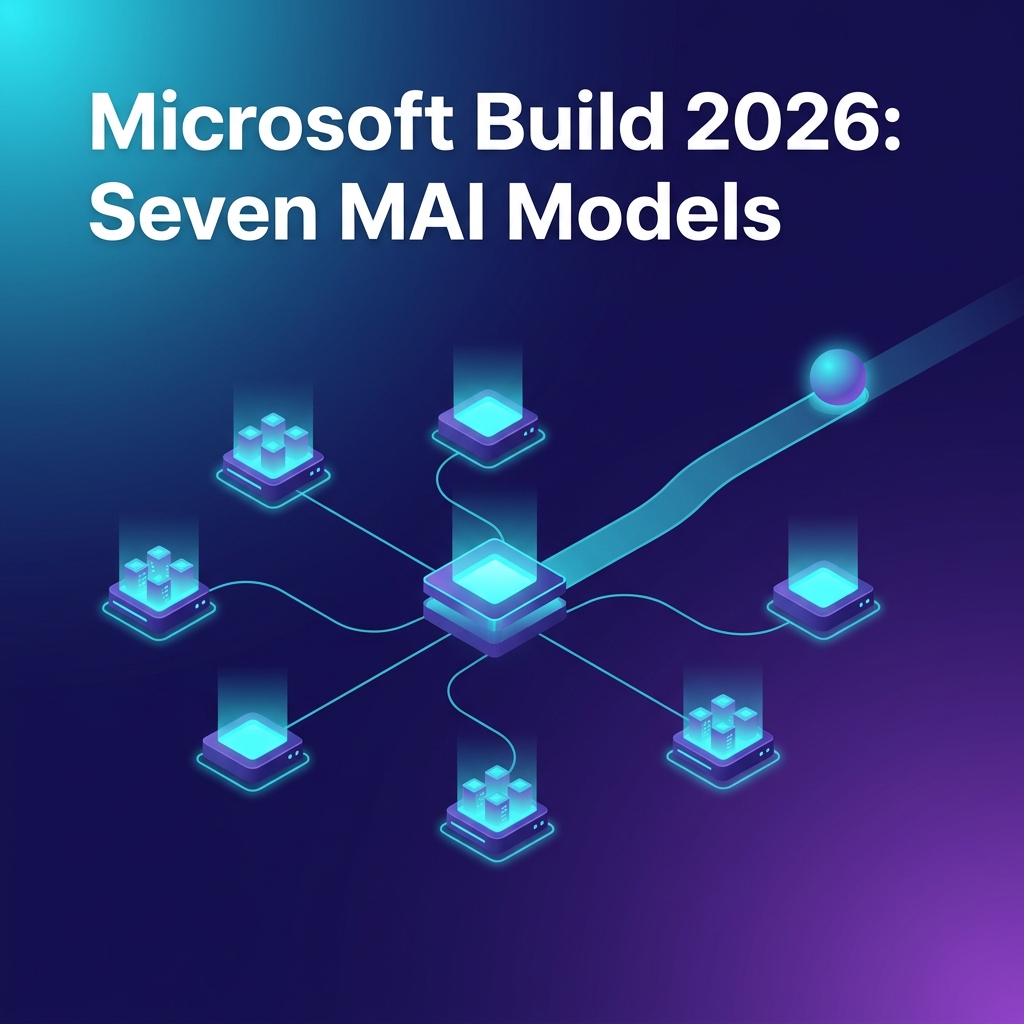
For more than a decade, “Microsoft AI” has really meant “OpenAI models wearing a Microsoft badge.” Copilot, Bing Chat, Azure OpenAI Service — the intelligence underneath almost always traced back to GPT. That era ended, at least symbolically, at Microsoft Build 2026. In early June, Microsoft used its flagship developer conference to launch seven in-house models under the MAI (Microsoft AI) banner, covering reasoning, coding, image generation, transcription, and voice. If you build software for a living, this announcement changes the menu of models you can reach for — and the economics behind them.
The “break from OpenAI” framing you have seen in headlines needs nuance, though. Microsoft did not tear up its partnership on stage. What it did was arguably more consequential: it proved it no longer needs the partnership to ship competitive AI. Here is everything that matters from the announcement, what each model actually does, and what it means for the projects you are building right now.
What Happened at Microsoft Build 2026?
Microsoft Build 2026 is the annual developer conference where Microsoft announced seven first-party MAI models — its first complete, self-developed AI model family spanning reasoning, code, image, transcription, and voice. The models were trained from scratch on Microsoft’s own infrastructure, without distillation from third-party models, marking a deliberate shift toward long-term AI self-sufficiency alongside the existing OpenAI partnership.
That definition covers the headline, but the keynote told a bigger story. Mustafa Suleyman’s Microsoft AI division described its approach as building a hill-climbing machine — an internal pipeline of data, infrastructure, and evaluation that can iterate on frontier models repeatedly, rather than producing a single one-off release. You can read the full announcement on the official Microsoft AI blog.
Three details stood out to developers in the audience:
- Open weights access: for the first time, Microsoft is letting developers tune the weights of some MAI models themselves — a significant departure from the locked-down Azure OpenAI model.
- Third-party distribution: the models launched not only in Microsoft Foundry and first-party products, but also on OpenRouter, Fireworks, and Baseten. Microsoft wants these models used everywhere, not just inside Azure.
- Clean training data: Microsoft repeatedly emphasized that the models were trained “from the ground up on clean data, without distillation from third-party models.” That phrasing is aimed squarely at enterprise customers who worry about data provenance and licensing risk.
The Seven MAI Models, Explained
Each model targets a specific workload rather than trying to be a do-everything system. Here is the full lineup at a glance:
| Model | Modality | What Microsoft Claims |
|---|---|---|
| MAI-Thinking-1 | Reasoning / text | Flagship reasoning model, roughly 35B active parameters, 256K context window; matches leading models on software engineering benchmarks |
| MAI-Code-1-Flash | Coding | 5B active parameters, tuned for GitHub Copilot and VS Code; positioned as comparable to small frontier models at lower cost |
| MAI-Image-2.5 | Image generation and editing | Top-tier Arena leaderboard scores for both text-to-image and editing |
| MAI-Image-2.5-Flash | Image generation | Ultra-efficient variant for high-volume, latency-sensitive image workloads |
| MAI-Transcribe-1.5 | Speech-to-text | State-of-the-art accuracy across 43 languages; roughly five times faster than competing transcription models |
| MAI-Voice-2 | Text-to-speech | Natural prosody and fine-grained emotional control across 15 languages |
| MAI-Voice-2-Flash | Text-to-speech | Lower-cost, efficient voice variant (announced, rolling out soon) |
MAI-Thinking-1: The Reasoning Flagship
MAI-Thinking-1 is the model Microsoft clearly wants you to compare against GPT, Claude, and Gemini. It is a medium-sized reasoning model — about 35 billion active parameters, meaning the parameters actually used per token in a mixture-of-experts architecture — with a 256K token context window. The pitch is efficiency: strong benchmark performance at a much lower token cost than the largest frontier models. Microsoft’s internal evaluations claim it is preferred over leading mid-tier competitors on software engineering tasks, though you should always validate vendor benchmarks against your own workload.
MAI-Code-1-Flash: A Copilot Engine Microsoft Owns
This one matters most for day-to-day developers. At 5 billion active parameters, MAI-Code-1-Flash is small, fast, and cheap to run — and it now powers code completion paths inside GitHub Copilot and VS Code. Every completion served by an in-house model instead of an OpenAI model is inference cost Microsoft no longer pays a partner for. At Copilot’s scale, that is an enormous margin lever, and it explains why a coding model was among the first things Microsoft built.
Image, Transcription, and Voice
The remaining models round out a full multimodal stack. MAI-Image-2.5 handles both generation and editing with leaderboard-topping scores. MAI-Transcribe-1.5 targets meeting transcription — an obvious fit for Teams — with claimed state-of-the-art accuracy in 43 languages and strong handling of domain-specific terminology. MAI-Voice-2 continues the work started by MAI-Voice-1 in 2025, adding emotional control and support for 15 languages, with a Flash variant coming for cost-sensitive applications.
Why Microsoft Is Breaking from OpenAI (Without a Divorce)
To understand why Build 2026 felt like a turning point, you need the backstory. In October 2025, Microsoft and OpenAI restructured their partnership: Microsoft took an equity stake in the newly reorganized OpenAI, retained IP rights to OpenAI models into the early 2030s, and — critically — both sides gained independence. OpenAI could buy compute from other clouds, and Microsoft could pursue frontier AI development on its own.
The seven MAI models are Microsoft cashing in that independence. The strategic logic comes down to three pressures:
- Cost control. Serving OpenAI models across Copilot, Windows, Office, and Bing means paying for someone else’s training run. Owning the models converts a partner expense into an internal asset.
- Negotiating leverage. A credible in-house alternative changes every future conversation with OpenAI about pricing, exclusivity, and roadmap priorities.
- Risk management. OpenAI is a fast-moving company with its own governance drama, its own consumer ambitions, and now its own cloud deals elsewhere. Betting Microsoft’s entire AI product line on a single external lab was always a concentration risk.
The real headline of Build 2026 is not that Microsoft left OpenAI. It is that Microsoft made leaving possible — and in platform economics, a credible exit option is worth almost as much as the exit itself.
Notably, Satya Nadella and CTO Kevin Scott went out of their way on stage to say GPT models remain central to the Azure AI platform. OpenAI’s newest GPT release went generally available in Microsoft Foundry the day after the keynote. This is diversification, not separation — as GeekWire’s coverage put it, a bid for “long-term self-sufficiency.”
How to Try the MAI Models as a Developer
The most developer-friendly part of the announcement is distribution. You do not need an Azure subscription to experiment. The MAI models are available through Microsoft Foundry and through third-party inference platforms like OpenRouter, Fireworks, and Baseten, most of which expose an OpenAI-compatible API. That means your existing client code works with a two-line change:
from openai import OpenAI

# OpenRouter exposes an OpenAI-compatible endpoint,
# so the standard openai client library works as-is.
client = OpenAI(
    base_url="https://openrouter.ai/api/v1",
    api_key="YOUR_OPENROUTER_API_KEY",
)

response = client.chat.completions.create(
    # Check the provider's model catalog for the exact ID string
    model="microsoft/mai-thinking-1",
    messages=[
        {
            "role": "user",
            "content": "Explain the difference between a process and a thread "
                       "in two short paragraphs.",
        }
    ],
)

print(response.choices[0].message.content)
This script uses the standard openai Python package but points base_url at OpenRouter instead of OpenAI’s servers — a common pattern for accessing any OpenAI-compatible provider. The only MAI-specific part is the model string; verify the exact identifier in your provider’s catalog before running it, since model IDs occasionally differ between platforms. The same swap works for evaluating MAI-Code-1-Flash against whatever model currently powers your tooling.
If you are already on Azure, the models appear in the Microsoft Foundry catalog alongside GPT, Llama, Mistral, and others, and they plug into Foundry’s model router — which brings us to the part of the announcement most people skimmed past.
Model Routing: The Quiet Strategy Behind Build 2026
Microsoft is not positioning MAI models as a wholesale GPT replacement. The actual product vision is a multi-model fabric: Foundry’s router inspects each request and dispatches it to whichever model offers the best trade-off of capability, latency, and cost. A simple summarization job might route to a cheap MAI model; a hard multi-step reasoning task might still go to a frontier GPT model.
For you as a developer, this reframes the question from “which model should I standardize on?” to “what does each request in my system actually need?” A few practical implications:
- Cost profiles become heterogeneous. If 80% of your traffic is routine and routable to efficient models like MAI-Code-1-Flash, your blended per-request cost can drop substantially without a quality hit on the hard 20%.
- Evaluation becomes mandatory. Routing only works if you can measure quality per task type. If you have not built an evaluation harness for your AI features yet, 2026 is the year that stops being optional.
- Data residency gets simpler. A Microsoft-owned model running in Microsoft-managed environments means one less third party in your compliance story — a genuine selling point for regulated industries.
How MAI Models Compare to GPT, Claude, and Gemini
An honest assessment: the MAI family is credible, not category-defining. MAI-Thinking-1 competes in the efficient mid-tier — the weight class where most real production workloads live — rather than at the absolute frontier. Independent analysts who reviewed the launch generally landed in the same place: strong engineering, real cost advantages, but not yet a reason for anyone to abandon the top-end models from OpenAI, Anthropic, or Google for their hardest problems.
Where the MAI models are genuinely differentiated:
- Transcription: MAI-Transcribe-1.5’s claimed speed and 43-language accuracy put it at or near the top of its category, and transcription is a workload with massive enterprise volume.
- Tunable weights: being able to fine-tune the actual weights — not just run a hosted fine-tuning job — is something you cannot do with GPT-class frontier models.
- Vertical integration: the same company now controls the silicon strategy, the data centers, the models, and the applications. Only Google can claim a comparable full stack.
Where they lag: ecosystem maturity. GPT and Claude have years of community knowledge, prompt patterns, and battle-tested tooling behind them. The MAI models launched days ago. Expect rough edges in documentation and third-party support for the first few months.
Common Misconceptions About the Microsoft–OpenAI Split
The headlines around Build 2026 spawned some confidently wrong takes. Worth correcting before they harden into folk wisdom:
- “Microsoft dumped OpenAI.” False. GPT models remain in Azure and Foundry, the partnership agreement runs for years, and new OpenAI models continue to launch on Microsoft’s platform first. This is a hedge, not a breakup.
- “MAI models are fine-tuned GPT models.” False, and Microsoft was emphatic about it: the models were trained from scratch without distillation from third-party models. Whether you trust that claim is your call, but it is the official, repeated position — and a legally meaningful one.
- “Copilot is now fully MAI-powered.” Not yet. MAI models handle specific paths (notably code completion and voice), while harder tasks still route to OpenAI models. The transition is gradual and workload-by-workload.
- “This only matters if you use Azure.” No — distribution through OpenRouter, Fireworks, and Baseten means any developer with an API key can use these models today, regardless of cloud.
Frequently Asked Questions About Microsoft Build 2026 and MAI
What are the seven MAI models announced at Build 2026?
MAI-Thinking-1 (reasoning), MAI-Code-1-Flash (coding), MAI-Image-2.5 and MAI-Image-2.5-Flash (image generation and editing), MAI-Transcribe-1.5 (speech-to-text), and MAI-Voice-2 plus MAI-Voice-2-Flash (text-to-speech). Together they form Microsoft’s first complete in-house model family across text, code, image, and audio.
Is Microsoft ending its partnership with OpenAI?
No. The partnership continues, and Microsoft executives reaffirmed on stage that GPT models remain central to Azure. What changed is dependence: under the October 2025 restructured agreement, Microsoft gained the right to develop frontier models independently, and the MAI family is the result.
Can I use MAI models outside of Azure?
Yes. The models are available through third-party inference platforms including OpenRouter, Fireworks, and Baseten, most of which offer OpenAI-compatible APIs. You can call them with standard client libraries by changing the base URL and model identifier.
Are MAI models better than GPT or Claude?
Not across the board. MAI-Thinking-1 competes well in the efficient mid-tier on cost and software engineering benchmarks, and MAI-Transcribe-1.5 leads its category, but the largest frontier models from OpenAI, Anthropic, and Google still win on the hardest reasoning tasks. Run your own evaluations rather than trusting any vendor’s benchmarks.
Why did Microsoft build its own models instead of relying on OpenAI?
Cost, leverage, and risk. Owning models cuts the inference bill across Copilot-scale products, strengthens Microsoft’s negotiating position with OpenAI, and removes the single point of failure that came from depending on one external lab for every AI feature.
What does “trained without distillation” mean, and why does it matter?
Distillation is training a new model on the outputs of an existing one, effectively copying its behavior. Microsoft’s claim that MAI models avoid this matters for enterprises worried about licensing disputes and data provenance — and it signals the models are an independent capability, not a derivative of GPT.
Conclusion
Microsoft Build 2026 will be remembered as the moment Microsoft stopped renting its intelligence and started owning it. The seven MAI models — Thinking, Code, two Image variants, Transcribe, and two Voice variants — give Microsoft a complete, self-developed stack across every major modality, distributed not just through Azure but across the open inference ecosystem.
The “break from OpenAI” is real, but it is a structural break, not a contractual one: the partnership survives while the dependency dissolves. For you as a developer, the practical takeaways are concrete. There is a new family of efficient, tunable models worth adding to your evaluation matrix; model routing — not model loyalty — is the architecture pattern Microsoft is betting on; and the per-token cost of capable AI just dropped again, because the world’s largest software company now has every incentive to undercut its own partner. Test MAI-Thinking-1 against your current mid-tier workhorse this week — the comparison costs you an afternoon, and it might cut your inference bill considerably.