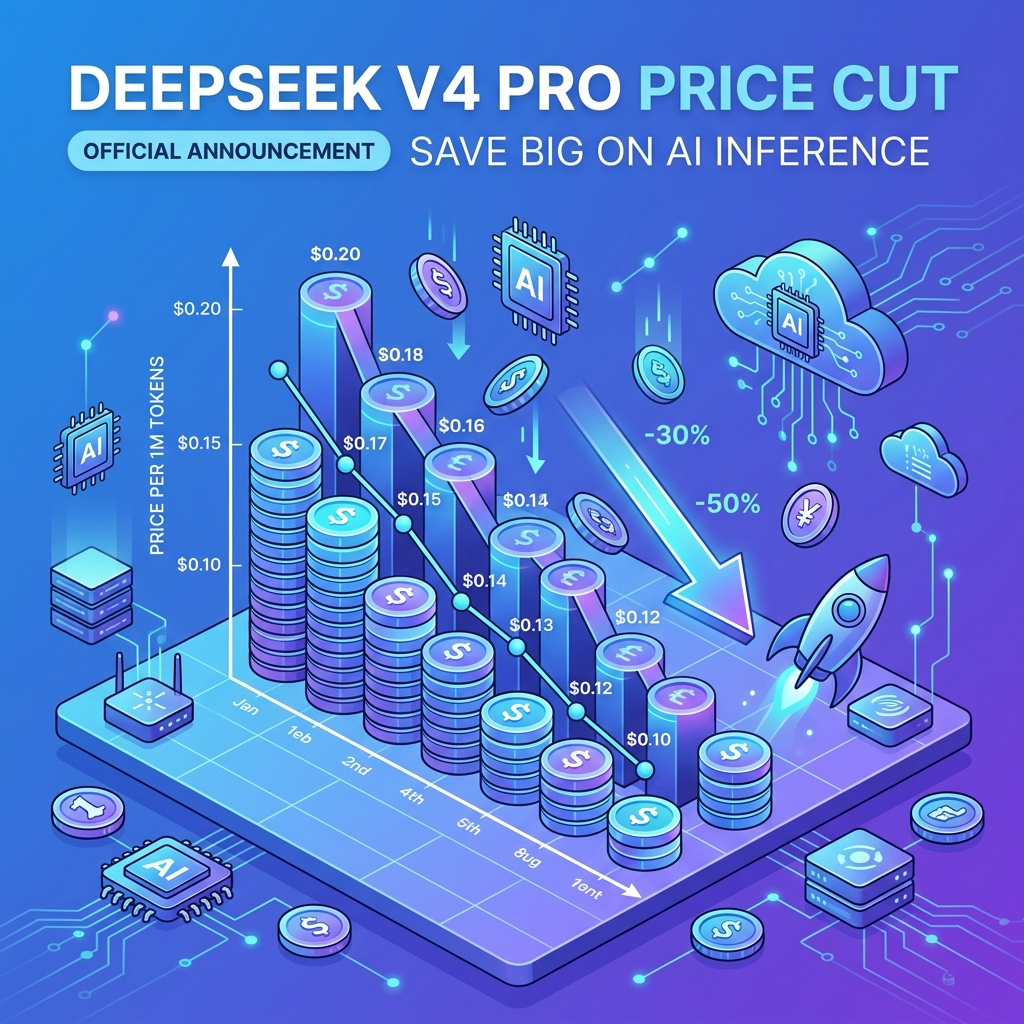
A million tokens for less than the price of a coffee refill. That is the headline economics behind the DeepSeek V4 Pro price cut, and it is forcing every team that ships AI features to rethink their budget spreadsheets. When a frontier-class model suddenly costs an order of magnitude less than its Western rivals, the question stops being “can we afford to add AI to this feature?” and becomes “why haven’t we already?”
If you build with large language models — whether you are wiring up a chatbot, batch-summarizing documents, or running agentic pipelines — the DeepSeek V4 Pro price cut affects you even if you never call a DeepSeek endpoint. Aggressive pricing from one serious player drags the entire LLM market toward cheaper tokens, and that changes which architectures, products, and habits make sense.
What Is the DeepSeek V4 Pro Price Cut?
The DeepSeek V4 Pro price cut is a reduction in the per-token API cost of DeepSeek’s flagship model, pricing frontier-level reasoning at a small fraction of what comparable proprietary models charge. It continues DeepSeek’s strategy of competing on inference efficiency rather than brand, using techniques like sparse mixture-of-experts architectures and context caching to drive costs down.
That definition matters because this is not a temporary promotion or a loss-leader trial tier. DeepSeek, the Chinese AI lab that shook the industry with its V3 and R1 releases, has consistently priced its API far below competitors while publishing open-weight models. You can read about the company’s background on DeepSeek’s Wikipedia page, but the short version is this: cheap tokens are the product strategy, not a marketing stunt.
Rule of thumb: when a capable model becomes 10x cheaper, the right move is rarely “save 90% on the same workload.” It is usually “run 10x more useful workloads.”
Why DeepSeek Can Afford Ultra-Cheap Tokens
Skeptics often assume rock-bottom pricing means subsidized losses. The more interesting answer is that DeepSeek’s costs genuinely are lower, for a few structural reasons.
Mixture-of-Experts: Paying for a Fraction of the Model
DeepSeek’s models use a mixture-of-experts (MoE) architecture. Instead of activating every parameter for every token, an MoE model routes each token through a small subset of specialized “expert” sub-networks. A model can have hundreds of billions of total parameters while only computing with a few tens of billions per token.
Think of it like a hospital. A dense model is a hospital where every doctor examines every patient. An MoE model has a triage desk that sends you to the two or three specialists you actually need. The hospital’s total expertise is enormous, but the cost per patient stays low.
Context Caching and Inference Engineering
A huge share of real-world prompts repeat the same prefix: system prompts, tool definitions, retrieved documents. DeepSeek pioneered automatic context caching, where previously processed prompt prefixes are stored and re-served at a steep discount — often around a tenth of the normal input price. Combine that with aggressive quantization, custom inference kernels, and high GPU utilization, and the cost per token at the data-center level drops dramatically.
Open Weights as a Pricing Anchor
Because DeepSeek releases open-weight versions of its models, anyone can self-host them or buy inference from third-party providers. That creates a natural price ceiling: the official API cannot charge much more than what efficient hosts charge to serve the same weights. Proprietary labs face no such anchor, which is exactly why DeepSeek’s pricing puts pressure on them.
How Ultra-Cheap Tokens Are Reshaping the LLM Market
Cheap tokens do not just lower bills. They change behavior across the whole ecosystem, and you can already see the effects in how vendors price and how developers architect.
The Price War Nobody Can Sit Out
Every time DeepSeek cuts prices, competitors respond — with cheaper “mini” and “flash” tiers, batch APIs at half price, and prompt-caching discounts of their own. The result is a market where the cost of intelligence falls on a curve that looks a lot like the historical price decline of storage and bandwidth. Capability that cost dollars per million tokens two years ago now costs cents.
A Representative Pricing Landscape
Exact numbers change monthly — always check the official DeepSeek API documentation and your vendor’s pricing page before budgeting. But the relative shape of the market looks like this:
| Model Tier | Typical Input Cost (per 1M tokens) | Typical Output Cost (per 1M tokens) | Best Suited For |
|---|---|---|---|
| Premium proprietary frontier | $2 – $15 | $10 – $75 | Hardest reasoning, highest-stakes outputs |
| Mid-tier proprietary (“mini”/”flash”) | $0.10 – $1 | $0.40 – $4 | General product features, chat, RAG |
| DeepSeek V4 Pro class (post-cut) | Under ~$0.30, less with cache hits | Roughly $0.40 – $1.20 | High-volume reasoning, agents, batch work |
| Self-hosted open weights | Hardware + ops cost only | Hardware + ops cost only | Privacy-sensitive or massive steady workloads |
The striking part is not any single cell — it is that the DeepSeek row delivers reasoning quality that benchmarks place near the top tier, at prices closer to the budget tier. That gap is the disruption.
New Product Categories Become Viable
Whole classes of applications were previously uneconomical: re-summarizing every support ticket on every update, running an LLM judge over every pull request, generating personalized study plans per student per day. At ultra-cheap token prices, “call the model in a loop” stops being a budget crisis and becomes a legitimate design pattern, which is why agentic workflows — where a model may consume millions of tokens per task — are the biggest beneficiaries of this price cut.
What the DeepSeek V4 Pro Price Cut Means for Your Stack
Lower prices reward developers who actually measure their costs. Start by knowing what a request costs you today. Here is a small Python utility that estimates the cost of a workload across pricing tiers:
def estimate_monthly_cost(
    requests_per_day: int,
    avg_input_tokens: int,
    avg_output_tokens: int,
    input_price_per_m: float,   # USD per 1M input tokens
    output_price_per_m: float,  # USD per 1M output tokens
    cache_hit_rate: float = 0.0,    # fraction of input served from cache
    cache_discount: float = 0.9,    # cached input is ~90% cheaper
) -> float:
    """Estimate monthly LLM API spend for a workload."""
    days = 30
    total_in = requests_per_day * avg_input_tokens * days
    total_out = requests_per_day * avg_output_tokens * days

    # Split input tokens into cached and uncached portions
    cached_in = total_in * cache_hit_rate
    fresh_in = total_in - cached_in

    cost_in = (fresh_in / 1e6) * input_price_per_m
    cost_in += (cached_in / 1e6) * input_price_per_m * (1 - cache_discount)
    cost_out = (total_out / 1e6) * output_price_per_m
    return round(cost_in + cost_out, 2)


# Example: a RAG chatbot doing 50k requests/day
# with a large shared system prompt (high cache hit rate)
print(estimate_monthly_cost(50_000, 4_000, 500,
                            input_price_per_m=0.27,
                            output_price_per_m=1.10,
                            cache_hit_rate=0.8))
This function models the two levers that matter most in 2026 pricing: raw per-token rates and cache hit rate. Notice how an 80% cache hit rate slashes input costs — for prompt-heavy workloads like RAG (retrieval-augmented generation), caching often saves more than switching models does. Run your real traffic numbers through it before deciding anything.
Model Routing: The Architecture Cheap Tokens Reward
The smartest teams no longer pick one model. They build a router (sometimes called a model cascade): cheap models handle easy requests, expensive models handle hard ones. Because DeepSeek exposes an OpenAI-compatible API, adding it to a cascade is usually a one-line base URL change:
from openai import OpenAI

# DeepSeek's API is OpenAI-compatible: same SDK, different base_url
cheap = OpenAI(base_url="https://api.deepseek.com", api_key="DEEPSEEK_KEY")
premium = OpenAI(api_key="PREMIUM_KEY")  # your fallback provider

def answer(question: str, hard: bool = False) -> str:
    client, model = (premium, "frontier-model") if hard else (cheap, "deepseek-chat")
    resp = client.chat.completions.create(
        model=model,
        messages=[{"role": "user", "content": question}],
    )
    return resp.choices[0].message.content

# Route by difficulty: a classifier, heuristic, or confidence
# score decides `hard` — most production traffic is not hard.
print(answer("Summarize this refund policy in two sentences."))
The pattern works because production traffic follows a power law: the vast majority of requests are routine, and only a small slice needs maximum capability. Routing 80–90% of traffic to an ultra-cheap tier while escalating the rest can cut total spend by 5–10x without users noticing any quality difference.
Trade-Offs: What Cheap Tokens Don’t Buy You
An honest cost analysis includes the costs that never appear on the invoice. Before moving production traffic, weigh these against the savings.
- Data governance and residency. DeepSeek’s hosted API processes data on servers subject to Chinese jurisdiction. For many enterprises in healthcare, finance, or government, that is a hard blocker for the official API — though self-hosting or Western-hosted open-weight deployments sidestep it.
- Rate limits and reliability. Ultra-cheap providers experience demand spikes, and throughput guarantees are typically weaker than premium enterprise SLAs. Build retries and fallbacks from day one.
- Capability gaps at the frontier. Benchmarks compress real differences. On the hardest agentic, multimodal, or long-horizon tasks, top proprietary models still hold an edge that cheap tokens cannot paper over.
- Ecosystem maturity. Tooling, fine-tuning options, content moderation layers, and support are thinner than what the largest providers offer.
- Switching costs are not zero. Prompts are tuned to specific models. A “drop-in” replacement still needs an evaluation suite to confirm quality holds on your tasks.
None of these are reasons to ignore the price cut. They are reasons to treat model choice as an engineering decision with measurable trade-offs, not a default you inherit from whichever SDK you installed first.
Common Pitfalls When Chasing Cheap Tokens
Teams rushing to capture savings make a predictable set of mistakes. Avoid these and you will keep both your budget and your quality bar intact.
- Switching without an eval suite. If you cannot measure output quality on your own tasks, you cannot know whether the cheaper model is actually equivalent. Build a small golden-set evaluation (even 50 representative examples) before migrating.
- Ignoring output token prices. Output tokens usually cost 3–5x more than input tokens. Verbose models or chain-of-thought-heavy reasoning modes can erase headline savings. Compare total request cost, not just the input rate.
- Forgetting cache economics. If your current provider gives you 90% off cached input and your prompts are prefix-heavy, a “cheaper” provider without comparable caching may cost more in practice.
- Letting cheap tokens excuse sloppy prompts. Low prices tempt teams into bloated contexts and unnecessary retries. Wasted tokens are still wasted latency, energy, and reliability risk.
- Skipping the compliance review. Sending customer data to any new API endpoint is a data-processing decision. Loop in whoever owns privacy and security before the traffic flows, not after.
Where the LLM Market Goes from Here
Extrapolate the trend and a few outcomes look likely. Token prices keep falling as inference hardware improves and MoE-style efficiency becomes standard. Open-weight models keep anchoring prices downward, since techniques published in papers — like those on arXiv — diffuse across labs within months. Differentiation shifts up the stack: providers compete on reliability, tooling, agent platforms, and enterprise trust rather than raw per-token rates.
For developers, the strategic takeaway is to design for model fluidity. Abstract your provider behind a thin internal interface, maintain evals, and treat models like interchangeable infrastructure components. Teams that hard-code a single vendor are betting against the most consistent trend in this industry: intelligence keeps getting cheaper.
Frequently Asked Questions About the DeepSeek V4 Pro Price Cut
Is DeepSeek V4 Pro really comparable to top-tier models?
On standard reasoning, coding, and math benchmarks, DeepSeek’s flagship models score within striking distance of the best proprietary systems, and ahead of most mid-tier offerings. On the hardest frontier tasks — complex agentic work, nuanced long-document analysis — premium models often retain an edge. The honest answer: comparable for most workloads, not all. Test on your own tasks.
How can DeepSeek charge so little without losing money?
Lower genuine costs, not just subsidies. Mixture-of-experts architectures activate only a fraction of parameters per token, context caching avoids recomputing repeated prompt prefixes, and heavy inference optimization keeps GPUs saturated. Open-weight competition also forces the official API price to stay near the real cost of serving the model.
Is it safe to send my data to the DeepSeek API?
It depends on your data and obligations. The hosted API is operated under Chinese jurisdiction, which many regulated industries cannot accept. For sensitive workloads, consider the open-weight versions served by hosting providers in your preferred region, or self-host them so data never leaves your infrastructure.
Should I switch all my traffic to the cheapest model?
Almost never. The better pattern is model routing: send routine, high-volume requests to an ultra-cheap tier and escalate difficult or high-stakes requests to a premium model. Most teams find that 80–90% of traffic routes cheaply with no measurable quality loss, which captures most of the savings with little risk.
Will other providers match these prices?
They already respond with cheaper model tiers, batch discounts, and prompt caching, even if their flagship list prices stay higher. Expect the gap to persist at the frontier but keep narrowing in the mid-tier, where competition is fiercest and switching costs are lowest.
Does cheaper inference mean lower quality per token?
Not inherently. Efficiency gains like MoE routing and caching reduce compute per token without degrading the model’s outputs. Quality differences between models are real, but they come from training choices and scale — not from the price tag on the API.
Conclusion
The DeepSeek V4 Pro price cut is less a discount and more a signal: the cost of capable AI inference is collapsing, and the LLM market is reorganizing around that fact. Ultra-cheap tokens make previously impossible products viable, push every provider toward cheaper tiers and caching discounts, and reward developers who architect for flexibility instead of vendor loyalty.
Your action items are concrete. Measure what your current workloads actually cost. Build a small evaluation suite for your real tasks. Experiment with routing high-volume traffic to a cheap tier while keeping a premium fallback. And weigh the off-invoice costs — data governance, reliability, ecosystem maturity — as seriously as the per-token rate. Token prices will keep falling; the teams that win are the ones ready to capture every drop.