Training a robot to stack boxes or teaching a self-driving car to handle a rare highway scenario used to mean months of data collection, simulation tuning, and policy training. On June 1, 2026, at GTC Taipei, NVIDIA announced something designed to collapse that timeline from months to days: NVIDIA Cosmos 3, billed as the first fully open omnimodel for physical AI. Unlike chatbots that live entirely in the world of text, Cosmos 3 reasons about and generates the physical world itself — video, sound, spatial relationships, and the motor actions a robot should take next.
If you build robotics systems, work on autonomous vehicles, or simply want to understand where AI is heading after large language models, NVIDIA Cosmos 3 is one of the most consequential releases of 2026. Here is what it actually is, how its architecture works, and how you can run it yourself today.
What Is NVIDIA Cosmos 3?
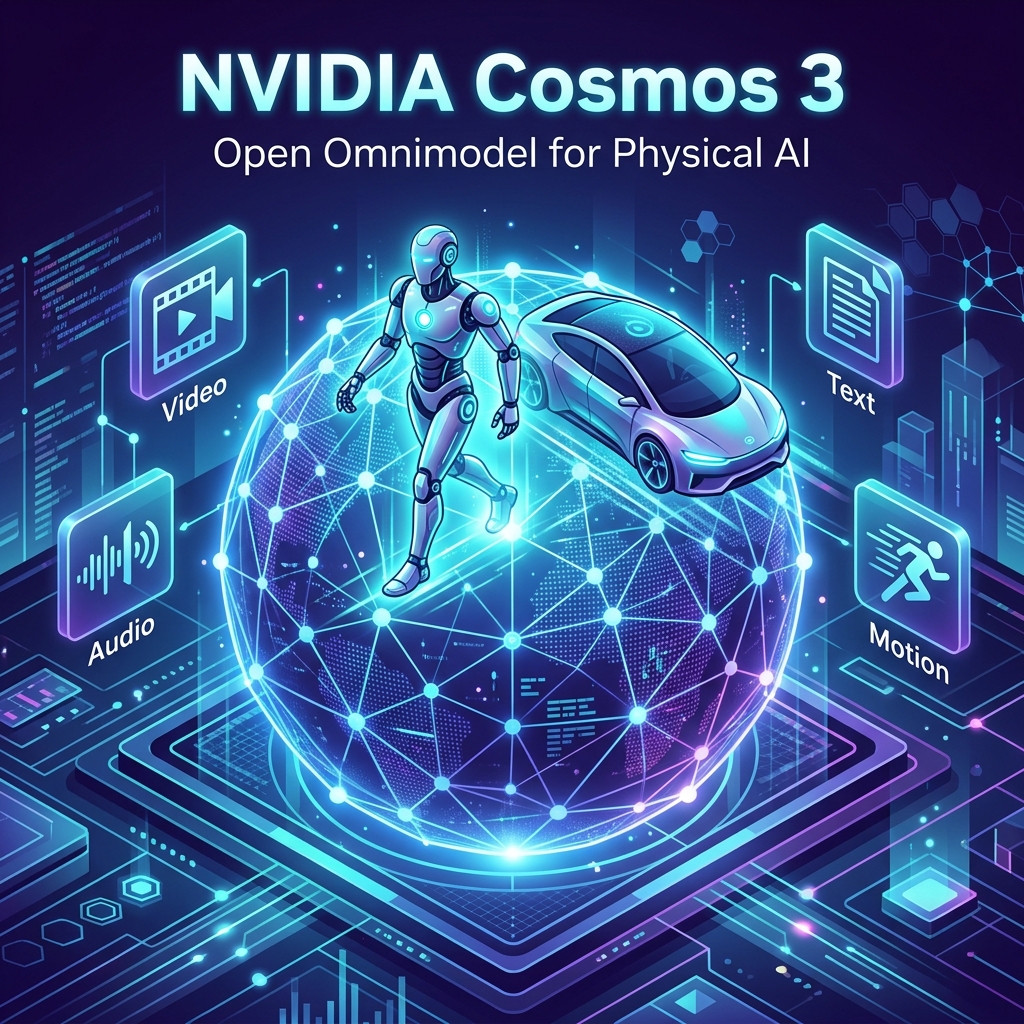
NVIDIA Cosmos 3 is an open world foundation model — an omnimodel — that natively understands and generates text, images, video, ambient sound, and robot actions within a single unified architecture. Built on a mixture-of-transformers design, it performs physical AI reasoning, world simulation, and action generation for robotics and autonomous vehicle development.
That definition packs in two terms worth unpacking. Physical AI refers to AI systems that perceive, reason about, and act in the real, physical world — robots, drones, self-driving cars, and industrial automation — as opposed to purely digital tasks like writing emails. A world foundation model is a large neural network trained to predict how the physical world evolves: if a robot arm pushes a cup, the model should predict the cup sliding, tipping, or falling in a physically plausible way.
Cosmos 3 builds on NVIDIA’s earlier Cosmos releases (the original world foundation models launched at CES 2025, followed by the Predict, Transfer, and Reason model families), but it consolidates what were previously separate specialized models into one omnimodel that can switch roles on demand. According to NVIDIA’s official announcement, the model reduces physical AI training and evaluation cycles from months to days.
What Makes an Omnimodel Different from a Multimodal Model?
You have probably used multimodal models before — GPT-class or Claude-class systems that accept images alongside text. So what makes Cosmos 3 an “omnimodel” rather than just another multimodal model?
The difference comes down to native generation across every modality, including action. Most multimodal models understand several input types but generate only text. Cosmos 3 both consumes and produces text, images, video, ambient audio, and action trajectories — the low-level motor commands a robot executes. The same weights can act as a vision-language model, a video generator, a dynamics simulator, or a robot policy model, depending on what you feed it.
Here is how the input-output combinations map to practical capabilities:
| Input | Output | What It Does |
|---|---|---|
| Text, image, video | Video | World simulation and video generation |
| Text, video | Text | Vision-language understanding and reasoning |
| Action, image, text | Video | Forward dynamics: “what happens if the robot does this?” |
| Text, video | Action | Inverse dynamics: “what actions produced this motion?” |
| Image, text | Video and action | Policy model: deciding what a robot should do next |
Think of it like a flight simulator that does not just render the view from the cockpit, but also understands aerodynamics well enough to fly the plane itself. One model, many hats — and because it is one model, knowledge transfers across tasks. Reasoning learned from video understanding improves the quality of generated robot actions, and vice versa.
Inside the Cosmos 3 Architecture: Mixture-of-Transformers
The technical heart of NVIDIA Cosmos 3 is its mixture-of-transformers (MoT) backbone. This is not the same thing as the mixture-of-experts (MoE) design you may know from models like Mixtral — it is a coarser, modality-aware split that pairs two cooperating transformers:
- A reasoning transformer — an autoregressive branch that works like a language model, predicting the next token to reason about object interactions, motion, and spatial-temporal relationships.
- An expert generation transformer — a diffusion branch that generates video frames and action trajectories through iterative denoising, the same family of techniques behind modern video generators.
Every modality first passes through a dedicated encoder: a vision transformer (ViT) for visual understanding, a variational autoencoder (VAE) for generation, and domain-aware vectors for robot actions. All of these project into a shared representation space. The autoregressive and diffusion branches keep separate parameters but interact through joint attention, meaning the reasoning side can directly inform the generation side at every layer.
Why does this matter in practice? Because it forces the model to think before it renders. Cosmos 3 reasons about whether a stack of boxes is stable or how a liquid should pour before generating the corresponding video or action sequence. That is the key to its physics accuracy — and physics accuracy is the entire game in physical AI, where a hallucinated video frame is an inconvenience but a hallucinated robot action can break hardware.
The architectural insight: separating “understanding the world” from “rendering the world” into two coupled transformers lets each branch specialize, while joint attention keeps them honest with each other.
Cosmos 3 Model Variants: Nano, Super, and Edge
NVIDIA ships Cosmos 3 in a tiered lineup so you can match model size to your hardware and latency budget:
| Variant | Parameters | Target Hardware | Best For |
|---|---|---|---|
| Cosmos 3 Nano | 16B (8B reasoner + 8B generator) | Workstation GPUs (e.g., RTX PRO 6000) | Fast video and action reasoning, local development, iteration |
| Cosmos 3 Super | 64B (32B reasoner + 32B generator) | Hopper / Blackwell data center GPUs | Highest physics accuracy, large-scale synthetic data generation, post-training robotics and AV models |
| Cosmos 3 Edge | Compact (announced, coming soon) | Embedded / edge devices | Real-time inference on robots and vehicles |
The parameter split is worth noticing: each variant divides its capacity roughly evenly between the reasoning transformer and the generation transformer, reflecting how central the think-then-generate loop is to the design. For most developers, Nano is the right starting point — it runs on a single high-end workstation GPU and produces high-quality video and action reasoning in fractions of a second, which is fast enough for interactive experimentation.
On the benchmark front, NVIDIA reports that Cosmos 3 ranks first among open models across Artificial Analysis, Physics-IQ, PAI-Bench, and R-Bench for world generation accuracy, RoboLab and RoboArena for action policy, and the VANTAGE-Bench and TAR leaderboards for vision understanding. As always with vendor-reported benchmarks, treat these as a strong signal rather than gospel until independent replications accumulate — but the breadth of leaderboards covered is notable.
How to Get Started with NVIDIA Cosmos 3
Because Cosmos 3 is openly released, you do not need an API key or a sales call to try it. The model weights are published on Hugging Face, and integration ships through the Diffusers library. The official Hugging Face launch post walks through the full pipeline; here is the minimal version for generating a physics-aware video from a text prompt and a starting image:
import torch
from diffusers import Cosmos3OmniPipeline
from diffusers.utils import load_image

# Load the 16B Nano variant in bfloat16 to fit workstation GPU memory
pipe = Cosmos3OmniPipeline.from_pretrained(
    "nvidia/Cosmos3-Nano",
    torch_dtype=torch.bfloat16,
)
pipe.to("cuda")

# Starting frame: a robot arm above a tabletop with scattered objects
initial_frame = load_image("robot_workspace.png")

# The reasoning transformer interprets the instruction and scene physics
# before the generation transformer renders the video rollout
result = pipe(
    prompt="The robot arm picks up the red cube and places it in the bin",
    image=initial_frame,
    num_frames=121,          # roughly 5 seconds of simulated rollout
    guidance_scale=7.0,      # how strongly to follow the prompt
)

result.frames[0].save("rollout.mp4")  # save the predicted world state
This code loads the Nano checkpoint, conditions it on a real photo of a robot workspace, and asks it to simulate what the scene would look like if the robot executed a pick-and-place task. The output video is a forward dynamics rollout — a prediction of future world states — which you can use to evaluate a planned action before any physical robot moves. Swap the output head and the same pipeline produces action trajectories instead of pixels.
Beyond the Diffusers integration, NVIDIA provides three other on-ramps:
- NVIDIA NIM microservices for production-grade, containerized deployment with optimized inference.
- The Cosmos GitHub repository with post-training scripts, so you can fine-tune Cosmos 3 on your own robot embodiment or driving domain.
- Six open synthetic data generation (SDG) datasets on Hugging Face, covering robotics simulation, physics simulation, spatial reasoning, human motion, autonomous driving, and warehouse operations.
Real-World Use Cases: Robots, Autonomous Vehicles, and Synthetic Data
Abstract capability lists only go so far. Here is where Cosmos 3 earns its keep in actual development workflows.
Robot Manipulation and Policy Training
Collecting real-world robot demonstrations is brutally expensive — each pick-and-place example requires a physical robot, a human teleoperator, and time. With Cosmos 3, you can generate thousands of physically plausible manipulation rollouts synthetically, then post-train a policy model on that data. Because the model handles inverse dynamics (video in, actions out), it can even label existing videos with the actions that would reproduce them.
Autonomous Vehicle Long-Tail Scenarios
The hardest part of AV development is the long tail: a mattress falling off a truck, a deer at dusk, a construction zone with hand signals. These events are too rare to capture at scale in real driving logs. Cosmos 3 generates targeted variations of these scenarios as video, giving perception and planning stacks dense training and evaluation coverage where real data is thinnest.
Industrial and Warehouse Safety
Warehouse operators use Cosmos 3 to synthesize safety-critical training data — near-miss forklift interactions, blocked exits, spill scenarios — without staging dangerous situations. The ambient audio modality matters here too: a model that understands the sound of a reversing forklift reasons about scenes more completely than a vision-only system.
Why Open Weights Matter for Physical AI
NVIDIA released Cosmos 3 with open weights, datasets, and post-training recipes, and launched the Cosmos Coalition alongside it — a group of AI labs and robotics companies including Agile Robots, Black Forest Labs, Generalist, LTX, Runway, and Skild AI committed to advancing open world models.
The openness is strategic, not charitable, and it is worth understanding why it benefits you either way:
- Embodiment diversity demands fine-tuning. Every robot has different kinematics, sensors, and grippers. A closed API model cannot be post-trained on your specific hardware; open weights can.
- Safety-critical systems demand inspectability. AV and industrial teams often cannot ship models they cannot audit, quantize, or run on-premises.
- Ecosystem gravity. For NVIDIA, every team that fine-tunes Cosmos 3 does so on NVIDIA GPUs. Open models grow the physical AI market, and NVIDIA sells the compute underneath all of it.
For background on the broader concept of models that learn predictive simulations of their environment, the Wikipedia entry on world models traces the research lineage from early model-based reinforcement learning to today’s foundation-scale systems.
Limitations and Mistakes to Avoid
Cosmos 3 is impressive, but a clear-eyed view will save you wasted weeks. Watch out for these common missteps:
- Treating generated video as ground truth. Cosmos 3 leads open models on physics benchmarks, but it is still a learned approximation of physics, not a physics engine. Validate synthetic data distributions against real-world samples before training downstream models on them, and keep a real-data evaluation set that synthetic data never touches.
- Skipping post-training. The base omnimodel is a generalist. Deploying its raw action outputs on your specific robot without fine-tuning on your embodiment is asking for jerky, miscalibrated motion. Use the released post-training scripts — that is what they are for.
- Underestimating hardware needs. Nano’s 16B parameters in bfloat16 want roughly 32 GB of VRAM before activations and the video VAE. Plan for a serious workstation GPU, and reach for the Super variant only when you have data center hardware.
- Confusing simulation fidelity with deployment readiness. A policy that performs perfectly inside Cosmos 3 rollouts still needs staged real-world testing. The sim-to-real gap has narrowed dramatically; it has not closed.
- Ignoring the license. Open weights does not automatically mean unrestricted use. Review the model card and license terms on Hugging Face before building a commercial product on top.
Frequently Asked Questions About NVIDIA Cosmos 3
What does “omnimodel” mean in NVIDIA Cosmos 3?
An omnimodel is a single model that both understands and generates every modality it supports. Cosmos 3 natively handles text, images, video, ambient sound, and robot actions as both inputs and outputs, letting one set of weights serve as a vision-language model, video generator, dynamics simulator, or robot policy.
Is NVIDIA Cosmos 3 really free and open source?
The model weights, post-training scripts, and six synthetic data generation datasets are openly published on Hugging Face and GitHub. “Open” here refers to open weights with a published license — check the model card for the exact terms that apply to commercial use, as open-weight licenses vary in their conditions.
What hardware do I need to run Cosmos 3?
Cosmos 3 Nano (16B parameters) targets workstation-class GPUs such as the RTX PRO 6000. Cosmos 3 Super (64B parameters) is built for Hopper and Blackwell data center GPUs. A lightweight Edge variant for real-time, on-robot inference was announced as coming soon.
How is Cosmos 3 different from video generators like Sora?
Consumer video models optimize for visual appeal; Cosmos 3 optimizes for physical accuracy and action grounding. It pairs generation with an explicit reasoning transformer, predicts action trajectories (not just pixels), and is evaluated on physics and robotics benchmarks rather than aesthetic preference scores.
Can Cosmos 3 control a real robot directly?
It can generate action trajectories, which makes it usable as a policy model, but in practice teams post-train it on their specific robot’s embodiment and run staged validation first. The upcoming Edge variant is the one designed for real-time, on-device control loops.
What is the difference between forward and inverse dynamics in Cosmos 3?
Forward dynamics predicts the future: given a current scene and a planned action, the model generates video of what would happen. Inverse dynamics works backward: given a video of motion, the model infers the action sequence that produced it — which is invaluable for labeling demonstration videos with training-ready actions.
Conclusion
NVIDIA Cosmos 3 marks the moment physical AI got its equivalent of an open frontier language model: one omnimodel that reasons about the world, simulates it across video, audio, and action, and ships with the weights, datasets, and fine-tuning recipes you need to make it yours. The mixture-of-transformers architecture — a reasoning transformer coupled to a generation transformer through joint attention — is the design idea to remember, because it is what lets the model think about physics before rendering it.
If you want to act on this today: start with Cosmos 3 Nano through the Diffusers pipeline, experiment with forward dynamics rollouts on your own scenes, and explore the six open SDG datasets before committing to a fine-tuning run. Keep your skepticism about benchmarks, validate synthetic data against reality, and respect the sim-to-real gap. The tooling for robots and autonomous systems just took a genuine step forward — and for once, the frontier model is one you can download.