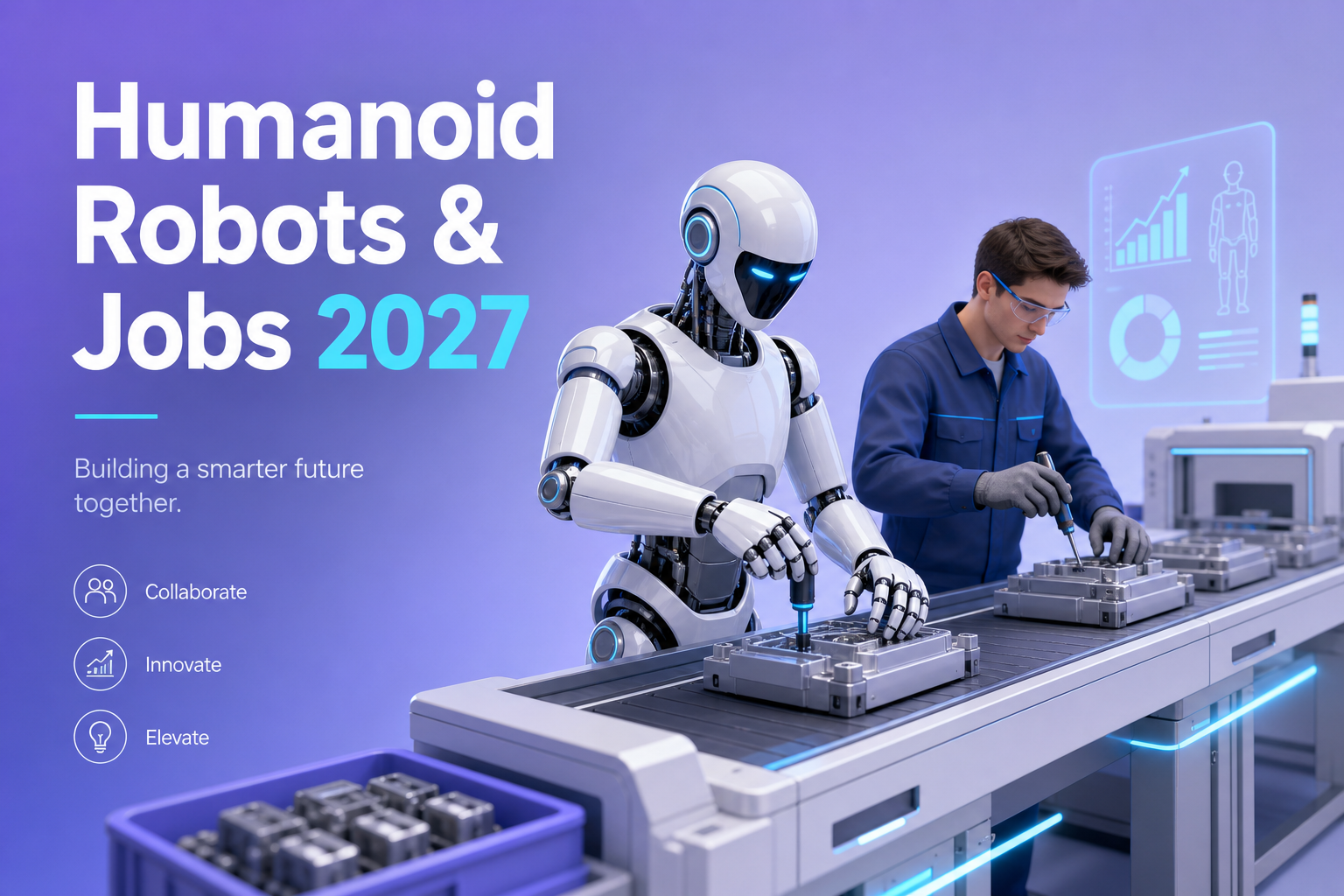
Imagine walking onto a factory floor at 2 a.m. The conveyor belts hum, parts move from station to station, and a five-foot-eight machine with two arms and ten fingers calmly lifts a tote, scans a label, and places it exactly where a human worker would have. No coffee break. No overtime pay. That scene is no longer science fiction. With Tesla Optimus Gen 3 reportedly entering pilot deployments across Tesla’s own production lines, the conversation about humanoid robots taking over blue-collar work has shifted from “someday” to “how soon.”
So here is the question worth answering honestly: are humanoid robots really about to replace warehouse pickers, line assemblers, and machine operators by 2027? Or is that timeline a mix of genuine engineering progress and very effective marketing? Let’s separate the hardware reality from the hype, and figure out what it actually means for your job and your skills.
What Are Humanoid Robots, Exactly?
A humanoid robot is a robot built with a body plan that mimics the human form: a torso, a head with sensors, two arms with dexterous hands, and two legs for bipedal movement. The goal is not to look human for its own sake. It is to operate in spaces and use tools that were already designed for people, without rebuilding the entire environment around the machine.
That last point is the whole reason companies are pouring billions into them. A traditional industrial robot is a bolted-down arm that does one repetitive motion forever. A humanoid robot is meant to be a general-purpose worker that walks to a task, picks up an existing tool, and adapts. The difference is flexibility, and flexibility is what makes blue-collar automation suddenly plausible.
Inside Tesla Optimus Gen 3: What Actually Changed
Each generation of Optimus has narrowed the gap between a stiff demo bot and a usable worker. The reported improvements in Tesla Optimus Gen 3 focus on the three things that actually matter for factory work: hands, balance, and battery life.
- Dexterous hands: Gen 3 reportedly moves toward 22 degrees of freedom per hand with tactile sensing in the fingertips. Grip and finger control are the single biggest bottleneck for manual labor, so this is the headline upgrade.
- Actuators and balance: Custom electric actuators give smoother, faster motion and better recovery when the robot is bumped or loses footing on uneven flooring.
- Onboard AI: Optimus borrows the same neural-network and vision stack philosophy Tesla uses for self-driving, learning tasks from video demonstrations rather than hand-coded instructions.
- Runtime: A full-shift battery target (roughly 6–8 hours of light work) is what separates a lab toy from something a plant manager can schedule.
Tesla’s stated ambition is to manufacture these units at scale and eventually price them in the $20,000–$30,000 range. If that price holds, the math changes dramatically, because that is below the annual fully-loaded cost of a single human worker in many regions.
The real breakthrough is not that a robot can walk. It is that a robot can learn a new task from watching, instead of waiting months for an engineer to program it.
Why Humanoid Robots Are Targeting Factories First
You might expect home robots to arrive first, since that is the dream everyone pictures. The opposite is true, and the reason is risk and structure. Factories are controlled environments: predictable lighting, flat floors, fixed station layouts, and clearly defined repetitive tasks. A robot does not need to handle a toddler running across the room or a cat knocking over a vase.
Manufacturing also has a measurable labor shortage in many countries, especially for physically demanding, repetitive, or hazardous roles that humans increasingly refuse. That combination — structured space plus genuine staffing gaps — makes the factory the perfect proving ground before humanoid robots ever reach a warehouse, a hospital, or your living room.
Which Blue-Collar Jobs Are Actually at Risk by 2027?
Not all manual jobs are equally exposed. The honest answer is that humanoid robots threaten tasks, not entire professions, and they go after the most repetitive, predictable tasks first. Here is a realistic breakdown of exposure on a 2027 horizon.
| Job Type | Task Predictability | Automation Risk by 2027 |
|---|---|---|
| Warehouse picking & sorting | Very high | High |
| Assembly line repetitive fitting | High | Medium-High |
| Machine tending & loading | High | Medium |
| Electricians & plumbers (field) | Low | Low |
| Construction finishing work | Low | Low |
| Maintenance & repair diagnostics | Low | Very Low |
Notice the pattern: jobs that involve unpredictable environments, problem-solving, and improvisation stay safe far longer. A plumber crawling under a sink in a 90-year-old house faces a different problem every single time. A warehouse picker repeats the same reach-grab-place motion thousands of times a day. Guess which one a robot masters first.
Running the Numbers: When Does a Robot Pay for Itself?
The adoption decision is rarely emotional — it is financial. A company asks one question: how fast does the robot pay back its purchase price compared to the wages it replaces? You can model this yourself with a simple payback calculation.
# Estimate how many months a humanoid robot takes to pay for itself
def payback_months(robot_cost, annual_wage, robot_yearly_opex, uptime_factor):
    # uptime_factor: fraction of a human's output the robot delivers (0.0 - 1.0)
    effective_savings_per_year = (annual_wage * uptime_factor) - robot_yearly_opex
    if effective_savings_per_year <= 0:
        return None  # robot never pays back at these numbers
    monthly_savings = effective_savings_per_year / 12
    return round(robot_cost / monthly_savings, 1)

# Example: $25k robot, replacing a $45k/yr role, $3k/yr running cost, 80% output
months = payback_months(25000, 45000, 3000, 0.80)
print(f"Payback period: {months} months")  # Payback period: 9.1 months
This snippet models the core logic plant managers use. With the example inputs, the robot pays for itself in roughly nine months, after which it keeps producing savings. The takeaway is that the humanoid robots business case becomes compelling the moment hardware drops below a worker’s annual cost and reliability climbs above roughly 70–80% of human output. Change the uptime_factor to 0.4 and the payback stretches past two years — which is exactly why reliability, not raw capability, is the real battleground.
The Reality Check: Why 2027 May Be Too Optimistic
Demo videos are seductive, but a scripted stage performance is not a 24/7 production deployment. Several hard problems still stand between a polished demo and a robot you can trust on a live line.
- The dexterity gap: Human hands handle soft, slippery, oddly shaped objects effortlessly. Robots still struggle with the messy “edge cases” that make up a surprising share of real work.
- Reliability and uptime: A robot that works 95% of the time sounds great until you realize that 5% failure rate halts a production line and needs a human to rescue it.
- Safety and liability: A 130-pound machine moving near people raises serious safety-certification and insurance questions that regulators have barely started addressing.
- Scaling manufacturing: Building thousands of complex robots reliably is itself a brutal engineering challenge — the same kind that has delayed many ambitious hardware timelines before.
History is full of “two years away” robotics promises that took ten. A grounded expectation is that 2027 brings meaningful pilot deployments and narrow task automation, not a wholesale replacement of the blue-collar workforce. Mass adoption is more plausibly a late-2020s to 2030s story.
How to Future-Proof Your Career Against Automation
Whether the timeline is 2027 or 2032, the direction is clear, so the smart move is to position yourself where humans stay valuable. Robots are weakest exactly where these skills are strongest.
- Move toward the unpredictable. Repair, troubleshooting, installation in messy real-world settings, and custom one-off work resist automation far longer than repetitive tasks.
- Learn to work alongside robots. Someone has to deploy, calibrate, supervise, and maintain these machines. “Robot technician” and “automation operator” are growth roles, not threatened ones.
- Build hybrid skills. Combine hands-on trade knowledge with basic coding, sensors, or data literacy. The person who understands both the physical task and the software controlling it becomes irreplaceable.
- Lean into human-facing work. Roles requiring judgment, communication, and trust — supervision, quality oversight, customer interaction — are the last to be automated.
If you want a grounding in how these systems actually perceive and decide, the field of robotics fundamentals and the broader study of artificial intelligence concepts are the most direct on-ramps to the jobs that will grow rather than shrink.
Tesla Optimus vs Other Humanoid Robots
Tesla is loud, but it is far from alone. Several well-funded competitors are racing toward the same factory deployments, and comparing them shows this is an industry-wide push rather than a single company’s bet.
| Robot | Maker | Primary Edge |
|---|---|---|
| Optimus Gen 3 | Tesla | Mass-manufacturing scale and low target price |
| Figure 02 / 03 | Figure AI | Commercial pilots and AI partnerships |
| Atlas (electric) | Boston Dynamics | Athletic mobility and balance |
| Digit | Agility Robotics | Already deployed for logistics tasks |
Tesla’s genuine advantage is not necessarily the smartest robot — it is the company’s experience building complex machines on assembly lines at volume. If anyone can drive the price down to consumer-product territory, manufacturing scale is how it happens. That cost curve, more than any single demo, is what could make humanoid robots common on factory floors.
Frequently Asked Questions
Will Tesla Optimus actually replace human workers in 2027?
Most likely partially, not fully. Expect Optimus and similar humanoid robots to handle narrow, repetitive tasks in controlled factory settings by 2027, while humans shift toward supervision, maintenance, and unpredictable work. A complete blue-collar replacement on that timeline is unrealistic given current reliability limits.
How much will a Tesla Optimus robot cost?
Tesla has publicly targeted a price of roughly $20,000 to $30,000 per unit at scale. That figure is an ambition, not a confirmed retail price, and early units are expected to be more expensive and reserved for Tesla’s own facilities before any broader sale.
Which blue-collar jobs are safest from humanoid robots?
Jobs in unpredictable environments are safest: electricians, plumbers, HVAC technicians, construction finishers, and repair specialists. These roles demand improvisation and problem-solving in spaces no two of which are identical — precisely the conditions where current humanoid robots still struggle badly.
What is the difference between a humanoid robot and an industrial robot?
An industrial robot is a fixed, specialized arm that performs one repetitive motion in a dedicated cell. A humanoid robot is a mobile, general-purpose machine designed to walk into human spaces, use existing tools, and switch between many tasks without redesigning the workspace.
Should I be worried about my factory job right now?
Not panicked, but proactive. The change will roll out gradually, giving you time to adapt. Focus on skills robots lack — troubleshooting, machine supervision, and hybrid technical knowledge — and you position yourself to benefit from automation rather than be displaced by it.
Conclusion
Tesla Optimus Gen 3 reaching factory floors is a real milestone, and it signals that humanoid robots are crossing from research labs into production environments faster than many expected. The dexterous hands, full-shift battery targets, and learn-from-video AI are genuine progress, not just stagecraft.
But the honest verdict on the 2027 question is “partial, not total.” Expect humanoid robots to absorb the most repetitive, predictable blue-collar tasks first — warehouse picking, simple assembly, machine tending — while reliability, safety certification, and manufacturing scale keep full replacement years further out. The unpredictable, hands-on, problem-solving work stays human for a good while yet.
Your best response is not fear but positioning. Lean into the skills robots cannot copy, learn to work beside the machines instead of against them, and you turn a disruptive shift into a career advantage. The factories of 2027 will have more robots — and they will still need people who know exactly what those robots cannot do.