A software engineer with three years of experience just signed an offer worth more than most surgeons earn. No PhD. No published papers. Just a sharp set of skills, a portfolio that proved them, and good timing. That offer wasn’t luck — it was the predictable result of building the right things in the right order. Landing a $400K AI engineer job in 2026 is harder than the headlines suggest and far more achievable than the imposter syndrome in your head insists.
The catch is that the path is misunderstood. People stack up certificates, grind algorithm puzzles, and watch endless theory lectures, then wonder why recruiters ignore them. Top offers go to engineers who can ship reliable machine learning systems, not to people who can recite the math behind backpropagation. This roadmap shows you exactly what to learn, what to build, and what to skip.
What a $400K AI Engineer Job Actually Involves
An AI engineer is a software engineer who designs, builds, and ships systems powered by machine learning models — especially large language models. Unlike a research scientist who invents new algorithms, an AI engineer turns models into dependable products: data pipelines, evaluation harnesses, retrieval systems, and the infrastructure that serves predictions to millions of users.
The day-to-day looks less like a Kaggle notebook and more like senior backend work with a probabilistic twist. You wire models into applications, measure whether their outputs are actually good, and keep latency and cost under control. The distinction matters because the highest-paying roles reward production judgment, not just model knowledge.
The engineers earning the most aren’t the ones who know the most about transformers. They’re the ones companies trust to put a model in front of real users without breaking things.
That trust is the product you’re really selling. Every skill below exists to build it.
The 2026 AI Engineer Salary Landscape
The “$400K” number is real, but it needs context. It refers to total compensation — base salary plus equity plus bonus — and it usually appears at the senior level and above, concentrated at frontier labs and well-funded startups. Compensation aggregators like Levels.fyi track these bands publicly, and they vary widely by company, location, and equity timing.
Here is a realistic picture of how the tiers stack up for AI and machine learning engineering roles:
| Level | Typical Title | Total Comp Range (USD) | What Sets You Apart |
|---|---|---|---|
| Entry | Junior AI Engineer | $150K – $220K | Can build and deploy a working ML feature |
| Mid | AI Engineer | $220K – $320K | Owns systems end to end, writes solid evals |
| Senior | Senior AI Engineer | $320K – $450K | Leads architecture, mentors, controls cost |
| Staff+ | Staff / Research Engineer | $450K – $900K+ | Sets technical direction across teams |
Notice that the jump into $400K territory is not about adding another framework to your resume. It’s about scope: owning systems, making cost and reliability trade-offs, and lifting the people around you. Keep that in mind as you read the skills roadmap — every phase is designed to expand your scope, not just your toolkit.
Core Skills That Command a $400K AI Engineer Salary
You don’t need all of these on day one. You need a credible foundation and then visible depth in one or two areas. Recruiters hire specialists who can collaborate broadly, not generalists who are shallow everywhere.
Production-Grade Python and Software Engineering
Python is the lingua franca of AI, but the bar is real software engineering: clean APIs, tests, async I/O, type hints, and packaging. If your code only runs in a notebook, you look like a hobbyist. If it ships as a tested service, you look like a hire. Strong Git, Docker, and CI habits separate the $200K candidate from the $400K one more than any model knowledge does.
Machine Learning and Deep Learning Foundations
You need working intuition for how models learn — loss functions, gradient descent, overfitting, embeddings, and the transformer architecture that powers modern large language models. You do not need to derive the math from scratch. Spend your time in PyTorch and the Hugging Face Transformers ecosystem, where production teams actually work.
LLMs, Prompting, and Retrieval-Augmented Generation
This is the highest-leverage skill cluster in 2026. Most AI products are now wrappers of intelligence around proprietary data, and retrieval-augmented generation (RAG) is the dominant pattern. RAG means fetching relevant information at query time and feeding it to a model so answers stay grounded in your data instead of hallucinated.
Here is the core of a retrieval step — turning text into vectors and finding the closest matches:
# Minimal semantic retrieval for a RAG pipeline
from sentence_transformers import SentenceTransformer
import numpy as np

# Load an embedding model that maps text to dense vectors
embedder = SentenceTransformer("all-MiniLM-L6-v2")

# Your knowledge base — in production this lives in a vector database
docs = [
    "Refunds are processed within 5 business days.",
    "Premium plans include 24/7 priority support.",
    "You can cancel your subscription anytime in settings.",
]
doc_vectors = embedder.encode(docs)

def retrieve(query, k=2):
    q_vec = embedder.encode([query])[0]
    # Cosine similarity between the query and every document
    scores = doc_vectors @ q_vec / (
        np.linalg.norm(doc_vectors, axis=1) * np.linalg.norm(q_vec)
    )
    top = scores.argsort()[::-1][:k]
    return [docs[i] for i in top]

print(retrieve("How long until I get my money back?"))
This code converts both the documents and the question into vectors, then ranks documents by cosine similarity so semantically related text scores high even when the words differ — “money back” matches “refunds.” That single idea powers most production search and chatbot features today.
Retrieval alone isn’t an answer. You then assemble the results into a prompt and let the model phrase a grounded response:
import anthropic

client = anthropic.Anthropic()  # reads ANTHROPIC_API_KEY from the environment

def answer(query):
    context = "\n".join(retrieve(query))   # reuse the retriever above
    prompt = (
        "Answer using only the context below. "
        "If the answer is not present, say you don't know.\n\n"
        f"Context:\n{context}\n\nQuestion: {query}"
    )
    message = client.messages.create(
        model="claude-sonnet-4-6",
        max_tokens=300,
        messages=[{"role": "user", "content": prompt}],
    )
    return message.content[0].text

print(answer("How long until I get my money back?"))
The instruction to use “only the context” and to admit uncertainty is what keeps the system honest. Engineers who understand why that line reduces hallucinations — and who can prove it with evaluations — are exactly who senior AI teams want.
MLOps, Evaluation, and Cost Control
Models are easy to demo and hard to operate. Evaluation harnesses, monitoring, versioning, and token-cost budgeting are where most teams are understaffed, which makes these skills directly tied to top pay. If you can prove a model change improved quality without raising latency or spend, you control the conversation in any interview.
The Complete AI Engineer Skills Roadmap
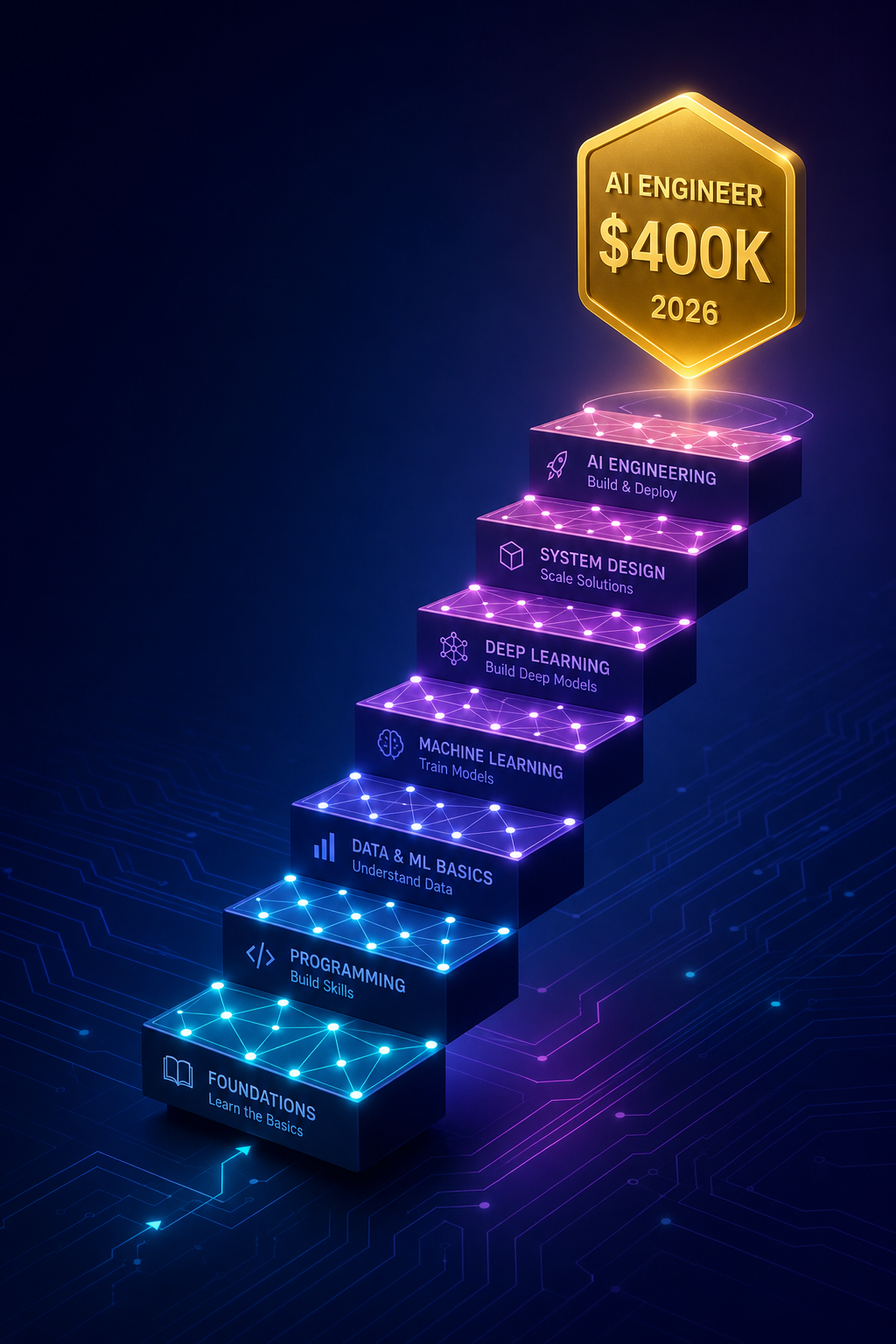
Follow this sequence. Each phase builds on the last, and skipping ahead is the single most common reason talented people stall before the $400K AI engineer job they want.
- Months 1–3: Software fundamentals. Get genuinely good at Python, Git, Docker, and building a tested REST API. Ship one small web service to a cloud provider.
- Months 3–6: ML literacy. Learn supervised learning, embeddings, and the transformer architecture. Fine-tune or fine-prompt a model on a real dataset and measure the result.
- Months 6–9: LLM applications. Build a complete RAG system with a vector database, an evaluation suite, and proper error handling. This is your flagship project.
- Months 9–12: Production and scale. Add monitoring, caching, cost tracking, and a CI pipeline. Learn to reason about latency and reliability under load.
- Ongoing: Depth and visibility. Pick one specialty — agents, evaluation, inference optimization, or data engineering — and go deep enough to teach it.
The whole roadmap fits in a focused year if you’re already a developer, or 18–24 months if you’re starting fresh. Speed matters less than the order.
Build a Portfolio That Proves You Can Ship
Resumes list skills; portfolios prove them. A hiring manager skims your GitHub for thirty seconds and decides whether you build toys or tools. Bias every project toward “this looks like real production work.”
- One deep flagship project. A deployed RAG application with evaluations beats five half-finished tutorials. Show the metrics, not just the demo.
- Public evaluation results. A short report showing how you measured and improved answer quality signals senior judgment instantly.
- Clean, documented code. Tests, a clear README, and a live link. Make it trivial for a stranger to run.
- Written reasoning. A blog post explaining a trade-off you made demonstrates the communication skills that separate senior engineers from juniors.
One project executed to a professional standard outperforms a dozen shallow ones. Depth is the signal that survives the recruiter’s thirty-second skim.
Common Pitfalls That Keep AI Engineers Underpaid
Even strong candidates leave money on the table by repeating the same avoidable mistakes. Watch for these.
- Chasing theory over shipping. Knowing the math is nice; deploying a working system is what gets paid. Build first, deepen theory as needed.
- Ignoring evaluation. “It seems to work” is not a metric. Without evals you can’t prove improvement, and proof is what unlocks senior offers.
- Tutorial hell. Endless courses feel productive but produce nothing original. Cap your learning and force yourself to build.
- Treating cost as someone else’s problem. Token spend and latency are engineering constraints. Owning them marks you as production-ready.
- Underselling scope. In interviews, talk about systems you owned and trade-offs you made — not features you touched. Scope is what the $400K band rewards.
Frequently Asked Questions
Do I need a PhD to land a $400K AI engineer job?
No. A PhD helps for pure research roles, but most $400K AI engineering jobs reward production skill and demonstrated impact. A strong portfolio and senior software judgment can outweigh academic credentials at the majority of companies.
How long does it take to become an AI engineer?
If you’re already a working developer, a focused 12 months following the roadmap above is realistic. Starting from scratch, plan for 18–24 months. Consistency and shipped projects matter far more than raw study hours.
Which programming language should I learn for AI engineering?
Python first, without question — it owns the AI ecosystem. Add SQL for data work, and pick up TypeScript if you build the application layer. One strong language used in production beats three you only know casually.
Is the $400K AI engineer salary realistic or just hype?
It’s realistic but concentrated. These numbers cluster at senior levels in major tech hubs and well-funded labs, and they include equity. Mid-level roles in the $200K–$300K range are far more common and still excellent outcomes.
What’s the difference between an AI engineer and an ML engineer?
The titles overlap heavily in 2026. Traditionally, ML engineers build and train models, while AI engineers integrate existing models — especially LLMs — into products. Many job postings now use the terms interchangeably, so read the responsibilities, not the title.
Conclusion: Your Path to a $400K AI Engineer Job
The $400K AI engineer job isn’t a lottery ticket reserved for prodigies. It’s the outcome of a learnable sequence: solid software engineering, real machine learning literacy, hands-on LLM and RAG skills, and the production discipline to ship systems people can trust. Companies pay top dollar for that trust, and trust is something you can build deliberately.
Start where you are. Pick the next phase of the roadmap, ship one project to a professional standard, and let your portfolio do the arguing. The engineers landing these offers in 2026 aren’t smarter than you — they simply built the right things in the right order, and now it’s your turn to do the same.