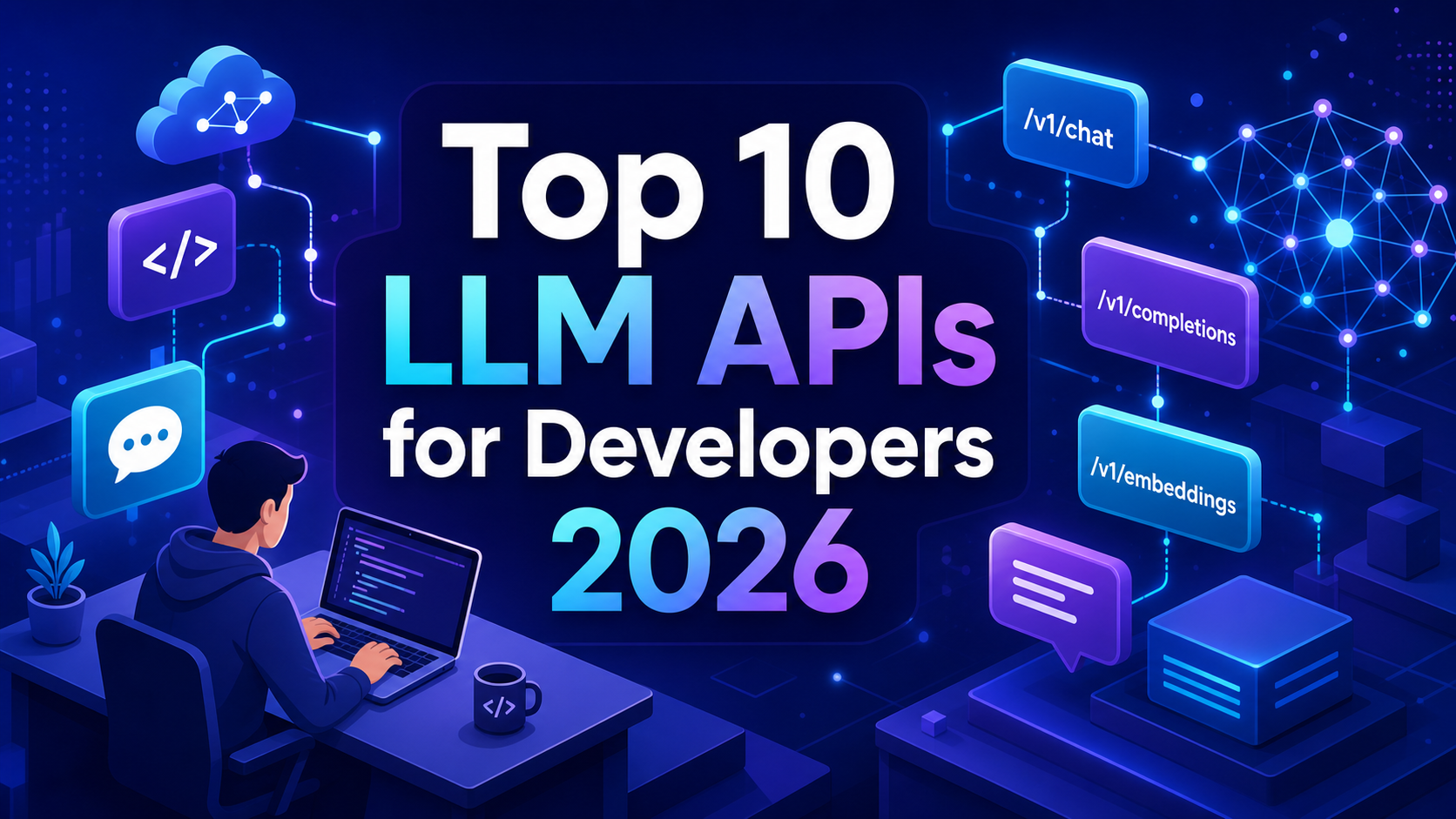
Choosing the wrong large language model API can quietly drain your budget, throttle your product at the worst moment, or lock you into a vendor that can’t keep up with the next wave of releases. With over a dozen serious providers shipping new models every quarter, the question isn’t “which LLM is best?” anymore — it’s “which LLM API fits my workload, my latency budget, and my wallet?”
This comparison of the top 10 LLM APIs for developers in 2026 cuts through the marketing noise. You’ll see real pricing, context-window numbers, code samples, and the trade-offs that actually matter when you put one of these models behind a production endpoint.
What Is an LLM API and Why Does It Matter in 2026?
An LLM API is a hosted HTTP interface that lets you send text (and increasingly images, audio, or video) to a large language model and get a generated response back. Instead of running a 70-billion-parameter model on your own GPUs, you pay per token and the provider handles inference, scaling, and updates. For most teams, this is the fastest path from idea to shipped feature.
In 2026, the landscape looks very different from the early GPT-4 era. Context windows now stretch to one million tokens or more, prompt caching has slashed costs by up to 90% for repeated context, and reasoning models can think through problems for minutes before answering. Picking the right LLM API today means understanding not just quality, but caching behavior, tool-use semantics, and structured-output reliability.
How We Compared the Top 10 LLM APIs
Every API on this list was evaluated against the criteria developers actually ask about during architecture reviews:
- Model quality — reasoning, coding, and instruction-following on independent benchmarks
- Pricing — input, output, and cached-token costs per million tokens
- Context window — maximum tokens per request, including extended-context tiers
- Latency — time-to-first-token and tokens-per-second under typical load
- Developer experience — SDK quality, docs, error messages, and observability
- Tool use and structured output — function calling, JSON mode, and agent support
- Multimodality — vision, audio, and document understanding
- Data and privacy — retention policies, zero-retention options, and regional hosting
1. Anthropic Claude API
Anthropic’s Claude API remains a favorite for long-form writing, code generation, and agentic workflows. The Claude 4 family — Opus, Sonnet, and Haiku — gives you a clear quality-vs-cost ladder, and prompt caching plus the 1M-token context tier on Sonnet make it especially strong for codebases and document Q&A.
import anthropic

client = anthropic.Anthropic()

response = client.messages.create(
    model="claude-sonnet-4-6",
    max_tokens=1024,
    system="You are a senior backend engineer.",
    messages=[
        {"role": "user", "content": "Explain idempotency keys in 3 sentences."}
    ],
)

# Print just the text content from the first content block
print(response.content[0].text)
This snippet calls Claude Sonnet 4.6 with a system prompt and a single user message. Note the max_tokens cap — Claude requires it explicitly, which prevents runaway bills if a model decides to ramble.
Strengths and trade-offs
- Pros: Excellent coding and reasoning, native tool use, prompt caching with 5-minute and 1-hour TTLs, strong safety defaults
- Cons: Opus tier is expensive, no first-party image generation, fewer regional endpoints than the hyperscalers
2. OpenAI API (GPT-5 Family)
OpenAI’s API is still the most-used LLM API for developers, and the GPT-5 family extended the lead with native multimodality and a unified responses endpoint that replaces the older chat-completions pattern for new projects. The Realtime API now handles speech-to-speech with sub-300ms latency, which is hard to match elsewhere.
import OpenAI from "openai";
const client = new OpenAI();

const response = await client.responses.create({
  model: "gpt-5",
  input: "Write a SQL query to find duplicate emails in a users table.",
  reasoning: { effort: "medium" }, // low | medium | high
});

console.log(response.output_text);
The reasoning.effort parameter is the GPT-5 knob that controls how long the model “thinks” before answering. Lower effort means cheaper and faster; higher effort improves multi-step problem solving at the cost of latency.
Strengths and trade-offs
- Pros: Massive ecosystem, best-in-class voice and image models, mature batch and fine-tuning APIs
- Cons: Pricing tiers can be confusing, occasional rate-limit volatility on launch days
3. Google Gemini API
Google’s Gemini API is the value champion for long-context workloads. Gemini 2.5 Pro keeps a 2M-token context window, and the Flash tier is dramatically cheaper than competing mid-tier models. Native video understanding — you can pass an entire MP4 — is still a unique selling point.
from google import genai

client = genai.Client()

response = client.models.generate_content(
    model="gemini-2.5-pro",
    contents="Summarize the key clauses in this contract.",
    config={"temperature": 0.2},
)

print(response.text)
Gemini’s SDK accepts files, URLs, and inline bytes for the same contents field, which keeps multimodal code refreshingly simple compared to providers that require separate file-upload calls.
4. Mistral AI API
Mistral is the strongest European option and a pragmatic choice when GDPR or data-residency requirements rule out US-hosted models. Mistral Large 2 and the Codestral family punch above their weight on code generation, and the la Plateforme dashboard exposes fine-tuning without an enterprise sales call.
from mistralai import Mistral
import os

client = Mistral(api_key=os.environ["MISTRAL_API_KEY"])

chat_response = client.chat.complete(
    model="mistral-large-latest",
    messages=[{"role": "user", "content": "Refactor this Python loop to use a comprehension."}],
)

print(chat_response.choices[0].message.content)
The Mistral SDK mirrors OpenAI’s chat-completions shape, so porting prototypes between the two providers takes minutes, not hours.
5. Cohere API
Cohere targets enterprise RAG (retrieval-augmented generation) workloads. Its Command R+ chat model pairs with class-leading embed and rerank endpoints, which together produce some of the most accurate document-search pipelines you can build without stitching three vendors together.
import cohere
co = cohere.ClientV2()

# Rerank search results before sending them to the LLM
results = co.rerank(
    model="rerank-v3.5",
    query="How do I rotate AWS KMS keys?",
    documents=[
        "KMS keys can be rotated automatically every year...",
        "S3 bucket policies use JSON syntax...",
        "AWS IAM roles delegate permissions...",
    ],
    top_n=2,
)

for r in results.results:
    print(r.index, r.relevance_score)
This rerank step is the secret weapon for RAG quality. Embedding search alone often surfaces semantically related but unhelpful chunks; a rerank pass usually lifts answer accuracy by double digits.
6. Meta Llama API (and Hosted Providers)
Meta’s first-party Llama API now serves the Llama 4 family directly, but most teams still consume Llama through specialized inference hosts like Groq, Together AI, or Fireworks. The reason is speed: Groq’s LPU hardware regularly delivers 500+ tokens/second on Llama 4 Scout, which is unbeatable for streaming UX.
curl https://api.groq.com/openai/v1/chat/completions \
  -H "Authorization: Bearer $GROQ_API_KEY" \
  -H "Content-Type: application/json" \
  -d '{
    "model": "llama-4-scout",
    "messages": [{"role": "user", "content": "Explain CORS in 2 sentences."}]
  }'
Notice the OpenAI-compatible path — most Llama hosts implement that schema, so any OpenAI SDK works by just swapping the base URL.
7. xAI Grok API
xAI’s Grok API matured fast in 2025–2026. Grok 4 is competitive on reasoning benchmarks, and the optional X-data integration gives it real-time awareness that closed competitors deliberately avoid. Pricing sits between OpenAI and Anthropic, with a generous free tier for experimentation.
8. DeepSeek API
DeepSeek shocked the market with aggressive pricing and strong reasoning models. The DeepSeek-V3 and R1 series cost a fraction of comparable Western models, and prompt caching pushes effective costs even lower. The trade-off is data residency — inference runs in China unless you self-host the open weights via another provider.
9. AWS Bedrock
If your stack already lives in AWS, Bedrock is less an LLM API and more a meta-API: a single SDK gives you Claude, Llama, Mistral, Cohere, Titan, and others behind IAM, VPC endpoints, and CloudWatch. The latency overhead versus calling providers directly is usually 30–80ms, which most teams happily trade for unified billing and security posture.
import boto3, json

bedrock = boto3.client("bedrock-runtime", region_name="us-east-1")

response = bedrock.converse(
    modelId="anthropic.claude-sonnet-4-6-v1:0",
    messages=[{"role": "user", "content": [{"text": "Hello from Bedrock"}]}],
    inferenceConfig={"maxTokens": 256},
)

print(response["output"]["message"]["content"][0]["text"])
The converse API normalizes message shapes across all Bedrock-hosted models, so swapping Claude for Llama means changing one string instead of rewriting the request payload.
10. Azure OpenAI Service
Azure OpenAI is functionally the OpenAI API with enterprise plumbing: private networking, Microsoft Entra auth, regional residency, and contractual data-handling guarantees. For regulated industries — finance, healthcare, government — it’s often the only practical way to use GPT-class models. New model availability typically lags the public OpenAI API by a few weeks.
Side-by-Side Comparison Table
| Provider | Flagship Model | Max Context | Input $/M tokens | Best For |
|---|---|---|---|---|
| Anthropic | Claude Opus 4 / Sonnet 4.6 | 1M | $3 – $15 | Coding, agents, long docs |
| OpenAI | GPT-5 | 400K | $1.25 – $10 | General purpose, voice |
| Gemini 2.5 Pro | 2M | $1.25 – $5 | Long context, video | |
| Mistral | Mistral Large 2 | 128K | $2 – $6 | EU residency, code |
| Cohere | Command R+ | 128K | $2.50 | Enterprise RAG |
| Meta (via Groq) | Llama 4 Scout | 10M | $0.11 – $0.34 | High-speed streaming |
| xAI | Grok 4 | 256K | $3 – $15 | Real-time data |
| DeepSeek | DeepSeek-V3 | 128K | $0.27 – $1.10 | Cost-sensitive workloads |
| AWS Bedrock | Multi-model | Varies | Pass-through | AWS-native stacks |
| Azure OpenAI | GPT-5 | 400K | OpenAI parity | Regulated enterprises |
Prices reflect typical 2026 list rates and exclude discounts from prompt caching, batch processing, or committed-spend agreements. Always check the provider’s pricing page before architecting around a specific number.
How to Pick the Right LLM API for Your Project
Start by writing down three numbers: your expected daily token volume, your maximum acceptable per-request latency, and the regulatory zone your data must stay in. Those three constraints eliminate at least half the options.
From there, use this rough decision tree:
- Need the absolute best reasoning? Claude Opus 4 or GPT-5 with high reasoning effort.
- Need huge context cheaply? Gemini 2.5 Pro or Llama 4 Scout via Groq.
- Need EU residency? Mistral on European endpoints, or Azure OpenAI in an EU region.
- Building enterprise RAG? Cohere’s chat + embed + rerank stack.
- Already on AWS or Azure? Use Bedrock or Azure OpenAI for unified governance.
- Optimizing for cost per token? DeepSeek or cached Llama 4 calls.
The best LLM API is the one your team can debug at 3 a.m. when production breaks. Optimize for observability and SDK ergonomics before you optimize for benchmark scores.
Common Pitfalls When Integrating LLM APIs
- Ignoring prompt caching. Repeated system prompts and few-shot examples can be cached on Anthropic, OpenAI, and Gemini for 50–90% cost savings. Most teams leave this on the table.
- Hard-coding model IDs. Models get deprecated. Read the model ID from configuration so you can roll forward without redeploying.
- Skipping retries with jitter. 429 and 529 responses are normal. Use exponential backoff with jitter, and never retry non-idempotent tool calls without a deduplication key.
- Trusting structured output blindly. Even with JSON mode, validate against a schema (Pydantic, Zod, JSON Schema) before passing data downstream.
- Forgetting streaming for UX. A 6-second response feels slow as a single payload but instant when streamed token by token.
- Logging full prompts to plaintext logs. User PII can leak into prompts. Redact or hash before persisting.
Frequently Asked Questions About LLM APIs
Which LLM API is the cheapest in 2026?
For raw input tokens, Llama 4 Scout via Groq and DeepSeek-V3 are the cheapest mainstream options, often under $0.30 per million input tokens. With prompt caching enabled on Anthropic or Gemini, however, real-world workload costs can be even lower than nominal price comparisons suggest.
What is the largest context window available?
Llama 4 Scout offers up to 10 million tokens on select hosts, Gemini 2.5 Pro supports 2 million, and Claude Sonnet 4.6 reaches 1 million on its extended-context tier. Useful context — the range over which the model still reasons accurately — is usually shorter than the maximum, so always benchmark on your actual data.
Can I use multiple LLM APIs in the same application?
Yes, and many production systems do. A common pattern is to route cheap, high-volume requests to Llama or DeepSeek, escalate complex reasoning tasks to Claude or GPT-5, and keep a third provider as a failover. Libraries like LiteLLM, LangChain, and the Vercel AI SDK abstract the provider differences behind a single interface.
Are my prompts and outputs used to train the models?
By default, most enterprise tiers (Anthropic, OpenAI, Google, AWS Bedrock, Azure OpenAI) do not train on API traffic. Free tiers and consumer products often do. Always read the data-usage section of the provider’s terms before sending sensitive content, and prefer zero-retention endpoints when handling PII or proprietary code.
What’s the difference between a chat completion and a reasoning model?
A standard chat completion produces tokens immediately based on pattern matching. A reasoning model (GPT-5 with effort, Claude with extended thinking, DeepSeek-R1) generates internal “thinking” tokens before the visible answer, trading latency and cost for substantially better performance on math, code, and multi-step problems.
Do LLM APIs support function calling and agents?
All ten providers in this list support some form of tool use or function calling, but the semantics differ. Anthropic and OpenAI have the most mature agent loops, including parallel tool calls and structured tool results. If you’re building agents, prototype your tool definitions on both before committing.
Conclusion
The top 10 LLM APIs for developers in 2026 are no longer separated by raw model quality alone — they’re differentiated by pricing structure, context length, latency profile, and the operational guarantees they offer. Anthropic and OpenAI lead on reasoning and ecosystem, Google and Meta dominate on context-per-dollar, Cohere and Mistral specialize in RAG and EU residency, while DeepSeek and Groq-hosted Llama are reshaping cost expectations.
Pick two or three providers, build a thin abstraction layer, and benchmark them on your prompts and your latency targets. The right LLM API for your project is rarely the one with the highest benchmark score — it’s the one whose cost, speed, and developer experience match the system you’re actually shipping.