What are Threads in Operating Systems?
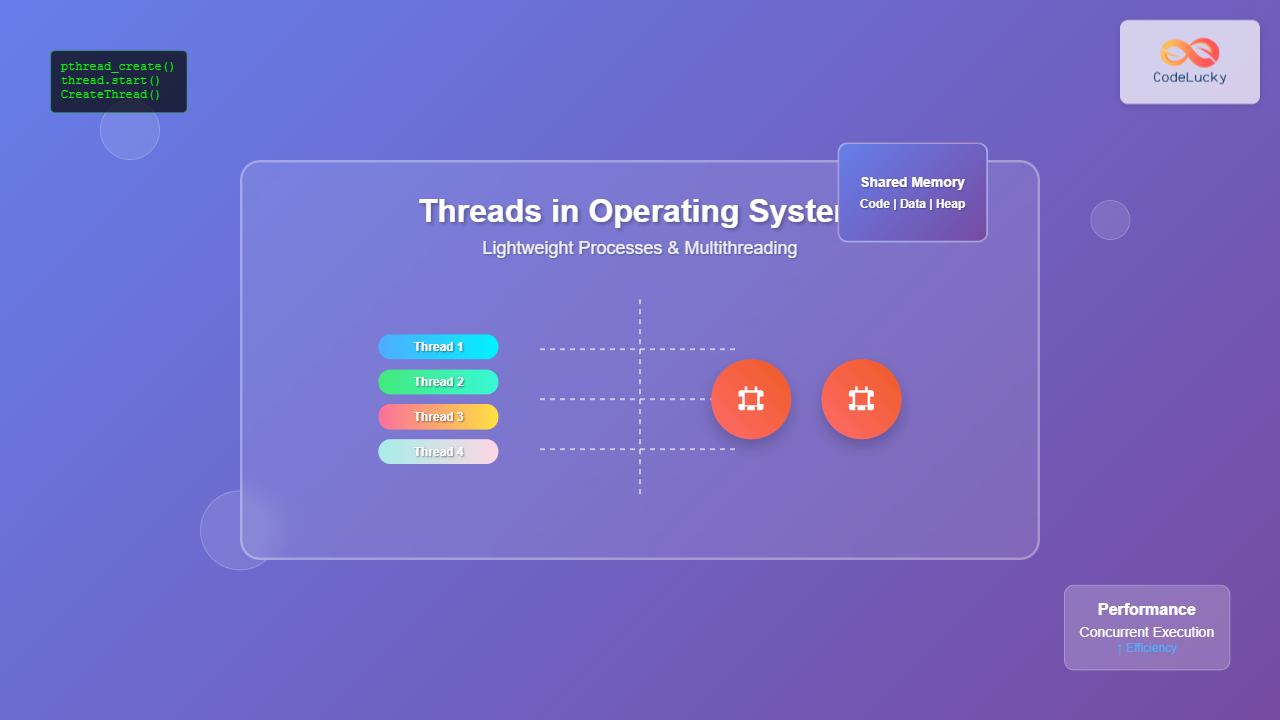
A thread is the smallest unit of execution within a process that can be scheduled independently by the operating system. Unlike processes, threads share the same memory space and resources of their parent process, making them lightweight processes. Threads enable concurrent execution within a single program, allowing multiple tasks to run simultaneously and improving system efficiency.

Key Characteristics of Threads
Shared Resources
Threads within the same process share several resources:
- Memory space: Code, data, and heap segments
- File descriptors: Open files and I/O streams
- Signal handlers: Process-wide signal handling
- Process ID: All threads share the same PID
- Working directory: Current directory context
Private Resources
Each thread maintains its own:
- Stack: Local variables and function calls
- Program counter: Current instruction pointer
- Register set: CPU register values
- Thread ID: Unique identifier within the process
Types of Threads
User-Level Threads (ULT)
User-level threads are managed entirely by user-space thread libraries without kernel intervention. The kernel is unaware of their existence and treats the entire process as a single execution unit.
Advantages:
- Fast thread creation and switching
- No system calls required for thread operations
- Portable across different operating systems
- Custom scheduling algorithms possible
Disadvantages:
- Blocking system calls block entire process
- No true parallelism on multiprocessor systems
- Complex signal handling
Kernel-Level Threads (KLT)
Kernel-level threads are managed directly by the operating system kernel. Each thread has its own thread control block (TCB) in kernel space.
Advantages:
- True parallelism on multiprocessor systems
- Non-blocking system calls
- Better fault tolerance
- Kernel-level scheduling
Disadvantages:
- Higher overhead for thread operations
- System calls required for thread management
- Platform-dependent implementation
Hybrid Threading Models
Many modern systems implement hybrid models combining user-level and kernel-level threads:

Thread Lifecycle
Threads go through various states during their execution:

Thread States Explained
- New: Thread object created but not yet started
- Ready: Thread ready to run, waiting for CPU assignment
- Running: Thread currently executing on CPU
- Blocked: Thread waiting for I/O or synchronization
- Terminated: Thread execution completed
Multithreading Implementation
POSIX Threads (Pthreads) Example
#include <pthread.h>
#include <stdio.h>
#include <stdlib.h>

void* worker_thread(void* arg) {
    int thread_id = *(int*)arg;
    printf("Thread %d: Starting execution\n", thread_id);

    // Simulate work
    for (int i = 0; i < 5; i++) {
        printf("Thread %d: Working... step %d\n", thread_id, i + 1);
        sleep(1);
    }

    printf("Thread %d: Finished\n", thread_id);
    return NULL;
}

int main() {
    pthread_t threads[3];
    int thread_ids[3] = {1, 2, 3};

    // Create threads
    for (int i = 0; i < 3; i++) {
        if (pthread_create(&threads[i], NULL, worker_thread, &thread_ids[i]) != 0) {
            fprintf(stderr, "Error creating thread %d\n", i + 1);
            return 1;
        }
    }

    // Wait for all threads to complete
    for (int i = 0; i < 3; i++) {
        pthread_join(threads[i], NULL);
    }

    printf("All threads completed\n");
    return 0;
}
Expected Output:
Thread 1: Starting execution
Thread 2: Starting execution
Thread 3: Starting execution
Thread 1: Working... step 1
Thread 2: Working... step 1
Thread 3: Working... step 1
Thread 1: Working... step 2
Thread 2: Working... step 2
Thread 3: Working... step 2
...
Thread 1: Finished
Thread 2: Finished
Thread 3: Finished
All threads completed
Java Threading Example
class WorkerThread extends Thread {
    private int threadId;

    public WorkerThread(int id) {
        this.threadId = id;
    }

    @Override
    public void run() {
        System.out.println("Thread " + threadId + ": Starting execution");

        for (int i = 0; i < 5; i++) {
            System.out.println("Thread " + threadId + ": Working... step " + (i + 1));
            try {
                Thread.sleep(1000);
            } catch (InterruptedException e) {
                System.err.println("Thread " + threadId + " interrupted");
                return;
            }
        }

        System.out.println("Thread " + threadId + ": Finished");
    }
}

public class MultithreadingExample {
    public static void main(String[] args) {
        WorkerThread[] threads = new WorkerThread[3];

        // Create and start threads
        for (int i = 0; i < 3; i++) {
            threads[i] = new WorkerThread(i + 1);
            threads[i].start();
        }

        // Wait for all threads to complete
        for (WorkerThread thread : threads) {
            try {
                thread.join();
            } catch (InterruptedException e) {
                System.err.println("Main thread interrupted");
            }
        }

        System.out.println("All threads completed");
    }
}
Thread Synchronization
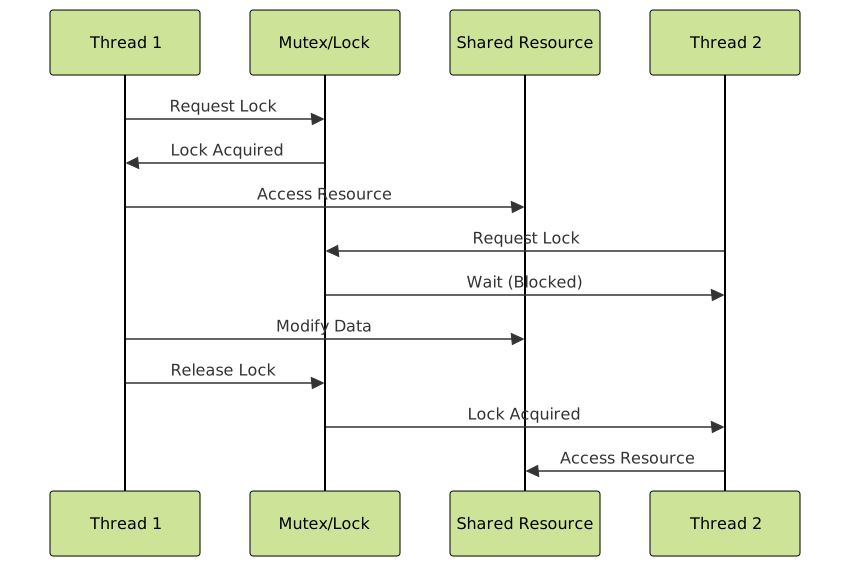
When multiple threads access shared resources, synchronization mechanisms prevent race conditions and ensure data consistency:
Common Synchronization Primitives
- Mutex (Mutual Exclusion): Binary lock for exclusive access
- Semaphore: Counter-based synchronization primitive
- Condition Variables: Signal-based thread coordination
- Read-Write Locks: Allow concurrent reads, exclusive writes
- Spin Locks: Busy-waiting synchronization mechanism
Mutex Example in C
#include <pthread.h>
#include <stdio.h>

int shared_counter = 0;
pthread_mutex_t counter_mutex = PTHREAD_MUTEX_INITIALIZER;

void* increment_counter(void* arg) {
    for (int i = 0; i < 100000; i++) {
        pthread_mutex_lock(&counter_mutex);
        shared_counter++;
        pthread_mutex_unlock(&counter_mutex);
    }
    return NULL;
}

int main() {
    pthread_t threads[2];

    // Create threads
    pthread_create(&threads[0], NULL, increment_counter, NULL);
    pthread_create(&threads[1], NULL, increment_counter, NULL);

    // Wait for completion
    pthread_join(threads[0], NULL);
    pthread_join(threads[1], NULL);

    printf("Final counter value: %d\n", shared_counter);
    printf("Expected value: 200000\n");

    return 0;
}
Thread Scheduling
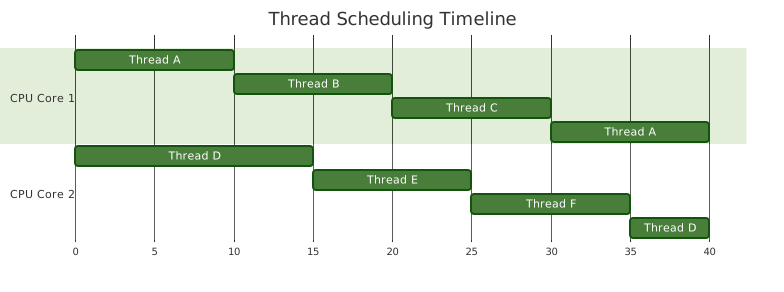
Thread schedulers determine which thread runs on available CPU cores. Common scheduling algorithms include:
Scheduling Algorithms
- Round Robin: Time-sliced execution with fixed quantum
- Priority-based: Higher priority threads execute first
- Multilevel Feedback Queue: Dynamic priority adjustment
- Completely Fair Scheduler (CFS): Linux’s default scheduler
Advantages and Disadvantages of Threading
Advantages
- Improved Performance: Concurrent execution and parallelism
- Resource Sharing: Efficient memory and resource utilization
- Responsiveness: Better user interface responsiveness
- Scalability: Better utilization of multiprocessor systems
- Communication: Fast inter-thread communication
Disadvantages
- Complexity: Increased programming complexity
- Synchronization Issues: Race conditions and deadlocks
- Debugging Difficulty: Non-deterministic behavior
- Context Switching: Overhead from thread switching
- Memory Overhead: Additional memory for thread stacks
Threading Models in Different Operating Systems
Linux Threading
Linux implements threads using the clone() system call and the Native POSIX Thread Library (NPTL). Each thread has its own task_struct in the kernel.
# View threads of a process
ps -eLf | grep process_name

# Monitor thread activity
top -H -p PID
Windows Threading
Windows provides comprehensive threading support through Win32 API and .NET Framework threading classes.
// Windows thread creation
HANDLE hThread = CreateThread(
    NULL,              // Security attributes
    0,                 // Stack size
    ThreadFunction,    // Thread function
    NULL,              // Parameters
    0,                 // Creation flags
    &threadId         // Thread ID
);
macOS Threading
macOS supports POSIX threads and provides Grand Central Dispatch (GCD) for concurrent programming.
// GCD example
dispatch_queue_t queue = dispatch_get_global_queue(DISPATCH_QUEUE_PRIORITY_DEFAULT, 0);
dispatch_async(queue, ^{
    // Background work
    printf("Background thread execution\n");
});
Best Practices for Multithreading
Design Guidelines
- Minimize Shared State: Reduce shared data between threads
- Use Thread-Safe Libraries: Employ reentrant functions
- Avoid Deadlocks: Consistent lock ordering
- Handle Exceptions: Proper error handling in threads
- Resource Cleanup: Ensure proper resource deallocation
Performance Optimization
- Thread Pool Usage: Reuse threads instead of creating new ones
- Load Balancing: Distribute work evenly across threads
- Cache Considerations: Minimize false sharing
- NUMA Awareness: Consider memory locality
Modern Threading Concepts
Green Threads
Lightweight threads scheduled by runtime rather than OS kernel, commonly used in languages like Go (goroutines) and Erlang (processes).
Async/Await Pattern
Modern asynchronous programming model that provides thread-like behavior without explicit thread management.
# Python async/await example
import asyncio

async def worker_coroutine(worker_id):
    print(f"Worker {worker_id}: Starting")
    await asyncio.sleep(1)  # Non-blocking sleep
    print(f"Worker {worker_id}: Finished")

async def main():
    tasks = [worker_coroutine(i) for i in range(3)]
    await asyncio.gather(*tasks)

asyncio.run(main())
Conclusion
Threads represent a fundamental concept in modern operating systems, enabling efficient concurrent execution within processes. Understanding thread types, lifecycle, synchronization, and best practices is crucial for developing efficient multithreaded applications. While threading introduces complexity, proper implementation can significantly improve application performance and user experience.
As computing systems continue evolving toward greater parallelism, mastering threading concepts becomes increasingly important for system programmers and application developers. Whether implementing low-level system software or high-level applications, threads provide the foundation for concurrent programming in modern operating systems.
Related Posts
Multithreading in Operating Systems: Benefits, Challenges, and Implementation Guide
What is Multithreading in Operating Systems? Multithreading is a fundamental concept in modern operating systems that allows a single process...
Thread vs Process: Complete Guide to Differences and When to Use Each
Understanding the fundamental differences between threads and processes is crucial for system programming, application design, and performance optimization. While both...

C Thread Programming: Introduction to Multithreading
In the world of modern computing, efficiency is key. As processors become more powerful and capable of handling multiple tasks...
Java Threads: Basics of Multithreading
In the world of modern computing, multithreading has become an essential concept for developers to grasp. Java, being one of...
Virtual CPU Scheduling: Complete Guide to Time-sharing Physical Processors
Virtual CPU scheduling is the cornerstone of modern operating systems, enabling multiple processes to share limited physical processors efficiently. This...
Operating System Functions: Core Components and System Responsibilities
An operating system (OS) serves as the fundamental software layer that manages computer hardware resources and provides essential services to...

Thread Synchronization: Mutexes, Semaphores and Deadlocks in Operating Systems
Introduction to Thread Synchronization Thread synchronization is a fundamental concept in operating systems that ensures multiple threads can safely access...

C++ Threads: Basics of Multithreading
In today's world of multi-core processors, understanding and implementing multithreading is crucial for developing efficient C++ applications. This article delves...
Process Creation in OS: Fork, Exec and Process Spawning Complete Guide
Introduction to Process Creation in Operating Systems Process creation is one of the fundamental concepts in operating systems that enables...

Process Synchronization: Critical Sections and Race Conditions in Operating Systems
Introduction to Process Synchronization Process synchronization is a fundamental concept in operating systems that ensures multiple processes can safely access...

Java Thread Pool: Efficient Thread Management
In the world of Java programming, efficient thread management is crucial for developing high-performance applications. One of the most powerful...
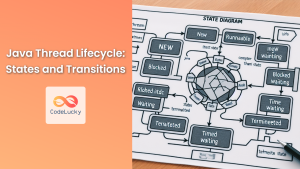
Java Thread Lifecycle: States and Transitions
Java's multithreading capabilities are a cornerstone of its power and flexibility. At the heart of this system lies the Java...