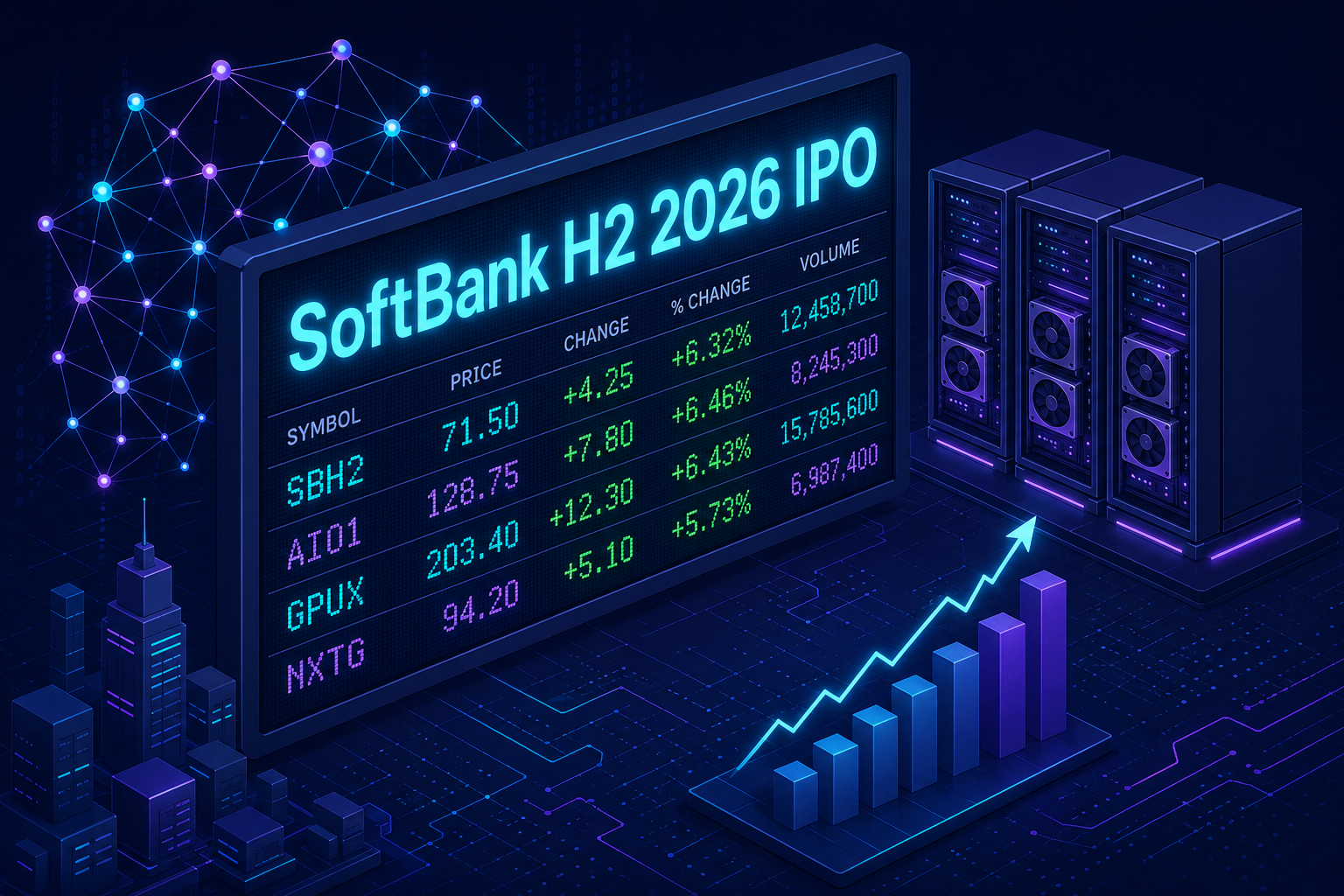
Imagine selling a chunk of your most valuable asset just to buy more of someone else’s most valuable asset — at a higher price. That is essentially what Masayoshi Son is preparing to do. Reports circulating in early 2026 suggest that SoftBank is preparing a second-half 2026 IPO, likely of one of its core operating units, with proceeds earmarked for an extraordinary expansion of its bet on OpenAI and a sprawling new AI infrastructure footprint. The SoftBank H2 2026 IPO is shaping up to be one of the most consequential capital-raising events of the decade, and it tells you a lot about where the next phase of the AI build-out is headed.
If you follow markets, build with large language models, or just want to understand who is funding the GPUs behind your favorite chatbot, this story matters. You are watching a single conglomerate try to become the financial backbone of frontier AI — and it is borrowing, listing, and selling stakes to do it.
What Is the SoftBank H2 2026 IPO, Exactly?
The SoftBank H2 2026 IPO refers to the planned public listing of a SoftBank-controlled entity, expected to price in the second half of calendar year 2026. The proceeds are intended to recapitalize the parent group so it can keep funding its enlarged stake in OpenAI, its share of the Stargate data-center program, and its strategic positions in chip design and robotics. In short: a public listing engineered to convert private holdings into liquid capital for AI deployment.
Several candidates have surfaced in market commentary — including additional secondary offerings of Arm Holdings, a re-listing of PayPay, or a fresh listing of a payments or AI-services subsidiary. SoftBank has not formally named the vehicle, but the strategic logic is consistent regardless of which one is chosen: monetize equity in something that already trades well, redeploy the cash into AI assets that do not yet trade publicly.
Why Son Needs the Cash Now
SoftBank’s commitments have ballooned faster than its on-hand liquidity. The group has publicly committed to a multi-tens-of-billions investment cadence into OpenAI, anchored by tranches that unlock as OpenAI hits restructuring and growth milestones. Layer on top the capital share of the Stargate data-center initiative — a multi-year, multi-hundred-billion-dollar partnership involving OpenAI, Oracle, and SoftBank — and the math becomes uncomfortable for any balance sheet, even one as storied as SoftBank’s.
You can think of it as a three-sided pressure:
- Equity outflows: direct purchases of OpenAI shares at progressively higher implied valuations.
- Capex outflows: SoftBank’s contribution to building hyperscale AI campuses across the U.S., the Gulf, and Asia.
- Debt servicing: margin loans against Arm and other holdings, which must be refinanced or unwound at favorable prices.
An IPO addresses all three at once: it raises fresh equity, validates a market price for a subsidiary, and gives the parent room to reduce loan-to-value ratios on its margin facilities.
The OpenAI Position: How Big Is It Really?
SoftBank has moved from being a late-stage investor to arguably OpenAI’s largest single shareholder. Across primary investments, secondary tender offers, and the post-restructuring share class, public reporting suggests SoftBank’s committed exposure to OpenAI exceeds $30 billion, with some tranches still pending milestone clearance. At OpenAI’s most recent secondary-market valuations, that stake is one of the largest single-asset positions in any public conglomerate’s portfolio.
Why pay up? Three reasons commonly cited by SoftBank watchers:
- Compounding moat: Son’s thesis treats OpenAI as the platform layer of the AI economy — analogous to owning a meaningful slice of early Google or Apple.
- Vertical integration: SoftBank also owns Arm, holds a stake in chip-design firms, and is expanding into AI agents through subsidiaries. OpenAI completes a stack.
- Optionality on AGI: If artificial general intelligence becomes commercially material this decade, the upside dwarfs the entry price.
That is the bull case. The bear case is concentration risk — a single private company representing an outsized share of a publicly traded conglomerate’s net asset value.
Stargate and the Infrastructure Side of the Bet
The Stargate program is the physical-world counterpart to the OpenAI equity check. Announced in early 2025 and expanded through 2025–2026, Stargate aims to deploy hundreds of billions of dollars across U.S. data-center campuses optimized for frontier model training and inference. SoftBank’s role is part-financier, part-strategic-anchor, with construction partners handling on-site delivery and OpenAI as the primary tenant.
To put the scale in perspective, here is a simplified comparison of recent AI infrastructure commitments:
| Initiative | Lead Backers | Disclosed Capital Envelope | Primary Tenant |
|---|---|---|---|
| Stargate (US) | SoftBank, OpenAI, Oracle, MGX | ~$500B over multi-year horizon | OpenAI |
| Microsoft Azure AI Capex (FY26) | Microsoft | ~$80B annual run-rate | OpenAI, enterprise |
| Google Cloud AI Capex (FY26) | Alphabet | ~$75B annual run-rate | Gemini, enterprise |
| Amazon AI Capex (FY26) | Amazon, Anthropic-aligned | ~$100B annual run-rate | Anthropic, AWS |
SoftBank does not have a hyperscaler’s recurring cloud revenue to fund these checks organically. That is the gap an IPO is designed to close.
How an IPO Actually Funds an AI War Chest
If you are newer to corporate finance, it helps to walk through the mechanics. When SoftBank lists a subsidiary, two cash flows can be unlocked:
- Primary proceeds: the subsidiary itself issues new shares and receives cash directly. SoftBank, as parent, only benefits indirectly through a stronger balance sheet at the listed entity.
- Secondary proceeds: SoftBank sells a portion of its existing shares into the IPO. This cash flows up to the parent immediately and is the most common AI-funding lever.
In addition, a successful listing creates a publicly quoted price for the remaining shares SoftBank holds. That market price can then be pledged as collateral for low-cost margin loans — effectively letting the parent borrow against unsold shares at attractive rates without triggering a taxable disposal.
The IPO is rarely the destination. It is the on-ramp to a much larger, longer-lived borrowing facility collateralized by the newly liquid stock.
Risks You Should Take Seriously
Optimism aside, the strategy carries real downside scenarios. A responsible read of the SoftBank H2 2026 IPO story has to weigh the following risks honestly.
Valuation Compression in AI Names
OpenAI’s secondary-market valuation has climbed quickly. If frontier model economics disappoint — for example, if inference costs fall faster than enterprise pricing — the implied value of SoftBank’s stake could re-rate downward, even as cash continues to flow out the door under existing commitments.
Margin-Loan Cascades
SoftBank has historically used its listed holdings as collateral. A sharp drawdown in the IPO’d subsidiary’s stock could trigger margin calls, forcing additional asset sales at inopportune times. This is the same mechanism that pressured the group during prior tech selloffs.
Regulatory and Geopolitical Friction
U.S. data-center build-outs touch grid capacity, water rights, and increasingly, national-security review. Cross-border chip flows tied to Arm and adjacent investments face export-control regimes that can change with little notice. Any of these can delay capex deployment relative to fundraising.
Concentration Risk for Public Shareholders
If you buy SoftBank or the new listing, you are implicitly buying a leveraged proxy on OpenAI’s outcome. That is fine if you want that exposure — but you should know it is what you own.
What This Means for Builders and Engineers
You may be wondering why a Tokyo-listed conglomerate’s IPO timing should affect your weekend project. It does, in two practical ways.
First, capacity. Stargate-class infrastructure expansion means more frontier-model training runs, more inference capacity, and — over time — likely lower unit costs for high-end model usage. If SoftBank’s IPO closes on schedule, the funding flywheel for these data centers tightens, accelerating availability of next-generation models through OpenAI’s API.
Second, model cadence. OpenAI’s release cadence has historically tracked compute availability. More compute, sooner, generally means earlier access to longer context windows, more capable reasoning models, and cheaper agentic workloads. Builders should plan architecture decisions — like whether to fine-tune a smaller model or rely on a frontier API — with the assumption that frontier capability and cost curves will continue to improve sharply through 2027.
If you want to design AI applications that age well in this environment, a quick reference architecture looks like this:
# Pseudocode-style sketch of a model-agnostic routing layer.
# Designed so you can swap providers as economics shift post-IPO buildout.

from typing import Protocol

class LLMProvider(Protocol):
    def complete(self, prompt: str, max_tokens: int) -> str: ...

class OpenAIProvider:
    def complete(self, prompt, max_tokens):
        # call OpenAI Responses API
        ...

class AnthropicProvider:
    def complete(self, prompt, max_tokens):
        # call Claude Messages API
        ...

def route(task_kind: str) -> LLMProvider:
    # Cheap, high-volume tasks go to a small, commodity model.
    # Reasoning-heavy tasks go to a frontier model.
    if task_kind in {"classify", "extract", "summarize_short"}:
        return OpenAIProvider()  # small-tier
    return AnthropicProvider()   # frontier-tier

answer = route("reason").complete("Plan a 3-step migration.", 1024)
The point of the snippet is not the specific providers — it is the abstraction. Treat the model layer as a substitutable resource. If SoftBank-funded capacity makes one frontier provider materially cheaper in 2027, your routing layer should be able to take advantage without a rewrite.
Reading the Filing When It Drops
When the formal prospectus lands later in 2026, focus on a few signals rather than the headline valuation.
- Use of proceeds language: look for explicit allocations to “AI investments,” “data-center infrastructure,” or “strategic equity investments.”
- Lock-up periods: longer parent-side lock-ups suggest SoftBank intends to hold and borrow against shares rather than sell quickly.
- Related-party transactions: any disclosed contracts between the listing entity and OpenAI, Arm, or Stargate vehicles will reveal how tightly the group’s bets are interlinked.
- Risk factors: the AI-exposure risk factors are where the bear case is written by the company’s own lawyers. Read them.
For background on how IPO mechanics translate into shareholder cash flows, the SEC’s primer on going public is a clear, jargon-light starting point. For broader context on SoftBank’s structure, the SoftBank Group overview on Wikipedia is a useful map of subsidiaries and historical exits.
Common Misconceptions About the Deal
A few ideas circulating online deserve a clean correction.
“SoftBank is taking OpenAI public.” No. The IPO under discussion is of a SoftBank-controlled entity, not OpenAI. OpenAI’s own corporate restructuring is a separate process with its own timeline.
“The IPO will fund Stargate by itself.” Unlikely. Stargate’s capital envelope is far larger than any single IPO can cover. The listing is one funding lever among debt issuance, partner contributions, and customer prepayments.
“This locks in SoftBank as the dominant AI investor.” It strengthens the position, but Microsoft, Google, Amazon, and sovereign funds are deploying comparable or larger sums. SoftBank’s edge is concentration and speed of decision-making, not absolute capital scale.
Frequently Asked Questions
When exactly will the SoftBank H2 2026 IPO price?
No formal date has been confirmed as of mid-2026. “Second half” implies anywhere from July through December 2026. Tokyo and U.S. listings typically signal pricing windows two to four weeks before the actual offering date through preliminary prospectus filings.
Which subsidiary is most likely to be listed?
Market speculation centers on a payments-focused entity such as PayPay, an additional Arm secondary tranche, or a newly carved-out AI-services unit. SoftBank has not officially confirmed the vehicle, and the choice will depend on market conditions closer to the listing window.
How does this affect OpenAI users and developers?
Indirectly but meaningfully. More committed capital flowing into OpenAI and its Stargate infrastructure typically translates into faster model releases, larger context windows, and improving price-per-token economics over the following 12 to 24 months. It does not change OpenAI’s API contracts or pricing in the short term.
Should retail investors participate in the IPO?
That is a personal financial decision and depends on your risk tolerance, time horizon, and existing AI exposure. The honest framing is that any SoftBank-linked listing in 2026 is a leveraged bet on AI infrastructure economics. If you already hold significant AI exposure through index funds or single-name tech stocks, additional concentration may not be ideal. Consult a licensed advisor before acting.
What happens if the IPO is delayed or pulled?
SoftBank has alternative levers — additional margin loans, asset sales, or debt issuance — but each is more expensive or dilutive than a successful equity listing. A delay would likely compress the pace of the group’s incremental AI commitments rather than cancel them outright.
How does Stargate differ from a normal cloud build-out?
Stargate is purpose-built for frontier AI training and inference, with site selection optimized for power availability and water for cooling. Traditional hyperscale data centers serve general cloud workloads; Stargate campuses are anchored by a single primary tenant — OpenAI — and engineered around large-scale GPU clusters from the outset.
Conclusion
The SoftBank H2 2026 IPO is more than a corporate finance event. It is the moment Masayoshi Son tries to convert decades of conglomerate-building into the single largest concentrated bet on artificial intelligence ever made by a public company. If it works, SoftBank ends up as the financial spine of a generation of AI infrastructure, with an outsized claim on OpenAI’s upside. If it stumbles, the same concentration becomes the story’s villain rather than its hero.
For builders, the takeaway is to design systems that benefit from cheaper, more capable frontier models without betting on any single provider. For investors, read the prospectus carefully when it lands and treat the listing for what it is — a leveraged proxy on AI economics, not a diversified tech holding. And for everyone watching the AI race, the SoftBank H2 2026 IPO will be one of the clearest signals yet of how much capital the market is willing to commit to the thesis that frontier intelligence is worth almost any price.