K-Means Clustering is a foundational unsupervised learning algorithm widely used in machine learning and data science for grouping similar data points into clusters. Unlike supervised algorithms, K-Means does not require labeled data, making it ideal for discovering hidden patterns and structures in datasets. This article offers a detailed explanation of the K-Means algorithm, its working principles, mathematical formulation, and step-by-step examples with visual outputs. You will also find interactive diagrams and practical insights to enhance understanding.
What is K-Means Clustering?
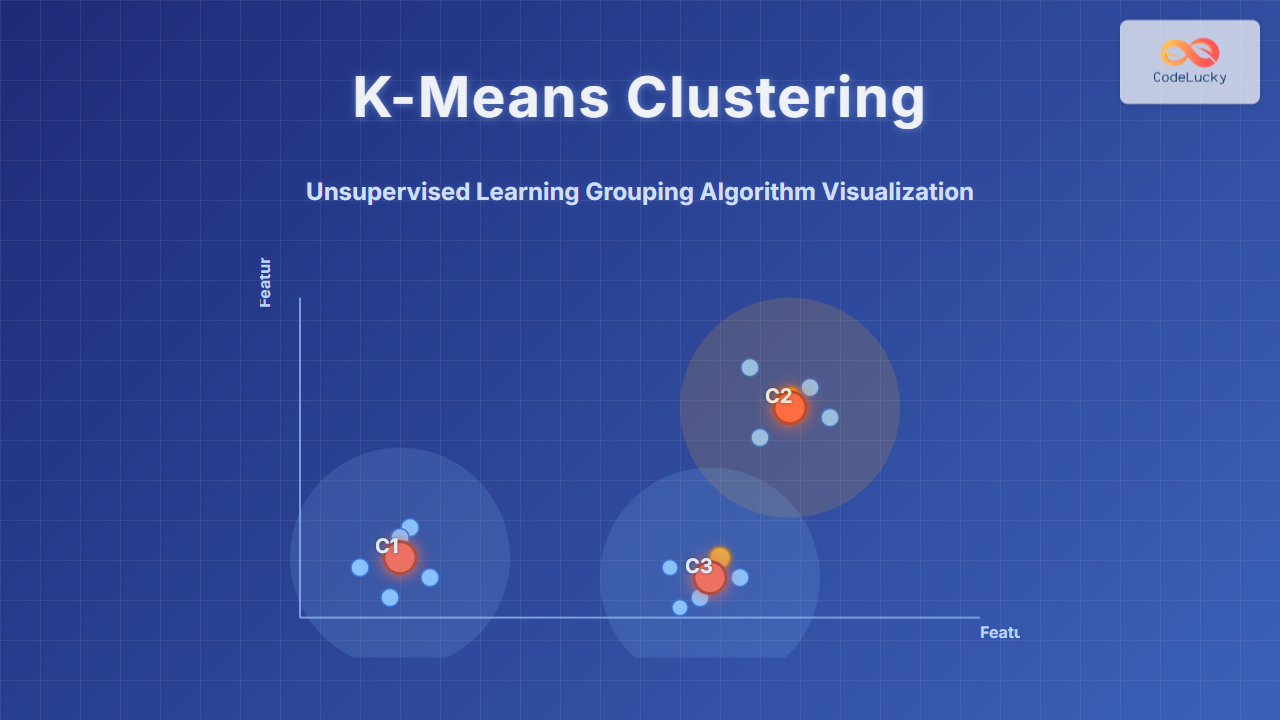
K-Means Clustering aims to partition n data points into k distinct clusters, where each data point belongs to the cluster with the nearest mean or centroid. It iteratively minimizes the variance within each cluster, thus grouping data points that are more similar to each other than to points in other clusters.

How K-Means Works: Step-by-Step
- Choose the number of clusters,
k. - Initialize centroids by randomly selecting
kpoints from the dataset or by some heuristic. - Assign each data point to the nearest centroid based on a distance metric (usually Euclidean distance).
- Recalculate centroids by averaging all points assigned to each cluster.
- Repeat steps 3 and 4 until centroids no longer move significantly or a maximum number of iterations is reached.
Mathematical Formulation
The objective of K-Means is to minimize the within-cluster sum of squares (inertia):
J = ∑i=1k ∑x ∈ Ci ||x - μi||2Where:
Ciis the set of points in clusteriμiis the centroid of clusteri||x - μi||2is the squared Euclidean distance between pointxand centroidμi
Choosing K: The Number of Clusters
Determining the best value of k requires evaluation techniques such as:
- Elbow Method: Plot the inertia across different values of
k. The “elbow” point where inertia starts to diminish slowly is a good choice. - Silhouette Score: Measures how well points fit within their clusters versus others.
Example: K-Means Clustering with 2D Points
Consider the following points plotted on a 2D plane:
- Points: (1,2), (1,4), (1,0), (10,2), (10,4), (10,0)
- We want to cluster these points into
k=2groups.
Step 1: Initialize centroids randomly:
- Centroid 1 at (1,2)
- Centroid 2 at (10,4)
Step 2: Assign points to nearest centroid:
- Cluster 1: (1,2), (1,4), (1,0)
- Cluster 2: (10,2), (10,4), (10,0)
Step 3: Update centroids:
- Centroid 1: Average of (1,2), (1,4), (1,0) → (1, 2)
- Centroid 2: Average of (10,2), (10,4), (10,0) → (10, 2)
Step 4: Reassign points as centroid positions barely change, clusters stabilize.
Interactive Visual Explanation
Try modifying the initial centroid positions and the value of k interactively in your own environment to observe how clustering results vary. This helps concretize the iterative nature of the algorithm and the effect of initialization.
K-Means Clustering Use Cases
- Market Segmentation: Identifying customer groups with similar behaviors.
- Image Compression: Reducing the number of colors in images by clustering pixels.
- Document Clustering: Grouping similar textual documents for topic discovery.
Advantages and Limitations
| Advantages | Limitations |
|---|---|
| Simple implementation and fast convergence. | Requires specifying k upfront, which may not be intuitive. |
| Works well for spherical clusters with similar sizes. | Sensitive to initial centroid placement and outliers. |
| Scales well to large datasets. | Not suitable for clusters of varying shapes and densities. |
Conclusion
K-Means Clustering remains a fundamental tool in the unsupervised learning toolkit due to its simplicity, efficiency, and effectiveness for many practical applications. Understanding its iterative centroid update process and the role of parameters like the number of clusters empowers data scientists to unlock meaningful group structures from unlabeled data. Experimenting with visualizations and cluster evaluation methods further enhances its utility in real-world projects.
By mastering K-Means, one gains a powerful algorithm to segment data intuitively and apply it confidently to diverse domains from marketing to image analysis.