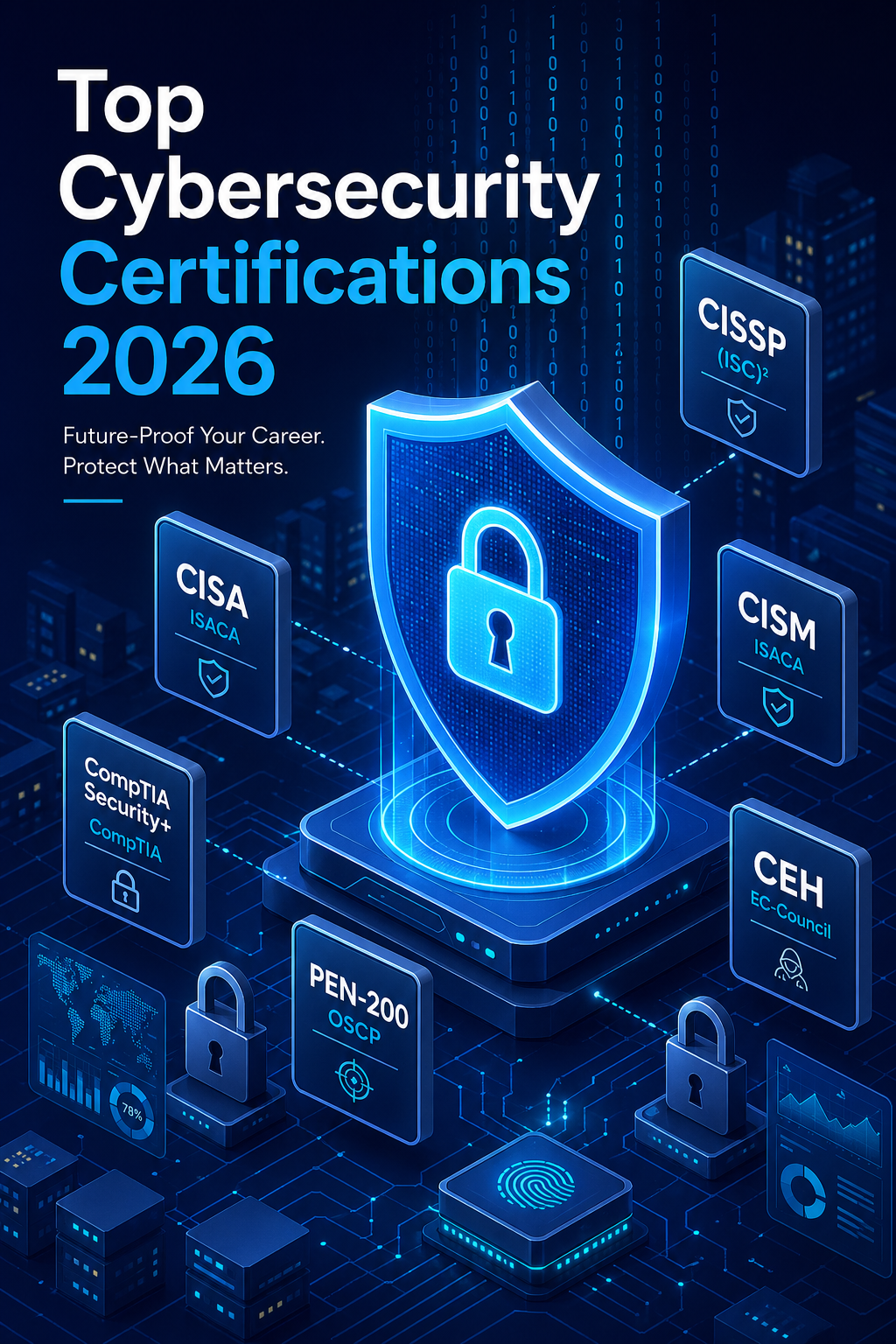
A senior penetration tester in Austin earns more than most surgeons in their first decade of practice. A cloud security architect in Berlin pulls in roughly twice the median software engineer salary. The pattern is hard to miss: the right credential at the right time can rewrite your earning curve. The cybersecurity certifications that pay six figures in 2026 are not just resume decorations — they are gatekeepers to a market where demand still wildly outpaces supply, with millions of unfilled roles globally.
If you are weighing where to invest your next 200 hours of study, this guide ranks the ten most lucrative credentials, what they actually test, who they are for, and the realistic salary bands you can negotiate with each one in your back pocket.
Why Cybersecurity Certifications Still Matter in 2026
Hiring managers are flooded with applicants who claim familiarity with firewalls, SIEM tools, and zero-trust architectures. A vendor-neutral or vendor-specific cert is the cheapest signal a recruiter has that a candidate can actually do the work. It compresses a forty-minute technical screen into a single line on a resume.
A cybersecurity certification is a third-party validated credential that confirms a professional has demonstrated specific knowledge, skills, and ethical commitments in defending systems, networks, or data. Most certifications require passing a proctored exam, and many also require documented work experience, continuing education credits, and a code-of-ethics agreement to maintain active status.
The credentials below all clear three bars: median salaries above $100,000 USD in mature markets, sustained employer demand on platforms like LinkedIn and Indeed, and recognition from the U.S. Department of Defense 8140 baseline certification list or equivalent international frameworks.
How We Ranked the Top Cybersecurity Certifications
Salary data alone produces misleading lists. We weighted four factors:
- Median compensation across U.S., U.K., and EU markets, drawn from public job-board aggregators and certifying-body surveys.
- Job-posting volume — how often hiring managers explicitly request the credential.
- Career ceiling — does this cert open doors to director, CISO, or principal-architect roles, or does it cap at mid-level?
- Difficulty-to-payoff ratio — a $300 exam that unlocks a $40,000 raise scores higher than a $5,000 boot camp with marginal lift.
With that lens, here is the 2026 ranking.
1. CISSP — Certified Information Systems Security Professional
The CISSP, issued by ISC2, is the gold standard for security generalists who want to move into management. It covers eight domains, from security architecture to software development security, and requires five years of paid full-time experience to be fully credentialed.
- Median salary (U.S., 2026): $145,000 – $175,000
- Exam cost: ~$749
- Best for: Security managers, architects, consultants, aspiring CISOs
The CISSP is less about what you can hack and more about how you would design a control framework that survives a Big Four audit. Study accordingly.
2. OSCP — Offensive Security Certified Professional
If CISSP is the suit, the OSCP is the hoodie. The exam is a brutal 24-hour hands-on lab where you must compromise a series of machines and submit a professional penetration test report. There is no multiple choice. You either own the boxes or you do not.
- Median salary: $120,000 – $160,000 for offensive roles; senior red-team leads clear $200,000.
- Exam cost: ~$1,649 (includes lab access)
- Best for: Penetration testers, red teamers, exploit developers
The OSCP’s “Try Harder” reputation is earned. Most candidates need two attempts. But once you pass, you have a credential that hiring managers genuinely respect because it cannot be brain-dumped.
3. CCSP — Certified Cloud Security Professional
Cloud has eaten enterprise infrastructure, and securing it is a different discipline from on-prem defense. The CCSP, also from ISC2, validates skills in cloud architecture, data lifecycle security, platform and infrastructure security, and legal compliance across AWS, Azure, and Google Cloud.
- Median salary: $140,000 – $170,000
- Exam cost: ~$599
- Best for: Cloud security engineers, DevSecOps leads, cloud architects
4. CISM — Certified Information Security Manager
Issued by ISACA, the CISM is laser-focused on governance, risk management, and incident response from a leadership perspective. It is the cert you earn when you want to stop being the person who patches vulnerabilities and start being the person who decides what gets patched and why.
- Median salary: $150,000 – $180,000
- Exam cost: ~$760
- Best for: Security program managers, risk officers, compliance leads
5. CEH — Certified Ethical Hacker
The CEH from EC-Council is the most recognizable hacking cert by name, and it is on virtually every U.S. federal job posting that touches offensive security. The exam is multiple choice, with an optional practical component that adds credibility.
- Median salary: $105,000 – $135,000
- Exam cost: ~$1,199 with training
- Best for: SOC analysts moving into offensive roles, federal contractors
Be honest with yourself: CEH is broad and shallow. Pair it with OSCP or PNPT if you want to actually compete for senior pentesting roles.
6. CompTIA Security+ — The Foundation That Still Pays
Yes, Security+ is technically an entry-level cert. It also happens to satisfy DoD 8140 baseline requirements for a huge swath of U.S. government contracting jobs, many of which start in the low six figures with a clearance.
- Median salary (with clearance): $95,000 – $125,000
- Exam cost: ~$404
- Best for: Career switchers, government contractors, junior SOC analysts
7. GIAC GPEN / GCIH — The SANS Premium Tier
SANS courses are expensive — often $8,000 or more — but their GIAC certifications are deeply respected in incident response and penetration testing. GCIH (incident handler) and GPEN (penetration tester) consistently command premium salaries.
- Median salary: $140,000 – $170,000
- Exam cost: ~$2,499 standalone
- Best for: Incident responders, threat hunters, blue-team leads
8. AWS Certified Security – Specialty
If your organization runs on AWS — and a huge portion of the Fortune 500 does — this specialty cert proves you can lock down IAM, encryption, and network controls in production. It is one of the few vendor certs that consistently breaks six figures on its own.
- Median salary: $135,000 – $165,000
- Exam cost: ~$300
- Best for: AWS-focused security engineers, cloud auditors
9. CRTP / CRTO — Modern Red Team Credentials
The Certified Red Team Professional (Altered Security) and Certified Red Team Operator (Zero-Point Security) are newer entrants that have rapidly displaced legacy certs in the offensive space. They focus on Active Directory exploitation and Cobalt Strike-style operations against modern enterprise environments.
- Median salary: $130,000 – $190,000
- Exam cost: ~$249 – $499
- Best for: Senior red teamers, adversary emulation specialists
10. CISA — Certified Information Systems Auditor
The CISA sits at the intersection of security and audit. Big Four consulting firms, banks, and regulated industries pay handsomely for professionals who can both speak to engineers and satisfy regulators.
- Median salary: $115,000 – $150,000
- Exam cost: ~$760
- Best for: IT auditors, GRC analysts, compliance specialists
Side-by-Side Salary and Difficulty Comparison
| Certification | Median U.S. Salary | Exam Cost (USD) | Difficulty (1–5) | Primary Track |
|---|---|---|---|---|
| CISSP | $160,000 | $749 | 4 | Management / Architecture |
| OSCP | $140,000 | $1,649 | 5 | Offensive |
| CCSP | $155,000 | $599 | 4 | Cloud Security |
| CISM | $165,000 | $760 | 3 | Governance |
| CEH | $120,000 | $1,199 | 2 | Offensive (broad) |
| Security+ | $110,000 | $404 | 2 | Foundational |
| GCIH / GPEN | $155,000 | $2,499 | 4 | IR / Pentest |
| AWS Security Specialty | $150,000 | $300 | 3 | Cloud (vendor) |
| CRTP / CRTO | $160,000 | $349 | 4 | Red Team |
| CISA | $130,000 | $760 | 3 | Audit / GRC |
Building a Realistic Study Plan
Most candidates underestimate study time and overestimate retention. A 16-week plan is more reliable than a 6-week sprint for any of the four-or-five-difficulty certs above. Here is a simple Python tracker you can adapt — drop it into a script and log daily progress to keep yourself honest.
from datetime import date, timedelta

# Configure your target cert and exam date
cert_name = "CISSP"
exam_date = date(2026, 9, 15)
total_domains = 8
hours_per_domain = 25  # rough average

today = date.today()
days_left = (exam_date - today).days
study_days = max(days_left - 7, 1)  # leave a buffer week for review

target_hours = total_domains * hours_per_domain
hours_per_day = round(target_hours / study_days, 2)

print(f"Cert: {cert_name}")
print(f"Days until exam: {days_left}")
print(f"Total study hours needed: {target_hours}")
print(f"Hours per day to stay on track: {hours_per_day}")

# Flag unrealistic plans early
if hours_per_day > 3:
    print("Warning: schedule exceeds 3 hrs/day — consider postponing.")
The script computes how many study hours per day you actually need, then warns you if your timeline is unrealistic. Adjust total_domains and hours_per_domain for whichever cert you are pursuing. The “warning” threshold matters: sustained study above three hours daily on top of a job leads to burnout and poor retention.
Common Pitfalls That Cost People Six-Figure Offers
- Stacking certs without experience. Three certifications and zero hands-on hours raise red flags. Recruiters interview for skills, not paper.
- Ignoring soft skills. The CISSP and CISM in particular open doors to roles where you must explain risk to executives. If you cannot translate “lateral movement” to “business impact,” your ceiling is lower than your credentials suggest.
- Letting certs lapse. Most premium certifications require continuing professional education credits. Lose those, lose the cert, lose the salary band.
- Choosing prestige over fit. A red-team operator does not need CISA; a GRC analyst does not need OSCP. Map the cert to the job description, not the LinkedIn flex.
- Underestimating practical labs. OSCP, CRTO, and GIAC practical exams punish people who only studied theory. Spend at least 40% of prep time in labs like HackTheBox or TryHackMe.
How to Sequence Your Certifications for Maximum ROI
If you are early in your career, treat certs like a tech tree. A pragmatic three-stage path looks like this:
- Years 0–2 (Foundation): Security+ → CySA+ or CEH → first SOC analyst role.
- Years 2–5 (Specialization): Pick one track — OSCP/CRTO for offense, CCSP/AWS Security for cloud, GCIH for incident response.
- Years 5+ (Leadership): CISSP or CISM, then optionally CISA for audit-heavy industries.
This ordering aligns with how compensation curves actually rise. Skipping the foundation tier saves money on exams but often costs you the practical fluency that interviewers test for.
Frequently Asked Questions
Which cybersecurity certification pays the most in 2026?
On a pure median basis, CISM and CISSP lead the pack at $160,000–$180,000 in the U.S., because they qualify holders for management and architect-level roles. However, senior OSCP– and CRTO-credentialed red teamers in private industry frequently break $200,000 with bonuses, particularly in finance and Big Tech.
Can I land a six-figure role with no degree if I have certifications?
Yes, and it happens daily. Federal contractors, MSSPs, and many cloud-native employers care more about a clearance, Security+, and demonstrable lab work than a four-year degree. The catch: you usually still need 2–4 years of provable experience, even if it comes from home labs, bug bounties, or open-source contributions.
How long does it take to earn the CISSP?
Most candidates need 3–6 months of focused study, assuming they already have several years of security experience. Without that experience, you can still pass and become an “Associate of ISC2,” but you cannot use the CISSP designation until you log five years of qualifying full-time work.
Are vendor-specific certifications worth it compared to vendor-neutral ones?
Both have a place. Vendor-neutral certs (CISSP, CISM, CCSP) travel with you across employers and prove conceptual mastery. Vendor-specific certs (AWS Security Specialty, Azure SC-100) prove you can ship secure systems on the platform your employer actually uses. The highest-paid practitioners typically hold one of each.
Do cybersecurity certifications expire?
Almost all premium certs require renewal every three years through continuing professional education credits and an annual maintenance fee. Budget roughly 40 CPE credits per year and $100–$150 in fees per active credential to keep them in good standing.
Should I pursue CEH or OSCP first?
If you need a credential for a federal job posting that explicitly lists CEH, take it first. Otherwise, OSCP delivers significantly more interview leverage per dollar spent, because it proves practical exploitation skills rather than memorized terminology.
Conclusion
The cybersecurity certifications that pay six figures in 2026 are not a lottery ticket. They are a deliberate investment of money and study hours that, paired with hands-on experience, push your earning potential into territory most other tech tracks cannot match. The leaders — CISSP, OSCP, CCSP, CISM, and the modern red-team credentials — each open distinct lanes, so the right pick depends on whether your future self is happier in front of a terminal, a whiteboard, or a board of directors.
Pick one cert. Commit a realistic timeline. Pair it with lab time and a mentor if you can find one. Twelve months from now, you will either be in a stronger negotiating position or you will have stayed exactly where you are — and that choice is genuinely yours to make.