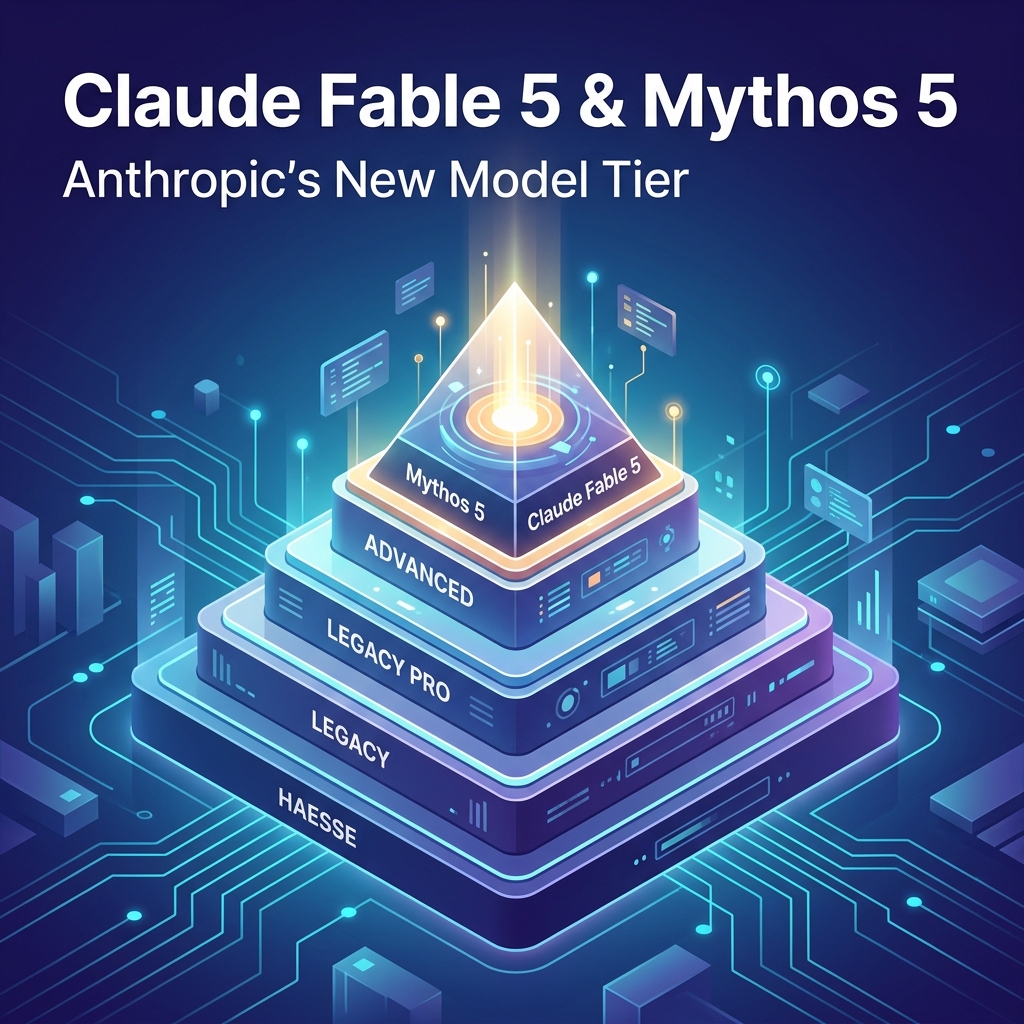
For the past few years, picking an Anthropic model meant choosing between three familiar names: Haiku for speed, Sonnet for balance, and Opus for maximum intelligence. That mental model just broke. With the release of Claude Fable 5 and Claude Mythos 5, Anthropic has introduced an entirely new tier — the Mythos class — that sits above Opus in capability and price. If you build with the Claude API, this changes how you think about model selection, cost planning, and even how you structure your requests.
The headline facts are simple: Claude Fable 5 is the first model in the Claude 5 family, it is Anthropic’s most intelligent generally available model, and it ships with API behavior that differs from the Opus line in ways that will break code if you swap the model ID blindly. Mythos 5 is the same underlying model offered without certain dual-use safety measures, but only to approved organizations. Everything else — pricing, context window, API surface — is identical between the two.
What Is Claude Fable 5?
Claude Fable 5 is Anthropic’s flagship AI model and the first release in the Claude 5 family. It belongs to a new Mythos-class tier above Claude Opus, designed for the most demanding reasoning and long-horizon agentic work. It offers a 1 million token context window, 128K output tokens, and always-on adaptive thinking.
That definition hides an important nuance: Fable 5 and Claude Mythos 5 share the same underlying model. The difference is access and safeguards. Fable 5 includes additional safety measures for dual-use capabilities — areas like advanced biology and most cybersecurity content — and is available to everyone through the standard API. Mythos 5 ships without those measures and is restricted to approved organizations through a program called Project Glasswing. Anthropic explains the split in its official Claude Fable 5 and Mythos 5 announcement.
Think of it like prescription versus over-the-counter medication. The active ingredient is the same; the difference is who can access it and what controls wrap around it. For the vast majority of developers, Fable 5 is the model you will actually use, so that is where this guide focuses.
The Mythos-Class Tier: Where Claude Fable 5 Fits
Anthropic’s lineup now has four tiers instead of three. Here is how the current models compare:
| Model | Model ID | Context Window | Max Output | Input / Output ($ per 1M tokens) |
|---|---|---|---|---|
| Claude Fable 5 | claude-fable-5 |
1M tokens | 128K | $10.00 / $50.00 |
| Claude Mythos 5 | claude-mythos-5 |
1M tokens | 128K | $10.00 / $50.00 (approved orgs only) |
| Claude Opus 4.8 | claude-opus-4-8 |
1M tokens | 128K | $5.00 / $25.00 |
| Claude Sonnet 4.6 | claude-sonnet-4-6 |
1M tokens | 64K | $3.00 / $15.00 |
| Claude Haiku 4.5 | claude-haiku-4-5 |
200K tokens | 64K | $1.00 / $5.00 |
Notice the pricing jump: Fable 5 costs exactly twice as much as Opus 4.8 per token. That is a deliberate signal. Anthropic is not positioning Fable 5 as the new default — Opus 4.8 remains the recommended workhorse for most production workloads. The Mythos class exists for problems where the extra intelligence is genuinely worth paying for: long autonomous coding runs, complex multi-step research, end-to-end enterprise deliverables, and agentic systems that coordinate parallel sub-agents over hours. The full lineup is documented in the Anthropic models overview.
API Changes in Claude Fable 5 You Need to Know
This is where developers get burned. Claude Fable 5 keeps the same Messages API and tool-use patterns as Opus 4.8, but several parameters that worked before now return errors. If your code targets Opus and you change only the model string, expect 400 responses.
Thinking Is Always On
Extended thinking is no longer something you enable — it is a permanent part of how the model works. Omit the thinking parameter entirely (or pass {"type": "adaptive"}, which is also accepted). Any other configuration is rejected: both {"type": "disabled"} and the old {"type": "enabled", "budget_tokens": N} form return a 400 error. You control reasoning depth with the effort setting instead:
import anthropic

client = anthropic.Anthropic()

# No thinking parameter needed -- thinking is always on for Fable 5.
# Depth is controlled via output_config.effort instead of token budgets.
response = client.messages.create(
    model="claude-fable-5",
    max_tokens=16000,
    output_config={"effort": "high"},  # low | medium | high | xhigh | max
    messages=[
        {"role": "user", "content": "Design a rate limiter for a multi-tenant API."}
    ],
)

for block in response.content:
    if block.type == "text":
        print(block.text)
This example shows the minimal correct request shape for Fable 5. The effort parameter replaces the old thinking budget as your primary intelligence-versus-cost lever: high is a strong default, xhigh suits demanding coding and agentic work, and low or medium handle routine tasks — often still outperforming older models at their maximum settings.
Reasoning Summaries Instead of Raw Chain of Thought
Fable 5 never returns its raw chain of thought. Responses include regular thinking blocks, but by default their text is empty. If your application surfaces reasoning to users, opt into readable summaries with thinking={"type": "adaptive", "display": "summarized"}. Either way, when you continue a conversation on the same model, pass the thinking blocks back exactly as you received them — editing or reconstructing them causes the API to reject the request.
Other Parameters That Now Fail
temperature,top_p, andtop_kare removed — sending any of them returns a 400. Steer behavior through prompting instead.- Assistant prefill (ending your messages with a partial assistant turn to force an output shape) is not supported. Use structured outputs via
output_config.formatwith a JSON schema, or a system prompt instruction. - Fable 5 requires 30-day data retention. Organizations configured for zero data retention receive a 400 error on every request, even with a perfectly valid payload — check your retention settings before debugging request bodies.
Handling the New Refusal Stop Reason
Because Fable 5 carries safety classifiers targeting dual-use domains, a request can be declined even though the HTTP call itself succeeds. The response comes back as a normal 200 with stop_reason: "refusal" and a stop_details object describing the category. A refusal before any output has an empty content array and is not billed; a mid-stream refusal bills the tokens already streamed, and you should discard the partial output.
Code that reads response.content[0] unconditionally will crash on refused requests. Always branch on stop_reason first:
response = client.messages.create(
    model="claude-fable-5",
    max_tokens=16000,
    messages=[{"role": "user", "content": user_prompt}],
)

if response.stop_reason == "refusal":
    # Pre-output refusal: content is empty and nothing is billed.
    # Mid-stream refusal: discard the partial output.
    category = response.stop_details.category if response.stop_details else None
    print(f"Request declined (category: {category})")
else:
    print(response.content[0].text)
This guard makes refusals a handled state rather than an unhandled exception. For production systems, Anthropic also offers a beta server-side fallbacks parameter: you list a substitute model such as claude-opus-4-8, and if the classifiers decline the request, the API retries it on the fallback model in the same round trip. That matters because benign work adjacent to restricted domains — legitimate security tooling, life-sciences research — can occasionally trigger false positives, and a configured fallback keeps your users from seeing an error.
Claude Mythos 5 and Project Glasswing
Claude Mythos 5 deserves its own explanation because the name causes confusion. It is not a different model, a bigger model, or a preview of something newer. It is the same model as Fable 5, with identical pricing, limits, and API surface — minus the additional dual-use safety measures, and accessible only through Project Glasswing, Anthropic’s program for approved organizations. It succeeds the earlier invitation-only Claude Mythos Preview.
Who needs it? Organizations doing legitimate work in domains the Fable 5 classifiers restrict — think authorized security research or advanced life-sciences applications — where false-positive refusals would make the standard model impractical. For everyone else, the practical answer is straightforward: use claude-fable-5. If your code references the old claude-mythos-preview ID, migrate to claude-mythos-5 if you participate in Project Glasswing, or to claude-fable-5 if you do not.
Rule of thumb: if you have to ask whether you have Mythos 5 access, you don’t. Build against
claude-fable-5and design your refusal handling well — that covers virtually every real-world use case.
Migrating to Claude Fable 5: Mistakes to Avoid
Upgrading from Opus is mostly mechanical, but each of these mistakes shows up repeatedly in early migrations. The official Claude model migration guide covers the full checklist; these are the ones that bite hardest.
- Leaving old thinking config in place. Any
budget_tokensplumbing or explicit{"type": "disabled"}must be deleted, not just ignored. Both return 400 errors on Fable 5. - Not planning for longer turns. Single requests on hard tasks at high effort can run many minutes — a 15-minute request is normal when the model gathers context, builds, and verifies its own work. Use streaming, generous timeouts, and asynchronous check-ins rather than blocking a user-facing thread on one call.
- Skipping the cost re-baseline. Fable 5 uses the same tokenizer as Opus 4.8, so token counts are roughly unchanged from Opus 4.7/4.8 — but the per-token price doubles. Re-run your cost projections rather than assuming a flat 2x, since higher effort up front often reduces total turn count on agentic work.
- Over-prescriptive prompts. Prompts written for older models — step-by-step scaffolding, aggressive “CRITICAL: YOU MUST” instructions — often reduce Fable 5 output quality. State the goal and constraints; let the model plan. A/B test your existing prompts with the scaffolding removed.
- Treating it as the default upgrade. For a routine “move to the latest model” request, Opus 4.8 remains the right target. Reach for Fable 5 when the task demands it, not because it is newest.
When Should You Choose Claude Fable 5 Over Opus 4.8?
A practical decision framework, based on how the two tiers are positioned:
- Choose Fable 5 for long-horizon autonomous agents, overnight coding runs, complex multi-source research, first-shot implementations of well-specified systems, and orchestrators coordinating parallel sub-agents. Its strongest gains are on work above what prior models could complete at all.
- Stay on Opus 4.8 for interactive chat, standard code assistance, classification and extraction pipelines, and any high-volume workload where the per-token price matters. It is half the cost and still exceptionally capable.
- Use Sonnet 4.6 or Haiku 4.5 for high-throughput production traffic and simple, speed-critical tasks — nothing about the new tier changes that calculus.
One under-appreciated detail: lower effort settings on Fable 5 still perform very well, often exceeding the maximum-effort performance of previous-generation models. If you adopt it, sweep low through xhigh on your own evaluation set rather than reflexively maxing the dial — sometimes medium delivers equal results in less time and at lower cost.
Frequently Asked Questions About Claude Fable 5 and Mythos 5
What is the difference between Claude Fable 5 and Claude Mythos 5?
They share the same underlying model, pricing, and API surface. Fable 5 includes additional safety measures for dual-use capabilities and is generally available; Mythos 5 omits those measures and is accessible only to approved organizations through Project Glasswing.
How much does Claude Fable 5 cost?
Claude Fable 5 costs $10 per million input tokens and $50 per million output tokens — exactly double Claude Opus 4.8. Prompt caching and the Batches API (50% discount on asynchronous workloads) can significantly reduce effective costs for repeated or non-latency-sensitive work.
Is Claude Fable 5 better than Claude Opus 4.8?
It is more capable, particularly on long-horizon agentic work, demanding reasoning, and tasks requiring sustained autonomy. But “better” depends on your workload: Opus 4.8 remains the recommended default for most production use, and the doubled price means Fable 5 should earn its place on a per-task basis.
Can I disable extended thinking on Claude Fable 5?
No. Thinking is always on. Sending thinking: {"type": "disabled"} returns a 400 error — omit the parameter entirely. You control how deeply the model reasons with output_config.effort, from low up to max.
What is the context window for Claude Fable 5?
One million tokens, which is also the default — there is no separate long-context opt-in or premium. Maximum output is 128K tokens per request, though the SDKs require streaming for outputs that large to avoid HTTP timeouts.
Do I need to rewrite my prompts when migrating from Opus?
Often, yes — but by removing things rather than adding them. Prompts tuned for older models tend to be too prescriptive for Fable 5 and can reduce output quality. Test your workload with step-by-step scaffolding stripped out, stating goals and constraints instead of enumerating steps.
Conclusion
Claude Fable 5 and Mythos 5 mark a genuine structural change in Anthropic’s lineup: a Mythos-class tier above Opus, priced at $10/$50 per million tokens, built for work that previous models could not finish on their own. For developers, the takeaways are concrete. Use the exact ID claude-fable-5, delete all thinking configuration and sampling parameters, handle the stop_reason: "refusal" case before reading response content, confirm your organization meets the 30-day data retention requirement, and design for requests that may run minutes rather than seconds.
Just as importantly, resist the urge to upgrade everything. Claude Fable 5 is a specialist’s tool for the hardest problems in your stack — long autonomous runs, deep research, complex agentic orchestration — while Opus 4.8, Sonnet 4.6, and Haiku 4.5 continue to cover the everyday tiers at a fraction of the cost. Pick the model per workload, run an effort sweep on your own evaluations, and let measured results — not the version number — decide where the new tier earns its keep.