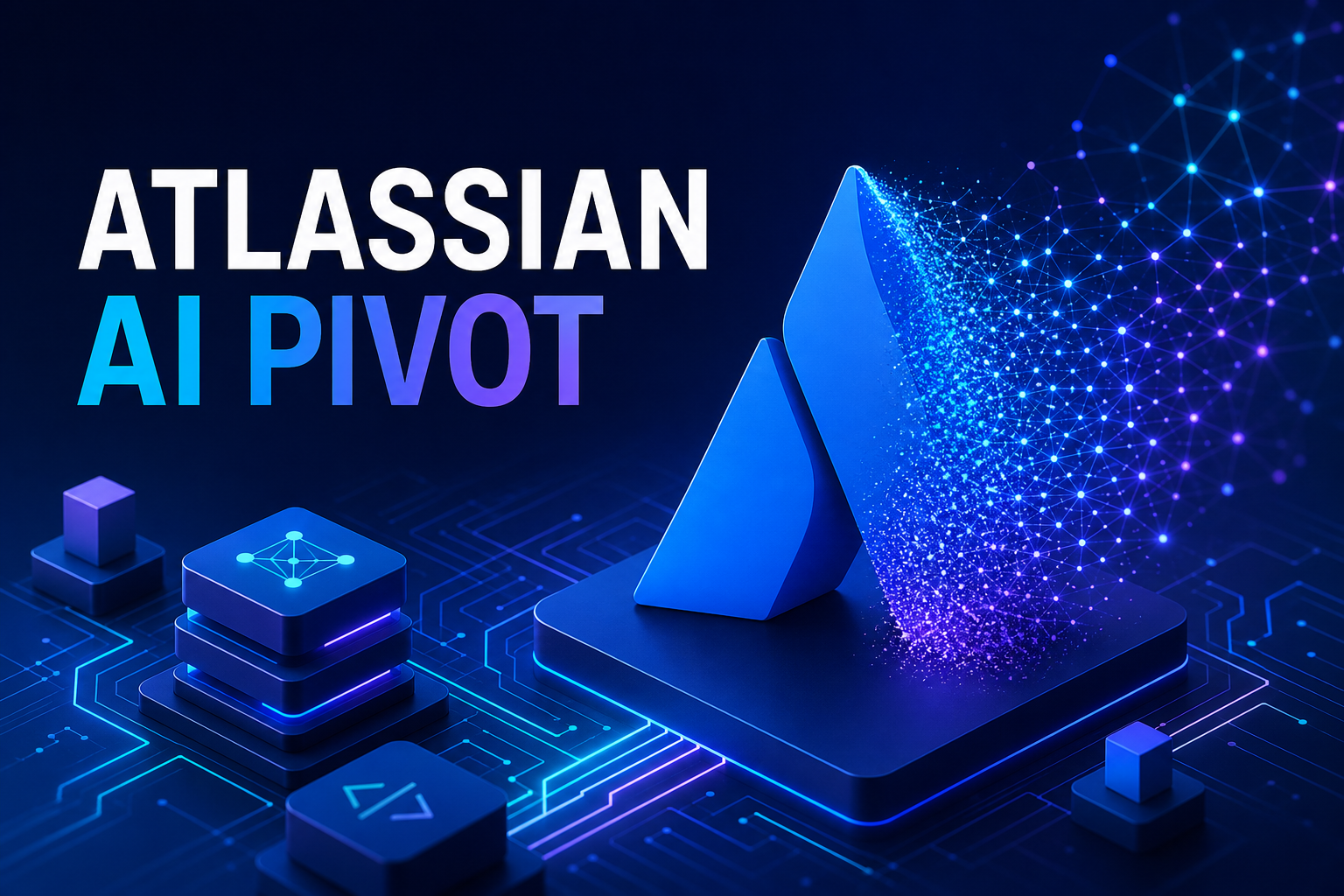
If you opened Jira this morning expecting business as usual, the headlines told a different story. Atlassian — the Australian software giant behind Jira, Confluence, Bitbucket, and Trello — just announced one of the most consequential restructurings in its 24-year history: a roughly 10% workforce reduction and the replacement of its long-serving Chief Technology Officer, all framed as a single, aggressive bet on artificial intelligence.
The Atlassian AI pivot isn’t a quiet pivot. It’s a public re-architecture of how a company that defines modern team collaboration plans to survive the post-LLM era. For the roughly 1,500 employees affected, for engineering leaders who depend on Atlassian’s stack, and for every SaaS vendor watching from the sidelines, this is a signal worth understanding in detail.
Below, you’ll get a clear breakdown of what changed, why it changed now, what it means for Jira and Confluence users, and what other enterprise software companies are likely to do next.
What Atlassian Actually Announced
The Atlassian AI pivot is a coordinated set of moves rather than a single layoff event. In a memo to staff and an investor update, co-CEOs Mike Cannon-Brookes and Scott Farquhar outlined three simultaneous changes: a workforce reduction of approximately 10%, the departure of CTO Rajeev Rajan, and the elevation of a new technical leadership team focused on AI-native product development.
In plain terms: Atlassian is reorganizing around AI agents — particularly its Rovo platform — and saying out loud that the previous shape of the engineering organization isn’t the right shape for what comes next.
Here is the high-level snapshot:
- Workforce impact: ~10% of roles eliminated, weighted toward middle management, traditional QA, support tiers, and overlapping product teams.
- Leadership change: CTO replaced; the new technical lead is expected to consolidate AI engineering, platform, and developer experience under one organization.
- Product focus: Accelerated investment in Rovo, agent-based workflows, and deeper LLM integration into Jira and Confluence.
- Geographic footprint: Reductions span the United States, Australia, India, and Poland — Atlassian’s distributed-by-default model means no single hub is shielded.
“We aren’t shrinking because the business is weak. We’re reshaping because the work is changing.” — paraphrased from the leadership memo circulated internally.
Why Now? The Forces Behind the AI Pivot
To understand the timing, you need to understand the squeeze that every horizontal SaaS company is currently feeling. Three forces collided in 2025 and crested in 2026.
1. AI Is Eating the Middle Layer of SaaS
Tools like Jira and Confluence have always sold a tradeoff: they impose structure on chaotic team workflows in exchange for predictability. Large language models break that tradeoff. An AI agent can read a Slack thread, summarize the decision, draft a Jira ticket, and update a Confluence page automatically. The “structure tax” that justified seat-based pricing for two decades is suddenly negotiable.
2. Customers Are Demanding Outcomes, Not Seats
Procurement teams at large enterprises now ask vendors a sharp question: If your AI does the work, why am I paying per human user? Atlassian’s leadership has hinted at a future pricing model that mixes seats with consumption — measured by AI agent actions, automations executed, or workflows completed. That requires a very different cost structure than today’s organization supports.
3. Cloud Migration Is Almost Done
Atlassian’s multi-year push off Server and Data Center toward Cloud is winding down. The teams built to handle that migration — release engineering, hybrid support, on-prem compatibility — are no longer the bottleneck. Many of the eliminated roles trace back to functions that were essential during the migration era and redundant in the AI era.
Who Was Cut, and Who Wasn’t
One of the more telling details of the Atlassian AI pivot is the shape of the workforce reduction, not just the size. Based on the public memo and reporting from Reuters and Bloomberg, the cuts skew heavily toward roles that AI is starting to absorb.
| Function | Direction | Why |
|---|---|---|
| Tier 1 / Tier 2 Support | Sharp reduction | Rovo and LLM-based deflection now resolve a large share of routine tickets. |
| Manual QA | Reduction | Generative test creation and self-healing test suites reduce headcount needs. |
| Middle management | Significant flattening | Fewer layers between IC engineers and product decisions. |
| Technical writing | Partial reduction | AI-assisted documentation pipelines. |
| AI/ML engineering | Hiring | Agent infrastructure, evaluations, model orchestration. |
| Platform / SRE | Hiring | Scaling agent workloads, GPU capacity planning. |
| Solutions / Field engineering | Hiring | Helping enterprise customers deploy agents safely. |
The pattern matches what you’ve seen at Salesforce, Microsoft, and Workday over the past 18 months: net layoffs, gross hiring. The headline number is shrinkage, but the company is actively rebuilding around AI-native skill sets.
The CTO Change: More Than a Personnel Move
Replacing a CTO during a 10% reduction is rarely cosmetic. In Atlassian’s case, the change reflects a deliberate split between two engineering philosophies.
The outgoing technical leadership presided over the multi-tenant cloud rebuild — a multi-year project that successfully moved millions of users from on-prem deployments onto Atlassian Cloud. That was a distributed systems problem.
The incoming leadership is being asked to solve an agent orchestration problem: how do you let thousands of AI agents read, write, and reason across a customer’s Jira, Confluence, Bitbucket, and connected SaaS tools without breaking governance, security, or trust? Those are different muscles. Different tooling. Different hiring profiles.
What the New CTO’s Mandate Likely Includes
- Unifying Rovo, Jira AI, and Confluence AI under a single agent platform.
- Building enterprise-grade evaluations and safety rails for agent actions.
- Reducing inference costs through smarter routing across frontier and small models.
- Opening Rovo to third-party developers via a stable agent SDK.
- Aligning the engineering org around outcomes (jobs done) rather than products (Jira, Confluence).
What This Means for Jira and Confluence Users
If you’re an engineering manager, scrum master, or platform owner, the practical question is: does my workflow break? The short answer is no — but the long answer is that the product surface you’ve trained your team on is going to evolve quickly over the next 12–18 months.
Expect three concrete shifts in your daily Atlassian experience.
1. Jira Becomes Conversational
The classic Jira workflow — open ticket, set fields, assign, transition — is being wrapped in natural language. You’ll increasingly tell Jira what happened, and an agent will produce the structured ticket. Here’s a simplified example of how the new Rovo-style agent action might be invoked from a custom automation:
// Example: trigger a Rovo agent from a Jira automation rule
// (illustrative shape — actual SDK names may vary)
const result = await rovo.invokeAgent({
  agent: "ticket-summarizer",
  context: {
    issueKey: "PROJ-1423",
    includeComments: true,
    includeLinkedIssues: true
  },
  output: {
    format: "markdown",
    targetField: "customfield_10250" // "AI Summary" field
  }
});

// The agent reads the issue, related tickets, and comment history,
// then writes a concise summary back into the AI Summary field.
console.log(result.status); // "completed"
The code above shows the conceptual shape of an agent invocation: you give the agent a scope, it reads context across the workspace, and it writes structured output back into Jira. The important detail isn’t the syntax — it’s the model. Agents are first-class citizens in workflows, not bolted-on chatbots.
2. Confluence Becomes a Knowledge API
Confluence pages have always been documents written for humans. Going forward, they’re being rebuilt as documents written for both humans and agents. That means structured headings, machine-readable decisions, and stable anchors that an LLM can cite reliably.
3. Pricing and Packaging Will Shift
You should plan for a hybrid pricing model — seats for humans, credits or actions for AI agents. Procurement cycles in 2026 and 2027 will look very different from the flat per-seat math you’re used to.
How to Read This as a Developer or Engineering Leader
The Atlassian AI pivot is a useful case study even if you’ve never opened Jira. It tells you what large SaaS vendors believe about the next three years.
- Headcount planning is decoupling from revenue growth. Atlassian’s revenue is still growing. The cuts are not a financial rescue — they’re a reshaping. Expect more “growing but smaller” announcements across SaaS.
- The middle of the workflow stack is the most exposed. Tools that exist to translate human intent into structured records are precisely where AI agents add the most leverage.
- Platform companies are racing to own the agent runtime. Whoever owns the place where agents execute the work — not just chat about it — owns the next decade.
Common Misconceptions About the Atlassian AI Pivot
A pivot of this size attracts a lot of bad takes. A few worth correcting.
“Atlassian Is in Trouble”
It isn’t. The company is profitable and growing. The pivot is offensive, not defensive — a bet that the cost of not reshaping the org is higher than the cost of doing it now.
“AI Is Replacing All These Jobs”
Not exactly. AI is replacing tasks, and Atlassian is rebuilding around the tasks that remain valuable: governance, integration, customer success, and platform engineering. Net headcount drops; the composition shifts.
“Jira Is Going Away”
The opposite. Jira is being repositioned as the system of record that AI agents read from and write to. If anything, Jira’s strategic importance inside Atlassian is going up, not down.
Comparison: Atlassian vs. Other Recent AI Pivots
Atlassian isn’t alone, but the shape of its pivot is distinct. Here’s how it compares to two adjacent moves.
| Company | Layoff Scale | Leadership Change | AI Strategy | Risk Profile |
|---|---|---|---|---|
| Atlassian (2026) | ~10% | CTO replaced | Rovo agents across Jira/Confluence | Medium — bets on owning the agent runtime |
| Salesforce (2024–25) | Multiple rounds, ~10% cumulative | None at CTO level | Agentforce | Medium — enterprise relationships cushion the bet |
| Workday (2025) | ~8.5% | None at CTO level | HR-specific agents | Lower — narrower domain |
Atlassian’s bet is the most aggressive of the three because it pairs the workforce reshaping with a top-of-the-house technical leadership change. That signals a belief that the architecture of the next product generation needs different opinions at the top.
What Other SaaS Vendors Are Likely to Do Next
If you’re tracking this from outside Atlassian, watch for these signals over the next two quarters:
- More net-down, gross-hiring announcements that emphasize “AI-native operating models.”
- Public agent SDKs from at least two more horizontal SaaS vendors.
- Pricing experiments that introduce action-based or outcome-based credits alongside seat licenses.
- Consolidation of duplicated product lines that AI now blurs the boundaries between (e.g., docs vs. wiki vs. tickets).
Frequently Asked Questions
How many employees did Atlassian lay off?
Atlassian eliminated approximately 10% of its global workforce, which translates to roughly 1,500 roles based on its most recent headcount. Cuts are spread across the United States, Australia, India, and Poland, with the heaviest impact on support, manual QA, technical writing, and middle management.
Why did Atlassian replace its CTO?
The CTO change reflects a strategic shift from cloud migration engineering to AI agent orchestration. The previous technical leadership successfully completed the multi-year move to Atlassian Cloud; the new leadership is being asked to build the agent platform — Rovo — that the company is betting its next decade on.
What is Atlassian Rovo?
Rovo is Atlassian’s agent platform that lets AI agents read, summarize, and act across Jira, Confluence, Bitbucket, and connected third-party tools. It is the centerpiece of the Atlassian AI pivot and is expected to expand from internal Atlassian agents to a developer SDK for building custom agents.
Will Jira and Confluence still work the same way?
Existing workflows continue to function, but expect rapid evolution. Jira is being wrapped with conversational interfaces and AI-generated tickets, while Confluence is being restructured to be readable by both humans and agents. Custom automations and integrations should keep working through standard APIs.
Is this layoff a sign that Atlassian is struggling financially?
No. Atlassian remains profitable and is still growing revenue. The reduction is a reshaping rather than a rescue — the company is reallocating budget from roles AI is absorbing to roles that build, secure, and scale AI agent infrastructure.
Should I worry about my Atlassian-based workflows long term?
Not in the near term. Plan for two changes over 18–24 months: pricing models that add action-based or agent-based components, and product surfaces that increasingly assume AI agents are participants in your workflows. Build flexibility into procurement and review your automation rules regularly.
Common Pitfalls When Reacting to a Vendor’s AI Pivot
If you’re a customer or competitor watching the Atlassian AI pivot, avoid these traps.
- Don’t panic-migrate. Vendor pivots create FUD; switching tools mid-pivot is usually more expensive than waiting two quarters for the dust to settle.
- Don’t assume “AI features” equal “AI strategy.” Many vendors will sprinkle LLM features on top of unchanged org structures. That’s marketing, not transformation.
- Don’t underweight pricing risk. The biggest near-term impact of agent-driven SaaS won’t be UX — it will be how vendors meter and bill for value.
- Don’t ignore governance. When agents start writing Jira tickets and Confluence pages on your behalf, audit trails, permissions, and data residency questions multiply.
Conclusion
The Atlassian AI pivot is one of the clearest signals yet that the SaaS playbook of the 2010s — grow headcount, ship features, charge per seat — is being deliberately retired by the companies that wrote it. Cutting 10% of the workforce, replacing the CTO, and reorganizing around Rovo agents tells you that Atlassian’s leadership believes the next version of Jira and Confluence cannot be built by the organization that built the current one.
For developers, engineering leaders, and procurement teams, the implication is concrete: assume that your collaboration stack will become more conversational, more agent-driven, and more outcome-priced over the next 24 months — and start planning for that today. Atlassian has effectively made its bet public. Other vendors are about to make theirs, and the ones that hesitate will be remembered the way we remember the Server-only holdouts of the late 2010s.
Whether the Atlassian AI pivot succeeds or stumbles, the experiment is now running in the open. Watch how Rovo evolves, watch how pricing shifts, and watch how the engineering culture changes under new technical leadership. Those three signals will tell you more about the future of enterprise software than any keynote will.