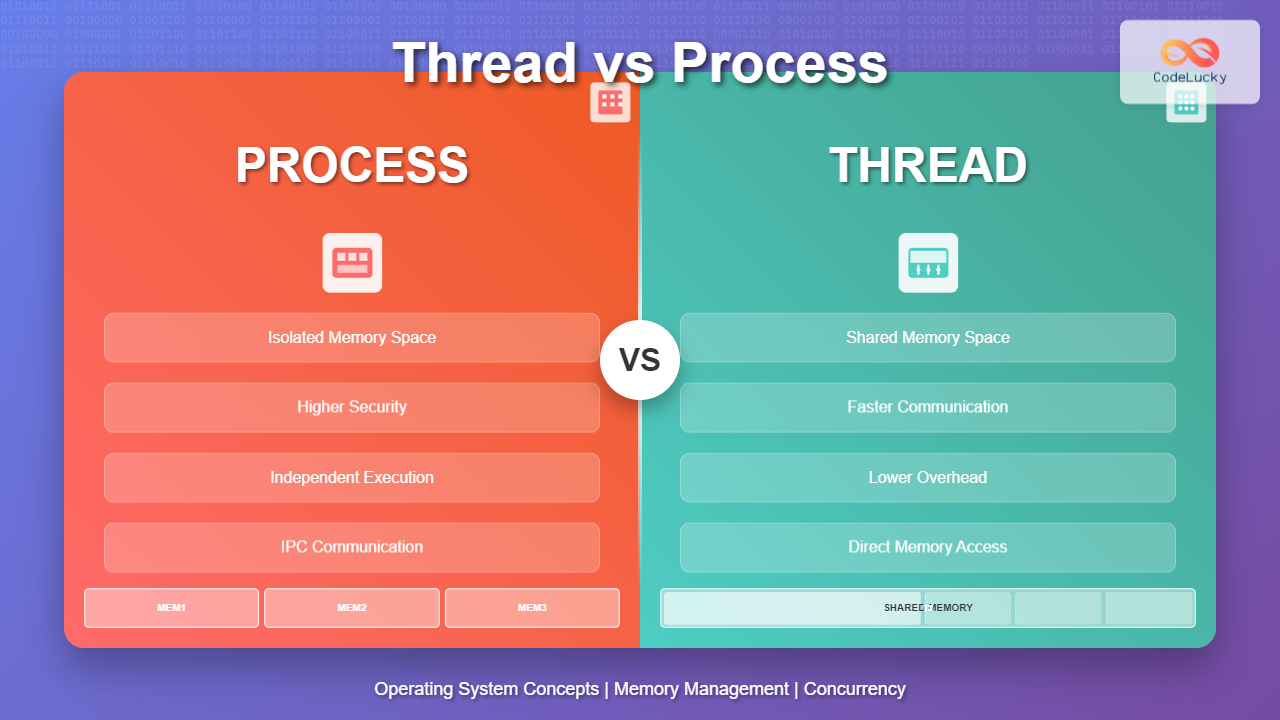
Understanding the fundamental differences between threads and processes is crucial for system programming, application design, and performance optimization. While both enable concurrent execution, they differ significantly in resource usage, communication mechanisms, and implementation complexity.
What is a Process?
A process is an independent execution unit that contains a complete copy of the program code, data, and system resources. Each process runs in its own memory space, completely isolated from other processes.
Key Characteristics of Processes
- Memory Isolation: Each process has its own virtual address space
- Resource Ownership: Processes own file handles, network connections, and system resources
- Independent Execution: Processes can run independently without affecting others
- Security: Strong isolation provides security boundaries

Process Creation Example
Here’s how process creation works in different operating systems:
Linux/Unix – fork() System Call
#include <stdio.h>
#include <unistd.h>
#include <sys/wait.h>

int main() {
    pid_t pid;

    printf("Before fork(): PID = %d\n", getpid());

    pid = fork();

    if (pid == 0) {
        // Child process
        printf("Child process: PID = %d, Parent PID = %d\n",
               getpid(), getppid());
        return 0;
    } else if (pid > 0) {
        // Parent process
        printf("Parent process: PID = %d, Child PID = %d\n",
               getpid(), pid);
        wait(NULL); // Wait for child to complete
        return 0;
    } else {
        // Fork failed
        perror("fork failed");
        return 1;
    }
}
Expected Output:
Before fork(): PID = 1234
Parent process: PID = 1234, Child PID = 1235
Child process: PID = 1235, Parent PID = 1234
Windows – CreateProcess() API
#include <windows.h>
#include <stdio.h>

int main() {
    STARTUPINFO si;
    PROCESS_INFORMATION pi;

    ZeroMemory(&si, sizeof(si));
    si.cb = sizeof(si);
    ZeroMemory(π, sizeof(pi));

    // Create child process
    if (CreateProcess(
        "notepad.exe",  // Application name
        NULL,           // Command line
        NULL,           // Process security attributes
        NULL,           // Thread security attributes
        FALSE,          // Inherit handles
        0,              // Creation flags
        NULL,           // Environment
        NULL,           // Current directory
        &si,            // Startup info
        π)) {         // Process info

        printf("Process created successfully!\n");
        printf("Process ID: %d\n", pi.dwProcessId);

        // Wait for process to complete
        WaitForSingleObject(pi.hProcess, INFINITE);

        // Close handles
        CloseHandle(pi.hProcess);
        CloseHandle(pi.hThread);
    } else {
        printf("CreateProcess failed (%d)\n", GetLastError());
    }

    return 0;
}
What is a Thread?
A thread is a lightweight execution unit within a process that shares the process’s memory space and resources. Multiple threads can exist within a single process, enabling concurrent execution while sharing data efficiently.
Key Characteristics of Threads
- Shared Memory: All threads share the same memory space
- Lightweight: Minimal overhead for creation and context switching
- Fast Communication: Direct memory access for inter-thread communication
- Shared Resources: File handles, network connections shared among threads

Thread Creation Examples
POSIX Threads (pthread)
#include <stdio.h>
#include <pthread.h>
#include <unistd.h>

// Shared global variable
int counter = 0;

void* thread_function(void* arg) {
    int thread_id = *(int*)arg;

    for (int i = 0; i < 5; i++) {
        printf("Thread %d: Counter = %d\n", thread_id, ++counter);
        sleep(1);
    }

    return NULL;
}

int main() {
    pthread_t threads[3];
    int thread_ids[3] = {1, 2, 3};

    printf("Creating threads...\n");

    // Create threads
    for (int i = 0; i < 3; i++) {
        if (pthread_create(&threads[i], NULL, thread_function, &thread_ids[i]) != 0) {
            perror("pthread_create failed");
            return 1;
        }
    }

    // Wait for all threads to complete
    for (int i = 0; i < 3; i++) {
        pthread_join(threads[i], NULL);
    }

    printf("All threads completed. Final counter: %d\n", counter);
    return 0;
}
Expected Output:
Creating threads...
Thread 1: Counter = 1
Thread 2: Counter = 2
Thread 3: Counter = 3
Thread 1: Counter = 4
Thread 2: Counter = 5
Thread 3: Counter = 6
...
All threads completed. Final counter: 15
Windows Threads
#include <windows.h>
#include <stdio.h>

DWORD WINAPI ThreadFunction(LPVOID lpParam) {
    int thread_id = *(int*)lpParam;

    for (int i = 0; i < 5; i++) {
        printf("Thread %d: Iteration %d\n", thread_id, i + 1);
        Sleep(1000); // Sleep for 1 second
    }

    return 0;
}

int main() {
    HANDLE threads[3];
    DWORD thread_ids[3];
    int ids[3] = {1, 2, 3};

    printf("Creating Windows threads...\n");

    // Create threads
    for (int i = 0; i < 3; i++) {
        threads[i] = CreateThread(
            NULL,              // Security attributes
            0,                 // Stack size
            ThreadFunction,    // Thread function
            &ids[i],          // Parameter
            0,                 // Creation flags
            &thread_ids[i]);   // Thread ID

        if (threads[i] == NULL) {
            printf("CreateThread failed (%d)\n", GetLastError());
            return 1;
        }
    }

    // Wait for all threads
    WaitForMultipleObjects(3, threads, TRUE, INFINITE);

    // Close thread handles
    for (int i = 0; i < 3; i++) {
        CloseHandle(threads[i]);
    }

    printf("All threads completed!\n");
    return 0;
}
Key Differences Between Threads and Processes
| Aspect | Process | Thread |
|---|---|---|
| Memory Space | Separate address space for each process | Shared address space within process |
| Creation Cost | High (complete memory copy) | Low (minimal overhead) |
| Context Switching | Expensive (full context save/restore) | Fast (minimal context switching) |
| Communication | IPC mechanisms (pipes, sockets, shared memory) | Direct memory access |
| Isolation | Complete isolation | No isolation (shared memory) |
| Failure Impact | Isolated (one process crash doesn’t affect others) | Shared (one thread crash can affect entire process) |
| Security | High (separate address spaces) | Lower (shared memory vulnerabilities) |
| Scalability | Limited by system resources | Better scalability within process limits |
Performance Comparison

Benchmark Example
#include <stdio.h>
#include <time.h>
#include <pthread.h>
#include <unistd.h>
#include <sys/wait.h>

#define NUM_OPERATIONS 1000000

void* thread_work(void* arg) {
    int sum = 0;
    for (int i = 0; i < NUM_OPERATIONS; i++) {
        sum += i;
    }
    return NULL;
}

void process_work() {
    int sum = 0;
    for (int i = 0; i < NUM_OPERATIONS; i++) {
        sum += i;
    }
}

int main() {
    clock_t start, end;

    // Benchmark thread creation
    printf("Benchmarking thread creation...\n");
    start = clock();

    pthread_t threads[4];
    for (int i = 0; i < 4; i++) {
        pthread_create(&threads[i], NULL, thread_work, NULL);
    }

    for (int i = 0; i < 4; i++) {
        pthread_join(threads[i], NULL);
    }

    end = clock();
    double thread_time = ((double)(end - start)) / CLOCKS_PER_SEC;
    printf("Thread execution time: %.4f seconds\n", thread_time);

    // Benchmark process creation
    printf("\nBenchmarking process creation...\n");
    start = clock();

    for (int i = 0; i < 4; i++) {
        pid_t pid = fork();
        if (pid == 0) {
            process_work();
            exit(0);
        }
    }

    // Wait for all child processes
    for (int i = 0; i < 4; i++) {
        wait(NULL);
    }

    end = clock();
    double process_time = ((double)(end - start)) / CLOCKS_PER_SEC;
    printf("Process execution time: %.4f seconds\n", process_time);

    printf("\nPerformance ratio (Process/Thread): %.2fx\n",
           process_time / thread_time);

    return 0;
}
Communication Mechanisms
Inter-Process Communication (IPC)
Processes require special mechanisms for communication:
1. Pipes
#include <stdio.h>
#include <unistd.h>
#include <string.h>

int main() {
    int pipefd[2];
    pid_t pid;
    char buffer[100];
    char message[] = "Hello from parent process!";

    // Create pipe
    if (pipe(pipefd) == -1) {
        perror("pipe failed");
        return 1;
    }

    pid = fork();

    if (pid == 0) {
        // Child process - reader
        close(pipefd[1]); // Close write end

        read(pipefd[0], buffer, sizeof(buffer));
        printf("Child received: %s\n", buffer);

        close(pipefd[0]);
    } else {
        // Parent process - writer
        close(pipefd[0]); // Close read end

        write(pipefd[1], message, strlen(message) + 1);
        printf("Parent sent: %s\n", message);

        close(pipefd[1]);
    }

    return 0;
}
2. Shared Memory
#include <stdio.h>
#include <sys/shm.h>
#include <sys/ipc.h>
#include <unistd.h>
#include <string.h>

int main() {
    key_t key = ftok(".", 1);
    int shmid = shmget(key, 1024, IPC_CREAT | 0666);

    if (fork() == 0) {
        // Child process
        char* shared_mem = (char*)shmat(shmid, NULL, 0);
        strcpy(shared_mem, "Hello from child!");
        printf("Child wrote: %s\n", shared_mem);
        shmdt(shared_mem);
    } else {
        // Parent process
        sleep(1); // Wait for child
        char* shared_mem = (char*)shmat(shmid, NULL, 0);
        printf("Parent read: %s\n", shared_mem);
        shmdt(shared_mem);
        shmctl(shmid, IPC_RMID, NULL); // Remove shared memory
    }

    return 0;
}
Inter-Thread Communication
Threads communicate directly through shared memory:
#include <stdio.h>
#include <pthread.h>
#include <unistd.h>

// Shared data structure
struct shared_data {
    int counter;
    char message[100];
    pthread_mutex_t mutex;
};

struct shared_data shared = {0, "", PTHREAD_MUTEX_INITIALIZER};

void* producer(void* arg) {
    for (int i = 0; i < 5; i++) {
        pthread_mutex_lock(&shared.mutex);

        shared.counter++;
        sprintf(shared.message, "Message %d from producer", shared.counter);
        printf("Producer: %s\n", shared.message);

        pthread_mutex_unlock(&shared.mutex);
        sleep(1);
    }
    return NULL;
}

void* consumer(void* arg) {
    for (int i = 0; i < 5; i++) {
        sleep(1);

        pthread_mutex_lock(&shared.mutex);
        printf("Consumer read: %s (Counter: %d)\n", shared.message, shared.counter);
        pthread_mutex_unlock(&shared.mutex);
    }
    return NULL;
}

int main() {
    pthread_t prod_thread, cons_thread;

    pthread_create(∏_thread, NULL, producer, NULL);
    pthread_create(&cons_thread, NULL, consumer, NULL);

    pthread_join(prod_thread, NULL);
    pthread_join(cons_thread, NULL);

    pthread_mutex_destroy(&shared.mutex);
    return 0;
}
When to Use Processes
Use processes when:
- Fault Isolation: Critical applications where one component’s failure shouldn’t affect others
- Security Requirements: Different privilege levels or security domains needed
- Independent Services: Microservices architecture or separate application components
- Different Programming Languages: Components written in different languages
- Legacy System Integration: Integrating with existing standalone applications
Real-World Process Examples

# Example: Web server with multiple worker processes
# nginx configuration
worker_processes auto;  # One process per CPU core

events {
    worker_connections 1024;
    use epoll;
}

http {
    upstream backend {
        server 127.0.0.1:3001;  # Process 1
        server 127.0.0.1:3002;  # Process 2
        server 127.0.0.1:3003;  # Process 3
    }

    server {
        listen 80;
        location / {
            proxy_pass http://backend;
        }
    }
}
When to Use Threads
Use threads when:
- Shared State: Multiple execution units need to access the same data frequently
- Performance Critical: Low latency and high throughput requirements
- Resource Efficiency: Limited memory or need to minimize resource usage
- Fine-grained Parallelism: Breaking down tasks into small, parallel operations
- I/O Bound Operations: Handling multiple I/O operations concurrently
Thread Pool Example
#include <stdio.h>
#include <pthread.h>
#include <stdlib.h>
#include <unistd.h>

#define THREAD_POOL_SIZE 4
#define TASK_QUEUE_SIZE 20

typedef struct {
    void (*function)(void*);
    void* argument;
} task_t;

typedef struct {
    task_t task_queue[TASK_QUEUE_SIZE];
    int queue_front;
    int queue_rear;
    int queue_count;
    pthread_mutex_t queue_mutex;
    pthread_cond_t queue_cond;
    pthread_t threads[THREAD_POOL_SIZE];
    int shutdown;
} thread_pool_t;

thread_pool_t pool;

void* worker_thread(void* arg) {
    while (1) {
        pthread_mutex_lock(&pool.queue_mutex);

        while (pool.queue_count == 0 && !pool.shutdown) {
            pthread_cond_wait(&pool.queue_cond, &pool.queue_mutex);
        }

        if (pool.shutdown) {
            pthread_mutex_unlock(&pool.queue_mutex);
            break;
        }

        // Get task from queue
        task_t task = pool.task_queue[pool.queue_front];
        pool.queue_front = (pool.queue_front + 1) % TASK_QUEUE_SIZE;
        pool.queue_count--;

        pthread_mutex_unlock(&pool.queue_mutex);

        // Execute task
        task.function(task.argument);
    }

    return NULL;
}

void add_task(void (*function)(void*), void* argument) {
    pthread_mutex_lock(&pool.queue_mutex);

    if (pool.queue_count < TASK_QUEUE_SIZE) {
        pool.task_queue[pool.queue_rear].function = function;
        pool.task_queue[pool.queue_rear].argument = argument;
        pool.queue_rear = (pool.queue_rear + 1) % TASK_QUEUE_SIZE;
        pool.queue_count++;

        pthread_cond_signal(&pool.queue_cond);
    }

    pthread_mutex_unlock(&pool.queue_mutex);
}

void process_request(void* arg) {
    int request_id = *(int*)arg;
    printf("Processing request %d by thread %lu\n",
           request_id, pthread_self());
    sleep(2); // Simulate work
    printf("Completed request %d\n", request_id);
    free(arg);
}

int main() {
    // Initialize thread pool
    pool.queue_front = 0;
    pool.queue_rear = 0;
    pool.queue_count = 0;
    pool.shutdown = 0;
    pthread_mutex_init(&pool.queue_mutex, NULL);
    pthread_cond_init(&pool.queue_cond, NULL);

    // Create worker threads
    for (int i = 0; i < THREAD_POOL_SIZE; i++) {
        pthread_create(&pool.threads[i], NULL, worker_thread, NULL);
    }

    // Add tasks
    for (int i = 1; i <= 10; i++) {
        int* request_id = malloc(sizeof(int));
        *request_id = i;
        add_task(process_request, request_id);
        printf("Added request %d to queue\n", i);
    }

    sleep(15); // Wait for tasks to complete

    // Shutdown thread pool
    pthread_mutex_lock(&pool.queue_mutex);
    pool.shutdown = 1;
    pthread_cond_broadcast(&pool.queue_cond);
    pthread_mutex_unlock(&pool.queue_mutex);

    // Wait for threads to finish
    for (int i = 0; i < THREAD_POOL_SIZE; i++) {
        pthread_join(pool.threads[i], NULL);
    }

    pthread_mutex_destroy(&pool.queue_mutex);
    pthread_cond_destroy(&pool.queue_cond);

    return 0;
}
Best Practices and Common Pitfalls
Process Best Practices
- Resource Management: Always clean up child processes to avoid zombies
- Error Handling: Implement proper error handling for process creation
- Communication Design: Choose appropriate IPC mechanisms based on data volume and frequency
- Security: Use least privilege principle for process permissions
Thread Best Practices
- Synchronization: Always protect shared data with mutexes or other synchronization primitives
- Deadlock Prevention: Establish lock ordering to prevent deadlocks
- Thread Safety: Use thread-safe functions and libraries
- Resource Cleanup: Properly join or detach threads
Common Pitfalls
// WRONG: Race condition in threads
int global_counter = 0;

void* unsafe_increment(void* arg) {
    for (int i = 0; i < 100000; i++) {
        global_counter++; // Race condition!
    }
    return NULL;
}

// CORRECT: Protected with mutex
pthread_mutex_t counter_mutex = PTHREAD_MUTEX_INITIALIZER;

void* safe_increment(void* arg) {
    for (int i = 0; i < 100000; i++) {
        pthread_mutex_lock(&counter_mutex);
        global_counter++;
        pthread_mutex_unlock(&counter_mutex);
    }
    return NULL;
}
Modern Alternatives and Hybrid Approaches
Event-Driven Programming
Modern applications often use event loops and asynchronous I/O to handle concurrency without the overhead of multiple threads or processes:
// Node.js event-driven example
const http = require('http');
const fs = require('fs').promises;

const server = http.createServer(async (req, res) => {
    try {
        // Non-blocking file read
        const data = await fs.readFile('large-file.txt');
        res.writeHead(200, {'Content-Type': 'text/plain'});
        res.end(data);
    } catch (error) {
        res.writeHead(500);
        res.end('Error reading file');
    }
});

server.listen(3000, () => {
    console.log('Server running on port 3000');
});
Container and Microservices Architecture
Modern distributed systems often combine both approaches:
- Processes: For service isolation and fault tolerance
- Threads: Within each service for handling concurrent requests
- Event-driven: For I/O-intensive operations
Conclusion
The choice between threads and processes depends on your specific requirements:
Choose processes for: Security, fault isolation, independent services, and different privilege levels.
Choose threads for: Performance-critical applications, shared state, resource efficiency, and fine-grained parallelism.
Modern applications often use hybrid approaches, combining processes for service boundaries with threads for internal concurrency, and event-driven programming for I/O operations. Understanding these fundamental concepts enables you to make informed architectural decisions and write efficient concurrent applications.
Remember that concurrency introduces complexity, so always consider whether the benefits outweigh the added complexity for your specific use case. Start simple and add concurrency only when needed for performance or functionality requirements.
Related Posts
Thread in Operating System: Lightweight Processes and Multithreading Explained
What are Threads in Operating Systems? A thread is the smallest unit of execution within a process that can be...
Multithreading in Operating Systems: Benefits, Challenges, and Implementation Guide
What is Multithreading in Operating Systems? Multithreading is a fundamental concept in modern operating systems that allows a single process...
Process in Operating System: Complete Guide to Definition, States and Lifecycle
What is a Process in Operating System? A process is a program in execution that consists of the program code...
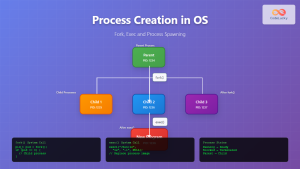
Process Creation in OS: Fork, Exec and Process Spawning Complete Guide
Introduction to Process Creation in Operating Systems Process creation is one of the fundamental concepts in operating systems that enables...

Process Synchronization: Critical Sections and Race Conditions in Operating Systems
Introduction to Process Synchronization Process synchronization is a fundamental concept in operating systems that ensures multiple processes can safely access...

Peterson’s Algorithm: Complete Guide to Two-Process Mutual Exclusion in Operating Systems
What is Peterson's Algorithm? Peterson's Algorithm is a classic solution for achieving mutual exclusion between two processes or threads in...

Thread Synchronization: Mutexes, Semaphores and Deadlocks in Operating Systems
Introduction to Thread Synchronization Thread synchronization is a fundamental concept in operating systems that ensures multiple threads can safely access...

C++ Threads: Basics of Multithreading
In today's world of multi-core processors, understanding and implementing multithreading is crucial for developing efficient C++ applications. This article delves...

C++ Thread Synchronization: Mutexes and Locks
In the world of modern C++ programming, multithreading has become an essential technique for improving application performance and responsiveness. However,...
Critical Section Problem: Complete Guide to Mutual Exclusion Solutions in Operating Systems
What is the Critical Section Problem? The critical section problem is a fundamental challenge in operating systems where multiple processes...
Monitor in Operating System: High-level Synchronization for Process Coordination
What is a Monitor in Operating System? A monitor is a high-level synchronization construct in operating systems that provides a...
Java Threads: Basics of Multithreading
In the world of modern computing, multithreading has become an essential concept for developers to grasp. Java, being one of...