What is Program Increment (PI) Planning?
Program Increment (PI) Planning represents the heartbeat of large-scale Agile development, serving as a critical ceremony that aligns multiple teams toward common objectives within the Scaled Agile Framework (SAFe). This intensive planning event brings together stakeholders, product owners, scrum masters, and development teams to collaboratively plan the next 8-12 weeks of work across an entire Agile Release Train (ART).
Unlike traditional sprint planning that focuses on individual teams, PI Planning operates at a program level, ensuring synchronization and alignment across multiple teams working on interconnected features and capabilities. This large-scale planning approach addresses the complexity of enterprise software development while maintaining Agile principles and practices.
The Strategic Importance of PI Planning in Large-Scale Agile
PI Planning serves multiple strategic purposes within large-scale Agile implementations. It establishes a shared understanding of priorities, dependencies, and constraints across all participating teams. The ceremony creates transparency around capacity, capabilities, and potential risks that could impact delivery timelines.
The planning event also strengthens cross-team collaboration by facilitating face-to-face interactions between team members who might otherwise work in isolation. This human connection proves invaluable when teams need to coordinate complex integrations or resolve dependencies during the Program Increment execution.
Furthermore, PI Planning provides a forum for leadership to communicate strategic direction and business context, ensuring that all teams understand how their work contributes to broader organizational goals. This alignment proves crucial for maintaining motivation and focus throughout the increment.
Core Components and Structure of PI Planning
Pre-Planning Preparation
Successful PI Planning begins weeks before the actual event. Product Management must prepare a comprehensive Program Backlog with prioritized features and capabilities. Business Owners should be ready to articulate business value and strategic objectives clearly.
Technical preparation includes ensuring that architectural runway items are identified and prioritized appropriately. System Architects and Engineers need to prepare technical presentations covering enabler work, technology decisions, and integration approaches that will impact multiple teams.
Logistical preparation involves securing adequate meeting spaces, ensuring all necessary tools and materials are available, and confirming attendance from key stakeholders. Remote planning considerations require additional attention to technology setup and communication protocols.
Day One Activities
The first day of PI Planning typically opens with business context presentations where leadership shares strategic objectives, market conditions, and customer priorities. These presentations establish the “why” behind the upcoming increment and help teams understand the broader business landscape.
Product Management follows with detailed feature presentations, walking through prioritized capabilities and their acceptance criteria. These presentations provide teams with the “what” they need to deliver during the increment.
Architecture and technical presentations conclude the morning sessions, covering infrastructure changes, technology decisions, and cross-cutting concerns that will impact development work. These sessions address the “how” of implementation from a technical perspective.
Team Planning and Breakout Sessions
Following the opening presentations, teams break into smaller groups to begin detailed planning activities. Each team works through their assigned features, decomposing them into user stories and estimating effort required for completion.
During these breakout sessions, teams identify dependencies on other teams, external systems, or infrastructure components. They also assess risks that could impact their ability to deliver committed work and develop mitigation strategies.
Team planning involves capacity planning considerations, accounting for holidays, planned time off, and other commitments that might reduce available development time during the increment.
Program Board Creation and Management
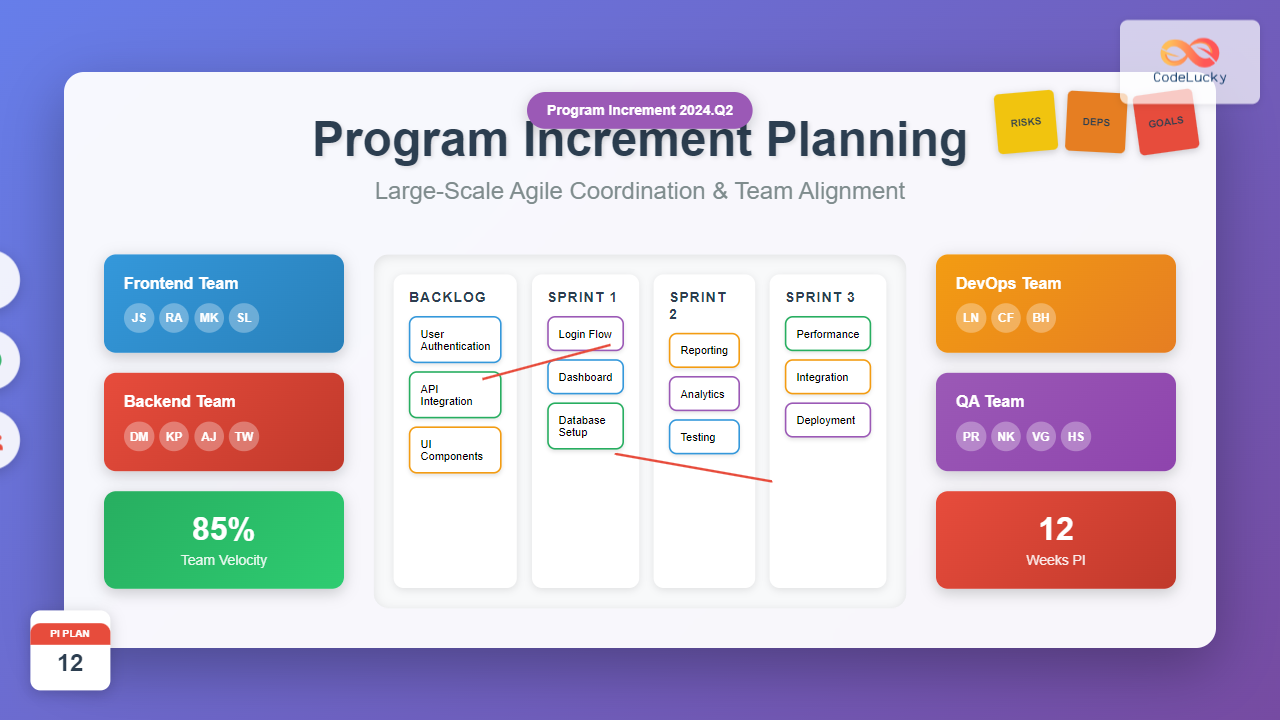
The Program Board serves as the visual representation of all team commitments, dependencies, and milestones for the upcoming increment. Teams place their planned features and stories on the board, creating a comprehensive view of planned work across all teams.
Dependencies between teams are explicitly marked on the board using colored strings or digital connections. This visualization makes cross-team coordination requirements immediately apparent to all participants.
Milestones and integration points are clearly marked, showing when teams need to have specific capabilities ready for integration or demonstration. These milestones help coordinate work across teams and ensure smooth system integration.
Key Roles and Responsibilities in PI Planning
Release Train Engineer (RTE)
The Release Train Engineer serves as the chief facilitator for PI Planning, ensuring the event runs smoothly and objectives are met. They coordinate logistics, manage timeboxes, and facilitate cross-team discussions when dependencies or conflicts arise.
RTEs also coach teams through the planning process, helping them apply consistent estimation practices and ensuring alignment with SAFe principles. They monitor progress throughout the event and make adjustments to keep planning on track.
Product Management
Product Management owns the Program Backlog and is responsible for communicating feature priorities and acceptance criteria. They work closely with Business Owners to ensure features align with business objectives and customer needs.
During planning, Product Managers answer questions about feature requirements, negotiate scope adjustments when capacity constraints are identified, and make trade-off decisions to optimize business value delivery.
System Architect and Engineering
System Architects provide technical guidance and ensure architectural consistency across teams. They identify technical dependencies, communicate architectural decisions, and help teams understand integration requirements.
Engineering leadership supports capacity planning discussions and helps teams assess technical risks. They also contribute to enabler identification and prioritization to support upcoming development work.
Scrum Masters and Team Leads
Scrum Masters facilitate team-level planning activities and help their teams navigate the PI Planning process. They ensure teams follow consistent planning practices and help identify and escalate impediments that could impact commitments.
Team leads contribute technical expertise to estimation discussions and help their teams understand implementation approaches for assigned features. They also participate in cross-team technical discussions to resolve integration challenges.
Best Practices for Successful PI Planning
Preparation and Communication
Invest significant effort in pre-planning preparation to maximize the effectiveness of the planning event. Ensure all participants understand their roles and responsibilities before the event begins. Create clear agendas and communicate expectations well in advance.
Establish communication protocols for the event, including how decisions will be made, how conflicts will be resolved, and how information will be captured and shared. Consider both in-person and remote participants when designing communication approaches.
Facilitation and Time Management
Maintain strict time management throughout the event to ensure all necessary topics are covered adequately. Use visual timers and clear signals to help participants stay focused on current activities.
Employ skilled facilitators who can guide discussions productively and help teams reach consensus quickly. Train facilitators in conflict resolution techniques and decision-making frameworks.
Dependency Management
Make dependencies highly visible throughout the planning process using the Program Board and other visual management tools. Regularly review dependencies and ensure teams understand their commitments to other teams.
Create clear protocols for managing dependency changes during the increment, including communication channels and escalation procedures when dependencies cannot be met as planned.
Risk and Issue Management
Implement systematic risk identification and assessment processes during planning. Encourage teams to be transparent about potential risks rather than optimistic in their assessments.
Develop risk mitigation strategies collaboratively and assign ownership for risk monitoring throughout the increment. Create escalation paths for risks that cannot be resolved at the team level.
Common Challenges and Solutions
Scope Management and Over-Commitment
Teams often struggle with realistic capacity assessment during PI Planning, leading to over-commitment and subsequent delivery challenges. Combat this tendency by using historical velocity data and accounting for known capacity reductions.
Implement buffer management strategies that reserve capacity for unplanned work and risk mitigation. Encourage teams to commit to achievable objectives rather than stretch goals that increase delivery risk.
Cross-Team Coordination
Complex dependencies between teams can create coordination challenges that impact delivery predictability. Address this through clear dependency tracking, regular synchronization meetings, and proactive communication protocols.
Consider architectural approaches that reduce tight coupling between teams, such as API-first development and service-oriented architectures that enable more independent development and deployment cycles.
Remote and Distributed Team Challenges
Remote PI Planning requires additional attention to technology setup, communication protocols, and engagement strategies. Invest in high-quality video conferencing tools and collaborative digital workspaces.
Create structured interaction opportunities for remote participants and ensure they have equal voice in planning discussions. Consider hybrid approaches that combine synchronous and asynchronous planning activities.
Stakeholder Alignment and Buy-In
Securing consistent stakeholder participation and buy-in can be challenging, particularly when competing priorities exist. Address this through clear communication about PI Planning value and business impact.
Create stakeholder-specific value propositions that demonstrate how PI Planning supports their particular objectives and concerns. Ensure stakeholder time investment yields visible returns in terms of predictability and alignment.
Measuring PI Planning Success
Quantitative Metrics
Track program predictability by measuring the percentage of committed objectives that teams successfully deliver during the increment. This metric provides insight into planning accuracy and team capacity assessment skills.
Monitor dependency satisfaction rates to understand how well teams coordinate cross-team work. High dependency failure rates indicate need for improved coordination processes or architectural changes.
Measure planning efficiency by tracking the time required to reach planning consensus and the stability of commitments throughout the increment. Improved efficiency indicates growing PI Planning maturity.
Qualitative Assessments
Conduct retrospectives after each PI Planning event to gather feedback on process effectiveness and participant satisfaction. Use this feedback to continuously improve planning approaches and facilitation techniques.
Assess team confidence levels in their commitments and their understanding of business objectives. Higher confidence and understanding indicate successful knowledge transfer during planning.
Evaluate cross-team collaboration quality and relationship strength. PI Planning should strengthen working relationships and improve collaboration effectiveness.
Scaling PI Planning for Different Organizational Contexts
Multi-ART Coordination
Large organizations may need to coordinate PI Planning across multiple Agile Release Trains. This requires additional ceremony layers, such as pre-PI Planning events and solution-level planning activities.
Implement clear communication protocols between ARTs and establish shared calendars for cross-ART dependencies and integration points. Consider staggered planning schedules that allow for cross-ART coordination without creating bottlenecks.
Regulatory and Compliance Considerations
Organizations in regulated industries must incorporate compliance requirements into PI Planning processes. This might include additional documentation requirements, approval workflows, and risk assessment procedures.
Work with compliance teams to understand requirements and build appropriate processes into planning workflows without compromising Agile principles or team autonomy.
Cultural and Geographic Distribution
Global organizations must account for cultural differences, time zone challenges, and communication preferences when designing PI Planning approaches. Consider cultural communication styles and decision-making preferences.
Implement follow-the-sun planning approaches that allow teams in different time zones to contribute effectively to planning activities. Use asynchronous planning tools to bridge time zone gaps.
Technology and Tools for PI Planning
Digital Planning Platforms
Modern PI Planning increasingly relies on digital tools that support both in-person and remote planning activities. Platforms like Jira Align, Azure DevOps, and specialized PI Planning tools provide comprehensive planning support.
Evaluate tool capabilities including dependency tracking, capacity planning, risk management, and real-time collaboration features. Ensure chosen tools integrate well with existing development toolchains.
Visual Management Tools
Implement visual management approaches that make planning progress and team commitments immediately apparent to all participants. Digital Program Boards, dependency maps, and risk registers improve transparency.
Consider hybrid approaches that combine physical and digital visual management tools to accommodate different participant preferences and technology constraints.
Future Evolution of PI Planning
PI Planning continues to evolve as organizations gain experience with large-scale Agile implementations. Emerging trends include increased automation of planning activities, AI-assisted capacity planning, and more sophisticated dependency analysis tools.
Integration with DevOps practices and continuous delivery pipelines is creating new opportunities for more frequent planning cycles and reduced batch sizes. These changes promise to improve responsiveness while maintaining coordination benefits.
As organizations mature in their SAFe implementations, PI Planning is becoming more streamlined and efficient while maintaining its core benefits of alignment, transparency, and collaboration. The future likely holds even greater integration between planning and execution activities.
Conclusion
Program Increment Planning represents a cornerstone practice for successful large-scale Agile implementation. When executed effectively, it provides the alignment, transparency, and coordination necessary for multiple teams to work together toward common objectives.
Success with PI Planning requires careful preparation, skilled facilitation, and commitment to continuous improvement. Organizations that invest in building strong PI Planning capabilities typically see significant improvements in delivery predictability, team satisfaction, and business alignment.
As the practice continues to evolve, organizations should remain open to adapting their approaches while maintaining focus on the core objectives of alignment, transparency, and collaborative planning that make PI Planning so valuable for large-scale Agile success.
Related Posts
Sprint Planning: Complete Guide and Best Practices for Agile Teams
Sprint planning forms the cornerstone of successful agile development, serving as the critical bridge between product vision and executable work....
Scaling Agile Adoption: Complete Guide to Enterprise-Wide Transformation Success
Scaling Agile adoption from a single team to an entire enterprise represents one of the most challenging yet rewarding transformations...

Scrum Events: Sprint Planning, Daily Scrum, Sprint Review, Retrospective
Scrum events form the backbone of the Scrum framework, providing structured opportunities for inspection, adaptation, and collaboration throughout each sprint....
Predictability: Consistency in Delivery Through Agile Methodologies
Predictability in Agile development represents the cornerstone of successful project delivery, enabling teams to establish consistent patterns that stakeholders can...
Dependencies Management in Scaled Agile: Complete Guide to Cross-Team Coordination
Understanding Dependencies in Scaled Agile Environments Dependencies management represents one of the most critical challenges in scaled agile environments. When...
Introduction to Scrum Framework: Complete Guide for Agile Project Management
The Scrum framework has revolutionized how teams approach project management and software development. As one of the most popular agile...

Analysis Paralysis: Breaking Free from Over-Planning in Agile Development
Analysis paralysis is one of the most insidious enemies of Agile development teams. While thorough planning seems like a virtue,...
Agile Release Train (ART): Complete Guide to Coordinating Multiple Teams for Enterprise Success
What is an Agile Release Train (ART)? An Agile Release Train (ART) is a long-lived team of Agile teams that...

Agile Contracts: Complete Guide to Flexible Vendor Agreements for Modern Software Development
Understanding Agile Contracts in Modern Software Development Agile contracts represent a fundamental shift from traditional fixed-scope agreements to flexible, collaborative...
DevOps and Agile: Extending Agility to Operations – Complete Guide for Modern Software Delivery
The evolution of software development has witnessed remarkable transformations, from traditional waterfall methodologies to Agile practices, and now to the...
Feature Prioritization: MoSCoW Method, Kano Model & RICE Framework Guide
What is Feature Prioritization in Agile Development? Feature prioritization is the systematic process of determining which features, user stories, or...
Agile Architecture: Designing for Change – Building Flexible Software Systems
In today's rapidly evolving digital landscape, traditional waterfall architecture approaches often fail to meet the dynamic needs of modern software...