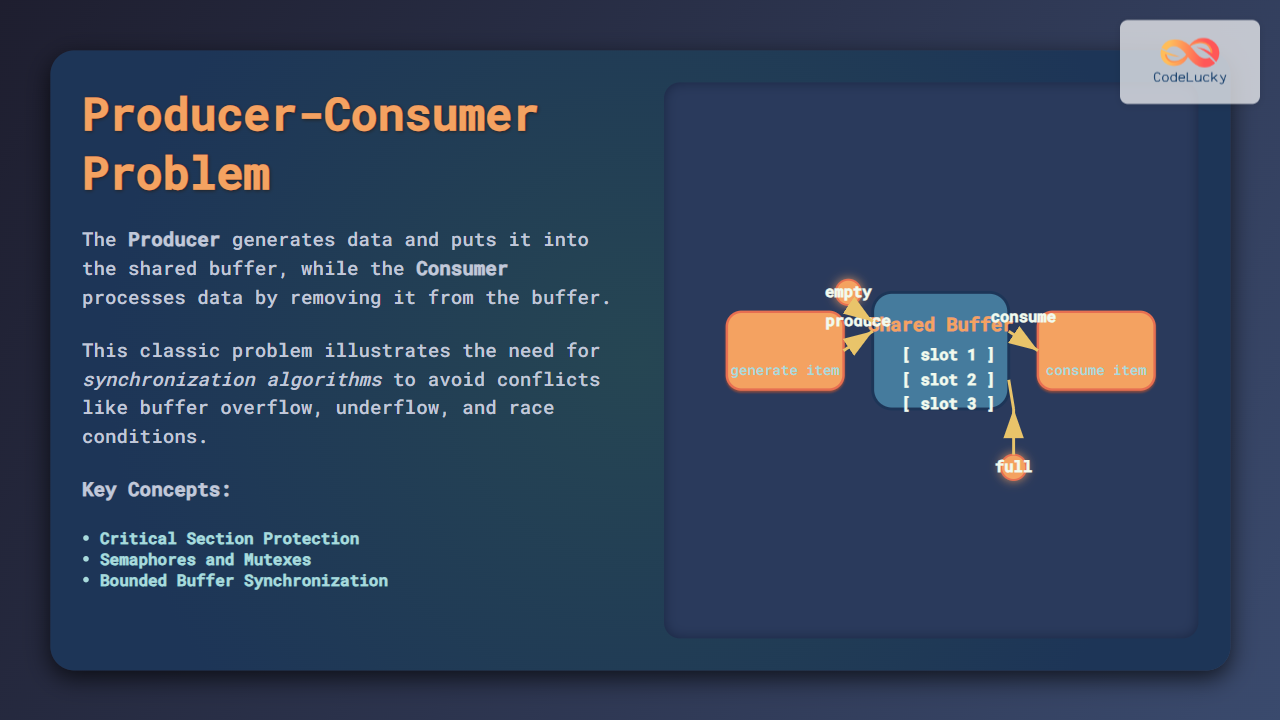
The Producer-Consumer Problem is one of the most important classical problems in process synchronization and operating systems. It demonstrates the challenges of sharing resources in concurrent programming and highlights how semaphores, mutexes, and monitors can be used to avoid race conditions, deadlocks, or data inconsistency.
In this article, we will cover everything you need to know about the Producer-Consumer Problem, with examples, code snippets, and mermaid diagrams for better understanding.
What is the Producer-Consumer Problem?
The Producer-Consumer Problem models two types of processes:
- Producer: Generates data and puts it in a shared buffer.
- Consumer: Takes data from the shared buffer and processes it.
The challenge arises when multiple producers and consumers access the shared buffer simultaneously. Without proper synchronization, this can lead to conditions like:
- Buffer Overflow: Producer adds data when the buffer is already full.
- Buffer Underflow: Consumer tries to read data when the buffer is empty.
- Race Conditions: Two processes accessing/modifying the same shared resource concurrently.
Understanding the Shared Buffer
The buffer is often considered as a circular queue with limited size. The producer will add an item to the queue, and the consumer will remove one. Synchronization is needed so that the two processes do not interfere with each other.

Synchronization Tools Required
To solve the Producer-Consumer Problem, operating systems and programming languages commonly provide these tools:
- Mutex (Mutual Exclusion): Prevents simultaneous access to critical sections.
- Semaphores: Two semaphores are required:
empty: Counts empty slots in the buffer.full: Counts filled slots in the buffer.
- Condition Variables or Monitors: High-level synchronization abstraction.
Algorithm Using Semaphores
The most well-known solution is implemented using semaphores:
// Global definitions
semaphore empty = n;  // n = size of buffer
semaphore full = 0;
mutex = 1;

// Producer Process
while (true) {
    produce_item(item);
    wait(empty);    // Decrement empty count
    wait(mutex);    // Enter critical section
    insert_item(item);
    signal(mutex);  // Exit critical section
    signal(full);   // Increment full count
}

// Consumer Process
while (true) {
    wait(full);     // Wait for item
    wait(mutex);    // Enter critical section
    item = remove_item();
    signal(mutex);  // Exit critical section
    signal(empty);  // Increment empty count
    consume_item(item);
}
Producer-Consumer Problem Illustrated
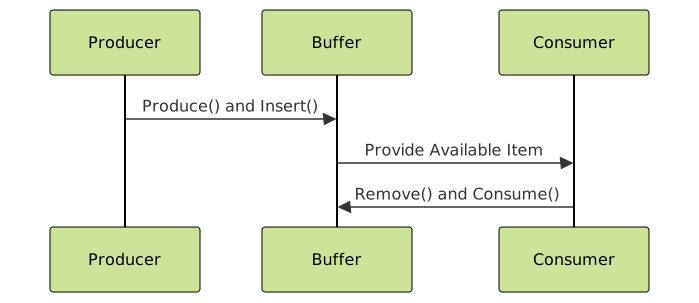
In this sequence, the buffer acts as the middleman, and semaphores synchronize the actions of producer and consumer.
Example Walkthrough
Let us assume a buffer of size 3:
- Step 1: Producer inserts item A → Buffer: [A]
- Step 2: Producer inserts item B → Buffer: [A, B]
- Step 3: Consumer consumes A → Buffer: [B]
- Step 4: Producer inserts item C → Buffer: [B, C]
- Step 5: Consumer consumes B → Buffer: [C]
- Step 6: Consumer consumes C → Buffer: []
If the producer tries to insert when the buffer is full or the consumer tries to remove when it’s empty, synchronization primitives prevent them from accessing the buffer incorrectly.

Visualization of Buffer States
Consider the following buffer state visualization:
| Step | Producer Action | Consumer Action | Buffer State |
|---|---|---|---|
| 1 | Insert A | – | [A] |
| 2 | Insert B | – | [A, B] |
| 3 | – | Consume A | [B] |
| 4 | Insert C | – | [B, C] |
| 5 | – | Consume B | [C] |
| 6 | – | Consume C | [] |
Producer-Consumer Problem with Monitors
Monitors provide an object-oriented way to tackle synchronization:
monitor ProducerConsumer {
    condition full, empty;
    Queue buffer;

    procedure insert(item) {
        if (buffer.isFull())
            wait(empty);
        buffer.add(item);
        signal(full);
    }

    procedure remove() {
        if (buffer.isEmpty())
            wait(full);
        item = buffer.remove();
        signal(empty);
        return item;
    }
}
Applications of Producer-Consumer Problem
- Multithreaded programming (threads sharing resources).
- IO Buffers in computer systems (keyboard buffer, disk IO).
- Message passing systems in distributed computing.
- Concurrent data streaming services.
Key Takeaways
- Producer-Consumer demonstrates the importance of synchronization in multithreading.
- Semaphores and mutexes prevent race conditions.
- Monitors provide a cleaner, higher-level abstraction for achieving synchronization.
By mastering the Producer-Consumer Problem, developers can write efficient, deadlock-free concurrent programs that manage shared resources effectively.