You open a coding problem, read it twice, and your mind goes blank — not because you can’t write code, but because nobody ever taught you how to pick the right tool for the job. That gap is exactly what a data structures and algorithms roadmap fixes. Instead of jumping between random tutorials, you learn concepts in the order your brain can actually absorb them: foundations first, then building blocks, then the patterns that solve real problems.
This guide lays out a clear, step-by-step DSA roadmap for beginners in 2026 — one you can follow whether you’re preparing for interviews, strengthening your fundamentals, or finally trying to understand what “Big O” really means. You’ll get concrete phases, working code, a study plan, and the mistakes to skip.
What Is a Data Structures and Algorithms Roadmap?
A data structures and algorithms roadmap is a structured learning sequence that takes you from basic programming logic to solving complex problems efficiently. It orders topics by dependency — you learn how to measure efficiency before you compare structures, and you understand arrays before you tackle graphs. The goal is not memorizing solutions but recognizing which approach fits a given problem.
Think of it like learning to cook. You don’t start with a five-course meal. You learn knife skills, then basic techniques, then recipes, and eventually you improvise. DSA works the same way: master the primitives, and the hard problems start to look like combinations of things you already know.
Why Learning DSA Still Matters in 2026
With AI assistants writing boilerplate and frameworks hiding complexity, it’s fair to ask whether data structures and algorithms still matter. They do — arguably more than before. AI tools generate code quickly, but they don’t reliably choose the most efficient approach for your specific constraints. Knowing the difference between an O(n) and an O(n²) solution is what separates an app that scales from one that crawls.
Here’s where this knowledge pays off in practice:
- Technical interviews: Most companies still test DSA fundamentals, from startups to large tech firms.
- Performance: Choosing the right structure can turn a 10-second operation into a 10-millisecond one.
- Debugging AI-generated code: You can’t review what you don’t understand.
- System design: Caches, databases, and queues are all data structures at scale.
Phase 1: Build Your Programming Foundation
Before any DSA roadmap makes sense, you need to be comfortable in one language. Pick a single language and stick with it — Python is the friendliest for beginners because its syntax stays out of your way, while Java and C++ remain popular for interviews. Switching languages mid-roadmap only slows you down.
Make sure you’re solid on these basics first:
- Variables, data types, and operators
- Conditionals (
if/else) and loops (for,while) - Functions, parameters, and return values
- Recursion — a function calling itself (you’ll use this constantly later)
- Basic input/output and reading error messages
If you can write a function that reverses a string or finds the largest number in a list without looking it up, you’re ready for Phase 2. The official Python tutorial is a reliable, free place to close any gaps.
Phase 2: Master Big O Notation and Complexity Analysis
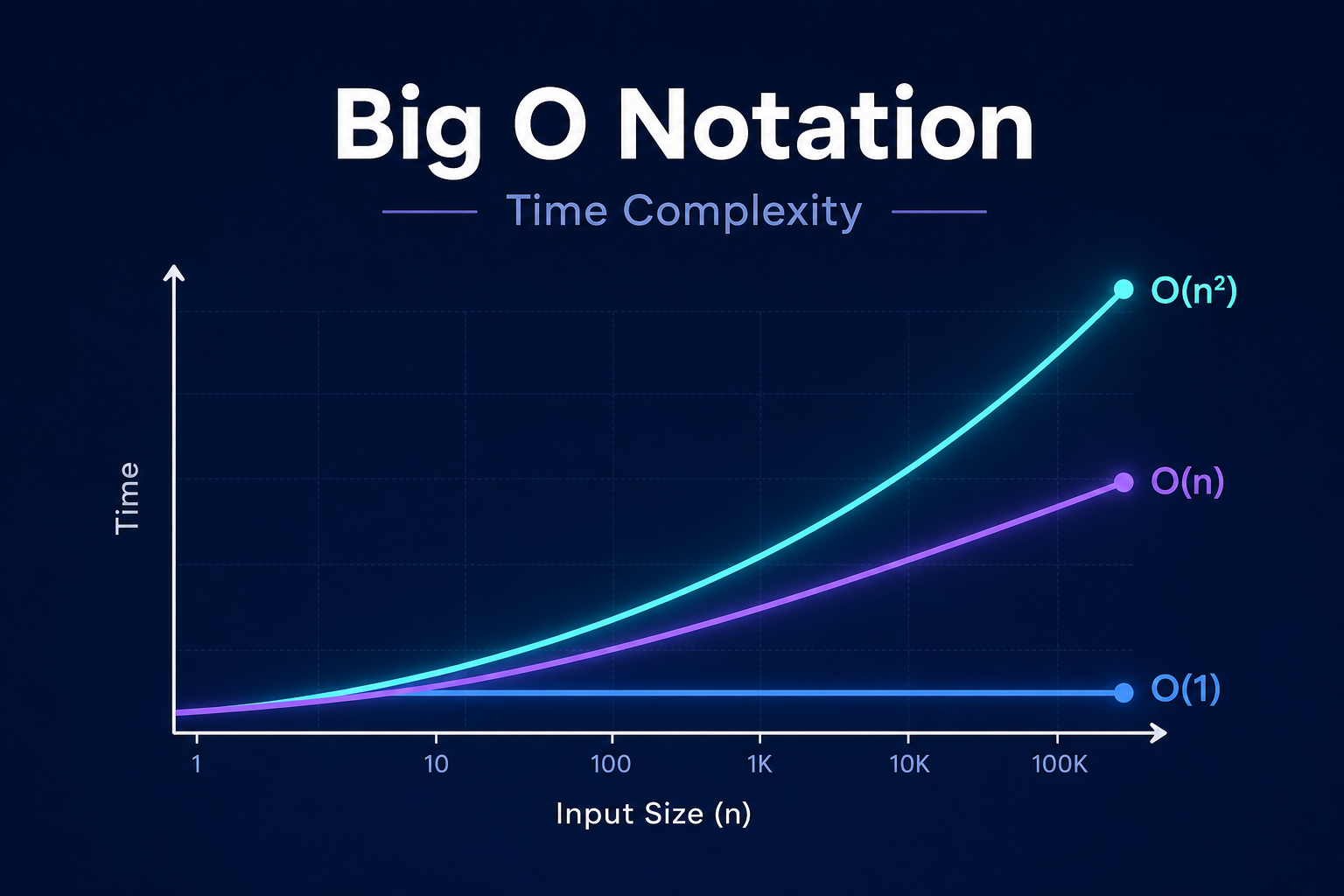
This is the single most important phase, and most beginners rush past it. Big O notation describes how the runtime or memory of an algorithm grows as the input gets larger. It’s how you compare two solutions objectively instead of guessing which is faster.
The code below shows three common complexity classes in action:
# O(1) - constant time: one operation no matter how big the input is
def get_first(items):
    return items[0]

# O(n) - linear time: work grows directly with the input size
def contains(items, target):
    for item in items:            # runs n times in the worst case
        if item == target:
            return True
    return False

# O(n^2) - quadratic time: a nested loop over the same data
def has_duplicate(items):
    for i in range(len(items)):
        for j in range(i + 1, len(items)):
            if items[i] == items[j]:
                return True
    return False
Notice how get_first does the same amount of work for 10 items or 10 million — that’s constant time. contains scales linearly because it may touch every element. And has_duplicate grows quadratically, so doubling the input roughly quadruples the work. Once you can label code like this on sight, you can spot slow solutions before you even run them.
Don’t memorize Big O charts. Instead, ask one question of every loop: “If the input doubles, how much more work happens?” The answer is your complexity.
For a deeper reference, the Big O notation article on Wikipedia covers the formal definitions and common growth rates.
Phase 3: Core Data Structures You Must Know
Now you learn the building blocks. Each data structure trades off speed for different operations, so the right choice depends on what you do most — read, search, insert, or delete. The table below summarizes the average-case complexity of the structures every beginner should master.
| Data Structure | Access | Search | Insert | Delete | Best Used For |
|---|---|---|---|---|---|
| Array | O(1) | O(n) | O(n) | O(n) | Fast indexed access |
| Hash Table | — | O(1) | O(1) | O(1) | Fast lookups by key |
| Stack | O(n) | O(n) | O(1) | O(1) | Undo, backtracking (LIFO) |
| Queue | O(n) | O(n) | O(1) | O(1) | Scheduling, BFS (FIFO) |
| Linked List | O(n) | O(n) | O(1) | O(1) | Frequent inserts/deletes |
| Binary Search Tree | O(log n) | O(log n) | O(log n) | O(log n) | Sorted, ordered data |
| Heap | O(1) peek | O(n) | O(log n) | O(log n) | Priority queues, top-K |
Learn them in this order: arrays → hash tables → stacks and queues → linked lists → trees → heaps → graphs. Each one builds on the last. Trees, for example, are easier once you understand recursion and linked lists, and graphs are simply trees with fewer rules.
The hash table: your most-used tool
If you remember one structure, make it the hash table (a Python dict). It gives you near-instant lookups and unlocks a huge category of problems. Here’s the classic “two sum” problem solved with a hash table instead of nested loops:
def two_sum(nums, target):
    seen = {}                        # maps each value to its index
    for index, value in enumerate(nums):
        complement = target - value
        if complement in seen:       # average O(1) lookup
            return [seen[complement], index]
        seen[value] = index
    return []
The brute-force version would check every pair in O(n²) time. By storing values you’ve already seen, this version finds the answer in a single pass — O(n). That trade of memory for speed is one of the most repeated patterns in all of DSA, which is why hash tables show up everywhere.
Phase 4: Essential Algorithms and Patterns
With structures in hand, you learn the algorithms that operate on them. Beginners often try to memorize hundreds of problems, but strong problem-solvers learn a small set of reusable patterns instead. Focus on these:
- Searching: linear search and binary search
- Sorting: understand bubble and insertion sort conceptually, then merge sort and quicksort
- Two pointers: for sorted arrays and pair problems
- Sliding window: for substrings and subarrays
- Recursion and backtracking: for permutations, combinations, and mazes
- Breadth-first and depth-first search (BFS/DFS): for trees and graphs
- Dynamic programming: the final boss — solving overlapping subproblems
Binary search is the perfect first algorithm because it shows the power of logarithmic time. Instead of scanning a sorted list one item at a time, it halves the search space on every step:
def binary_search(sorted_nums, target):
    low, high = 0, len(sorted_nums) - 1
    while low <= high:               # keep going while the range is valid
        mid = (low + high) // 2
        if sorted_nums[mid] == target:
            return mid               # found the target
        elif sorted_nums[mid] < target:
            low = mid + 1            # discard the left half
        else:
            high = mid - 1          # discard the right half
    return -1                        # target not in the list
Searching a sorted list of one million items takes at most about 20 steps with binary search, versus up to a million with a linear scan. That’s the difference between O(log n) and O(n) — and it only works because the data is sorted, a precondition worth always checking. To explore how the major sorting and graph algorithms behave step by step, the interactive visualizations at VisuAlgo are excellent.
Phase 5: Practice, Patterns, and Interview Prep
Reading about DSA builds awareness; solving problems builds skill. Once you’ve reached this stage of the data structures and algorithms roadmap, shift most of your time to deliberate practice on platforms like LeetCode, HackerRank, or Codeforces.
A practice method that actually works:
- Start with easy problems grouped by topic, not random ones.
- Spend 20–30 minutes attempting a problem before looking at hints.
- When stuck, study the solution, then close it and re-solve from memory.
- Revisit the same problem after a few days to confirm it stuck.
- Track which pattern each problem used so you build a mental index.
A realistic 12-week study plan
You don’t need to grind eight hours a day. One to two focused hours daily, consistently, beats weekend marathons. Here’s a sustainable pace:
- Weeks 1–2: Language refresh and Big O notation
- Weeks 3–5: Arrays, strings, hash tables, two pointers, sliding window
- Weeks 6–7: Stacks, queues, linked lists
- Weeks 8–9: Recursion, trees, and tree traversals (BFS/DFS)
- Weeks 10–11: Heaps, graphs, and graph traversal
- Week 12: Intro to dynamic programming and mixed review
Common Mistakes to Avoid on Your DSA Journey
Most beginners don’t fail because DSA is too hard — they fail because of avoidable habits. Watch out for these:
- Skipping Big O. Without it, you can’t tell a good solution from a bad one.
- Passive learning. Watching videos feels productive but builds little skill. Write the code yourself.
- Memorizing solutions. Interviewers change the wording; understand the pattern instead.
- Jumping to hard problems. Failing repeatedly at “Hard” problems destroys motivation. Earn the difficulty.
- Tutorial hopping. Switching resources every week resets your momentum. Pick one roadmap and finish it.
- Ignoring edge cases. Empty inputs, single elements, and duplicates break naive code — test them.
Frequently Asked Questions About the DSA Roadmap
How long does it take to learn data structures and algorithms?
For most beginners, building solid fundamentals takes about three to six months of consistent daily practice. Interview-level fluency usually takes longer, but you’ll be solving real problems within the first few weeks of following a structured DSA roadmap.
Which programming language is best for learning DSA in 2026?
Python is the most beginner-friendly thanks to its clean syntax, letting you focus on logic instead of boilerplate. If you’re targeting interviews at large tech companies, Java and C++ are also strong choices. Pick one and stay with it through the whole roadmap.
Do I need to be good at math to learn DSA?
No advanced math is required. You’ll mainly use basic arithmetic, logic, and a little bit of reasoning about growth rates for Big O. Comfort with problem-solving matters far more than calculus or algebra.
Is DSA still worth learning when AI can write code?
Yes. AI tools generate code quickly but don’t reliably choose the most efficient approach for your constraints, and they make mistakes you need to catch. Understanding data structures and algorithms is what lets you review, debug, and optimize that output.
Should I learn data structures or algorithms first?
Learn them together, structure by structure. Study a data structure, then immediately practice the algorithms that operate on it. This roadmap interleaves both so each concept reinforces the other instead of sitting as abstract theory.
Conclusion: Your Next Step on the DSA Roadmap
A data structures and algorithms roadmap turns an overwhelming subject into a sequence of small, winnable steps. Build your programming foundation, master Big O notation, learn the core structures, internalize a handful of reusable patterns, and then practice deliberately. The path matters more than raw speed — consistency beats intensity every time.
The biggest takeaway is this: don’t try to memorize your way through. Aim to understand why each structure and algorithm exists and which problem it solves best. Do that, and the next blank-screen moment in an interview won’t feel like a wall — it’ll feel like a problem you already have the tools to solve. Pick Phase 1, open your editor today, and start writing code.