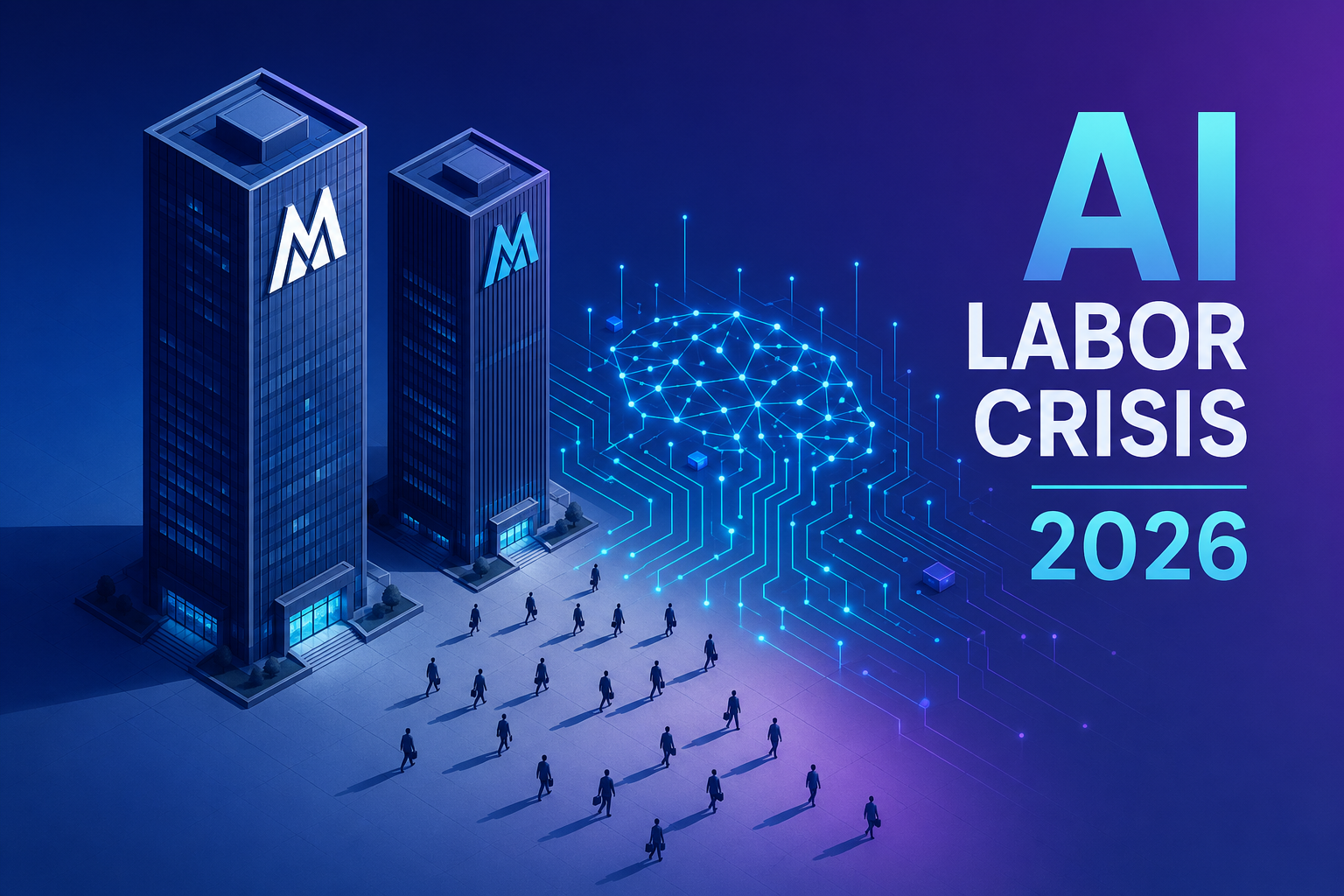
Twenty thousand pink slips landed in inboxes across Silicon Valley this spring, and the shockwave is still rippling through every coffee-shop conversation in the industry. Meta and Microsoft, two of the most profitable companies in human history, just announced a combined 20,000 job cuts — and unlike past rounds, executives are openly attributing the decision to artificial intelligence rather than market correction. The Meta and Microsoft 20,000 job cuts mark the clearest signal yet that the AI productivity wave is no longer hypothetical for white-collar workers; it is restructuring payrolls in real time.
If you write code, design systems, manage projects, or work in technical recruiting, this story matters. It is not just a news cycle — it is the opening chapter of a labor reorganization that will likely define the next decade of careers in technology.
What Just Happened: Breaking Down the 20,000 Job Cuts
In late April 2026, Meta confirmed it would eliminate roughly 8,000 positions across its Reality Labs, infrastructure, and recruiting divisions. Within days, Microsoft followed with cuts approaching 12,000 roles spanning Azure operations, Xbox studios, and middle-management layers. Together the announcements form one of the largest synchronized workforce reductions Big Tech has executed since the post-pandemic correction of 2023.
Unlike earlier layoff cycles, both companies were posting record profits when the cuts were announced. Meta’s most recent quarter showed operating margins above 40 percent. Microsoft’s cloud and AI segments grew double digits. The cuts, in other words, were not a response to losses — they were a response to a new theory of how software companies should be staffed.
The Numbers at a Glance
| Company | Roles Cut | Primary Divisions Affected | Stated Rationale |
|---|---|---|---|
| Meta | ~8,000 | Reality Labs, recruiting, middle management | “Year of Efficiency 2.0” and AI-assisted engineering |
| Microsoft | ~12,000 | Azure ops, gaming studios, sales support | AI tooling reducing duplicated headcount |
| Combined | ~20,000 | White-collar, technical, and creative roles | Restructuring around AI-native workflows |
Why These Tech Layoffs Feel Different
Layoffs are not new in technology — but the framing this time is. In 2023, executives blamed over-hiring during the pandemic. In 2024 and 2025, they pointed to interest rates and slower ad markets. In 2026, both Meta CEO Mark Zuckerberg and Microsoft CEO Satya Nadella have explicitly cited productivity gains from AI tooling as a justification for the reductions.
That shift in language is what is sparking the broader AI-driven labor crisis fears. When a profitable company says “we need fewer engineers because Copilot writes a third of our code,” it implicitly tells every other CEO that the same math could apply to them. The Meta and Microsoft 20,000 job cuts are functioning less as isolated events and more as a permission slip for the rest of the industry.
The previous decade’s tech layoffs were about cost. This decade’s layoffs are about capacity — how much output a single engineer with AI can now produce versus a team of five without it.
Defining the AI-Driven Labor Crisis
An AI-driven labor crisis describes a structural shift in employment where generative AI and autonomous agents reduce the number of humans needed to perform knowledge work, faster than the broader economy can create equivalent new roles. It differs from cyclical unemployment because the displaced jobs do not return when the economy recovers — they are absorbed by software permanently.
This definition matters because it separates short-term layoff anxiety from a long-term restructuring of who does what. The first is uncomfortable but recoverable. The second requires retraining, policy responses, and individual career adaptation.
Which Roles Are Actually Being Replaced?
If you scan internal memos and severance documents leaked from both companies, a clear pattern emerges. The cuts are concentrated in roles where AI tooling has matured fastest:
- Technical recruiters — automated sourcing and AI screening have collapsed early-funnel work
- Mid-level support engineers — Copilot-style assistants resolve a growing share of L1 and L2 tickets
- Content moderators and reviewers — multimodal models now handle most first-pass classification
- QA and manual testers — agentic test generators have reduced the need for repetitive manual cycles
- Middle managers of small teams — when a team shrinks from 8 to 3, its manager often shrinks to zero
Notably, senior staff engineers, ML researchers, security specialists, and infrastructure leads have largely been spared. The pattern suggests that tech layoffs in 2026 are not anti-engineer — they are anti-redundancy. Roles that involve judgment, novel problem-solving, and high-stakes ownership remain in demand.
Why You Should Care Even If You Are Not at Meta or Microsoft
Big Tech sets the tone for the rest of the industry. When Google cut perks in 2023, smaller startups followed within months. When Amazon mandated return-to-office in 2024, the policy spread. The Meta and Microsoft 20,000 job cuts will likely trigger a similar cascade. Expect three knock-on effects in the next 6 to 12 months:
- Mid-tier SaaS companies copy the playbook — companies with 500 to 5,000 employees will quietly reduce headcount under the banner of “AI efficiency”
- Hiring bars rise sharply — surviving roles demand demonstrated AI fluency, not just traditional skills
- Compensation bifurcates — top engineers who can wield agents see raises; everyone else sees flat or declining offers
How to Read the Signals: A Practical Code Example
Engineers who want to stay ahead can study what AI tooling actually does today. The simple Python snippet below uses an LLM to draft a pull-request review — the kind of task that previously required a junior engineer’s time. Understanding this workflow is now table stakes.
# review_pr.py — minimal AI-assisted code review
import os
from anthropic import Anthropic

client = Anthropic(api_key=os.environ["ANTHROPIC_API_KEY"])

def review_diff(diff_text: str) -> str:
    """Send a git diff to Claude and return a structured review."""
    prompt = (
        "You are a senior reviewer. For the diff below, list:\n"
        "1) bugs, 2) security issues, 3) style nits.\n"
        "Be specific and cite line numbers.\n\n"
        f"DIFF:\n{diff_text}"
    )
    msg = client.messages.create(
        model="claude-opus-4-7",
        max_tokens=1024,
        messages=[{"role": "user", "content": prompt}],
    )
    return msg.content[0].text

if __name__ == "__main__":
    with open("change.diff", "r", encoding="utf-8") as f:
        print(review_diff(f.read()))
This forty-line script replaces a non-trivial slice of what a junior reviewer used to do during code review. It does not replace senior judgment, architectural review, or production-readiness sign-off — but it does compress the routine pass-through work. Multiply that compression across thousands of pull requests per day at a company the size of Microsoft, and the staffing implications become obvious.
Historical Parallels: Have We Been Here Before?
Every major productivity shift has triggered fears of mass unemployment, and history offers a mixed record. The mechanization of agriculture in the early 1900s did permanently eliminate millions of farming jobs — but it also enabled the rise of manufacturing and services. The introduction of spreadsheets in the 1980s eliminated armies of bookkeepers but created the modern financial analyst profession. You can read more about these transitions in the Wikipedia article on technological unemployment.
The 2026 situation may follow a similar pattern, but the speed is unprecedented. Spreadsheets diffused over twenty years. Generative AI tooling has gone from curiosity to enterprise default in roughly thirty months. That compression is exactly why the Meta and Microsoft 20,000 job cuts are landing so hard — there is less time for displaced workers to retrain or for new categories of work to emerge.
What Workers Can Do Right Now
If you are an engineer, designer, or technical professional reading this on a Wednesday afternoon wondering whether your job is next, the honest answer is: probably not this quarter, but you should not assume forever. Here are concrete moves that compound over time.
Become AI-Fluent, Not AI-Dependent
Learn to use coding agents, not just to autocomplete lines but to scaffold entire features, write tests, and refactor legacy modules. Anthropic’s official API documentation and Microsoft’s Learn platform are both free and surprisingly thorough.
Move Up the Abstraction Stack
Routine implementation work is the most automatable layer. System design, distributed-systems debugging, security hardening, and product judgment are not. Bias your career toward the work AI is bad at: ambiguity, integration with messy real-world stakeholders, and decisions with irreversible consequences.
Build a Public Track Record
Open-source contributions, technical blog posts, and conference talks become more valuable in a tighter labor market because they substitute for the social proof a recruiter would otherwise provide. In an environment where 8,000 Meta recruiters were just laid off, your portfolio is your recruiter.
Common Misconceptions About the AI Labor Crisis
“AI Will Replace All Software Engineers”
This overstates the case. AI replaces tasks, not roles. Software engineering involves dozens of tasks, and only a fraction are currently automatable. The roles being eliminated tend to be those concentrated on a small number of routine tasks — not the full breadth of senior engineering work.
“This Is Just Another Layoff Cycle”
This understates the case. Previous cycles ended with rehiring once budgets recovered. The companies driving the Meta and Microsoft 20,000 job cuts are not budget-constrained — they are deliberately running with smaller, more AI-augmented teams as a permanent operating model.
“Junior Engineers Are Doomed”
The data is more nuanced. Entry-level roles that were essentially “do the routine thing the senior engineer described” are shrinking. Entry-level roles framed as “learn fast, ship judgment, and grow into ownership” are still being filled — but the bar is higher and the cohort is smaller.
Frequently Asked Questions
Are the Meta and Microsoft 20,000 job cuts permanent?
By all available signals, yes. Both companies have stated the reductions are part of a multi-year operating model, not a temporary cost-cutting measure. Severance packages and internal communications describe the cuts as structural rather than cyclical.
Will other big tech companies follow with similar AI-driven layoffs?
Almost certainly. Industry patterns show that when one or two market leaders make a workforce decision based on a new operating theory, peers tend to copy within two to four quarters. Expect Google, Amazon, and Salesforce to make comparable announcements before the end of 2026.
Which tech jobs are safest from AI replacement?
Roles that combine deep technical skill with high-stakes judgment remain safest: senior infrastructure engineers, security specialists, ML research scientists, applied AI engineers, and engineering managers of complex systems. Roles that are largely repetitive or well-documented are most exposed.
How can I tell if my role is at risk?
Ask three questions. First, can a current AI tool already do 30 percent or more of your daily output? Second, is the rest of your work documented well enough that a tool could learn it? Third, has your team’s headcount-to-output ratio been flagged in recent planning meetings? Two or more “yes” answers warrant active career planning.
Is now a bad time to study computer science?
No, but the curriculum matters. A computer science education focused only on syntax and rote algorithm practice is less valuable than it was five years ago. A curriculum that emphasizes systems thinking, applied AI, security, and the ability to direct AI tooling effectively is arguably more valuable than ever.
What policy responses are being discussed?
Governments in the EU, UK, and parts of the US are exploring expanded retraining credits, portable benefits for displaced workers, and AI-disclosure requirements for large employers. None have yet passed in a form that meaningfully changes the trajectory, so individual preparation remains the most reliable strategy.
Common Pitfalls to Avoid in Your Response
- Panic-pivoting into a new field without finishing your current strengths — depth still wins
- Refusing to use AI tools on principle while your peers ship twice as fast
- Ignoring soft skills — communication, mentorship, and stakeholder management are increasingly differentiating
- Over-indexing on certifications instead of shipping real projects
- Assuming tenure protects you — long tenure can actually increase replacement risk if your work has not evolved
The Bigger Picture: A Forced Conversation
Whatever your read on the long-term outcome, the Meta and Microsoft 20,000 job cuts have done something useful: they have forced a conversation that the industry has been avoiding for two years. Executives can no longer dismiss AI as a productivity rounding error. Workers can no longer treat it as someone else’s problem. Educators can no longer teach the same curriculum and assume graduates will have jobs waiting.
That conversation will be uncomfortable, but it is also where opportunity lives. The engineers, designers, and operators who treat 2026 as a forcing function — to learn fast, to ship visibly, and to take ownership of more of the stack — will likely look back on this moment as a turning point in their careers, not the end of one.
Conclusion
The Meta and Microsoft 20,000 job cuts are not just a headline; they are a structural signal that the AI-driven labor crisis has moved from forecast to operating reality. Both companies are profitable, both cited AI productivity as the rationale, and both are likely setting a template the rest of the industry will follow. For technical professionals, the response is not despair but deliberate adaptation: become fluent in AI tooling, move toward work that requires judgment, and build a public track record that travels with you. The next decade will reward the engineers who treat AI as a collaborator they direct, not a competitor they ignore. Watch this space carefully — the next round of announcements will tell us how broadly the Meta and Microsoft pattern is being copied, and how quickly.