The Dining Philosophers problem is a foundational scenario in concurrency and synchronization, vividly illustrating deadlock, starvation, and resource contention. This guide breaks down the problem, its insights, visualizes core concepts with Mermaid diagrams, and provides unique, interactive coding examples. Whether learning for interviews or system design, this article offers clarity, SEO-friendly depth, and hands-on understanding.
- Dining Philosophers: Problem Overview
- Mermaid Diagram: Visualizing the Scenario
- Why It Matters: Real-World Analogies
- The Problem: Deadlock, Starvation, Concurrency
- Naive Solution and its Pitfalls
- Deadlock-Free Solution: Pseudocode & Explanation
- Interactive Example: Try It Yourself (JavaScript)
- Key Takeaways
Dining Philosophers: Problem Overview
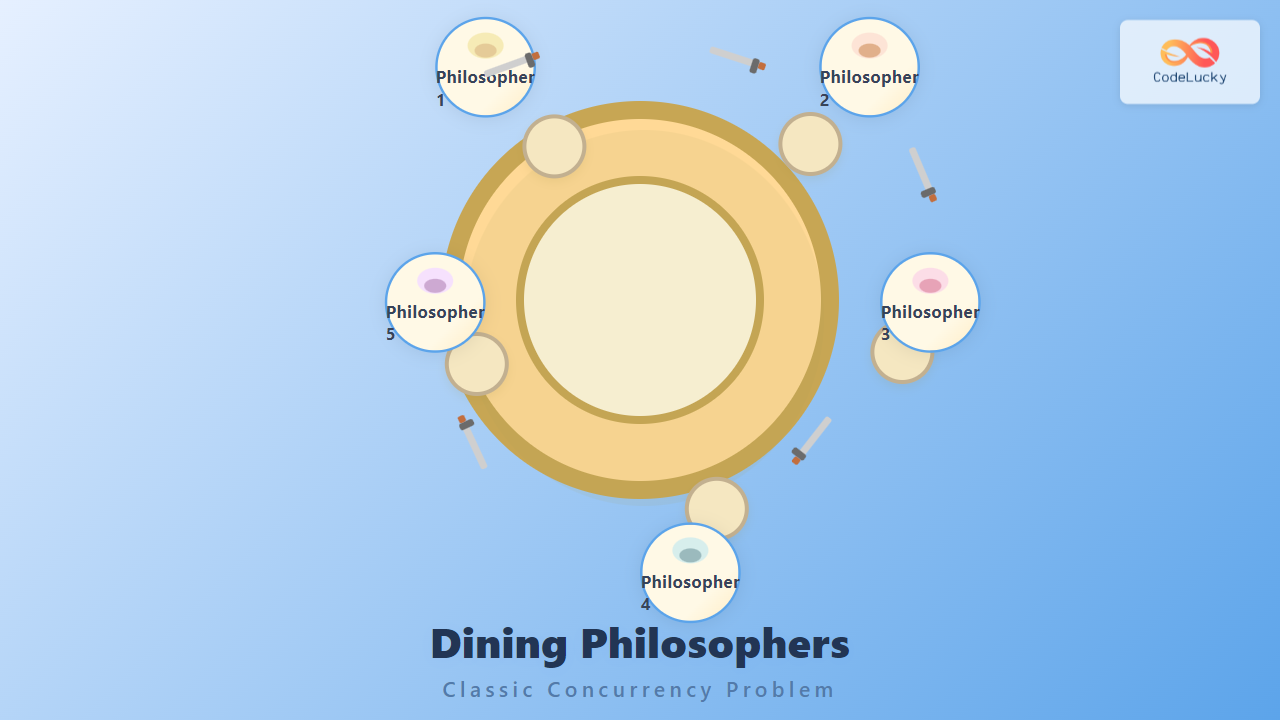
Five philosophers sit around a circular table. Each has a plate of food and a fork to their left and right (shared with their neighbors). To eat, a philosopher needs both the left and right fork. Philosophers alternate between thinking and eating; but if every philosopher picks up their left fork at once, a deadlock occurs, and none can eat. Proper synchronization solves this classic concurrency trap.
Mermaid Diagram: Visualizing the Scenario

As shown, philosophers are each linked to the two forks beside them. The structure creates contention for shared resources (forks) between neighbors.
Why It Matters: Real-World Analogies
- Database Transactions: Multiple transactions competing for exclusive locks on data.
- Operating System Processes: Competing for exclusive access to hardware or files.
- Multi-threaded Programs: Threads waiting for locks shared by others.
Learning to solve the Dining Philosophers problem is a critical step to mastering deadlock avoidance and efficient concurrency design in software engineering.
The Problem: Deadlock, Starvation, Concurrency
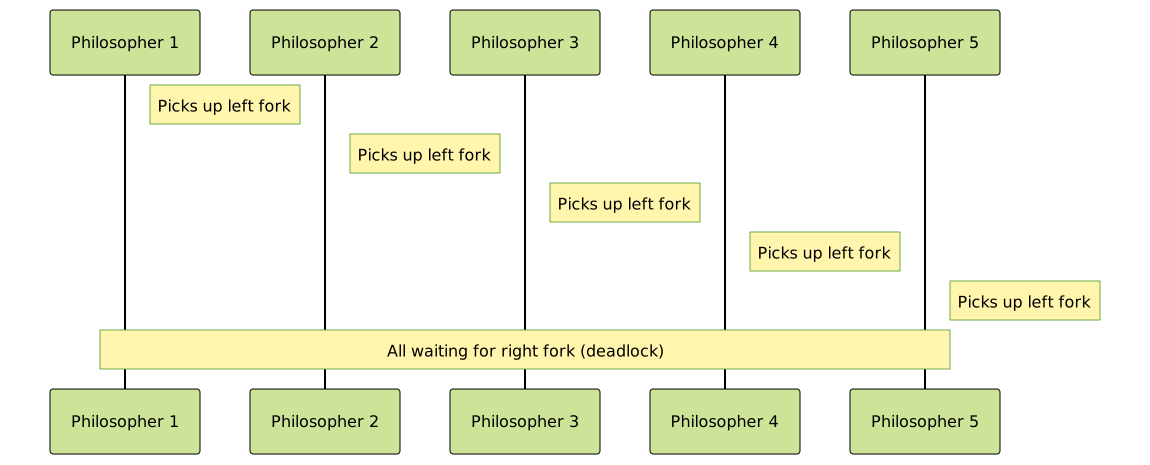
- Deadlock: Each philosopher picks up the left fork, causing everyone to wait infinitely for the right fork. No one eats.
- Starvation: A philosopher may forever miss out on eating if neighbors monopolize forks.
- Concurrency: Proper coordination enables all to alternate between thinking and eating efficiently.
Naive Solution and its Pitfalls
A simple naive algorithm for each philosopher:
while (true) {
  think();
  pick up left fork;
  pick up right fork;
  eat();
  put down left fork;
  put down right fork;
}
Problem: Every philosopher can pick up their left fork simultaneously, forever waiting on the right one—classic deadlock!
Deadlock-Free Solution: Pseudocode & Explanation
Several deadlock-free strategies exist, including:
- Arbitrator: A waiter ensures only four philosophers try to eat at once, preventing circular waits.
- Resource Ordering: Philosophers alternate the fork-picking order—odd-numbered take left then right; even-numbered take right then left.
Pseudocode (Resource Ordering):
while (true) {
  think();
  if (id % 2 == 0) {
    pick up right fork;
    pick up left fork;
  } else {
    pick up left fork;
    pick up right fork;
  }
  eat();
  put down left fork;
  put down right fork;
}

By eliminating circular waits, deadlock is avoided and philosophers continue to alternate eating and thinking.
Interactive Example: Try It Yourself (JavaScript)
Step through the Dining Philosophers using resource ordering strategy:
<script>
const N = 5;
let forks = Array(N).fill(false);
let eating = Array(N).fill(false);

function canEat(id) {
  let left = id, right = (id + 1) % N;
  return !forks[left] && !forks[right];
}

function tryEat(id) {
  let left = id, right = (id + 1) % N;
  if (id % 2 === 0) { // Even philosopher
    if (!forks[right] && !forks[left]) {
      forks[right] = forks[left] = true;
      eating[id] = true;
      return `Philosopher ${id} starts eating.`;
    }
  } else { // Odd philosopher
    if (!forks[left] && !forks[right]) {
      forks[left] = forks[right] = true;
      eating[id] = true;
      return `Philosopher ${id} starts eating.`;
    }
  }
  return `Philosopher ${id} is waiting.`;
}

function stopEat(id) {
  let left = id, right = (id + 1) % N;
  forks[left] = forks[right] = false;
  eating[id] = false;
  return `Philosopher ${id} stops eating.`;
}
// Example usage:
console.log(tryEat(0));
console.log(tryEat(1));
console.log(stopEat(0));
console.log(tryEat(1));
</script>
Paste this code in a browser console or JS playground to step through the dining philosophers logic, observing which philosophers wait or eat.

Key Takeaways
- The Dining Philosophers problem models real-world concurrency and resource contention, highlighting deadlock and starvation issues.
- Naive solutions easily lead to deadlock; elegant strategies (resource ordering, arbitrators, semaphores) ensure progress.
- Visualization and interactive code bring out the synchronization and solution strategies, preparing software engineers for practical concurrent system design.