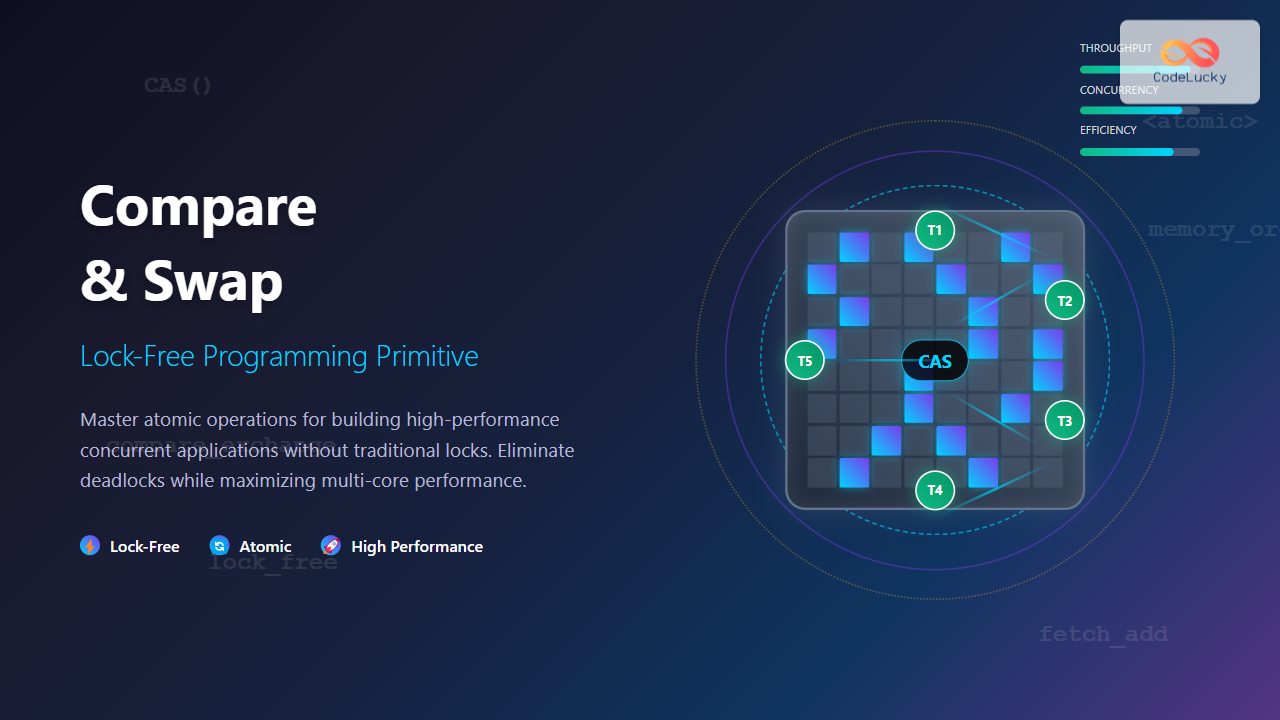
Compare and Swap (CAS) is a fundamental atomic operation that forms the backbone of lock-free programming and high-performance concurrent systems. This powerful primitive allows multiple threads to safely modify shared data without traditional locking mechanisms, resulting in better performance and avoiding common concurrency pitfalls like deadlocks.
What is Compare and Swap (CAS)?
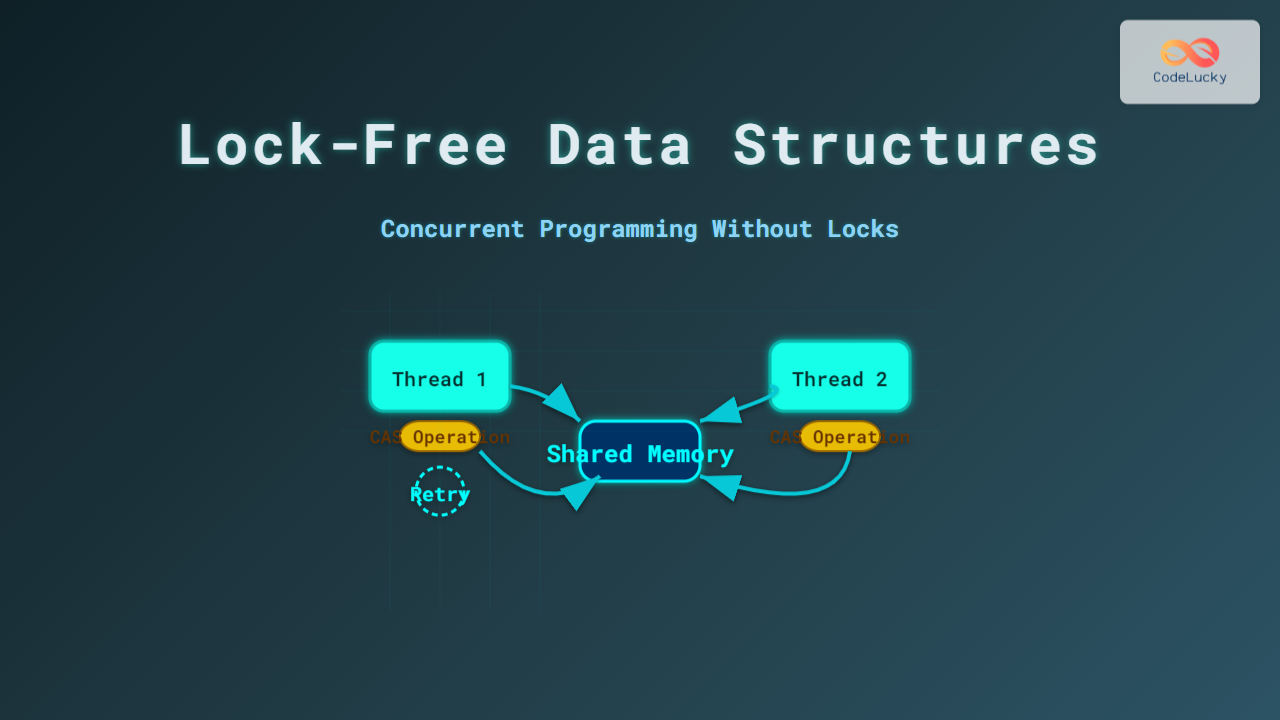
Compare and Swap is an atomic instruction that compares the contents of a memory location with a given value and, only if they match, modifies the contents to a new value. This entire operation happens atomically, meaning it cannot be interrupted by other threads.
The basic CAS operation can be described as:
boolean CAS(memory_location, expected_value, new_value) {
    if (*memory_location == expected_value) {
        *memory_location = new_value;
        return true;
    }
    return false;
}

How CAS Works Under the Hood
At the hardware level, CAS is implemented as a single atomic instruction supported by modern processors. Different architectures provide different implementations:
- x86/x64: CMPXCHG instruction
- ARM: LDREX/STREX instruction pair
- RISC-V: LR/SC (Load-Reserved/Store-Conditional)
- SPARC: CAS instruction
Memory Ordering and CAS
CAS operations typically provide sequential consistency, ensuring that all threads observe the same order of operations. However, modern implementations often allow specifying memory ordering constraints for better performance:
// C++ example with memory ordering
std::atomic<int> counter{0};

// Sequential consistency (default)
bool success = counter.compare_exchange_weak(expected, desired);

// Relaxed ordering for better performance
bool success = counter.compare_exchange_weak(expected, desired,
                                           std::memory_order_relaxed);
Advantages of Compare and Swap
1. Lock-Free Programming
CAS enables lock-free data structures that don’t suffer from the overhead and potential issues of traditional locks:
- No deadlock possibility
- No priority inversion
- Better scalability on multi-core systems
- Reduced context switching overhead
2. Performance Benefits
Lock-free algorithms using CAS often provide superior performance characteristics:
// Performance comparison example (conceptual)
// Traditional lock-based counter
class LockedCounter {
    private:
        int value = 0;
        mutex mtx;

    public:
        void increment() {
            lock_guard<mutex> lock(mtx);
            value++;
        }

        int get() {
            lock_guard<mutex> lock(mtx);
            return value;
        }
};

// Lock-free CAS-based counter
class LockFreeCounter {
    private:
        atomic<int> value{0};

    public:
        void increment() {
            int current = value.load();
            while (!value.compare_exchange_weak(current, current + 1)) {
                // Retry until successful
            }
        }

        int get() {
            return value.load();
        }
};
Common Use Cases and Applications
1. Atomic Counters
One of the simplest applications of CAS is implementing atomic counters without locks:
#include <atomic>
#include <thread>
#include <vector>
#include <iostream>

class AtomicCounter {
private:
    std::atomic<int> count{0};

public:
    void increment() {
        int expected = count.load();
        while (!count.compare_exchange_weak(expected, expected + 1)) {
            // CAS failed, expected was updated with current value
            // Loop will retry with the new expected value
        }
    }

    int getValue() const {
        return count.load();
    }
};

int main() {
    AtomicCounter counter;
    std::vector<std::thread> threads;

    // Launch 10 threads, each incrementing 1000 times
    for (int i = 0; i < 10; ++i) {
        threads.emplace_back([&counter]() {
            for (int j = 0; j < 1000; ++j) {
                counter.increment();
            }
        });
    }

    // Wait for all threads to complete
    for (auto& t : threads) {
        t.join();
    }

    std::cout << "Final counter value: " << counter.getValue() << std::endl;
    // Output: Final counter value: 10000

    return 0;
}
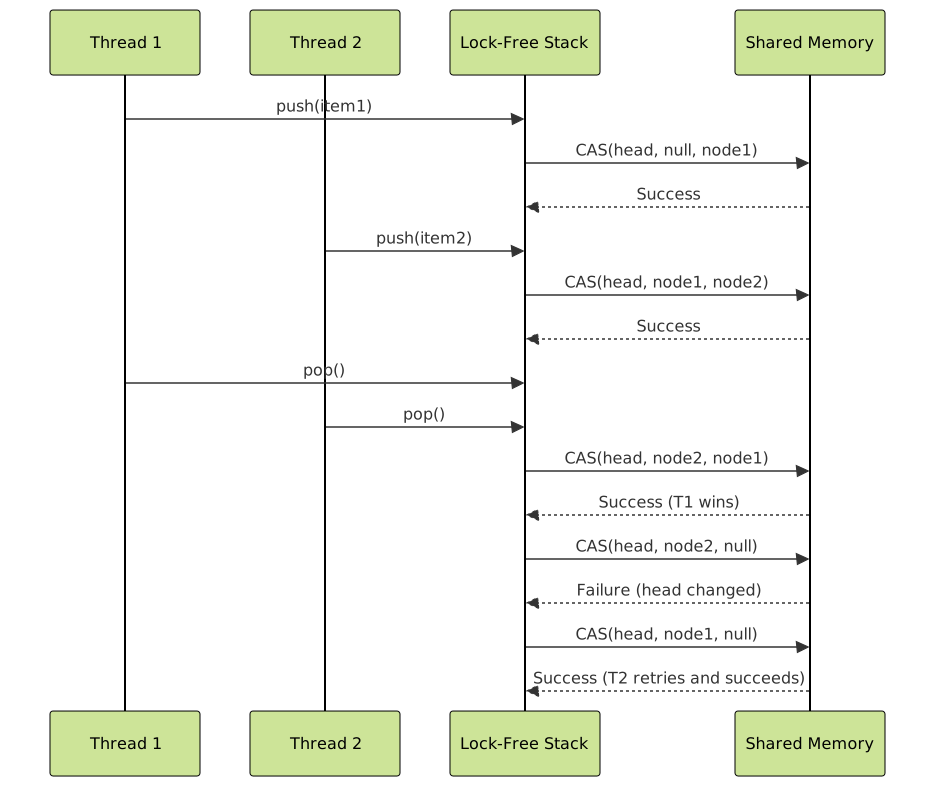
2. Lock-Free Stack Implementation
CAS is essential for implementing lock-free data structures like stacks:
template<typename T>
class LockFreeStack {
private:
    struct Node {
        T data;
        Node* next;
        Node(T item) : data(std::move(item)), next(nullptr) {}
    };

    std::atomic<Node*> head{nullptr};

public:
    void push(T item) {
        Node* new_node = new Node(std::move(item));
        new_node->next = head.load();

        while (!head.compare_exchange_weak(new_node->next, new_node)) {
            // CAS failed, new_node->next was updated with current head
            // Retry the operation
        }
    }

    bool pop(T& result) {
        Node* old_head = head.load();

        while (old_head &&
               !head.compare_exchange_weak(old_head, old_head->next)) {
            // CAS failed, old_head was updated with current head
            // Retry if head is not null
        }

        if (old_head) {
            result = std::move(old_head->data);
            delete old_head;
            return true;
        }

        return false; // Stack was empty
    }
};
3. Memory Management with CAS
CAS is crucial in memory management systems, particularly for reference counting:
class RefCountedObject {
private:
    mutable std::atomic<int> ref_count{0};

public:
    void addRef() const {
        int current = ref_count.load();
        while (!ref_count.compare_exchange_weak(current, current + 1)) {
            // Retry until successful
        }
    }

    bool releaseRef() const {
        int current = ref_count.load();
        while (true) {
            if (current == 0) {
                return false; // Object already destroyed
            }

            if (ref_count.compare_exchange_weak(current, current - 1)) {
                return current == 1; // Return true if this was the last reference
            }
            // current was updated by CAS failure, retry
        }
    }

    int getRefCount() const {
        return ref_count.load();
    }
};
CAS in Different Programming Languages
C++ std::atomic
#include <atomic>

std::atomic<int> value{10};
int expected = 10;
int desired = 20;

// Weak CAS - may fail spuriously on some architectures
if (value.compare_exchange_weak(expected, desired)) {
    std::cout << "CAS succeeded" << std::endl;
} else {
    std::cout << "CAS failed, current value: " << expected << std::endl;
}

// Strong CAS - will not fail spuriously
expected = 20;
desired = 30;
if (value.compare_exchange_strong(expected, desired)) {
    std::cout << "Strong CAS succeeded" << std::endl;
}
Java AtomicReference
import java.util.concurrent.atomic.AtomicReference;

public class CASExample {
    private AtomicReference<String> atomicString =
        new AtomicReference<>("initial");

    public boolean updateValue(String expectedValue, String newValue) {
        return atomicString.compareAndSet(expectedValue, newValue);
    }

    public String getValue() {
        return atomicString.get();
    }

    public static void main(String[] args) {
        CASExample example = new CASExample();

        // This will succeed
        boolean success1 = example.updateValue("initial", "updated");
        System.out.println("First update: " + success1); // true

        // This will fail because expected value doesn't match
        boolean success2 = example.updateValue("initial", "failed");
        System.out.println("Second update: " + success2); // false

        System.out.println("Current value: " + example.getValue()); // "updated"
    }
}
Go sync/atomic
package main

import (
    "fmt"
    "sync/atomic"
)

func main() {
    var value int64 = 10

    // Atomic compare and swap
    swapped := atomic.CompareAndSwapInt64(&value, 10, 20)
    fmt.Printf("CAS result: %v, new value: %d\n", swapped, value)
    // Output: CAS result: true, new value: 20

    // This will fail because current value is 20, not 10
    swapped = atomic.CompareAndSwapInt64(&value, 10, 30)
    fmt.Printf("CAS result: %v, current value: %d\n", swapped, value)
    // Output: CAS result: false, current value: 20
}
ABA Problem and Solutions
One of the most significant challenges with CAS operations is the ABA problem, where a value changes from A to B and back to A between CAS operations, potentially causing logical errors.

Example of ABA Problem
// Problematic scenario in a lock-free stack
class ProblematicStack {
    struct Node {
        int data;
        Node* next;
    };

    std::atomic<Node*> head;

public:
    bool pop(int& result) {
        Node* old_head = head.load();
        if (!old_head) return false;

        // DANGER: Between these two operations, another thread might:
        // 1. Pop this node (freeing it)
        // 2. Push it back (reusing the same memory address)
        // 3. The CAS below will succeed even though the stack changed!

        Node* new_head = old_head->next;
        if (head.compare_exchange_weak(old_head, new_head)) {
            result = old_head->data; // Potential use-after-free!
            delete old_head;
            return true;
        }
        return false;
    }
};
Solutions to ABA Problem
1. Version Numbers/Tags
template<typename T>
class TaggedPointer {
private:
    struct TaggedPtr {
        T* ptr;
        uint64_t tag;
    };

    std::atomic<TaggedPtr> tagged_ptr;

public:
    bool compare_exchange_weak(T* expected_ptr, T* desired_ptr) {
        TaggedPtr expected = tagged_ptr.load();
        if (expected.ptr != expected_ptr) return false;

        TaggedPtr desired = {desired_ptr, expected.tag + 1};
        TaggedPtr expected_tagged = {expected_ptr, expected.tag};

        return tagged_ptr.compare_exchange_weak(expected_tagged, desired);
    }
};
2. Hazard Pointers
class HazardPointer {
    static thread_local std::vector<void*> hazard_ptrs;

public:
    static void protect(void* ptr) {
        hazard_ptrs.push_back(ptr);
    }

    static void unprotect(void* ptr) {
        auto it = std::find(hazard_ptrs.begin(), hazard_ptrs.end(), ptr);
        if (it != hazard_ptrs.end()) {
            hazard_ptrs.erase(it);
        }
    }

    static bool is_protected(void* ptr) {
        return std::find(hazard_ptrs.begin(), hazard_ptrs.end(), ptr) != hazard_ptrs.end();
    }
};
Performance Considerations
CAS Performance Characteristics
- Contention Impact: High contention can lead to many CAS failures and retries
- Cache Line Bouncing: Multiple cores competing for the same cache line
- Memory Ordering Overhead: Stronger memory ordering guarantees cost performance
Optimization Techniques
// Exponential backoff to reduce contention
class OptimizedCounter {
private:
    std::atomic<int> count{0};

public:
    void increment() {
        int expected = count.load(std::memory_order_relaxed);
        int backoff = 1;

        while (!count.compare_exchange_weak(expected, expected + 1,
                                          std::memory_order_relaxed)) {
            // Exponential backoff
            for (int i = 0; i < backoff; ++i) {
                std::this_thread::yield();
            }
            backoff = std::min(backoff * 2, 1024);
        }
    }
};

// Batching operations to reduce CAS frequency
class BatchedCounter {
private:
    std::atomic<int> global_count{0};
    thread_local int local_count = 0;
    static const int BATCH_SIZE = 100;

public:
    void increment() {
        ++local_count;
        if (local_count >= BATCH_SIZE) {
            flush();
        }
    }

    void flush() {
        if (local_count > 0) {
            int expected = global_count.load();
            while (!global_count.compare_exchange_weak(expected,
                                                     expected + local_count)) {
                // Retry
            }
            local_count = 0;
        }
    }
};
When to Use CAS vs Traditional Locks

Use CAS When:
- Operations are simple (increment, swap, etc.)
- Low to moderate contention expected
- Maximum performance is critical
- Avoiding deadlocks is important
- Building foundational concurrent primitives
Use Traditional Locks When:
- Complex multi-step operations need atomicity
- Very high contention scenarios
- Code simplicity is more important than maximum performance
- Working with legacy systems or APIs
Real-World Examples and Benchmarks
Here’s a practical benchmark comparing different synchronization approaches:
#include <chrono>
#include <thread>
#include <vector>
#include <mutex>
#include <atomic>
#include <iostream>

class PerformanceTest {
public:
    // Test different counter implementations
    static void benchmarkCounters() {
        const int NUM_THREADS = 8;
        const int INCREMENTS_PER_THREAD = 1000000;

        std::cout << "Benchmarking different counter implementations:\n";
        std::cout << "Threads: " << NUM_THREADS << ", Increments per thread: "
                  << INCREMENTS_PER_THREAD << "\n\n";

        // Mutex-based counter
        auto mutex_time = benchmarkMutexCounter(NUM_THREADS, INCREMENTS_PER_THREAD);
        std::cout << "Mutex counter: " << mutex_time << "ms\n";

        // CAS-based counter
        auto cas_time = benchmarkCASCounter(NUM_THREADS, INCREMENTS_PER_THREAD);
        std::cout << "CAS counter: " << cas_time << "ms\n";

        // Relaxed atomic counter
        auto relaxed_time = benchmarkRelaxedCounter(NUM_THREADS, INCREMENTS_PER_THREAD);
        std::cout << "Relaxed atomic: " << relaxed_time << "ms\n";

        std::cout << "\nPerformance improvement:\n";
        std::cout << "CAS vs Mutex: " << (double(mutex_time) / cas_time) << "x faster\n";
        std::cout << "Relaxed vs CAS: " << (double(cas_time) / relaxed_time) << "x faster\n";
    }

private:
    static long benchmarkMutexCounter(int threads, int increments) {
        int counter = 0;
        std::mutex mtx;

        auto start = std::chrono::high_resolution_clock::now();

        std::vector<std::thread> workers;
        for (int i = 0; i < threads; ++i) {
            workers.emplace_back([&counter, &mtx, increments]() {
                for (int j = 0; j < increments; ++j) {
                    std::lock_guard<std::mutex> lock(mtx);
                    ++counter;
                }
            });
        }

        for (auto& t : workers) {
            t.join();
        }

        auto end = std::chrono::high_resolution_clock::now();
        return std::chrono::duration_cast<std::chrono::milliseconds>(end - start).count();
    }

    static long benchmarkCASCounter(int threads, int increments) {
        std::atomic<int> counter{0};

        auto start = std::chrono::high_resolution_clock::now();

        std::vector<std::thread> workers;
        for (int i = 0; i < threads; ++i) {
            workers.emplace_back([&counter, increments]() {
                for (int j = 0; j < increments; ++j) {
                    int expected = counter.load();
                    while (!counter.compare_exchange_weak(expected, expected + 1)) {
                        // Retry
                    }
                }
            });
        }

        for (auto& t : workers) {
            t.join();
        }

        auto end = std::chrono::high_resolution_clock::now();
        return std::chrono::duration_cast<std::chrono::milliseconds>(end - start).count();
    }

    static long benchmarkRelaxedCounter(int threads, int increments) {
        std::atomic<int> counter{0};

        auto start = std::chrono::high_resolution_clock::now();

        std::vector<std::thread> workers;
        for (int i = 0; i < threads; ++i) {
            workers.emplace_back([&counter, increments]() {
                for (int j = 0; j < increments; ++j) {
                    counter.fetch_add(1, std::memory_order_relaxed);
                }
            });
        }

        for (auto& t : workers) {
            t.join();
        }

        auto end = std::chrono::high_resolution_clock::now();
        return std::chrono::duration_cast<std::chrono::milliseconds>(end - start).count();
    }
};
Advanced CAS Patterns
Double-Width CAS (DCAS)
Some architectures support double-width CAS operations that can atomically update two adjacent memory locations:
// x86-64 CMPXCHG16B example (128-bit CAS)
struct alignas(16) DoubleWord {
    uint64_t low;
    uint64_t high;
};

bool double_cas(volatile DoubleWord* location,
                DoubleWord expected,
                DoubleWord desired) {
    return __sync_bool_compare_and_swap_16(
        reinterpret_cast<volatile __int128*>(location),
        *reinterpret_cast<__int128*>(&expected),
        *reinterpret_cast<__int128*>(&desired)
    );
}
Load-Link/Store-Conditional (LL/SC)
Some architectures provide LL/SC as an alternative to CAS, offering more flexibility:
// Conceptual LL/SC implementation
template<typename T>
class LLSCVariable {
private:
    std::atomic<T> value;
    thread_local bool reservation_valid = false;
    thread_local T reserved_value;

public:
    T load_linked() {
        reserved_value = value.load();
        reservation_valid = true;
        return reserved_value;
    }

    bool store_conditional(T new_value) {
        if (!reservation_valid) return false;

        T expected = reserved_value;
        bool success = value.compare_exchange_strong(expected, new_value);
        reservation_valid = false;
        return success && (expected == reserved_value);
    }
};
Debugging CAS-Based Code
Debugging lock-free code can be challenging. Here are some strategies:
class DebuggableAtomicCounter {
private:
    std::atomic<int> count{0};
    std::atomic<uint64_t> cas_attempts{0};
    std::atomic<uint64_t> cas_failures{0};

public:
    void increment() {
        int expected = count.load();
        cas_attempts.fetch_add(1, std::memory_order_relaxed);

        while (!count.compare_exchange_weak(expected, expected + 1)) {
            cas_failures.fetch_add(1, std::memory_order_relaxed);
        }
    }

    void printStats() {
        uint64_t attempts = cas_attempts.load();
        uint64_t failures = cas_failures.load();

        std::cout << "CAS Statistics:\n";
        std::cout << "  Total attempts: " << attempts << "\n";
        std::cout << "  Failures: " << failures << "\n";
        std::cout << "  Success rate: " << (100.0 * (attempts - failures) / attempts) << "%\n";
        std::cout << "  Current value: " << count.load() << "\n";
    }
};
Future of CAS and Lock-Free Programming
The future of CAS and lock-free programming looks promising with several emerging trends:
- Hardware Transactional Memory (HTM): Intel TSX and similar technologies
- Persistent Memory Support: CAS operations for non-volatile memory
- GPU Computing: Atomic operations in CUDA and OpenCL
- Formal Verification: Tools to verify correctness of lock-free algorithms
Conclusion
Compare and Swap is a powerful primitive that enables high-performance lock-free programming. While it comes with challenges like the ABA problem and complexity in debugging, the performance benefits and elimination of traditional locking issues make it an essential tool for system programmers and performance-critical applications.
Key takeaways for using CAS effectively:
- Start simple with atomic counters and basic data structures
- Be aware of the ABA problem and use appropriate mitigation strategies
- Profile your code to ensure CAS provides actual performance benefits
- Consider memory ordering requirements for your specific use case
- Use established libraries and patterns when possible rather than rolling your own
As multi-core systems become increasingly prevalent and performance demands continue to grow, mastering CAS and lock-free programming techniques becomes increasingly valuable for developing efficient concurrent applications.
Related Posts
Test and Set Lock: Complete Guide to Atomic Hardware Instructions for Process Synchronization
The Test and Set Lock is a fundamental atomic hardware instruction that plays a crucial role in process synchronization and...
C++ Atomic Operations: Lock-Free Programming
In the world of modern C++ programming, concurrency and parallelism have become increasingly important. As developers, we often need to...
Thread Synchronization: Mutexes, Semaphores and Deadlocks in Operating Systems
Introduction to Thread Synchronization Thread synchronization is a fundamental concept in operating systems that ensures multiple threads can safely access...
Spin Locks in Operating System: Complete Guide to Busy Waiting Synchronization
Spin locks are fundamental synchronization primitives in operating systems that implement busy waiting mechanisms to protect critical sections from concurrent...
C++ Thread Synchronization: Mutexes and Locks
In the world of modern C++ programming, multithreading has become an essential technique for improving application performance and responsiveness. However,...

C++ Condition Variables: Thread Communication
In the world of multithreaded programming, effective communication between threads is crucial for creating efficient and robust applications. C++ condition...
Monitor in Operating System: High-level Synchronization for Process Coordination
What is a Monitor in Operating System? A monitor is a high-level synchronization construct in operating systems that provides a...
Thread vs Process: Complete Guide to Differences and When to Use Each
Understanding the fundamental differences between threads and processes is crucial for system programming, application design, and performance optimization. While both...
Multithreading in Operating Systems: Benefits, Challenges, and Implementation Guide
What is Multithreading in Operating Systems? Multithreading is a fundamental concept in modern operating systems that allows a single process...
Binary Semaphore: Complete Guide to Mutual Exclusion Implementation in Operating Systems
What is a Binary Semaphore? A binary semaphore is a synchronization primitive in operating systems that can hold only two...
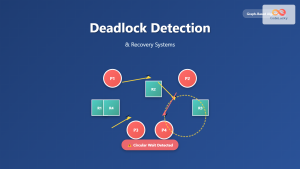
Deadlock Detection and Recovery: Graph-based Algorithms for Operating Systems
Introduction to Deadlock Detection and Recovery Deadlock is one of the most critical challenges in operating systems where multiple processes...

Mutex vs Semaphore: Complete Guide to Synchronization Primitives in Operating Systems
In the world of concurrent programming and operating systems, synchronization primitives are essential tools that prevent race conditions and ensure...