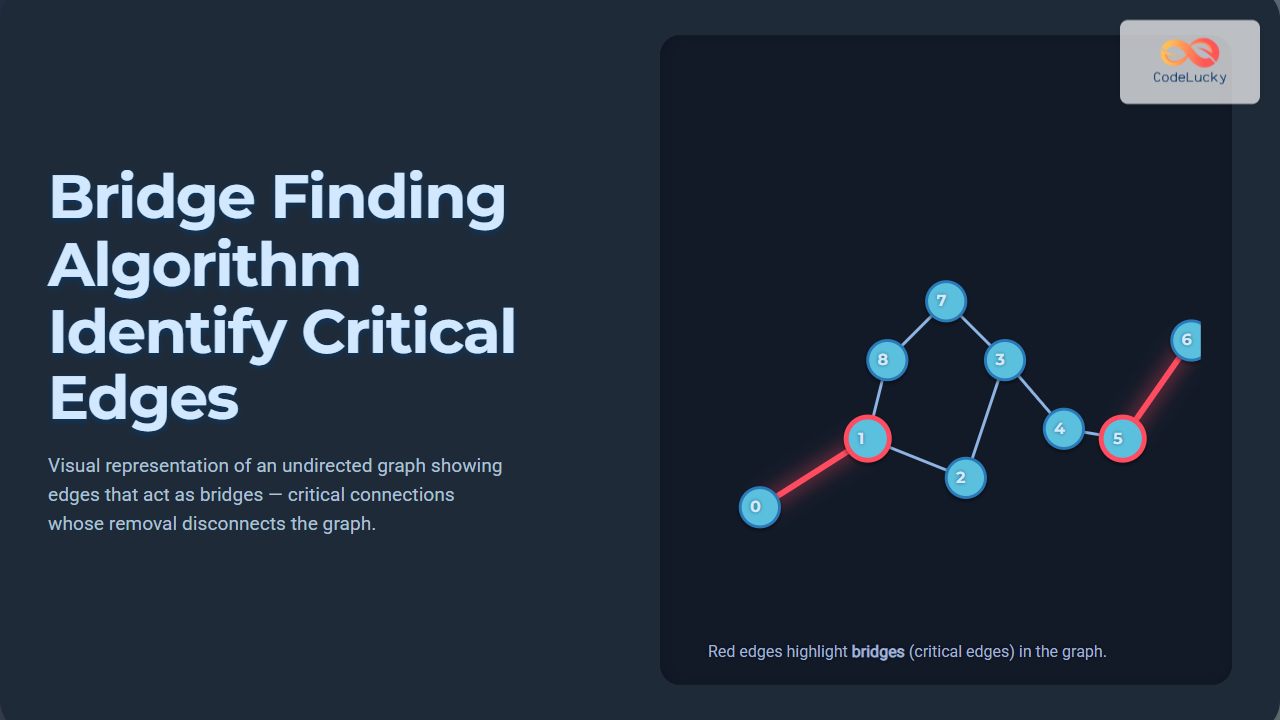
The Bridge Finding Algorithm is a fundamental technique in graph theory used to identify critical edges or bridges in an undirected graph. These edges are crucial because their removal increases the number of connected components, effectively disconnecting parts of the graph. Recognizing such edges is particularly important in network design, infrastructure reliability, and fault-tolerant systems.
What is a Bridge in a Graph?
In an undirected graph, a bridge (also called a cut-edge) is an edge that, if removed, increases the number of connected components of the graph. In other words, it disconnects some portion of the graph that was previously reachable. Bridges are critical for understanding graph connectivity.

For example, in the graph above, the edge between A and B is a bridge because removing it disconnects vertex A from the rest of the graph, while edges in the cycle (like C - E) are not bridges.
Why Find Bridges?
- Network Reliability: Bridges represent single points of failure in communication, transportation, or utility networks.
- Connectivity Analysis: Understanding how removal of edges affects connectivity helps improve resilience.
- Graph Decomposition: Bridges allow decomposition of graphs into 2-edge-connected components, useful in advanced algorithms.
Algorithm Overview: Tarjan’s Bridge Finding Algorithm
The most efficient method to find bridges in a graph is based on a modified depth-first search (DFS), pioneered by Robert Tarjan. It runs in O(V + E) time, where V is vertices and E is edges.
Key Concepts
- Discovery Time (
disc[u]): The time when a vertexuis first visited. - Low Value (
low[u]): The earliest visited vertex reachable fromuor its descendants, including back edges.
The key insight: an edge (u, v) is a bridge if low[v] > disc[u]. This means vertex v and its descendants cannot reach u or any ancestors of u except through the edge (u, v).
Step-by-Step Explanation

- Initialize: Set discovery times and low values to -1 (unvisited).
- DFS Traversal: For every unvisited vertex, run DFS, assigning discovery times.
- Update Low Values: For each neighbor, update
low[u]considering back edges and descendants. - Identify Bridges: If
low[v] > disc[u], edge(u, v)is a bridge.
Code Example in Python
def bridge_finding_algorithm(graph):
    time = 0
    n = len(graph)
    disc = [-1] * n
    low = [-1] * n
    parent = [-1] * n
    bridges = []

    def dfs(u):
        nonlocal time
        disc[u] = time
        low[u] = time
        time += 1

        for v in graph[u]:
            if disc[v] == -1:
                parent[v] = u
                dfs(v)
                low[u] = min(low[u], low[v])

                if low[v] > disc[u]:
                    bridges.append((u, v))
            elif v != parent[u]:
                low[u] = min(low[u], disc[v])

    for i in range(n):
        if disc[i] == -1:
            dfs(i)

    return bridges

# Example Usage:
graph = [
    [1],          # 0
    [0, 2, 3],    # 1
    [1, 3],       # 2
    [1, 2, 4],    # 3
    [3, 5],       # 4
    [4]           # 5
]

print("Bridges:", bridge_finding_algorithm(graph))
This example graph has edges like (3, 4) and (4, 5) which are bridges because their removal increases disconnected components.
Visualizing Bridge Detection

In this graph, edges 3-4 and 4-5 are bridges. Removing them breaks connectivity.
Interactive Explanation (Concept)
An interactive visualization can help explore how the algorithm discovers bridges during DFS traversal:
- Start DFS from a source node.
- Watching the discovery times and low values populating as nodes are visited.
- Highlight the edges identified as bridges dynamically.
Such an interactive tool helps in understanding the flow of DFS and conditions that create bridges.
Complexity Analysis
The algorithm runs in O(V + E) time since every vertex and edge is visited once during DFS. The space complexity is O(V) for storing discovery, low arrays, and recursion stack.
Common Applications
- Identifying vulnerability in communication and transportation networks.
- Analyzing social networks to find critical relationships.
- Graph decomposition techniques in advanced algorithms.
Summary
The Bridge Finding Algorithm efficiently detects critical edges that if removed, partition the graph. Using DFS and the concepts of discovery and low values, the algorithm identifies these edges in linear time. Understanding bridges is valuable in network design, reliability studies, and graph theory.