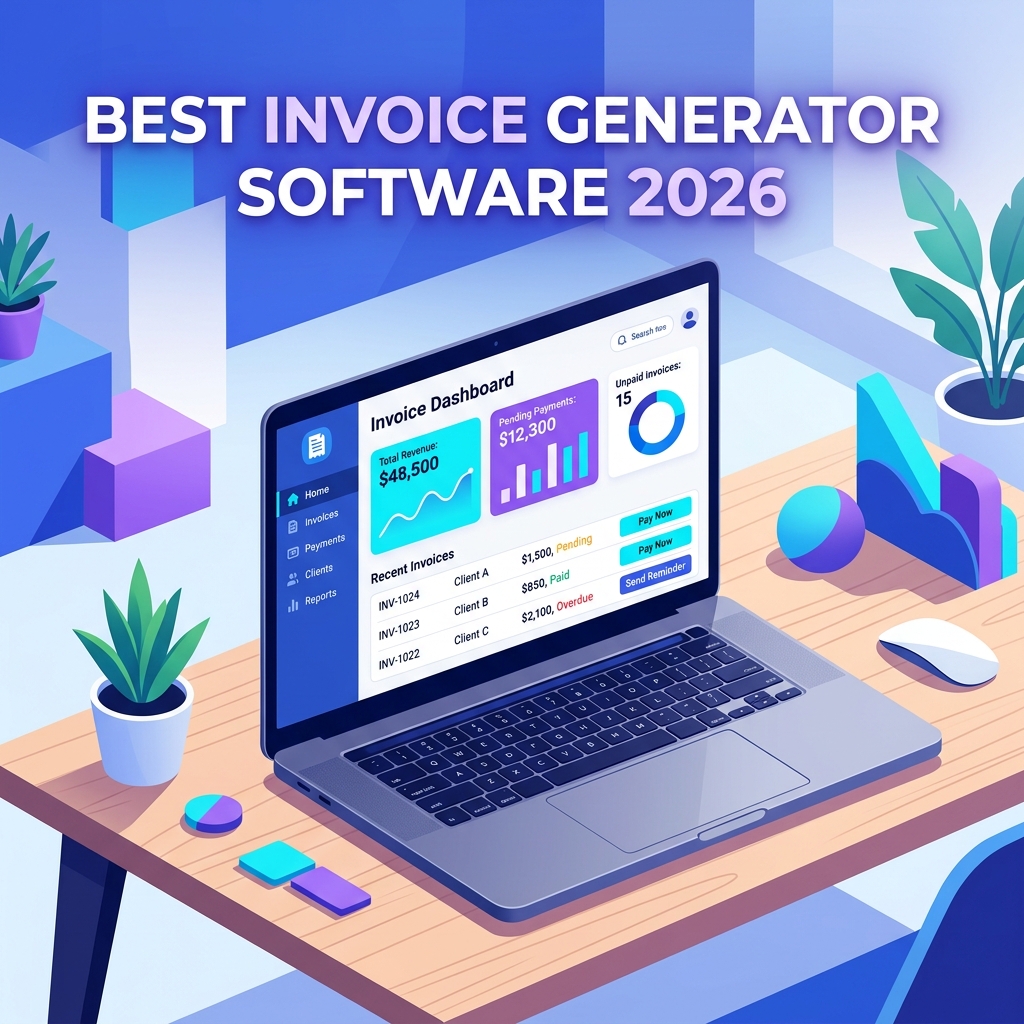
Chasing unpaid invoices is the silent tax every small business owner pays. You finish the work, send a quick PDF cobbled together in a word processor, and then watch your inbox while the payment due date slides past. The right invoice generator software turns that grind into a background process: invoices go out on schedule, reminders nudge late payers, and your books reconcile themselves. In 2026, the gap between businesses that automate billing and those that don’t shows up directly in cash flow.
This guide breaks down the best invoice generator software for small businesses in 2026, compares pricing and features honestly, and shows you how to pick a tool that fits the way you actually work — whether you’re a solo freelancer, a five-person agency, or a growing e-commerce store.
What Invoice Generator Software Actually Does
Invoice generator software is a billing tool that lets you create, send, track, and reconcile professional invoices without manually formatting documents or chasing payments. Modern platforms combine invoice creation with tax calculation, payment processing, recurring billing, expense tracking, and accounting integrations — so a single click can move an invoice from “draft” to “paid” inside your books.
Underneath the dashboard, most tools share the same core engine: a template system, a client database, a tax rules table, and a payment gateway connector. What separates them is how much friction they remove and how cleanly they hand data off to the rest of your stack.
Why Small Businesses Need Dedicated Invoicing Tools in 2026
Spreadsheets and Word templates technically work — until they don’t. Once you’re issuing more than five invoices a month, the manual approach starts costing you in three ways: lost time, late payments, and tax errors.
- Compliance has gotten stricter. Many jurisdictions now require structured e-invoicing formats (Peppol, FatturaPA, e-Invoice India). Generic PDFs no longer cut it for B2B billing in several regions.
- Customers expect online payment. An invoice with a “Pay Now” button gets paid roughly twice as fast as one with bank instructions in the footer.
- AI is now the baseline, not the upsell. Top tools auto-categorize expenses, draft invoices from email threads, and forecast cash flow without you asking.
If you’re billing more than once a week, the time you save in a month usually pays for the software for the year.
Key Features to Look For in Invoice Generator Software
Not every business needs every feature. But before you commit to a platform, walk through this checklist and decide which items are non-negotiable for your workflow.
Core Invoicing Capabilities
- Customizable templates with your logo, brand colors, and fonts
- Multi-currency and multi-language support
- Automatic tax calculation (GST, VAT, sales tax) by region
- Recurring invoices for retainer and subscription clients
- Estimates and quotes that convert to invoices in one click
Payments and Cash Flow
- Native integration with Stripe, PayPal, or local payment gateways
- ACH, credit card, and bank transfer support
- Automated payment reminders at 3, 7, and 14 days overdue
- Partial payments and deposits
Bookkeeping and Reporting
- Direct sync with QuickBooks, Xero, or Wave
- Profit and loss, aged receivables, and tax summary reports
- Exportable CSV/PDF for accountants
- Audit trail for compliance
If your accountant rolls their eyes at the file you send every quarter, choose a tool with a one-click export your accountant has actually used before. It’s the cheapest favor you can do for your bookkeeping.
Best Invoice Generator Software for Small Businesses in 2026
These are the platforms that consistently lead the small business invoicing space in 2026, picked across price tiers and use cases. None of them are perfect — each section calls out the trade-offs honestly.
1. FreshBooks — Best Overall for Service Businesses
FreshBooks remains the default recommendation for service-based small businesses because it’s built around the way they actually bill: time-tracked hours, project retainers, and milestone payments. The interface is friendly enough for non-accountants, and the mobile app handles real-world tasks like sending an invoice from a job site.
Strengths: Time tracking baked in, excellent client portal, strong proposals, robust reporting. Weaknesses: Pricing scales by number of billable clients, which can sting once you grow. Starts around $19/month.
2. Zoho Invoice — Best Free Option
Zoho Invoice is genuinely free for businesses with under a certain client count, with no ads and no time-locked trial games. You get recurring invoices, payment reminders, multi-currency, and a client portal — features competitors charge for. The catch is the upsell pressure into the wider Zoho ecosystem, which is fine if you want it and noisy if you don’t.
Strengths: Free, mature, well-integrated. Weaknesses: Reporting depth lags behind paid competitors; ecosystem lock-in.
3. Wave — Best for Solo Freelancers
Wave gives you unlimited invoicing free, then makes money on payment processing fees. For a freelancer billing a handful of clients monthly, it’s effectively a permanent free tier with respectable bookkeeping bolted on. The payment processing fees are slightly higher than direct Stripe, so once you cross significant monthly volume, it stops being the cheap option.
4. QuickBooks Online — Best for Businesses That Will Outgrow Anything Else
QuickBooks isn’t the cheapest or the prettiest, but it’s the tool your accountant already knows. If you plan to hire a bookkeeper or scale past ten employees, starting on QuickBooks saves a painful migration later. The invoicing module is competent — not class-leading, but tightly integrated with the rest of the platform.
5. Xero — Best for Multi-Currency and International Teams
Xero handles multi-currency, international tax rules, and global payment gateways more gracefully than any North-America-first competitor. Agencies and SaaS companies with clients across regions tend to land here. Read the official Xero documentation on multi-currency setup before committing — it has quirks worth understanding upfront.
6. Invoice Ninja — Best Self-Hosted Open Source Option
If you want full control over your data, Invoice Ninja offers a self-hosted version under an open-source license. You install it on your own server, customize it freely, and pay nothing in subscription fees. The trade-off is operational: you’re responsible for backups, updates, and security patches.
Pricing Comparison Table
| Software | Free Tier | Starting Paid Plan | Best For | Payment Processing |
|---|---|---|---|---|
| FreshBooks | 30-day trial | $19/month | Service businesses | 2.9% + 30¢ |
| Zoho Invoice | Yes (limited clients) | Bundled in Zoho One | Budget-conscious teams | Gateway dependent |
| Wave | Yes (unlimited invoices) | Pay-as-you-go | Solo freelancers | 2.9% + 60¢ |
| QuickBooks Online | 30-day trial | $30/month | Growing businesses | 2.9% + 25¢ |
| Xero | 30-day trial | $15/month | International teams | Stripe/PayPal native |
| Invoice Ninja | Self-hosted free | $10/month cloud | Developers / data control | 50+ gateways |
Pricing changes frequently — always confirm on the vendor’s own site before buying. The relative ranking, however, has been stable for the past few years.
Automating Invoices With APIs and Webhooks
Most of the platforms above expose a REST API, which means you can generate invoices from your own application — useful if you run an e-commerce store, a SaaS product, or any custom workflow. Here’s a minimal example using the Stripe invoicing API in Node.js:
// Create and send an invoice programmatically with Stripe
const Stripe = require('stripe');
const stripe = Stripe(process.env.STRIPE_SECRET_KEY);

async function billClient(customerId, amountInCents, description) {
  // Add a one-off line item to the customer
  await stripe.invoiceItems.create({
    customer: customerId,
    amount: amountInCents,
    currency: 'usd',
    description,
  });

  // Create the invoice and auto-finalize it
  const invoice = await stripe.invoices.create({
    customer: customerId,
    collection_method: 'send_invoice',
    days_until_due: 14,
  });

  // Send the invoice to the customer's email
  await stripe.invoices.sendInvoice(invoice.id);

  return invoice.hosted_invoice_url;
}
This function attaches a charge to a customer, generates a real invoice, and emails them a hosted payment page. You can wire it into a “Project Completed” button in your internal tool, or schedule it as a cron job for recurring clients. Most invoicing platforms — Zoho, Xero, QuickBooks, Invoice Ninja — offer similar endpoints with slightly different shapes.
Setting Up Recurring Invoices the Right Way
Recurring billing is where most small businesses leak revenue. A retainer client who pays $2,000 monthly should never require you to remember anything. Follow this pattern when you set up recurring invoices in any tool:
- Lock the schedule before the first invoice. Define the start date, frequency, and end date (or “until canceled”) in writing with the client.
- Enable auto-charge with stored card or bank details when the client agrees. Manual pay-on-receipt for recurring work creates avoidable late payments.
- Set a dunning sequence: automatic retries on failed cards at 1, 3, and 7 days, then an email handoff to you.
- Send a renewal heads-up 30 days before the cycle ends so clients aren’t surprised by a charge.
A well-configured recurring invoice should require zero touches from you between setup and tax season.
Common Pitfalls to Avoid
Even with the best invoice generator software, a few avoidable mistakes drag down cash flow. Watch for these:
- Vague line items. “Consulting services — $5,000” invites disputes. Itemize deliverables, dates, and rates.
- No payment terms on the invoice. If it doesn’t say “Net 14” or “Due on receipt,” your client’s AP department defaults to Net 45.
- Sending PDFs only. A PDF with no pay-now link is friction. Always include the hosted payment URL.
- Ignoring tax rules for digital services. VAT, GST, and US economic nexus rules now apply across borders. Configure your tool to apply the right rate by client location.
- Not reconciling weekly. Marking invoices “paid” by memory leads to silent revenue leaks. Reconcile with your bank feed on a fixed cadence.
- Picking software based on price alone. A $10/month tool that doesn’t integrate with your accountant’s stack costs you more in cleanup time than a $30/month tool that does.
How to Choose the Right Tool for Your Business
Cut the shortlist down with three honest questions.
How many invoices do you send per month? Under 10: Wave or Zoho Invoice free tiers are plenty. 10–50: FreshBooks or Xero hit the sweet spot. 50+: QuickBooks Online or a self-hosted Invoice Ninja with API automation.
Who else touches your books? If you have an accountant, ask which tool they prefer for clients your size. The 20 minutes that call takes is worth more than any feature comparison chart.
Where will you be in two years? A solo freelancer hiring contractors in 18 months should not pick the cheapest tool today and migrate later. Migration is brutal — historical invoices, client records, and tax data rarely transfer cleanly.
For broader context on small business financial tooling and tax compliance, the U.S. Small Business Administration publishes vendor-neutral guides worth reading before you commit.
Frequently Asked Questions About Invoice Generator Software
What is the best free invoice generator software for small businesses?
For most solo operators, Wave and Zoho Invoice are the strongest free options in 2026. Wave wins on unlimited invoicing and basic bookkeeping; Zoho wins on feature depth and ecosystem integration. Both are real products, not stripped trials.
Can I generate invoices that comply with VAT and GST rules automatically?
Yes. FreshBooks, Xero, QuickBooks, and Zoho all support automatic VAT and GST calculation based on client location and product type. You configure your tax registrations once, and the software applies the correct rate per invoice. For multi-region businesses, verify the tool supports e-invoicing formats required in your markets (Peppol in the EU, e-Invoice in India, etc.).
How is invoice generator software different from accounting software?
Invoice software focuses narrowly on creating, sending, and collecting on bills. Accounting software adds general ledger, expense tracking, payroll, and financial reporting. Many tools (QuickBooks, Xero, FreshBooks) do both. Pure invoice tools (Invoice Ninja, Zoho Invoice) are lighter and cheaper but require a separate accounting solution as you grow.
Are invoice generators secure enough for sensitive client data?
Established cloud platforms use bank-grade encryption, SOC 2 compliance, and PCI-DSS for payment data. The bigger risk is usually weak passwords and shared accounts on your side. Enable two-factor authentication, restrict user roles, and rotate API keys annually.
Can I switch invoice software without losing my history?
Mostly. Client lists, product catalogs, and outstanding invoices usually export cleanly via CSV. Paid invoice history and PDFs are harder — most tools let you export them, but the new tool won’t fully reconcile them into its reports. Plan switches at fiscal year boundaries to minimize the mess.
Do I really need software if I only send a few invoices a month?
If you send fewer than three invoices a month and have no growth plans, a clean template and a Stripe payment link will do. The moment you add a second client, a recurring engagement, or a tax jurisdiction, dedicated invoice generator software pays for itself within the first quarter.
Conclusion
The best invoice generator software for small businesses in 2026 is the one that disappears into your workflow — sends invoices on time, collects payments without nagging, and hands clean data to your accountant. FreshBooks remains the strongest all-rounder for service businesses, Wave and Zoho Invoice lead the free tier, and QuickBooks or Xero are the safe long-term bets once you scale.
Pick based on where your business will be in two years, not where it is today. Set up recurring invoices and dunning automation on day one, integrate with your accounting stack early, and treat your invoice generator software as the cash-flow engine it actually is — not just a PDF maker with a logo on top.