Introduction to Wait-for Graphs
In distributed systems, deadlock detection remains one of the most critical challenges for maintaining system reliability and performance. A wait-for graph serves as a fundamental data structure for identifying and resolving deadlocks across multiple processes and resources in distributed environments.
Unlike centralized systems where deadlock detection can be performed locally, distributed systems require sophisticated mechanisms to track dependencies across network boundaries. The wait-for graph provides a visual and algorithmic approach to represent process dependencies and detect circular waiting conditions that lead to deadlocks.
Understanding Deadlock in Distributed Systems
What is a Deadlock?
A deadlock occurs when two or more processes are permanently blocked, each waiting for resources held by the other processes. In distributed systems, this complexity multiplies as processes may exist on different machines, making detection and resolution significantly more challenging.
Necessary Conditions for Deadlock
For a deadlock to occur, four conditions must be satisfied simultaneously:
- Mutual Exclusion: Resources cannot be shared and can only be used by one process at a time
- Hold and Wait: Processes hold allocated resources while waiting for additional resources
- No Preemption: Resources cannot be forcibly removed from processes
- Circular Wait: A circular chain of processes exists where each process waits for a resource held by the next process
Wait-for Graph Fundamentals
Structure and Components
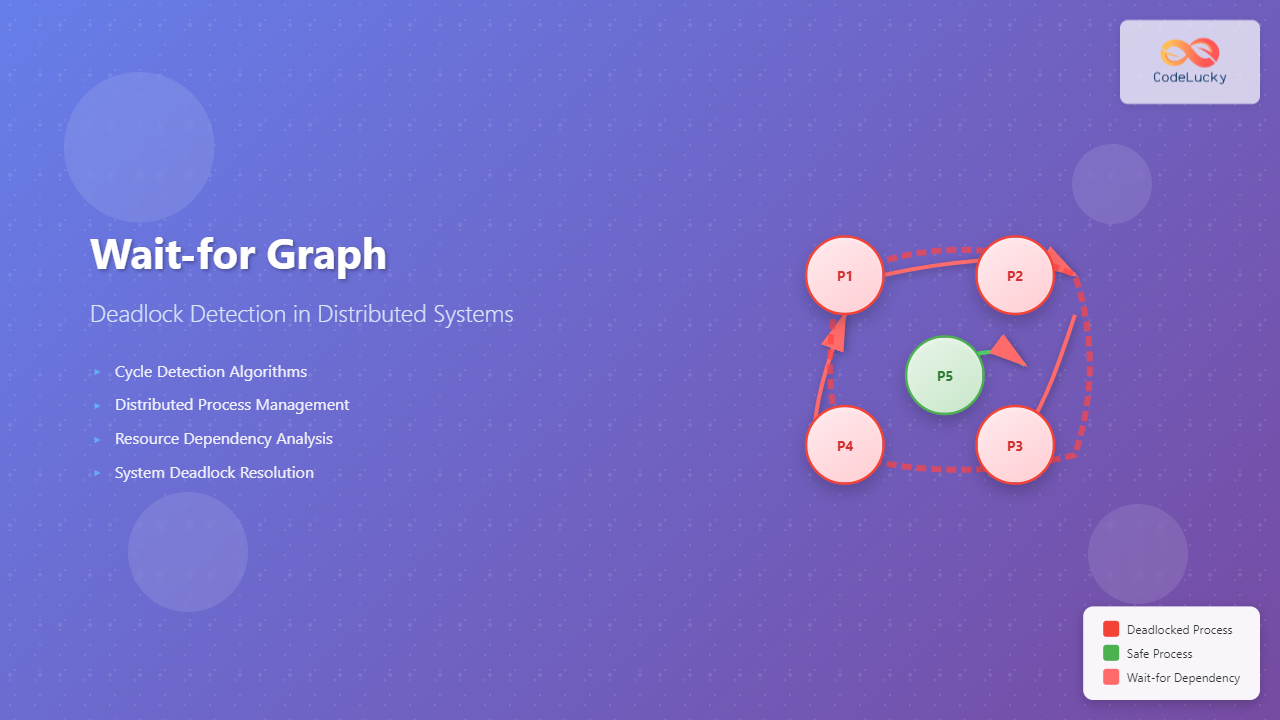
A wait-for graph is a directed graph where:
- Nodes: Represent processes or transactions in the system
- Directed Edges: Represent waiting relationships (Process A → Process B means A is waiting for B)
- Cycles: Indicate the presence of deadlocks

Types of Wait-for Graphs
Single-Site Wait-for Graph: Used in centralized systems where all processes and resources exist on a single machine.
Multi-Site Wait-for Graph: Distributed across multiple sites in a distributed system, requiring coordination between different nodes.
Deadlock Detection Algorithms
Centralized Deadlock Detection
In centralized detection, one designated site maintains the global wait-for graph and performs deadlock detection:

Algorithm Steps:
- Each site sends local dependency information to the central coordinator
- Central coordinator constructs the global wait-for graph
- Cycle detection algorithm identifies deadlocks
- Resolution commands are sent back to participating sites
Distributed Deadlock Detection
Distributed detection eliminates single points of failure by distributing detection responsibilities across multiple sites:

Implementation Strategies
Edge-Chasing Algorithm
The edge-chasing algorithm is widely used for distributed deadlock detection. It works by sending probe messages along the edges of the wait-for graph:
Algorithm Implementation:
class EdgeChasingDetector:
    def __init__(self):
        self.local_graph = {}
        self.probe_messages = {}

    def add_edge(self, from_process, to_process):
        if from_process not in self.local_graph:
            self.local_graph[from_process] = []
        self.local_graph[from_process].append(to_process)

    def initiate_probe(self, initiator, current, path):
        probe_id = f"{initiator}_{current}_{len(path)}"

        if current == initiator and len(path) > 1:
            return self.handle_deadlock(path)

        if current in self.local_graph:
            for next_process in self.local_graph[current]:
                new_path = path + [next_process]
                self.send_probe(probe_id, initiator, next_process, new_path)

    def handle_deadlock(self, cycle_path):
        print(f"Deadlock detected: {' -> '.join(cycle_path)}")
        return self.resolve_deadlock(cycle_path)
Timeout-Based Detection
This approach uses timeouts to detect potential deadlocks, assuming that processes waiting beyond a threshold are likely involved in deadlocks:
class TimeoutDetector:
    def __init__(self, timeout_threshold=30):
        self.timeout_threshold = timeout_threshold
        self.waiting_processes = {}
        self.start_times = {}

    def register_wait(self, process_id, resource_id):
        self.waiting_processes[process_id] = resource_id
        self.start_times[process_id] = time.time()

    def check_timeouts(self):
        current_time = time.time()
        suspected_deadlocks = []

        for process_id, start_time in self.start_times.items():
            if current_time - start_time > self.timeout_threshold:
                suspected_deadlocks.append(process_id)

        return self.analyze_suspected_processes(suspected_deadlocks)
Advanced Techniques
Hierarchical Deadlock Detection
Large distributed systems often employ hierarchical detection to manage complexity and reduce communication overhead:

Phantom Deadlock Prevention
Phantom deadlocks occur when the global state used for detection is inconsistent due to message delays. Prevention techniques include:
- Timestamp-based ordering: Using logical timestamps to ensure consistent global state
- Atomic snapshot algorithms: Capturing consistent global snapshots
- Vector clocks: Maintaining causal ordering of events
Real-World Applications
Database Management Systems
Distributed databases extensively use wait-for graphs for transaction deadlock detection:
class DatabaseDeadlockDetector:
    def __init__(self):
        self.transaction_graph = TransactionWaitGraph()
        self.lock_manager = DistributedLockManager()

    def detect_deadlock(self):
        # Build wait-for graph from lock dependencies
        self.build_graph_from_locks()

        # Detect cycles using DFS
        cycles = self.find_cycles_dfs()

        if cycles:
            victim_transaction = self.select_victim(cycles[0])
            self.abort_transaction(victim_transaction)
            return True

        return False

    def select_victim(self, cycle):
        # Choose transaction with least cost to abort
        min_cost = float('inf')
        victim = None

        for transaction in cycle:
            cost = self.calculate_abort_cost(transaction)
            if cost < min_cost:
                min_cost = cost
                victim = transaction

        return victim
Cloud Computing Environments
Cloud platforms implement sophisticated deadlock detection for resource allocation across virtual machines and containers:
- Resource scheduling: Preventing deadlocks in CPU, memory, and storage allocation
- Container orchestration: Managing dependencies between containerized services
- Network resource management: Detecting deadlocks in bandwidth allocation
Performance Optimization
Communication Overhead Reduction
Several strategies minimize the communication overhead inherent in distributed deadlock detection:
- Lazy propagation: Delaying updates to reduce message frequency
- Incremental updates: Sending only changes rather than complete graph states
- Compression techniques: Reducing message sizes through graph compression
Scalability Considerations
As systems scale, deadlock detection algorithms must adapt:
class ScalableDeadlockDetector:
    def __init__(self, partitioning_strategy="hash"):
        self.partitioning_strategy = partitioning_strategy
        self.local_detectors = {}
        self.coordinator_nodes = []

    def partition_graph(self, global_graph):
        if self.partitioning_strategy == "hash":
            return self.hash_partition(global_graph)
        elif self.partitioning_strategy == "geographic":
            return self.geographic_partition(global_graph)

    def hash_partition(self, graph):
        partitions = {}
        for node in graph.nodes:
            partition_id = hash(node) % len(self.coordinator_nodes)
            if partition_id not in partitions:
                partitions[partition_id] = []
            partitions[partition_id].append(node)
        return partitions
Challenges and Limitations
False Positives and Negatives
Distributed deadlock detection faces several accuracy challenges:
- False positives: Detecting deadlocks that don’t actually exist due to outdated information
- False negatives: Missing actual deadlocks due to incomplete global state
- Race conditions: Concurrent operations interfering with detection accuracy
Network Partitions
Network partitions create significant challenges for distributed deadlock detection:
- Split-brain scenarios: Multiple coordinators operating independently
- Incomplete information: Missing critical dependency information
- Recovery complexity: Reconciling state after partition healing
Best Practices and Recommendations
Design Guidelines
When implementing wait-for graph based deadlock detection, follow these guidelines:
- Choose appropriate detection frequency: Balance between detection overhead and resolution time
- Implement robust victim selection: Minimize system disruption during deadlock resolution
- Design for fault tolerance: Handle coordinator failures and network partitions gracefully
- Monitor performance metrics: Track detection accuracy, latency, and overhead
Implementation Checklist
- Define clear process and resource identification schemes
- Establish reliable communication protocols between sites
- Implement efficient graph storage and manipulation algorithms
- Design comprehensive testing scenarios including edge cases
- Plan for system monitoring and debugging capabilities
Future Directions
The field of distributed deadlock detection continues evolving with emerging technologies:
- Machine learning approaches: Using AI to predict and prevent deadlocks proactively
- Blockchain integration: Leveraging distributed ledger technology for consensus-based detection
- Edge computing considerations: Adapting algorithms for IoT and edge computing environments
- Quantum computing implications: Exploring quantum algorithms for deadlock detection
Conclusion
Wait-for graphs provide a powerful foundation for deadlock detection in distributed systems, offering both theoretical elegance and practical utility. While challenges such as phantom deadlocks, network partitions, and scalability concerns remain, modern algorithms and implementation strategies have made distributed deadlock detection both feasible and efficient.
Success in implementing these systems requires careful consideration of trade-offs between detection accuracy, performance overhead, and system complexity. As distributed systems continue growing in scale and importance, mastering wait-for graph techniques becomes increasingly valuable for system architects and developers.
The key to effective deadlock detection lies not just in choosing the right algorithm, but in understanding the specific requirements and constraints of your distributed environment. By combining solid theoretical knowledge with practical implementation experience, developers can build robust systems that gracefully handle deadlock scenarios while maintaining optimal performance.
Related Posts
Deadlock Detection and Recovery: Graph-based Algorithms for Operating Systems
Introduction to Deadlock Detection and Recovery Deadlock is one of the most critical challenges in operating systems where multiple processes...
Resource Allocation Graph: Complete Guide to Deadlock Detection and Prevention
Resource Allocation Graphs (RAG) serve as powerful visual tools in operating systems for detecting and preventing deadlocks. This comprehensive guide...
Deadlock in Operating System: Complete Guide to Necessary Conditions and Detection Methods
Deadlock is one of the most critical challenges in operating system design, where multiple processes become permanently blocked while waiting...

Deadlock Prevention: Complete Guide to Avoiding Circular Wait Conditions
Understanding Deadlock and Circular Wait Deadlock is one of the most critical issues in operating systems where two or more...
Critical Section Problem: Complete Guide to Mutual Exclusion Solutions in Operating Systems
What is the Critical Section Problem? The critical section problem is a fundamental challenge in operating systems where multiple processes...
Monitor in Operating System: High-level Synchronization for Process Coordination
What is a Monitor in Operating System? A monitor is a high-level synchronization construct in operating systems that provides a...

Banker’s Algorithm: Complete Guide to Safe State Detection and Resource Allocation
The Banker's Algorithm is a fundamental deadlock avoidance algorithm in operating systems, designed to ensure that resource allocation maintains the...
Process Synchronization: Critical Sections and Race Conditions in Operating Systems
Introduction to Process Synchronization Process synchronization is a fundamental concept in operating systems that ensures multiple processes can safely access...
Spin Locks in Operating System: Complete Guide to Busy Waiting Synchronization
Spin locks are fundamental synchronization primitives in operating systems that implement busy waiting mechanisms to protect critical sections from concurrent...
Thread Synchronization: Mutexes, Semaphores and Deadlocks in Operating Systems
Introduction to Thread Synchronization Thread synchronization is a fundamental concept in operating systems that ensures multiple threads can safely access...
Thread vs Process: Complete Guide to Differences and When to Use Each
Understanding the fundamental differences between threads and processes is crucial for system programming, application design, and performance optimization. While both...
Distributed Operating System: Complete Guide to Network-based OS Architecture
What is a Distributed Operating System? A distributed operating system is a sophisticated software system that manages and coordinates multiple...