You hit publish, then spot the typo three seconds later. Or worse: a reader emails to point it out. If you write anything for a living — blog posts, emails, documentation, marketing copy — the right grammar checker tools can be the difference between work that lands and work that gets dismissed. While Grammarly has dominated the conversation for years, 2026 has brought a wave of smarter, cheaper, and more privacy-respecting alternatives that deserve a place in your writing stack.
This guide breaks down the ten best grammar checker tools available right now, who each one is for, and where they fall short. No fluff, no affiliate-driven rankings — just honest comparisons so you can pick the one that actually fits how you write.
What Are Grammar Checker Tools and Why Do They Matter in 2026?
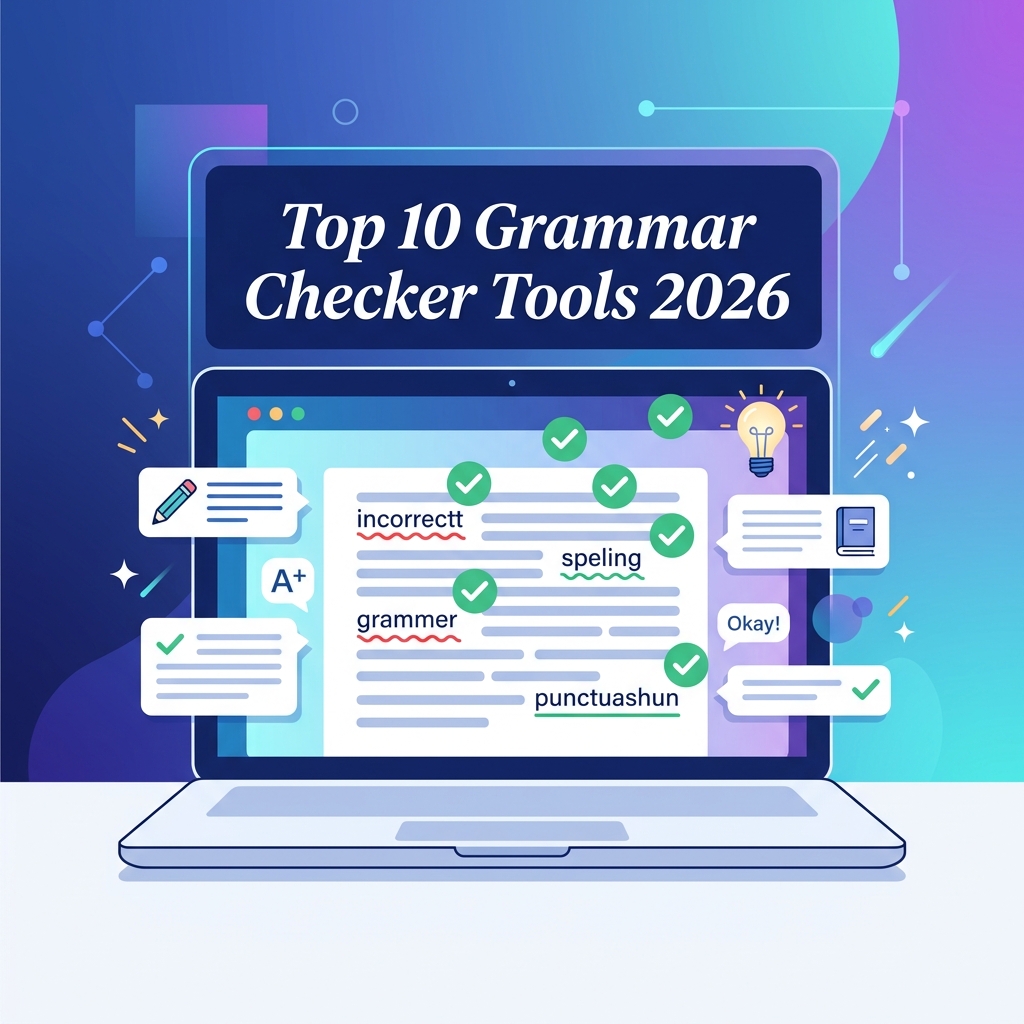
Grammar checker tools are software applications that analyze written text to detect spelling errors, grammatical mistakes, punctuation issues, style inconsistencies, and clarity problems. Modern tools go beyond simple rule matching by using large language models to understand context, tone, and intent — catching errors traditional spellcheckers miss and suggesting rewrites that improve readability.
In 2026, the field has shifted dramatically. AI-native checkers now offer near-human editing quality, on-device privacy modes have become standard, and many tools include features that would have been science fiction five years ago: tone matching, plagiarism detection, and even citation verification. The cost has dropped, too — several capable options are now free or under $10 per month.
The best grammar checker is the one you actually use. A 99% accurate tool that lives in a separate browser tab will help you less than an 85% accurate tool integrated directly into the apps where you write.
How We Evaluated These Grammar Checker Tools
Before jumping into the list, it helps to know what separates the great from the merely good. Every tool below was assessed against the following criteria:
- Accuracy — how often it catches real errors without flagging false positives
- Coverage — grammar, spelling, punctuation, style, tone, clarity, and inclusivity checks
- Integrations — browser extension, desktop app, mobile keyboard, Google Docs, MS Word, and API access
- Privacy — whether content is processed locally, encrypted in transit, or used for model training
- Pricing — free tier quality and the value of paid plans
- Performance — latency on long documents and offline availability
Now, the rundown.
1. ProWritingAid — The Power User’s Choice
ProWritingAid is the closest thing to having a full editorial team in software form. Beyond grammar, it runs more than 20 specialized reports covering pacing, sticky sentences, overused words, dialogue tags, and readability scores. Novelists and long-form writers tend to prefer it over Grammarly because it understands narrative structure.
The integrations are excellent: Word, Google Docs, Scrivener, Final Draft, and a browser extension that works almost everywhere you type. The interface can feel cluttered at first, but the depth pays off once you learn which reports matter for your kind of writing.
- Best for: Authors, academics, long-form bloggers
- Pricing: Free tier (500 words/check), Premium around $30/month or $120/year
- Watch out for: Slower analysis on documents over 10,000 words
3. LanguageTool — The Open Source Heavyweight
If you care about privacy or self-hosting, LanguageTool is the answer. It’s open source, supports more than 30 languages, and can run entirely on your own server with zero data leaving your machine. The free tier is genuinely usable, and the paid plan adds AI-powered rewrites without forcing you into a subscription that costs more than your text editor.
Setting up the self-hosted version is straightforward if you have basic Docker experience:
# Pull and run the LanguageTool server locally
docker run --rm -p 8010:8010 erikvl87/languagetool

# Test it with a quick curl request
curl -X POST -d "language=en-US" -d "text=She dont know what time it is." \
  http://localhost:8010/v2/check
That command spins up a local API server and sends a sample sentence for checking. The response is JSON containing each detected issue, the rule it triggered, and suggested replacements — perfect if you want to integrate grammar checking into your own writing app or CI pipeline.
4. Hemingway Editor — Clarity Above All
Hemingway doesn’t try to be everything. It focuses on one thing: making your writing easier to read. It highlights complex sentences, passive voice, adverbs, and overly fancy phrases that could be simpler. The grade-level score at the top is a quick gut check for whether you’re writing for humans or showing off.
The 2026 update added an AI assistant that can rewrite flagged sentences while preserving your voice, finally addressing the tool’s biggest historical weakness: telling you something is wrong without helping you fix it.
5. Ginger — Best for ESL Writers
Ginger shines when English isn’t your first language. Its sentence rephraser suggests entire rewrites rather than nitpicking word-by-word, and the built-in translator covers 60+ languages. The text-to-speech feature is also surprisingly useful for catching awkward phrasing — if a sentence sounds weird when read aloud, it usually reads weird too.
6. Writer.com — The Enterprise Style Guide Tool
Writer.com is built for teams that need consistent voice across hundreds of writers. You upload your brand style guide, and the tool enforces it everywhere your team types — Slack, Google Docs, Figma, you name it. Marketing departments and documentation teams have made it the default in many large organizations.
For individual freelancers it’s overkill, but if you manage content at scale, nothing else comes close for governance and consistency.
7. QuillBot — Paraphrasing First, Grammar Second
QuillBot started as a paraphrasing tool, but its grammar checker has matured enough to deserve a spot here. The killer feature is the integrated workflow: rewrite a clunky sentence, then run grammar checks on the result, all in one window. Students and content marketers who repurpose existing material lean on it heavily.
8. Antidote — The Linguist’s Tool
Antidote, made by Druide, is what professional translators and editors quietly use when accuracy matters more than convenience. It bundles grammar checking with the most thorough dictionaries and conjugation tables on the market. Unlike most tools on this list, it’s a one-time purchase rather than a subscription, which alone makes it worth considering.
9. Sapling — Built for Customer-Facing Teams
Sapling targets support and sales teams who type repetitive messages all day. It learns your team’s common responses, suggests snippets, and catches errors in real time across CRMs like Salesforce, Zendesk, and Intercom. The grammar engine itself is solid AI-based tech with strong accuracy on conversational text.
10. Microsoft Editor — The Free Surprise
If you already pay for Microsoft 365, you have access to Microsoft Editor, which has quietly become one of the best grammar checker tools available. It works in Word, Outlook, the Edge browser, and as a standalone extension in Chrome. Accuracy is close to Grammarly’s free tier, and the price is hard to argue with — zero, if you already use Office.
Side-by-Side Comparison of the Top Grammar Checker Tools
Here’s a quick reference table summarizing how the top contenders stack up on the features most writers care about:
| Tool | Free Tier | Paid Plan (Monthly) | Best For | Offline Mode |
|---|---|---|---|---|
| ProWritingAid | Limited | $30 | Long-form writers | Desktop app |
| LanguageTool | Generous | $20 | Privacy-focused users | Self-hosted |
| Hemingway | Web version | $10 (one-time desktop) | Readability | Yes |
| Ginger | Yes | $14 | ESL writers | No |
| Writer.com | Trial only | $18/user | Enterprise teams | No |
| QuillBot | Yes | $10 | Paraphrasing-heavy work | No |
| Microsoft Editor | Yes | Included with M365 | Office users | Word only |
Building Your Own: Using Grammar Checker APIs in Code
For developers building writing apps, blogging platforms, or content pipelines, most of these grammar checker tools expose an API. Here’s a small Node.js example that calls the LanguageTool public API to validate text inside a custom workflow:
// Simple grammar check using the LanguageTool public API
async function checkGrammar(text) {
  const response = await fetch('https://api.languagetool.org/v2/check', {
    method: 'POST',
    headers: { 'Content-Type': 'application/x-www-form-urlencoded' },
    body: new URLSearchParams({
      text: text,
      language: 'en-US'
    })
  });

  const data = await response.json();
  // Each match describes one detected issue and suggested replacements
  return data.matches.map(match => ({
    message: match.message,
    offset: match.offset,
    length: match.length,
    suggestions: match.replacements.map(r => r.value)
  }));
}

// Usage
checkGrammar('She dont know what time it is.').then(console.log);
The function posts the text to the LanguageTool endpoint and reshapes the response into a clean array of issues. You can plug this directly into a Markdown editor, a CMS save handler, or a pre-commit hook that lints documentation before it gets merged.
Common Mistakes to Avoid When Using Grammar Checker Tools
Even the best tool can hurt your writing if you use it wrong. Watch out for these traps:
- Accepting every suggestion. Grammar checkers don’t understand your voice. If a suggested rewrite makes the sentence less you, ignore it.
- Ignoring the explanation. Always read why a rule was flagged. Learning the underlying grammar concept means you’ll make the mistake less often next time.
- Running checks too early. Editing while drafting kills momentum. Write first, polish later.
- Trusting style scores blindly. A “grade 6 readability” score is great for marketing copy and terrible for a research paper. Match the metric to the audience.
- Pasting sensitive content into cloud tools. NDAs, legal drafts, and unreleased product copy belong in offline or self-hosted tools, not a free web app.
Frequently Asked Questions About Grammar Checker Tools
Which grammar checker tool is the most accurate in 2026?
In independent tests across mixed content types, ProWritingAid and LanguageTool’s premium tier are statistically tied for top accuracy, both edging out Grammarly slightly on stylistic catches. For pure grammar and spelling, the difference between the top five tools is now within a few percentage points — accuracy alone is rarely the deciding factor.
Are free grammar checker tools good enough for professional writing?
For most blog posts, emails, and casual content, yes. LanguageTool’s free tier and Microsoft Editor both catch the overwhelming majority of mistakes. Where free tools fall short is depth of style feedback, plagiarism detection, and unlimited document length — features professional writers may need but hobbyists rarely do.
Do grammar checker tools work offline?
A few do. Hemingway’s desktop app, Antidote, ProWritingAid’s desktop client, and self-hosted LanguageTool all work without an internet connection. Cloud-based tools like Grammarly, QuillBot, and Sapling require connectivity because the analysis happens on their servers.
Can grammar checker tools detect AI-generated text?
Some, like QuillBot and Writer.com, include AI-content detectors, but accuracy is inconsistent. False positives are common, and short text is especially hard to classify reliably. Treat AI-detection scores as one weak signal among many, never as proof.
Will grammar checker tools replace human editors?
Not for serious work. They catch mechanical errors and suggest improvements, but they can’t evaluate argument quality, fact-check claims, or understand audience context the way a skilled editor does. For high-stakes content — books, legal documents, peer-reviewed research — tools handle the first pass and humans handle the final one.
Is it safe to use cloud-based grammar checkers for confidential content?
Read the privacy policy before pasting anything sensitive. Most reputable tools encrypt data in transit and offer opt-outs for model training, but the safest path for confidential work is a self-hosted option like LanguageTool’s open source server or a desktop-only app like Antidote.
How to Choose the Right Grammar Checker Tool for You
Skip the feature lists for a minute and answer three questions honestly:
- Where do you actually write? If you live in Google Docs, pick a tool with a strong Docs integration. If you write in a niche editor, you may need the browser extension or API route.
- What kind of feedback do you want? Rule-based corrections, style coaching, or full-on rewriting are different jobs. Match the tool to the level of intervention you welcome.
- What’s your privacy threshold? If you ever handle confidential drafts, rule out cloud-only tools immediately.
Once those are clear, the shortlist usually picks itself. A solo blogger with a tight budget gravitates toward LanguageTool or Microsoft Editor. A novelist drafts in ProWritingAid. An agency standardizes on Writer.com. A startup founder grabs whatever ships in their email client and gets on with the day.
Conclusion: Pick One and Start Writing Better Today
The best grammar checker tools in 2026 are smarter, cheaper, and more flexible than ever — and Grammarly is no longer the obvious default. ProWritingAid leads on depth, LanguageTool wins on privacy and value, Hemingway dominates clarity, and Microsoft Editor quietly delivers a free experience that rivals paid competitors. Whatever you choose, remember: the tool exists to support your voice, not replace it.
Try two or three from this list during their free trials, run them on the same draft, and notice which one’s suggestions you actually accept. That’s your tool. The rest is just writing.