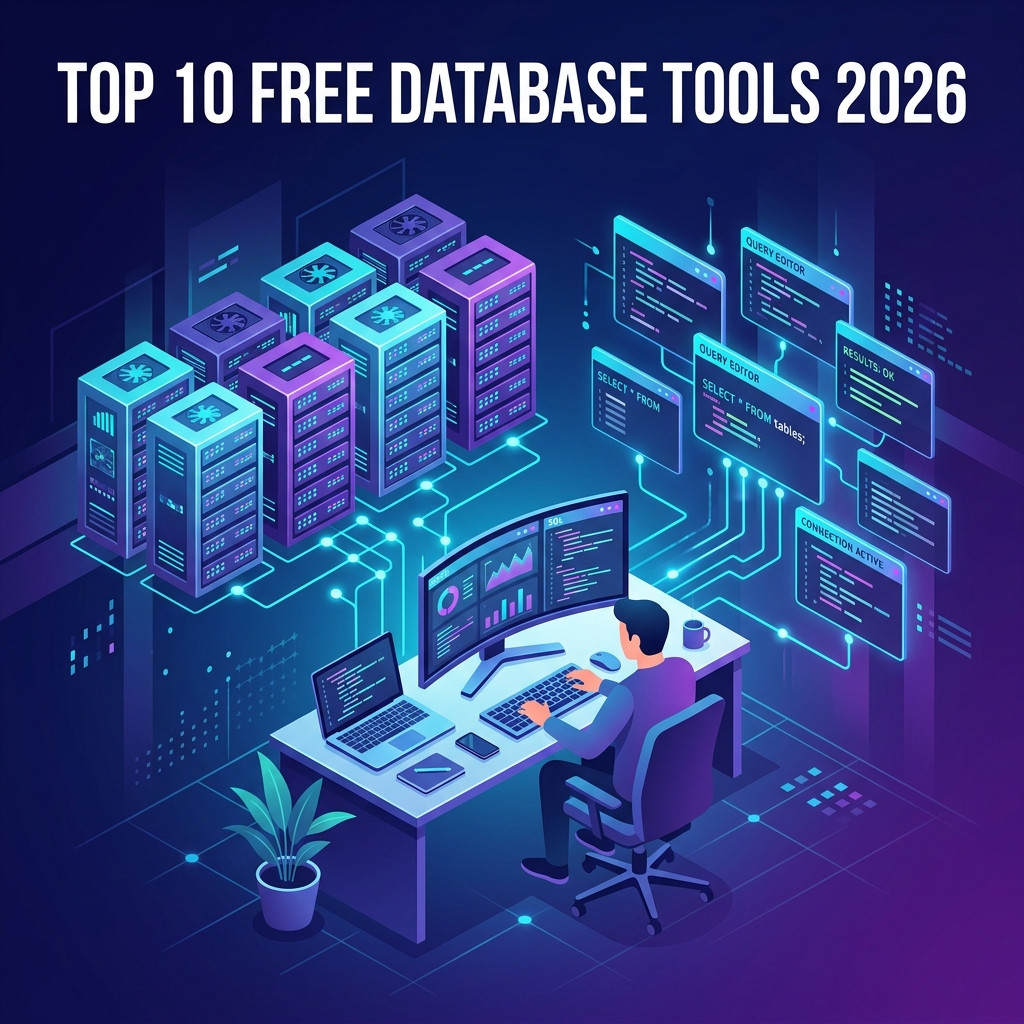
Picture this: you just inherited a legacy project with three different databases, no documentation, and a junior teammate who needs to write a query by tomorrow morning. The last thing you want to do is pay for an enterprise license just to peek inside a table. This is exactly where free database management tools earn their place in your toolkit — they let you connect, query, and visualize data without budget approvals or trial countdowns.
The good news for 2026: the free tier of database tooling has never been stronger. Open-source projects now match (and sometimes beat) commercial software on features like AI-assisted SQL, multi-engine support, and schema diffing. In this guide, you will explore the top 10 free database management tools for developers in 2026, what each one does best, and how to choose one without wasting an afternoon on installs.
What Is a Database Management Tool?
A database management tool is a graphical or command-line application that lets developers connect to a database, browse its structure, run queries, edit data, and administer users or backups — without writing low-level driver code. Think of it as the IDE for your data layer: it handles connections, syntax highlighting, query history, and visual schema design so you can focus on the logic instead of plumbing.
These tools matter because modern apps rarely speak to a single database. You might query PostgreSQL for transactional data, Redis for caching, MongoDB for documents, and ClickHouse for analytics — all in the same sprint. A solid tool unifies that workflow.
How We Picked the Best Free Database Management Tools
Not every “free” tool is actually free for long. Some are trialware in disguise; others limit you to a single connection or strip out essentials like data export. The picks below all meet four criteria:
- Genuinely free for individual developer use, with no time limit on core features.
- Actively maintained with releases in the last 12 months.
- Cross-platform support for at least Windows, macOS, and Linux (with a couple of intentional exceptions noted below).
- Production-quality — used by real engineering teams, not just hobby projects.
1. DBeaver Community Edition
DBeaver is the closest thing the open-source world has to a universal database client. It supports more than 80 database engines through JDBC drivers, including PostgreSQL, MySQL, SQLite, Oracle, SQL Server, Snowflake, and Cassandra. The Community Edition is genuinely free and surprisingly close in feature parity to its Pro sibling for everyday tasks.
What developers love: ER diagrams generated from existing schemas, a powerful data editor with foreign-key navigation, and SQL formatting that respects your team style. Connection setup is straightforward — here is a typical PostgreSQL connection string you can paste in:
jdbc:postgresql://localhost:5432/mydb?user=dev&password=secret&sslmode=requireThe URL uses JDBC syntax because DBeaver is Java-based. sslmode=require forces an encrypted handshake, which you should always enable when connecting to anything beyond localhost.
2. pgAdmin 4
If PostgreSQL is your daily driver, pgAdmin 4 is hard to beat. It is the official open-source administration platform for Postgres and runs as either a desktop app or a self-hosted web app — useful when you need a browser-based tool inside a Kubernetes cluster.
The dashboard exposes server-level metrics you usually have to dig for: transaction throughput, tuple churn, active sessions, and lock waits. For day-to-day work, the query tool has explain-plan visualization that turns a wall of EXPLAIN ANALYZE text into a clickable node graph.
-- Example query you can run from pgAdmin's query tool
EXPLAIN (ANALYZE, BUFFERS, FORMAT JSON)
SELECT u.id, u.email, COUNT(o.id) AS order_count
FROM users u
LEFT JOIN orders o ON o.user_id = u.id
WHERE u.created_at > NOW() - INTERVAL '30 days'
GROUP BY u.id, u.email
ORDER BY order_count DESC
LIMIT 50;
The FORMAT JSON hint is what pgAdmin uses internally to render the visual plan. Once you see which nodes are doing sequential scans, adding the right index becomes obvious.
3. MySQL Workbench
MySQL Workbench is Oracle’s official free GUI for MySQL and MariaDB. It bundles three roles in one app: SQL development, data modeling, and server administration. The visual schema designer is the standout — you can drag tables onto a canvas, draw foreign keys, and forward-engineer the result into a runnable CREATE TABLE script.
One caveat: the modeling tool can feel sluggish on schemas with hundreds of tables, and the macOS build occasionally lags behind the Windows release. For pure SQL work on smaller projects, it is still excellent and free under the GPL.
4. MongoDB Compass
Document databases need a different mental model, and MongoDB Compass is built for it. The free version lets you browse collections, write aggregation pipelines stage-by-stage with a visual builder, and analyze schema shape across millions of documents.
The aggregation builder is the killer feature. You assemble stages like $match, $group, and $lookup in a side panel and watch the intermediate result update live:
// Aggregation pipeline you can paste into Compass
[
  { $match: { status: "active", country: "IN" } },
  { $group: {
      _id: "$plan",
      users: { $sum: 1 },
      revenue: { $sum: "$monthly_fee" }
    }
  },
  { $sort: { revenue: -1 } }
]
This pipeline groups active Indian users by subscription plan and sorts by revenue. Compass shows the output of each stage in a side pane, which makes debugging a complex pipeline dramatically faster than trial-and-error in the shell.
5. Beekeeper Studio Community
Beekeeper Studio is the friendliest cross-platform SQL editor in the lineup. The Community Edition is open source under the MIT license and ships as a clean Electron app for Windows, macOS, and Linux. It supports PostgreSQL, MySQL, SQLite, SQL Server, MariaDB, CockroachDB, and Amazon Redshift.
Beekeeper is the tool to recommend to a teammate who finds DBeaver overwhelming. Tabs, autocomplete, saved queries, and CSV export all just work. There is no schema designer in the free build, but for day-to-day querying it stays out of your way.
6. HeidiSQL
HeidiSQL is a small, fast Windows-native client that has been around since 2002 and is still updated. It supports MySQL, MariaDB, PostgreSQL, SQL Server, and SQLite, and runs cleanly under Wine on Linux. If you live in Windows and want something that opens in under a second, HeidiSQL is the answer.
The session manager handles SSH tunnels natively, which is useful when you need to reach a database behind a bastion host:
# SSH tunnel HeidiSQL creates under the hood
ssh -L 3307:db.internal:3306 [email protected] -N
Once the tunnel is open, you connect HeidiSQL to 127.0.0.1:3307 as if the database were local. The SSH integration removes the need to run this command manually each morning.
7. Adminer
Adminer is the entire database GUI in a single PHP file — roughly 500 KB. You drop adminer.php on a web server, hit it in your browser, and you have a working tool for MySQL, PostgreSQL, SQLite, MS SQL, Oracle, and MongoDB. It is the perfect emergency tool for production servers where you cannot install a desktop client.
Treat Adminer like a hand grenade: invaluable in a pinch, dangerous if you forget to remove it. Always password-protect the directory and delete the file once your debugging session is done.
Despite its tiny footprint, Adminer supports stored procedures, triggers, events, foreign keys, and even a usable theming system. Compared to phpMyAdmin, the codebase is one-tenth the size and noticeably faster.
8. Azure Data Studio
Microsoft’s Azure Data Studio is free, cross-platform, and built on the same Electron shell as VS Code. Despite the name, it works happily with SQL Server, PostgreSQL, MySQL, and several cloud services. If you already live in VS Code, the keybindings, extensions, and notebook experience will feel instantly familiar.
The notebook feature is genuinely useful for data work. You can mix Markdown explanations with executable SQL or Python cells, then share the .ipynb file with a teammate. For documentation-as-code workflows, it beats pasting screenshots into a wiki.
9. DBGate
DBGate is an open-source database manager that runs as a desktop app, a portable executable, or a self-hosted web app inside Docker. It supports PostgreSQL, MySQL, SQL Server, MongoDB, SQLite, Redis, and several others — including a handful of NoSQL stores that most GUIs ignore.
The killer feature is the database diff and deploy tool: you point DBGate at two schemas and it generates the migration SQL to bring one in line with the other. The Docker setup is a one-liner:
docker run -d --name dbgate -p 3000:3000 \
  -v dbgate-data:/root/.dbgate \
  dbgate/dbgate
This runs DBGate on port 3000 with a named volume so your saved connections survive container restarts. It is a great option for shared dev environments where every developer should not need to install a desktop client.
10. TablePlus (Free Tier)
TablePlus is a native, polished GUI for macOS, Windows, and Linux. It is not open source, but the free tier is permanent and generous: you get unlimited connections with a soft limit of two open tabs and two advanced features at a time. For most casual sessions you will not notice the cap.
What earns its spot on this list is the engineering quality. Queries run instantly, the UI does not stutter on million-row tables, and the SSH+SSL connection handling is the cleanest of any tool here. If your hardware feels slow with Electron-based clients, TablePlus is a refreshing change.
Free Database Management Tools at a Glance
The right pick depends on which engines you use and how you prefer to work. The table below compares the headline features so you can shortlist quickly.
| Tool | Best For | Engines Supported | Platform | License |
|---|---|---|---|---|
| DBeaver CE | Multi-engine power users | 80+ via JDBC | Win / macOS / Linux | Apache 2.0 |
| pgAdmin 4 | PostgreSQL administration | PostgreSQL | Desktop & Web | PostgreSQL License |
| MySQL Workbench | Schema modeling | MySQL, MariaDB | Win / macOS / Linux | GPL v2 |
| MongoDB Compass | Document database work | MongoDB | Win / macOS / Linux | SSPL |
| Beekeeper Studio CE | Friendly SQL editing | 7 SQL engines | Win / macOS / Linux | MIT |
| HeidiSQL | Fast Windows-native client | MySQL, PG, MSSQL, SQLite | Windows | GPL v2 |
| Adminer | Single-file web tool | 6 engines | Any web server | Apache 2.0 / GPL v2 |
| Azure Data Studio | Notebooks & VS Code users | SQL Server, PG, MySQL | Win / macOS / Linux | Source-available |
| DBGate | Self-hosted web GUI | 10+ SQL & NoSQL | Desktop / Docker | MIT |
| TablePlus (Free) | Native polish on macOS | 20+ engines | Win / macOS / Linux | Proprietary (free tier) |
How to Choose the Right Free Database Management Tool
Picking a tool is mostly a function of three questions. Answer them honestly and the shortlist becomes obvious.
- Which engines do you actually use? If you only touch PostgreSQL, pgAdmin or Beekeeper is enough. If you bounce between five engines, DBeaver or DBGate saves you tab-switching.
- Where will the tool run? Locked-down corporate Windows laptop? HeidiSQL. A shared dev server you SSH into? Adminer or self-hosted DBGate. A team that wants a browser-only experience? pgAdmin Web or DBGate.
- How much polish do you need? If you spend eight hours a day inside the tool, TablePlus or Azure Data Studio earn their keep through speed and ergonomics. For occasional use, anything on this list works.
Common Pitfalls When Using Free Database Tools
Free tools save money, but they introduce a few traps that experienced developers have learned to avoid.
- Connecting as a superuser in production. Always create a read-only or scoped role for browsing. A misclick in the data editor can
UPDATEa million rows in seconds. - Skipping SSH tunnels. Exposing port 5432 or 3306 to the public internet for “quick access” is how databases end up in ransomware reports. Use a bastion host or VPN, every single time.
- Storing passwords in plain text. Most tools offer encrypted credential stores or OS keychain integration — turn it on. If a tool only stores passwords in a plain config file, treat that as a bug, not a feature.
- Trusting auto-generated migrations blindly. Schema-diff features are great hints but bad gospel. Read the generated SQL before running it in any environment you care about.
- Forgetting to remove web GUIs. Adminer and pgAdmin Web are wonderful — until you forget to delete them after debugging. Treat them as temporary tools, not permanent infrastructure.
Frequently Asked Questions
Are these free database management tools safe to use in production?
Yes, the open-source tools on this list are widely used by professional teams. The risk usually comes from configuration — exposed ports, oversized permissions, unpatched versions — not the tool itself. Follow the same hygiene you would for any production access: least privilege, encrypted connections, audit logs, and regular updates from the official source.
Which free database management tool is best for beginners in 2026?
Beekeeper Studio Community Edition is the easiest starting point. The interface is uncluttered, autocomplete is helpful without being noisy, and it supports the most common SQL engines beginners encounter. Once you outgrow it, DBeaver or pgAdmin add advanced features without forcing a workflow change.
Can I use one tool for both SQL and NoSQL databases?
DBeaver, DBGate, and Adminer all handle a mix of SQL and NoSQL engines. DBeaver Community covers MongoDB, Cassandra, and Redis alongside relational engines. DBGate has first-class MongoDB and Redis support and is the most consistent visual experience across paradigms.
Do free tools support cloud databases like Amazon RDS or Google Cloud SQL?
Yes. Cloud databases speak the same wire protocols as their on-premise counterparts, so any tool that supports PostgreSQL, MySQL, or SQL Server will connect to RDS, Cloud SQL, or Azure SQL with the appropriate host and credentials. Enable SSL and use IAM authentication where the cloud provider offers it.
What is the difference between a database management tool and an ORM?
A database management tool is a human-facing client used to inspect, query, and administer a database. An ORM (object-relational mapper) is a code-level library — like SQLAlchemy or Prisma — that translates between database rows and programming language objects inside your application. They solve different problems and you will usually use both.
Is DBeaver Community really equivalent to DBeaver Pro?
For most everyday development, yes. The Pro edition adds features like AI assistance, NoSQL-specific browsers for some engines, and commercial support. The Community Edition still covers connection management, SQL editing, ER diagrams, and data export for the vast majority of supported engines.
Conclusion
The 2026 landscape of free database management tools for developers is healthier than at any point in the last decade. You can manage almost any engine — relational, document, key-value, columnar — without spending a rupee on licenses, and the gap between free and paid is mostly polish and team features now.
If you want one safe default, install DBeaver Community for breadth and Beekeeper Studio for daily quick lookups. Add pgAdmin or MongoDB Compass when you need engine-specific depth, and keep Adminer in your back pocket for the day production needs a five-minute fix. Pick the tools that match your engines and workflow, lock down your connections, and the rest is just SQL.