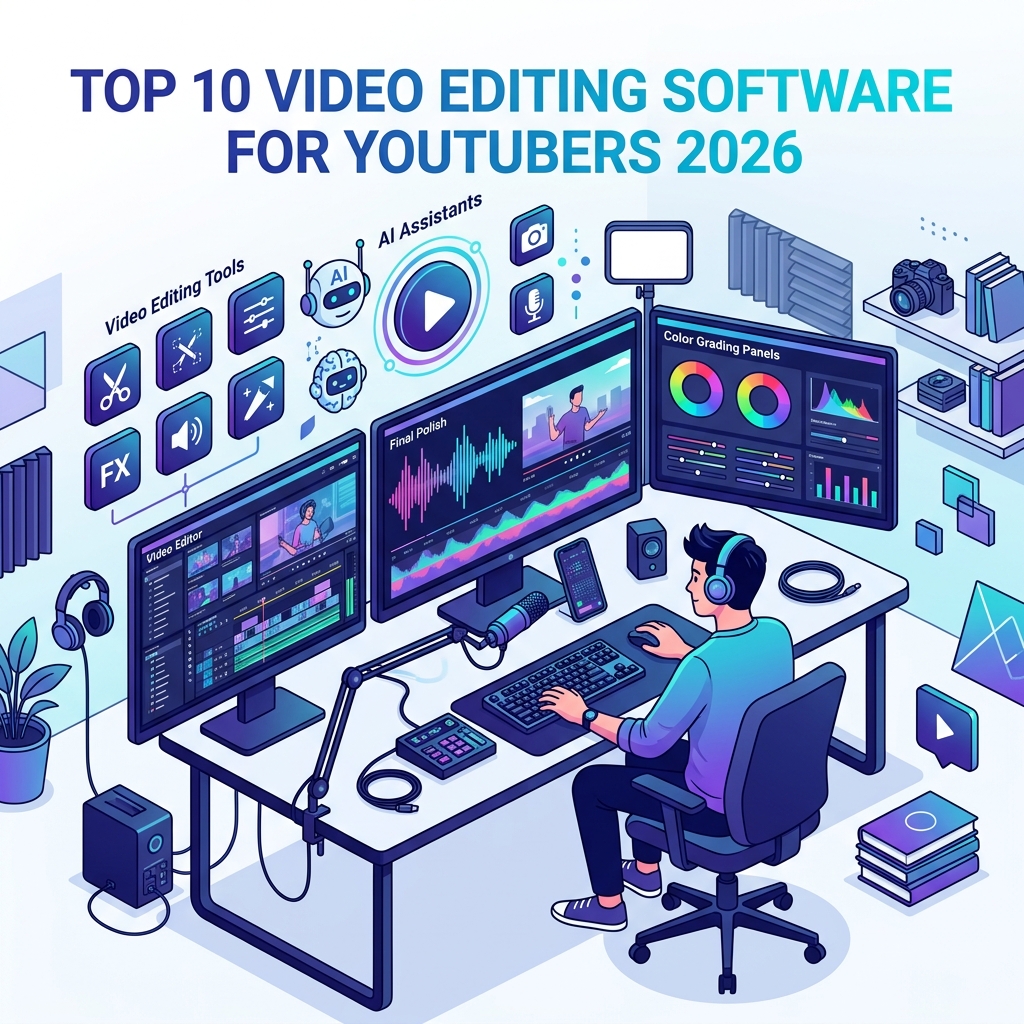
Your camera rolls perfectly, your script lands, your B-roll looks cinematic — and then you sit down to edit, and everything falls apart. The right editor turns a six-hour timeline-wrestling session into a confident creative flow, and the wrong one will quietly cap your channel’s growth. Picking the best video editing software for YouTubers in 2026 is less about chasing the flashiest feature list and more about matching the tool to your workflow, hardware, and content style.
This guide breaks down ten editors that genuinely earn their place on a creator’s workstation this year — from free powerhouses to studio-grade suites, plus the new wave of AI-assisted apps that are changing how fast you can ship a video. You will get honest trade-offs, pricing, real use cases, and a decision framework so you stop second-guessing your toolchain.
What Makes a Great Video Editor for YouTube in 2026
Video editing software for YouTubers is a non-linear editing application optimized for vertical and horizontal short-form and long-form content, with fast proxy workflows, timeline-based cutting, color grading, audio mixing, motion graphics, and direct export presets for platforms like YouTube, Shorts, TikTok, and Instagram Reels. The best options in 2026 also bundle AI-assisted captioning, silence removal, and background-noise cleanup.
Before we get into the list, here are the criteria that actually matter when you are picking an editor as a creator rather than a Hollywood colorist:
- Render speed on your actual hardware — not just benchmark charts.
- Proxy and background rendering so 4K and 6K footage stays scrubable.
- Auto-captions and AI silence trimming, which now save hours per upload.
- Audio repair, because YouTube viewers forgive shaky video but never bad audio.
- Export presets for YouTube long-form, Shorts (9:16), and SDR/HDR.
- Asset management — bins, smart search, and shared project libraries.
Keep those in mind as we walk through each pick. The right answer is rarely the most expensive one.
1. DaVinci Resolve 19
If you want one editor that scales from a beginner Shorts workflow to a full broadcast pipeline, DaVinci Resolve is the closest thing to a no-compromise pick on this list. The free tier alone is more capable than most paid editors a few years ago, and the Blackmagic Design DaVinci Resolve Studio license is a one-time purchase rather than a subscription.
The 2026 release leans hard into AI: the Neural Engine now handles smart reframing for Shorts, voice isolation, and transcript-based editing where you trim by deleting words from a script. Color grading remains industry-leading, and Fairlight gives you a real DAW inside your NLE for audio mixing.
Best for
- YouTubers who care about color and audio quality.
- Creators on tight budgets — the free version covers 95% of YouTube workflows.
- Anyone who hates subscriptions.
Trade-offs
The learning curve is real. Resolve has seven workspaces (Media, Cut, Edit, Fusion, Color, Fairlight, Deliver), which is empowering once it clicks and overwhelming on day one. It also needs a decent GPU; integrated graphics will struggle.
2. Adobe Premiere Pro
Premiere Pro is still the default editor in the creator economy, and for good reason. Tight integration with After Effects, Photoshop, and Audition means you can move a still, a motion-graphics template, or an audio session between apps without re-rendering. The 2026 update introduced object-aware masking, generative B-roll extension, and noticeably faster ProRes and H.265 decoding.
For collaborative channels, Productions and Frame.io integration let multiple editors work across shared bins, which is rare in this price range. The downside is the Creative Cloud subscription and Premiere’s well-known appetite for RAM.
Best for
- Creators already in the Adobe ecosystem.
- Channels with editors collaborating across machines.
- Heavy motion-graphics workflows via Dynamic Link to After Effects.
3. Final Cut Pro
If you are on Apple Silicon, Final Cut Pro is brutally fast. The magnetic timeline confuses Premiere veterans for about a week, then becomes a superpower for the kind of fast cuts most YouTubers actually do. A one-time license with free updates is a refreshing pricing model in 2026.
The latest version added live multi-cam from iPhones, scene-removal masks, and built-in transcript editing. Plugins from FxFactory and MotionVFX still make this a serious tool for premium-looking content.
If your machine is a recent MacBook Pro or Mac Studio, Final Cut routinely renders 4K H.265 timelines two to three times faster than competing editors on the same chip — because Apple’s media engines are tuned for it.
4. CapCut Desktop
CapCut graduated from “phone app” to “real desktop editor” over the last two years, and for short-form-first YouTubers it is genuinely hard to beat. The 2026 desktop build adds keyframable effects, multi-track audio, and a deeper text engine, while keeping the one-click viral templates that made it famous.
AI features here are aggressive: auto-captions with styled templates, script-to-video generation, voice cloning, and a long-form-to-Shorts splitter that finds the punchy moments on its own. The catch is the licensing terms and the ownership rules for AI-generated assets, so read those carefully if you monetize.
Best for
- Shorts-first and TikTok-first creators.
- Beginners who want results in their first hour.
- Repurposing long videos into clips.
5. Descript
Descript flipped editing on its head with transcript-based cutting: you edit your video by editing the words on a page. In 2026 it is no longer a quirky tool — it is a primary editor for podcasters, talking-head YouTubers, and tutorial creators who want to remove filler words with a single click.
Overdub voice cloning, Studio Sound, and AI Eye Contact (which subtly redirects your gaze to the camera) shorten the cycle from raw take to publish-ready cut. It is not the right pick for cinematic, effects-heavy edits, but for spoken-word channels it can cut your editing time by more than half.
6. CyberLink PowerDirector 2026
PowerDirector is the perennially underrated mid-tier pick. It runs well on Windows machines that would choke on Premiere, ships with a generous stock asset library, and includes AI tools like sky replacement, body effects, and motion tracking that punch above its price.
For creators who do gaming highlights, reaction videos, and lifestyle content, the speed-to-result ratio is excellent. The interface looks more “consumer” than Resolve or Premiere, but that is a feature when you are scaling output.
7. Vegas Pro
Vegas Pro has a loyal Windows-only following thanks to its track-based timeline (rather than Premiere’s clip-on-track model), strong audio routing, and forgiving GPU requirements. The 2026 build introduced smart-split AI, scene detection, and improved HDR delivery.
It is a strong pick if you cut a lot of music videos, multi-cam interviews, or layered audio content. It has lost some momentum to Resolve in recent years, but the workflow is still uniquely fast for certain styles.
8. Filmora
Wondershare Filmora is the gateway editor that surprised everyone by maturing into a legitimate tool. Its 2026 release added a proper proxy workflow, keyframe curve editor, and AI features including a smart cut-out, motion tracking, and audio-to-video sync.
If you have ever bounced off Resolve or Premiere because of overwhelm, Filmora is the editor that lets you ship a clean, polished video on day one, then grow into more advanced techniques without switching tools for at least the first year of your channel.
9. Kdenlive
Open-source, cross-platform, and free in the truest sense, Kdenlive is the editor of choice for Linux creators and anyone who refuses to install proprietary software. The 2026 releases brought a much faster timeline engine, nested sequences, and better proxy management.
It will not replace Resolve for color or Premiere for motion graphics, but for documentary-style channels, tutorial creators, and anyone publishing on a Pinebook or older laptop, Kdenlive is a serious, capable editor that costs nothing.
10. Runway and AI-Native Editors
The last slot goes to the new wave of AI-native editors — Runway, Pika Edit, and similar tools — because they are reshaping how creators handle B-roll, effects, and even principal footage in 2026. Generative inpainting, text-to-video clips, motion brush, and frame interpolation are no longer gimmicks; they are part of real production pipelines.
You will not cut a 20-minute long-form video entirely in Runway. You will, however, use it to extend a shot, remove a microphone from a frame, upscale archived footage, or generate a 4-second cutaway that would have cost a day of shooting. Pair it with one of the editors above, not as a replacement.
Comparison Table: Pricing, Platform, and Best Use
| Editor | Platform | Pricing (2026) | Best For | Learning Curve |
|---|---|---|---|---|
| DaVinci Resolve 19 | Win, Mac, Linux | Free / $295 one-time (Studio) | Color, audio, all-rounder | Steep |
| Adobe Premiere Pro | Win, Mac | Subscription | Pro creators, collaboration | Moderate |
| Final Cut Pro | Mac only | One-time license | Apple Silicon speed | Moderate |
| CapCut Desktop | Win, Mac | Free / Pro tier | Shorts, TikTok, beginners | Gentle |
| Descript | Win, Mac | Subscription | Talking-head, podcasts | Gentle |
| PowerDirector 2026 | Win, Mac | Subscription or one-time | Mid-tier Windows users | Gentle |
| Vegas Pro | Win | One-time or subscription | Audio-heavy, music videos | Moderate |
| Filmora | Win, Mac | Subscription or one-time | New creators | Gentle |
| Kdenlive | Win, Mac, Linux | Free, open-source | Linux users, budget builds | Moderate |
| Runway / AI tools | Web | Subscription | AI B-roll, VFX assists | Gentle |
How to Pick the Right Editor for Your Channel
Rather than chasing reviews, work through this decision in order:
- What does your typical video look like? Talking-head tutorials reward Descript or Final Cut; cinematic vlogs reward Resolve or Premiere; Shorts-first channels reward CapCut.
- What hardware do you actually own? A MacBook Air M-series happily edits in Final Cut and stalls in Premiere. A mid-range Windows laptop with a discrete GPU runs Resolve, PowerDirector, or Vegas comfortably.
- How much do you publish? Daily uploads favor AI-assisted workflows (CapCut, Descript, Filmora). Weekly long-forms reward more powerful tools where time saved per project compounds.
- Subscription tolerance. If you hate recurring costs, Resolve, Final Cut, Vegas, and Kdenlive all have one-time or free options.
- Do you collaborate? Premiere Productions and Frame.io are still the gold standard, with Resolve catching up via its Project Server.
A useful exercise: pick two editors from this list, edit the same five-minute video in each, and time yourself. Whichever lets you finish faster without compromising quality is your editor — regardless of reviews.
Common Mistakes YouTubers Make When Choosing an Editor
- Buying the most expensive tool first. Premiere will not make your storytelling better; finishing more videos will.
- Ignoring proxies. Editing 4K natively on a mid-tier machine and blaming the software is one of the most common avoidable frustrations.
- Switching editors every three months. Mastery compounds. Every hour you spend learning keyboard shortcuts in one tool pays back tenfold over a year.
- Skipping audio tools. Audio is half of video. Use an editor with real audio repair, or pair your editor with a dedicated tool.
- Trusting AI features blindly. Auto-captions still mis-transcribe brand names and technical terms; review every pass before publishing.
A Sample Render Setting for YouTube Long-form in 2026
Regardless of the editor you pick, the export settings for YouTube long-form have stabilized. Here is a reference you can mirror:
{
  "container": "MP4",
  "videoCodec": "H.265 (HEVC) or H.264",
  "resolution": "3840x2160",
  "frameRate": "matches source (24, 25, 30, 50, 60)",
  "bitrate": {
    "type": "VBR 2-pass",
    "target_mbps": 45,
    "max_mbps": 68
  },
  "audioCodec": "AAC-LC",
  "audioBitrate": "320 kbps",
  "audioSampleRate": 48000,
  "colorSpace": "Rec. 709 (SDR) or Rec. 2100 PQ (HDR)"
}
This JSON snippet is not a config file you import — it is a reference for what your export dialog should look like. H.265 cuts file size roughly in half versus H.264 at the same quality, which matters if you upload over a slower connection. Bump the bitrate higher only if you have a lot of motion or fine detail; YouTube re-encodes everything anyway.
FAQ: Video Editing Software for YouTubers
Which video editing software is best for beginners on YouTube?
For pure beginners, CapCut Desktop or Filmora will get you to a finished video fastest. Both have clean interfaces, generous free tiers, and AI features that handle captions, silence trimming, and basic color. Once you understand the fundamentals, you can graduate to DaVinci Resolve without changing your storytelling style.
Is DaVinci Resolve free version enough for YouTube?
Yes, for almost every YouTuber. The free version of Resolve handles 4K timelines, color grading, audio mixing in Fairlight, and Fusion motion graphics. The paid Studio license mainly unlocks higher-than-4K export, advanced noise reduction, certain AI features, and HDR delivery, which most channels do not need on day one.
Do I need a powerful computer to edit YouTube videos in 2026?
You need a balanced one. A modern Apple Silicon Mac or a Windows PC with at least 16 GB RAM, an SSD for media, and a discrete or recent integrated GPU is the practical floor. If your machine struggles, enable proxy workflows in your editor — they convert your footage to lighter files for editing and re-link the originals on export.
Should I use AI video editors instead of traditional ones?
Use both. AI editors like Descript and Runway shine at specific tasks — transcript editing, generative B-roll, automatic reframing. Traditional NLEs still own precise timeline control, color, and audio mixing. The most efficient creators in 2026 stitch AI tools into a traditional editor as part of one pipeline rather than treating them as either/or.
What is the cheapest pro-grade video editing software for YouTubers?
DaVinci Resolve’s free version is the obvious answer. After that, Kdenlive (free, open-source) and the one-time licenses for Final Cut Pro and Vegas Pro offer strong long-term value because there are no recurring fees. Over a three-year horizon, a one-time license usually undercuts any subscription.
Can I edit YouTube videos entirely on my phone?
You can, and many creators do. CapCut Mobile, LumaFusion (iOS), and Adobe Premiere Mobile produce uploads indistinguishable from desktop edits for most genres. The constraint is endurance — phone screens, thermals, and storage make multi-hour sessions painful. A phone-first workflow is excellent for Shorts and travel content, less so for daily long-form output.
Conclusion
The best video editing software for YouTubers in 2026 is the one you will actually open every week and finish videos in. DaVinci Resolve is the safest universal pick. Premiere Pro is the obvious choice if you already live in Adobe’s world. Final Cut Pro wins on Apple Silicon. CapCut and Filmora win on speed-to-first-video, and Descript wins for talking-head workflows. Runway and other AI-native tools belong in the pipeline, not at the center of it.
Pick one, give it three months of consistent use before you judge it, and invest in keyboard shortcuts more than plugins. The compounded time savings from mastering a single editor will out-earn any feature comparison on this list — and your channel will feel the difference long before your subscribers do.