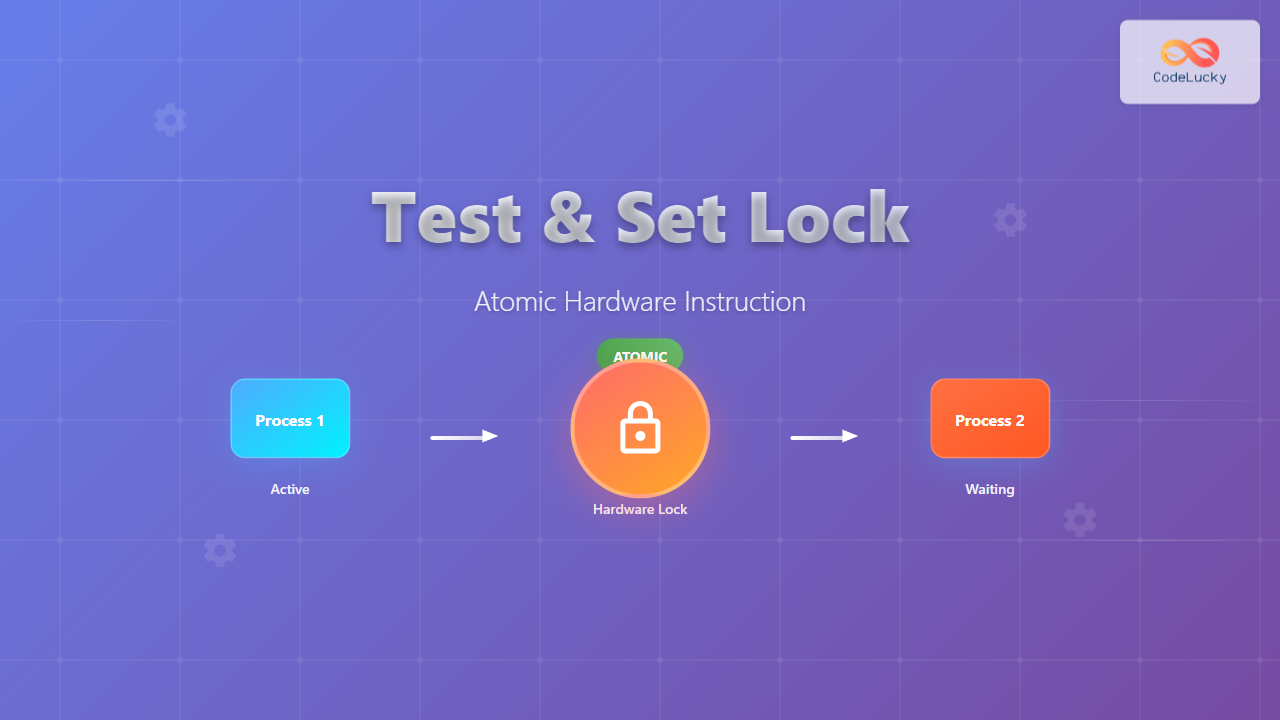
The Test and Set Lock is a fundamental atomic hardware instruction that plays a crucial role in process synchronization and mutual exclusion in operating systems. This powerful mechanism ensures that critical sections are accessed by only one process at a time, preventing race conditions and maintaining data integrity in concurrent programming environments.
What is Test and Set Lock?
Test and Set Lock (TSL) is an atomic hardware instruction that performs two operations indivisibly:
- Test: Read the current value of a memory location
- Set: Write a new value (typically 1) to that memory location
The key characteristic of this instruction is its atomicity – both operations happen as a single, uninterruptible unit. This ensures that no other process can interfere between the test and set operations, making it perfect for implementing locks and semaphores.

How Test and Set Lock Works
The Test and Set instruction operates on a boolean variable (lock) and follows this pseudo-code logic:
boolean TestAndSet(boolean *lock) {
    boolean original = *lock;  // Test: read current value
    *lock = true;              // Set: write new value
    return original;           // Return original value
}
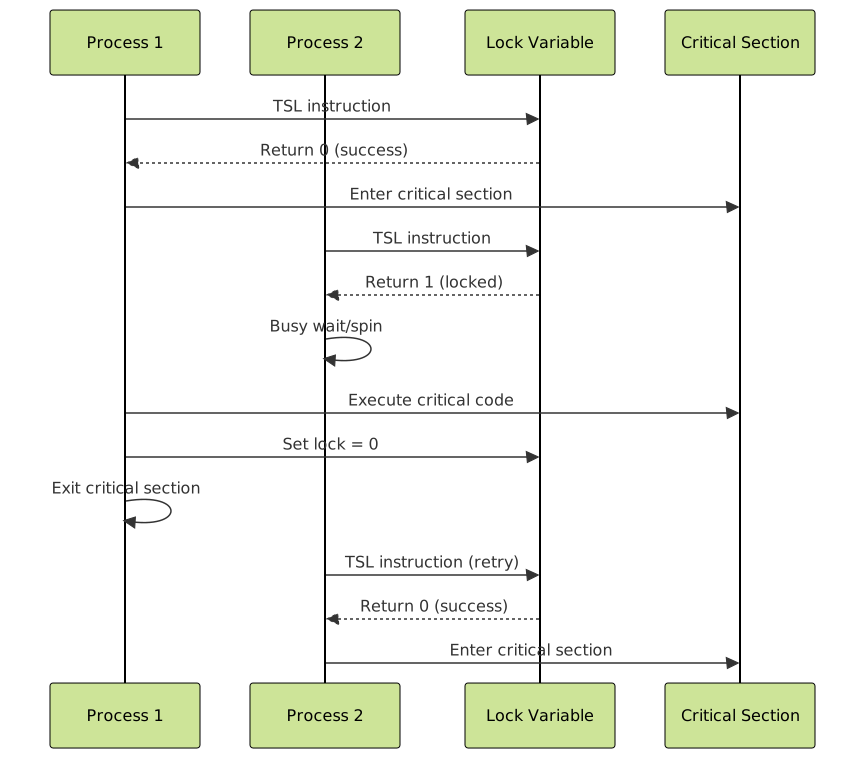
The process attempting to acquire the lock calls this instruction. If the returned value is false, the process successfully acquired the lock. If true is returned, another process already holds the lock.
Implementation Example in C
#include <stdio.h>
#include <stdbool.h>
#include <pthread.h>
#include <unistd.h>

// Global lock variable
bool lock = false;

// Simulate Test and Set instruction
bool test_and_set(bool *target) {
    bool original = *target;
    *target = true;
    return original;
}

// Critical section function
void enter_critical_section() {
    // Spin lock implementation
    while (test_and_set(&lock)) {
        // Busy waiting - process keeps trying
    }
}

void exit_critical_section() {
    lock = false;  // Release the lock
}

void* process_function(void* arg) {
    int process_id = *(int*)arg;

    printf("Process %d: Attempting to enter critical section\n", process_id);

    enter_critical_section();

    printf("Process %d: Inside critical section\n", process_id);
    sleep(2);  // Simulate work in critical section
    printf("Process %d: Exiting critical section\n", process_id);

    exit_critical_section();

    return NULL;
}

int main() {
    pthread_t threads[3];
    int process_ids[3] = {1, 2, 3};

    // Create multiple threads
    for (int i = 0; i < 3; i++) {
        pthread_create(&threads[i], NULL, process_function, &process_ids[i]);
    }

    // Wait for all threads to complete
    for (int i = 0; i < 3; i++) {
        pthread_join(threads[i], NULL);
    }

    return 0;
}
Expected Output:
Process 1: Attempting to enter critical section
Process 2: Attempting to enter critical section
Process 3: Attempting to enter critical section
Process 1: Inside critical section
Process 1: Exiting critical section
Process 2: Inside critical section
Process 2: Exiting critical section
Process 3: Inside critical section
Process 3: Exiting critical section
Assembly Language Implementation
Here’s how Test and Set might be implemented in x86 assembly language:
; Test and Set implementation in x86 assembly
test_and_set:
    mov al, 1        ; Load 1 into AL register
    xchg al, [lock]  ; Atomically exchange AL with memory location
    ret              ; Return original value in AL
The xchg instruction is inherently atomic on x86 processors, making it perfect for implementing Test and Set functionality.
Advantages of Test and Set Lock
1. Hardware-Level Atomicity
The instruction is implemented at the hardware level, ensuring true atomicity without the possibility of interruption.
2. Simple Implementation
The mechanism is straightforward to understand and implement, requiring minimal overhead.
3. Fast Operation
Being a single hardware instruction, it executes very quickly compared to software-based synchronization methods.
4. Universal Applicability
Can be used to implement various synchronization primitives like mutexes, semaphores, and monitors.
Disadvantages and Limitations
1. Busy Waiting (Spin Lock)
Processes continuously check the lock status, wasting CPU cycles:
// Inefficient busy waiting
while (test_and_set(&lock)) {
    // CPU cycles wasted here
    // No productive work done
}
2. No Fairness Guarantee
There’s no guarantee about which waiting process will acquire the lock next, potentially leading to starvation.
3. Priority Inversion
Low-priority processes holding locks can block high-priority processes indefinitely.

Real-World Applications
1. Operating System Kernels
Most modern operating systems use TSL for kernel-level synchronization:
// Linux kernel spinlock example
typedef struct {
    volatile unsigned int slock;
} spinlock_t;

static inline void spin_lock(spinlock_t *lock) {
    while (test_and_set(&lock->slock)) {
        while (lock->slock) {
            cpu_relax();  // Hint to CPU for better performance
        }
    }
}
2. Database Management Systems
Databases use TSL for transaction isolation and concurrent access control.
3. Embedded Systems
Resource-constrained environments benefit from the simplicity and efficiency of TSL.
Comparison with Other Synchronization Methods

| Method | Atomicity | Busy Waiting | Hardware Support | Performance |
|---|---|---|---|---|
| Test and Set | Hardware | Yes | Required | Fast |
| Peterson’s Algorithm | Software | Yes | Not Required | Moderate |
| Semaphores | OS-level | No | OS Support | Good |
Optimizations and Variations
1. Test-Test-and-Set
An optimized version that reduces memory bus traffic:
void optimized_lock_acquire(bool *lock) {
    while (true) {
        // First test without atomic operation
        while (*lock) {
            // Busy wait with simple read
        }

        // Only use atomic operation when lock appears free
        if (!test_and_set(lock)) {
            break;  // Successfully acquired lock
        }
    }
}
2. Exponential Backoff
Reducing contention by gradually increasing wait times:
#include <time.h>

void backoff_lock_acquire(bool *lock) {
    int delay = 1;

    while (test_and_set(lock)) {
        nanosleep(&(struct timespec){0, delay}, NULL);
        delay = (delay < 1000000) ? delay * 2 : delay;  // Cap at 1ms
    }
}
Implementation in Modern Programming Languages
Java Implementation
import java.util.concurrent.atomic.AtomicBoolean;

public class TestAndSetLock {
    private AtomicBoolean lock = new AtomicBoolean(false);

    public void acquire() {
        while (lock.getAndSet(true)) {
            // Busy wait
            Thread.yield();  // Hint to scheduler
        }
    }

    public void release() {
        lock.set(false);
    }
}

// Usage example
public class CriticalSection {
    private TestAndSetLock tsLock = new TestAndSetLock();
    private int sharedResource = 0;

    public void accessResource() {
        tsLock.acquire();
        try {
            // Critical section
            sharedResource++;
            System.out.println("Resource value: " + sharedResource);
        } finally {
            tsLock.release();
        }
    }
}
Python Implementation
import threading
import time

class TestAndSetLock:
    def __init__(self):
        self._lock = threading.Lock()
        self._locked = False

    def test_and_set(self):
        with self._lock:
            old_value = self._locked
            self._locked = True
            return old_value

    def acquire(self):
        while self.test_and_set():
            time.sleep(0.001)  # Small delay to reduce CPU usage

    def release(self):
        with self._lock:
            self._locked = False

# Usage example
def worker(lock, worker_id):
    print(f"Worker {worker_id}: Trying to acquire lock")
    lock.acquire()

    print(f"Worker {worker_id}: In critical section")
    time.sleep(1)

    print(f"Worker {worker_id}: Releasing lock")
    lock.release()

# Create lock and threads
ts_lock = TestAndSetLock()
threads = []

for i in range(3):
    t = threading.Thread(target=worker, args=(ts_lock, i))
    threads.append(t)
    t.start()

for t in threads:
    t.join()
Performance Considerations
CPU Cache Effects
Frequent polling of the lock variable can cause cache line bouncing between CPU cores, impacting performance in multi-core systems.
Memory Barriers
Test and Set instructions often include implicit memory barriers, ensuring proper ordering of memory operations.
Best Practices
- Keep Critical Sections Short: Minimize the time spent holding locks
- Use Backoff Strategies: Implement exponential backoff to reduce contention
- Consider Alternatives: For long critical sections, use blocking synchronization primitives
- Profile Performance: Monitor CPU usage and lock contention in production systems
- Avoid Nested Locks: Prevent deadlock situations by avoiding lock hierarchies
Debugging Test and Set Locks
Common issues and debugging techniques:
// Debug version with logging
bool debug_test_and_set(bool *lock, int process_id) {
    bool original = *lock;
    *lock = true;

    printf("Process %d: TSL - original=%d, new=1\n",
           process_id, original);

    return original;
}

// Lock acquisition with timeout
bool acquire_with_timeout(bool *lock, int timeout_ms) {
    int attempts = 0;
    int max_attempts = timeout_ms / 10;

    while (test_and_set(lock) && attempts < max_attempts) {
        usleep(10000);  // 10ms delay
        attempts++;
    }

    return attempts < max_attempts;  // true if acquired
}

Future Developments and Modern Alternatives
While Test and Set remains fundamental, modern systems often use more sophisticated approaches:
- Compare-and-Swap (CAS): More flexible atomic operation
- Load-Link/Store-Conditional: Alternative atomic primitive
- Transactional Memory: Hardware-assisted concurrent programming
- Lock-Free Data Structures: Eliminating locks entirely
Conclusion
Test and Set Lock represents a cornerstone of concurrent programming and operating system design. Despite its simplicity, it provides the fundamental building block for more complex synchronization mechanisms. Understanding TSL is crucial for system programmers, as it demonstrates how hardware and software collaborate to solve the critical challenge of mutual exclusion.
While TSL has limitations like busy waiting and potential for priority inversion, its atomic nature and hardware-level implementation make it invaluable for scenarios requiring fast, lightweight synchronization. As multi-core systems become increasingly prevalent, mastering Test and Set Lock and its optimizations remains essential for developing efficient concurrent applications.
The key to effective use of Test and Set Lock lies in understanding when to apply it, how to optimize its implementation, and when to consider alternative synchronization primitives. By combining this knowledge with best practices and performance considerations, developers can build robust, high-performance concurrent systems that effectively manage shared resources and maintain data integrity.
Related Posts
Binary Semaphore: Complete Guide to Mutual Exclusion Implementation in Operating Systems
What is a Binary Semaphore? A binary semaphore is a synchronization primitive in operating systems that can hold only two...

Thread Synchronization: Mutexes, Semaphores and Deadlocks in Operating Systems
Introduction to Thread Synchronization Thread synchronization is a fundamental concept in operating systems that ensures multiple threads can safely access...
C++ Atomic Operations: Lock-Free Programming
In the world of modern C++ programming, concurrency and parallelism have become increasingly important. As developers, we often need to...

Mutex vs Semaphore: Complete Guide to Synchronization Primitives in Operating Systems
In the world of concurrent programming and operating systems, synchronization primitives are essential tools that prevent race conditions and ensure...
Spin Locks in Operating System: Complete Guide to Busy Waiting Synchronization
Spin locks are fundamental synchronization primitives in operating systems that implement busy waiting mechanisms to protect critical sections from concurrent...
Monitor in Operating System: High-level Synchronization for Process Coordination
What is a Monitor in Operating System? A monitor is a high-level synchronization construct in operating systems that provides a...

Compare and Swap: Lock-Free Programming Primitive for High-Performance Concurrent Applications
Compare and Swap (CAS) is a fundamental atomic operation that forms the backbone of lock-free programming and high-performance concurrent systems....

C++ Condition Variables: Thread Communication
In the world of multithreaded programming, effective communication between threads is crucial for creating efficient and robust applications. C++ condition...

C++ Thread Synchronization: Mutexes and Locks
In the world of modern C++ programming, multithreading has become an essential technique for improving application performance and responsiveness. However,...
Thread vs Process: Complete Guide to Differences and When to Use Each
Understanding the fundamental differences between threads and processes is crucial for system programming, application design, and performance optimization. While both...

Process Synchronization: Critical Sections and Race Conditions in Operating Systems
Introduction to Process Synchronization Process synchronization is a fundamental concept in operating systems that ensures multiple processes can safely access...
Readers Writers Problem: Complete Guide to Database Synchronization
The Readers Writers Problem is one of the most fundamental synchronization challenges in operating systems and database management. This classic...