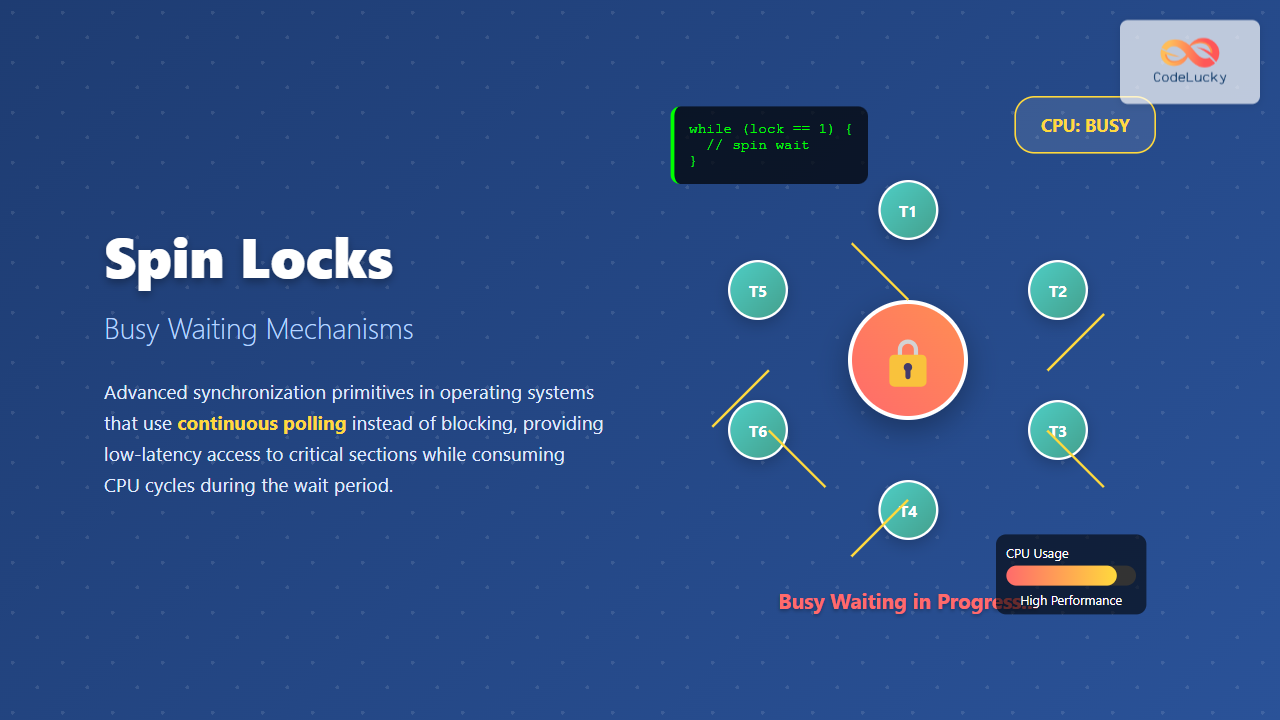
Spin locks are fundamental synchronization primitives in operating systems that implement busy waiting mechanisms to protect critical sections from concurrent access. Unlike traditional blocking locks, spin locks keep threads actively polling until the lock becomes available, making them essential for low-latency scenarios and kernel-level programming.
What are Spin Locks?
A spin lock is a synchronization mechanism where threads continuously check (spin) for lock availability rather than being put to sleep. When a thread attempts to acquire a busy spin lock, it enters a tight loop, repeatedly testing the lock’s state until it becomes free.

The key characteristic of spin locks is that waiting threads remain active, consuming CPU cycles while polling the lock status. This approach contrasts with blocking locks where threads are suspended and scheduled later.
How Spin Locks Work
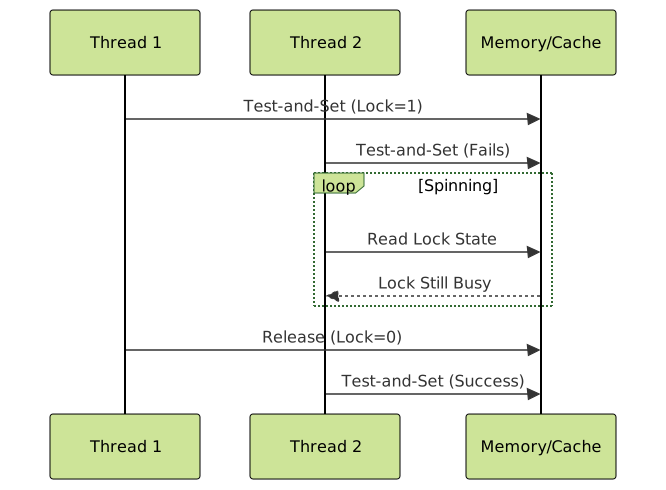
Spin locks operate using atomic operations to ensure thread safety. The basic mechanism involves:
- Acquisition Phase: Thread attempts to atomically change lock state from 0 (free) to 1 (locked)
- Spinning Phase: If unsuccessful, thread continuously polls the lock variable
- Critical Section: Once acquired, thread executes protected code
- Release Phase: Thread atomically resets lock state to 0
Basic Spin Lock Implementation
typedef struct {
    volatile int locked;
} spinlock_t;

void spinlock_init(spinlock_t *lock) {
    lock->locked = 0;
}

void spinlock_acquire(spinlock_t *lock) {
    while (__sync_lock_test_and_set(&lock->locked, 1)) {
        // Busy wait - keep spinning
        while (lock->locked) {
            // Optional: CPU pause instruction for better performance
            __asm__ __volatile__("pause" ::: "memory");
        }
    }
}

void spinlock_release(spinlock_t *lock) {
    __sync_lock_release(&lock->locked);
}
Types of Spin Locks
1. Test-and-Set Spin Lock
The simplest form using atomic test-and-set operations:
void simple_spinlock_acquire(volatile int *lock) {
    while (__sync_lock_test_and_set(lock, 1)) {
        // Spin until lock is acquired
    }
}

// Usage example
volatile int my_lock = 0;
simple_spinlock_acquire(&my_lock);
// Critical section
*lock = 0; // Release
2. Test-and-Test-and-Set (TTAS) Spin Lock
An optimized version that reduces memory traffic:
void ttas_spinlock_acquire(volatile int *lock) {
    while (1) {
        // First test without atomic operation
        while (*lock == 1) {
            // Spin without generating memory traffic
        }
        // Then try atomic test-and-set
        if (__sync_lock_test_and_set(lock, 1) == 0) {
            break; // Successfully acquired
        }
    }
}
3. Exponential Backoff Spin Lock
Implements delays between attempts to reduce contention:
void backoff_spinlock_acquire(volatile int *lock) {
    int delay = 1;
    while (__sync_lock_test_and_set(lock, 1)) {
        for (int i = 0; i < delay; i++) {
            __asm__ __volatile__("pause" ::: "memory");
        }
        delay = (delay < 1024) ? delay * 2 : delay; // Cap the delay
    }
}
Spin Lock vs Traditional Locks Comparison

| Aspect | Spin Locks | Mutex/Blocking Locks |
|---|---|---|
| CPU Usage | High (continuous polling) | Low (threads sleep) |
| Latency | Very low | Higher (context switching) |
| Best Use Case | Short critical sections | Long critical sections |
| Context Switching | None | Required |
| Memory Overhead | Minimal | Higher (thread queues) |
Real-World Implementation Example
Here’s a complete example demonstrating spin lock usage in a multi-threaded counter scenario:
#include
#include
#include

typedef struct {
    atomic_flag locked;
} spinlock_t;

typedef struct {
    int counter;
    spinlock_t lock;
} shared_data_t;

void spinlock_init(spinlock_t *lock) {
    atomic_flag_clear(&lock->locked);
}

void spinlock_lock(spinlock_t *lock) {
    while (atomic_flag_test_and_set_explicit(&lock->locked, memory_order_acquire)) {
        // Spin wait with CPU pause
        __asm__ __volatile__("pause" ::: "memory");
    }
}

void spinlock_unlock(spinlock_t *lock) {
    atomic_flag_clear_explicit(&lock->locked, memory_order_release);
}

void* worker_thread(void *arg) {
    shared_data_t *data = (shared_data_t*)arg;

    for (int i = 0; i < 100000; i++) {
        spinlock_lock(&data->lock);
        // Critical section
        data->counter++;
        spinlock_unlock(&data->lock);
    }
    return NULL;
}

int main() {
    shared_data_t data = {0};
    spinlock_init(&data.lock);

    pthread_t threads[4];

    // Create 4 threads
    for (int i = 0; i < 4; i++) {
        pthread_create(&threads[i], NULL, worker_thread, &data);
    }

    // Wait for all threads
    for (int i = 0; i < 4; i++) {
        pthread_join(threads[i], NULL);
    }

    printf("Final counter value: %d\n", data.counter);
    // Expected output: Final counter value: 400000
    return 0;
}
Performance Characteristics
Memory Traffic Analysis
The performance of spin locks depends heavily on:
- Critical Section Duration: Shorter sections favor spin locks
- Number of Contending Threads: More threads increase spinning overhead
- Cache Coherency: Frequent lock state changes cause cache invalidation
- CPU Architecture: NUMA systems may experience higher latency
Optimization Techniques
// Optimized spin lock with adaptive behavior
typedef struct {
    atomic_int locked;
    int spin_count;
} adaptive_spinlock_t;

void adaptive_spinlock_acquire(adaptive_spinlock_t *lock) {
    int spins = 0;
    int max_spins = lock->spin_count;

    while (1) {
        // Try to acquire immediately
        if (atomic_exchange(&lock->locked, 1) == 0) {
            lock->spin_count = (spins + lock->spin_count) / 2; // Adapt
            return;
        }

        if (spins++ < max_spins) {
            // Continue spinning with backoff
            for (int i = 0; i < spins; i++) {
                __asm__ __volatile__("pause" ::: "memory");
            }
        } else {
            // Fall back to yielding CPU
            sched_yield();
            spins = 0;
        }
    }
}
Use Cases and Applications
1. Kernel-Level Synchronization
Operating system kernels extensively use spin locks for:
- Interrupt handlers (cannot sleep)
- Scheduler data structures
- Memory management routines
- Device driver synchronization
2. High-Performance Applications
// Example: Lock-free queue with spin lock fallback
typedef struct {
    volatile int head;
    volatile int tail;
    spinlock_t resize_lock;
    void **buffer;
    int capacity;
} spsc_queue_t;

bool queue_enqueue(spsc_queue_t *queue, void *item) {
    int current_tail = queue->tail;
    int next_tail = (current_tail + 1) % queue->capacity;

    if (next_tail == queue->head) {
        // Queue full, need resize
        spinlock_lock(&queue->resize_lock);
        // Resize logic here
        spinlock_unlock(&queue->resize_lock);
    }

    queue->buffer[current_tail] = item;
    queue->tail = next_tail;
    return true;
}
3. Real-Time Systems
In real-time systems where predictable timing is crucial:
- Avoiding context switch overhead
- Maintaining thread priority levels
- Ensuring bounded execution times
Advantages and Disadvantages
Advantages
- Low Latency: No context switching overhead
- Simple Implementation: Minimal code complexity
- Predictable Timing: No scheduler interference
- Cache Friendly: Lock variable stays in cache
- Interrupt Safe: Can be used in interrupt contexts
Disadvantages
- CPU Wastage: Consumes cycles while waiting
- Power Consumption: High energy usage on mobile devices
- Scalability Issues: Performance degrades with many threads
- Priority Inversion: Low-priority threads can block high-priority ones
- Unsuitable for Long Waits: Inefficient for lengthy critical sections
Best Practices and Guidelines

Implementation Guidelines
- Keep Critical Sections Short: Aim for less than 100 CPU cycles
- Limit Thread Count: Don’t exceed the number of CPU cores
- Use Appropriate Memory Barriers: Ensure proper synchronization
- Consider NUMA Topology: Account for memory access patterns
- Profile Performance: Measure actual spinning overhead
// Good practice: Short critical section
spinlock_lock(&cache_lock);
cache_entry->value = new_value;  // Fast operation
cache_entry->timestamp = current_time();
spinlock_unlock(&cache_lock);

// Bad practice: Long critical section
spinlock_lock(&file_lock);
result = complex_file_processing();  // Slow I/O operation
write_results_to_disk(result);       // Another slow operation
spinlock_unlock(&file_lock);
Alternative Synchronization Mechanisms
When spin locks aren’t suitable, consider these alternatives:
- Mutex Locks: For longer critical sections
- Read-Write Locks: When reads are more frequent than writes
- Semaphores: For resource counting scenarios
- Lock-Free Data Structures: Using atomic operations
- Futex (Fast Userspace Mutex): Hybrid spin-then-block approach
Conclusion
Spin locks are powerful synchronization primitives that excel in specific scenarios requiring low-latency access to shared resources. Their busy-waiting mechanism makes them ideal for short critical sections in kernel code, real-time systems, and high-performance applications. However, their CPU-intensive nature requires careful consideration of use cases, thread counts, and critical section durations.
Understanding when to use spin locks versus traditional blocking mechanisms is crucial for system performance. By following best practices and considering the trade-offs between latency and CPU utilization, developers can effectively leverage spin locks to build efficient concurrent systems.
The key to successful spin lock implementation lies in profiling your specific use case, keeping critical sections minimal, and being aware of the underlying hardware characteristics that influence performance.
Related Posts

Thread Synchronization: Mutexes, Semaphores and Deadlocks in Operating Systems
Introduction to Thread Synchronization Thread synchronization is a fundamental concept in operating systems that ensures multiple threads can safely access...
Monitor in Operating System: High-level Synchronization for Process Coordination
What is a Monitor in Operating System? A monitor is a high-level synchronization construct in operating systems that provides a...

File Locking Mechanisms: Complete Guide to Advisory and Mandatory Locking in Operating Systems
File locking mechanisms are essential components of modern operating systems that prevent data corruption and ensure data integrity when multiple...

Process Synchronization: Critical Sections and Race Conditions in Operating Systems
Introduction to Process Synchronization Process synchronization is a fundamental concept in operating systems that ensures multiple processes can safely access...
Test and Set Lock: Complete Guide to Atomic Hardware Instructions for Process Synchronization
The Test and Set Lock is a fundamental atomic hardware instruction that plays a crucial role in process synchronization and...
Deadlock in Operating System: Complete Guide to Necessary Conditions and Detection Methods
Deadlock is one of the most critical challenges in operating system design, where multiple processes become permanently blocked while waiting...

C++ Thread Synchronization: Mutexes and Locks
In the world of modern C++ programming, multithreading has become an essential technique for improving application performance and responsiveness. However,...

Deadlock Prevention: Complete Guide to Avoiding Circular Wait Conditions
Understanding Deadlock and Circular Wait Deadlock is one of the most critical issues in operating systems where two or more...
Deadlock Detection and Recovery: Graph-based Algorithms for Operating Systems
Introduction to Deadlock Detection and Recovery Deadlock is one of the most critical challenges in operating systems where multiple processes...
C++ Atomic Operations: Lock-Free Programming
In the world of modern C++ programming, concurrency and parallelism have become increasingly important. As developers, we often need to...
Thread in Operating System: Lightweight Processes and Multithreading Explained
What are Threads in Operating Systems? A thread is the smallest unit of execution within a process that can be...

Mutex vs Semaphore: Complete Guide to Synchronization Primitives in Operating Systems
In the world of concurrent programming and operating systems, synchronization primitives are essential tools that prevent race conditions and ensure...