Introduction to Segmentation in Operating Systems
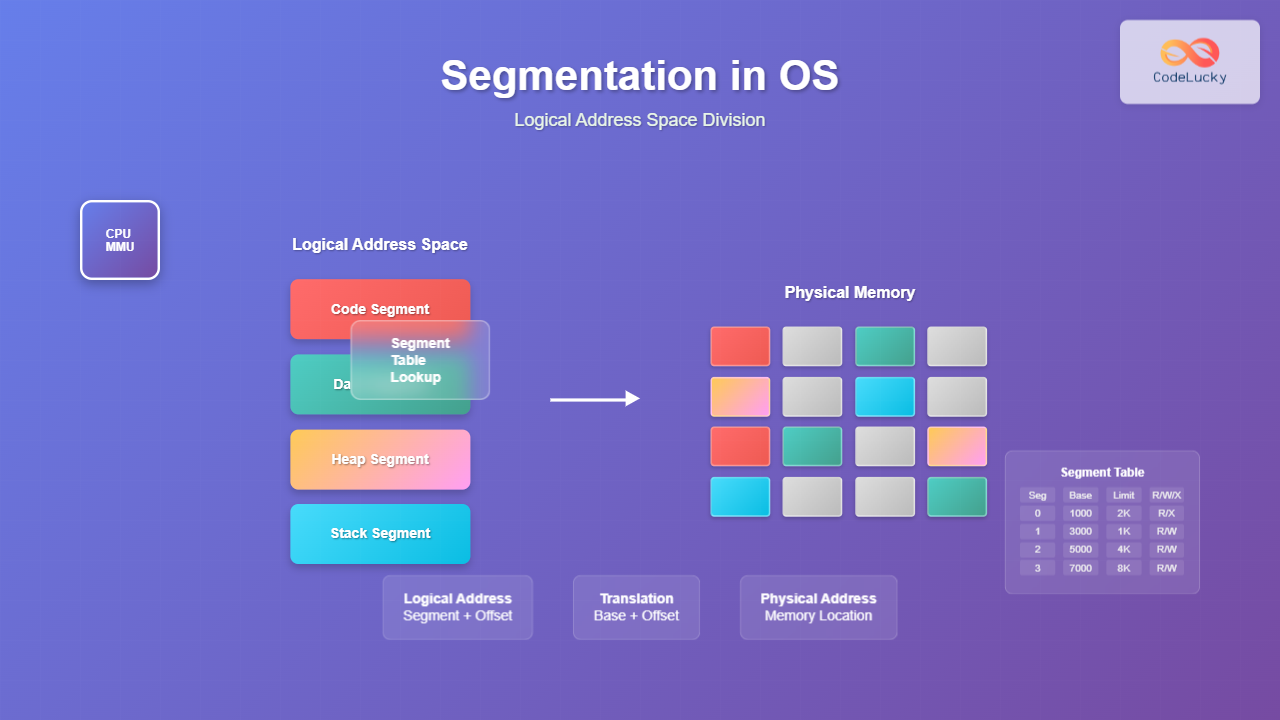
Segmentation is a fundamental memory management technique in operating systems that divides the logical address space of a process into variable-sized segments based on the logical structure of the program. Unlike paging, which divides memory into fixed-size pages, segmentation creates meaningful divisions that correspond to different parts of a program such as code, data, heap, and stack segments.
This approach provides a more intuitive way to organize memory that aligns with how programmers structure their applications, making memory management more efficient and secure.
What is Segmentation?
Segmentation is a memory management scheme where the logical address space is divided into segments of varying sizes. Each segment represents a logically related group of information, such as:
- Code Segment: Contains the executable instructions of the program
- Data Segment: Stores global and static variables
- Heap Segment: Dynamic memory allocation area
- Stack Segment: Function calls, local variables, and return addresses

How Segmentation Works
In a segmented memory system, each logical address consists of two parts:
- Segment Number (s): Identifies which segment the address belongs to
- Offset (d): Specifies the location within that segment
The Memory Management Unit (MMU) uses a segment table to translate logical addresses to physical addresses. Each entry in the segment table contains:
- Base Address: Starting physical address of the segment
- Limit: Size of the segment
- Protection Bits: Access permissions (read, write, execute)
Address Translation Process

Practical Example: C Program Segmentation
Let’s examine how a simple C program would be organized in memory using segmentation:
#include <stdio.h>
#include <stdlib.h>

int global_var = 100;           // Data Segment
static int static_var = 200;   // Data Segment

int main() {                    // Code Segment
    int local_var = 50;         // Stack Segment
    int *heap_ptr;              // Stack Segment (pointer)

    heap_ptr = malloc(sizeof(int)); // Heap Segment
    *heap_ptr = 75;

    printf("Global: %d\n", global_var);
    printf("Local: %d\n", local_var);
    printf("Heap: %d\n", *heap_ptr);

    free(heap_ptr);
    return 0;
}
Memory Layout
| Segment | Content | Base Address | Size | Permissions |
|---|---|---|---|---|
| Code | main() function, printf calls | 0x1000 | 2048 bytes | Read, Execute |
| Data | global_var, static_var | 0x2000 | 1024 bytes | Read, Write |
| Heap | malloc allocated memory | 0x3000 | 4096 bytes | Read, Write |
| Stack | local_var, heap_ptr, return addresses | 0x7000 | 8192 bytes | Read, Write |
Segment Table Structure
The segment table is a crucial data structure that maintains information about each segment. Here’s how it works:

Example Segment Table
Segment Table for Process ID: 1234

Segment | Base    | Limit | R | W | X |
--------|---------|-------|---|---|---|
   0    | 0x1000  | 2048  | 1 | 0 | 1 |  (Code)
   1    | 0x2000  | 1024  | 1 | 1 | 0 |  (Data)
   2    | 0x3000  | 4096  | 1 | 1 | 0 |  (Heap)
   3    | 0x7000  | 8192  | 1 | 1 | 0 |  (Stack)
Advantages of Segmentation
1. Logical Organization
Segmentation provides a natural way to organize programs that matches the programmer’s view of the application structure.
2. Protection and Security
Each segment can have different access permissions, preventing unauthorized access between different parts of the program.
3. Sharing
Code segments can be shared between multiple processes, reducing memory usage for common libraries and applications.
4. Dynamic Growth
Segments like heap and stack can grow or shrink during program execution without affecting other segments.
Disadvantages of Segmentation
1. External Fragmentation
Variable-sized segments can lead to fragmented free space in physical memory, making it difficult to allocate large contiguous blocks.
2. Complex Memory Management
Managing variable-sized segments requires more sophisticated algorithms for allocation and deallocation.
3. Segment Size Limitations
Maximum segment size is limited by the addressing scheme and available physical memory.
Segmentation vs. Paging Comparison
| Aspect | Segmentation | Paging |
|---|---|---|
| Division Method | Variable-sized logical units | Fixed-sized blocks |
| Programmer Visibility | Visible to programmer | Transparent to programmer |
| Fragmentation | External fragmentation | Internal fragmentation |
| Protection | Segment-level protection | Page-level protection |
| Sharing | Easy to share segments | Complex sharing mechanism |
Implementation Examples
Intel x86 Segmentation
The Intel x86 architecture implements segmentation through segment registers and descriptors:
; x86 Assembly example showing segment usage
mov ax, DATA_SEGMENT    ; Load data segment selector
mov ds, ax              ; Set data segment register
mov bx, 0x100          ; Offset within segment
mov al, [bx]           ; Access data at DS:0x100
Segmentation Fault Example
Here’s a C program that demonstrates a segmentation fault when trying to access memory outside segment bounds:
#include <stdio.h>

int main() {
    int arr[5] = {1, 2, 3, 4, 5};
    int *ptr = arr;

    // This will likely cause a segmentation fault
    // when accessing memory far beyond the segment bounds
    ptr += 1000000;
    printf("Value: %d\n", *ptr);  // Segmentation fault here

    return 0;
}
Expected Output:
Segmentation fault (core dumped)
Memory Allocation Strategies

Modern Segmentation Applications
1. Virtual Machines
Hypervisors use segmentation to isolate different virtual machines and provide security boundaries.
2. Database Systems
Database management systems use segmentation to organize different types of data (indexes, tables, logs) in separate segments.
3. Embedded Systems
Resource-constrained embedded systems often use segmentation for efficient memory utilization.
Segmentation with Paging
Many modern systems combine segmentation with paging to get benefits of both approaches:

Benefits of Combined Approach
- Logical Organization: From segmentation
- Efficient Memory Use: From paging
- Reduced Fragmentation: External fragmentation eliminated
- Better Performance: Optimized for both sharing and protection
Programming Considerations
Writing Segment-Aware Code
// Example of segment-aware programming
#include <stdio.h>
#include <stdlib.h>

// Function to check segment boundaries (conceptual)
int safe_access(void *ptr, size_t size) {
    // In real implementation, this would check
    // against segment limits
    if (ptr == NULL) return 0;

    // Simulate bounds checking
    uintptr_t addr = (uintptr_t)ptr;
    if (addr < 0x1000 || addr > 0xFFFF) {
        return 0; // Outside valid range
    }

    return 1; // Safe to access
}

int main() {
    int *data = malloc(100 * sizeof(int));

    if (safe_access(data, 100 * sizeof(int))) {
        // Safe to use the allocated memory
        for (int i = 0; i < 100; i++) {
            data[i] = i * i;
        }
        printf("Memory access completed safely\n");
    } else {
        printf("Unsafe memory access detected\n");
    }

    free(data);
    return 0;
}
Performance Optimization
Segment Size Optimization
- Code Segments: Keep them reasonably sized for better cache performance
- Data Segments: Group related data together
- Stack Segments: Size appropriately for recursion depth
- Heap Segments: Use memory pools for frequent allocations
Access Pattern Optimization
// Optimized access pattern for segmented memory
void process_data(int *data, size_t count) {
    // Access data sequentially within segment
    // to improve cache locality
    for (size_t i = 0; i < count; i++) {
        data[i] = data[i] * 2; // Sequential access
    }
}
Debugging Segmentation Issues
Common Tools and Techniques
- GDB: For analyzing segmentation faults
- Valgrind: Memory error detection
- AddressSanitizer: Runtime bounds checking
- Core Dumps: Post-mortem analysis
Example GDB Session
$ gdb ./program
(gdb) run
Program received signal SIGSEGV, Segmentation fault.
(gdb) bt
#0  0x000000000040052a in main ()
(gdb) info registers
(gdb) x/10x $sp
Conclusion
Segmentation provides a powerful and intuitive approach to memory management that aligns with the logical structure of programs. While it has challenges like external fragmentation, its benefits in terms of protection, sharing, and logical organization make it valuable in many computing scenarios.
Understanding segmentation is crucial for system programmers, as it provides insights into how operating systems manage memory and helps in writing more efficient and secure applications. Modern systems often combine segmentation with paging to leverage the advantages of both approaches, creating robust memory management systems that serve as the foundation for today’s computing environments.
Whether you’re developing system software, debugging memory issues, or optimizing application performance, a solid understanding of segmentation concepts will enhance your ability to work effectively with memory management in operating systems.
Related Posts
Virtual Memory in OS: Complete Guide to Paging, Segmentation and Address Translation
Virtual memory is one of the most fundamental concepts in modern operating systems, enabling efficient memory management and providing crucial...
Memory Allocation Techniques: Contiguous vs Non-contiguous Management Strategies
Memory allocation is a fundamental aspect of operating system design that determines how programs and data are stored and accessed...
Paging in Operating System: Complete Guide to Memory Management and Page Tables
What is Paging in Operating Systems? Paging is a memory management scheme that allows the operating system to store and...
Memory Management in Operating System: Virtual and Physical Memory Fundamentals
Introduction to Memory Management Memory management is one of the most critical functions of an operating system, responsible for efficiently...

Process in Operating System: Complete Guide to Definition, States and Lifecycle
What is a Process in Operating System? A process is a program in execution that consists of the program code...
Dynamic Memory Allocation: malloc, calloc and free Functions in C Programming
What is Dynamic Memory Allocation? Dynamic memory allocation is a fundamental concept in operating systems and programming that allows programs...

C Memory Management: Advanced Techniques and Best Practices
Memory management is a critical aspect of C programming that can make or break your application's performance and reliability. In...
Memory Fragmentation: Internal vs External Fragmentation in Operating Systems
Memory fragmentation is one of the most critical challenges in operating system memory management, directly impacting system performance and resource...

C Standard Library: <stdlib.h> Functions
The C Standard Library is a collection of header files that provide a wide array of functions, macros, and type...
File Allocation Methods: Contiguous, Linked and Indexed Storage Techniques
Understanding File Allocation Methods in Operating Systems File allocation methods are fundamental techniques used by operating systems to organize and...
Garbage Collection in Operating System: Complete Guide to Automatic Memory Management
What is Garbage Collection in Operating Systems? Garbage collection is an automatic memory management technique used by operating systems and...
Windows Memory Management: Virtual Memory Implementation and Optimization Guide
Introduction to Windows Virtual Memory Windows virtual memory is a sophisticated memory management system that allows programs to use more...
- Introduction to Segmentation in Operating Systems
- What is Segmentation?
- How Segmentation Works
- Practical Example: C Program Segmentation
- Segment Table Structure
- Advantages of Segmentation
- Disadvantages of Segmentation
- Segmentation vs. Paging Comparison
- Implementation Examples
- Memory Allocation Strategies
- Modern Segmentation Applications
- Segmentation with Paging
- Programming Considerations
- Performance Optimization
- Debugging Segmentation Issues
- Conclusion