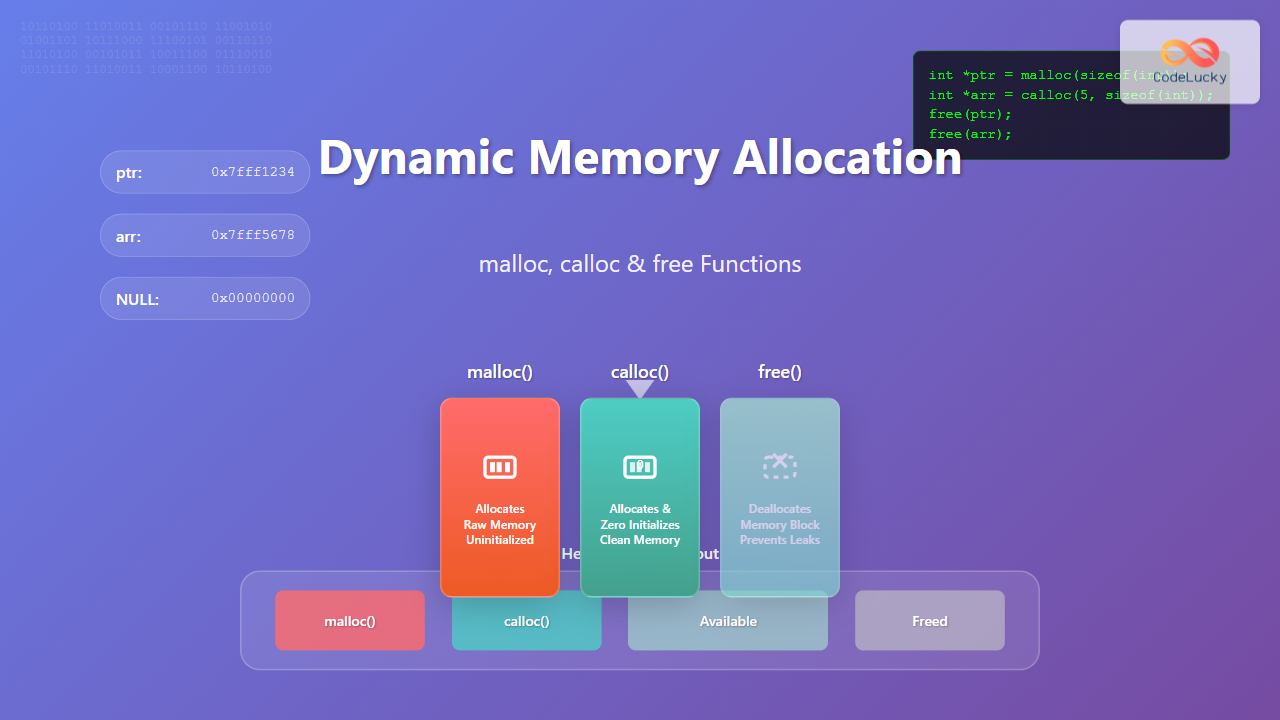
What is Dynamic Memory Allocation?
Dynamic memory allocation is a fundamental concept in operating systems and programming that allows programs to request and release memory during runtime. Unlike static memory allocation where memory is allocated at compile time, dynamic allocation provides flexibility to allocate memory as needed during program execution.
In C programming, dynamic memory allocation is managed through the heap – a region of memory separate from the stack where local variables are stored. The heap allows programs to allocate large amounts of memory and manage it efficiently throughout the program’s lifecycle.
The malloc() Function
The malloc() function (memory allocation) is the most commonly used function for dynamic memory allocation. It allocates a specified number of bytes from the heap and returns a pointer to the allocated memory block.
Syntax and Parameters
void* malloc(size_t size);- size: Number of bytes to allocate
- Return value: Pointer to allocated memory block, or NULL if allocation fails
Basic malloc() Example
#include <stdio.h>
#include <stdlib.h>

int main() {
    // Allocate memory for 5 integers
    int *ptr = (int*)malloc(5 * sizeof(int));

    // Check if allocation was successful
    if (ptr == NULL) {
        printf("Memory allocation failed!\n");
        return 1;
    }

    // Initialize and display values
    for (int i = 0; i < 5; i++) {
        ptr[i] = (i + 1) * 10;
        printf("ptr[%d] = %d\n", i, ptr[i]);
    }

    // Free allocated memory
    free(ptr);
    ptr = NULL; // Prevent dangling pointer

    return 0;
}
Output:
ptr[0] = 10
ptr[1] = 20
ptr[2] = 30
ptr[3] = 40
ptr[4] = 50
Dynamic String Allocation with malloc()
#include <stdio.h>
#include <stdlib.h>
#include <string.h>

int main() {
    char *name;
    int length = 50;

    // Allocate memory for string
    name = (char*)malloc(length * sizeof(char));

    if (name == NULL) {
        printf("Memory allocation failed!\n");
        return 1;
    }

    // Use the allocated memory
    strcpy(name, "Dynamic Memory Allocation");
    printf("String: %s\n", name);
    printf("Length: %lu bytes\n", strlen(name));

    // Reallocate for larger string
    name = (char*)realloc(name, 100 * sizeof(char));
    strcat(name, " with malloc and realloc");
    printf("Extended string: %s\n", name);

    free(name);
    return 0;
}
The calloc() Function
The calloc() function (contiguous allocation) allocates memory for an array of elements and initializes all bytes to zero. This is particularly useful when you need clean, initialized memory.
Syntax and Parameters
void* calloc(size_t num, size_t size);- num: Number of elements to allocate
- size: Size of each element in bytes
- Return value: Pointer to allocated and zero-initialized memory, or NULL if allocation fails
calloc() vs malloc() Comparison
#include <stdio.h>
#include <stdlib.h>

int main() {
    int *malloc_ptr, *calloc_ptr;
    int size = 5;

    // Allocate using malloc (uninitialized)
    malloc_ptr = (int*)malloc(size * sizeof(int));

    // Allocate using calloc (zero-initialized)
    calloc_ptr = (int*)calloc(size, sizeof(int));

    printf("malloc() allocated memory (uninitialized):\n");
    for (int i = 0; i < size; i++) {
        printf("malloc_ptr[%d] = %d\n", i, malloc_ptr[i]);
    }

    printf("\ncalloc() allocated memory (zero-initialized):\n");
    for (int i = 0; i < size; i++) {
        printf("calloc_ptr[%d] = %d\n", i, calloc_ptr[i]);
    }

    free(malloc_ptr);
    free(calloc_ptr);

    return 0;
}
Typical Output:
malloc() allocated memory (uninitialized):
malloc_ptr[0] = 32767
malloc_ptr[1] = -1073741824
malloc_ptr[2] = 32767
malloc_ptr[3] = 0
malloc_ptr[4] = -1073741816

calloc() allocated memory (zero-initialized):
calloc_ptr[0] = 0
calloc_ptr[1] = 0
calloc_ptr[2] = 0
calloc_ptr[3] = 0
calloc_ptr[4] = 0
The free() Function
The free() function deallocates memory previously allocated by malloc(), calloc(), or realloc(). Proper memory deallocation is crucial to prevent memory leaks.
Syntax and Best Practices
void free(void *ptr);- ptr: Pointer to memory block to be freed
- Return value: None (void)
Memory Leak Prevention Example
#include <stdio.h>
#include <stdlib.h>

void demonstrate_memory_leak() {
    int *ptr = (int*)malloc(1000 * sizeof(int));
    // Memory allocated but never freed - MEMORY LEAK!
    // This function ends without calling free(ptr)
}

void proper_memory_management() {
    int *ptr = (int*)malloc(1000 * sizeof(int));

    if (ptr == NULL) {
        printf("Allocation failed!\n");
        return;
    }

    // Use the memory
    for (int i = 0; i < 1000; i++) {
        ptr[i] = i;
    }

    // Properly free the memory
    free(ptr);
    ptr = NULL; // Prevent dangling pointer
    printf("Memory properly deallocated\n");
}

int main() {
    printf("Demonstrating proper memory management:\n");
    proper_memory_management();

    return 0;
}
Advanced Memory Management Techniques
Dynamic 2D Array Allocation
#include <stdio.h>
#include <stdlib.h>

int** create_2d_array(int rows, int cols) {
    // Allocate array of row pointers
    int **array = (int**)malloc(rows * sizeof(int*));

    if (array == NULL) {
        return NULL;
    }

    // Allocate each row
    for (int i = 0; i < rows; i++) {
        array[i] = (int*)malloc(cols * sizeof(int));
        if (array[i] == NULL) {
            // Free previously allocated rows on failure
            for (int j = 0; j < i; j++) {
                free(array[j]);
            }
            free(array);
            return NULL;
        }
    }

    return array;
}

void free_2d_array(int **array, int rows) {
    for (int i = 0; i < rows; i++) {
        free(array[i]);
    }
    free(array);
}

int main() {
    int rows = 3, cols = 4;
    int **matrix = create_2d_array(rows, cols);

    if (matrix == NULL) {
        printf("2D array allocation failed!\n");
        return 1;
    }

    // Initialize and display matrix
    printf("3x4 Matrix:\n");
    for (int i = 0; i < rows; i++) {
        for (int j = 0; j < cols; j++) {
            matrix[i][j] = i * cols + j + 1;
            printf("%2d ", matrix[i][j]);
        }
        printf("\n");
    }

    free_2d_array(matrix, rows);
    printf("Matrix memory freed successfully\n");

    return 0;
}
Output:
3x4 Matrix:
 1  2  3  4
 5  6  7  8
 9 10 11 12
Matrix memory freed successfully
Memory Allocation with Error Handling
#include <stdio.h>
#include <stdlib.h>
#include <errno.h>
#include <string.h>

typedef struct {
    int *data;
    size_t size;
    size_t capacity;
} DynamicArray;

DynamicArray* create_dynamic_array(size_t initial_capacity) {
    DynamicArray *arr = (DynamicArray*)malloc(sizeof(DynamicArray));

    if (arr == NULL) {
        fprintf(stderr, "Failed to allocate DynamicArray structure: %s\n",
                strerror(errno));
        return NULL;
    }

    arr->data = (int*)calloc(initial_capacity, sizeof(int));
    if (arr->data == NULL) {
        fprintf(stderr, "Failed to allocate array data: %s\n",
                strerror(errno));
        free(arr);
        return NULL;
    }

    arr->size = 0;
    arr->capacity = initial_capacity;
    printf("Dynamic array created with capacity: %zu\n", initial_capacity);

    return arr;
}

int resize_array(DynamicArray *arr, size_t new_capacity) {
    if (arr == NULL || new_capacity == 0) {
        return -1;
    }

    int *new_data = (int*)realloc(arr->data, new_capacity * sizeof(int));
    if (new_data == NULL) {
        fprintf(stderr, "Failed to resize array: %s\n", strerror(errno));
        return -1;
    }

    arr->data = new_data;
    arr->capacity = new_capacity;

    // Initialize new elements if capacity increased
    if (new_capacity > arr->size) {
        memset(arr->data + arr->size, 0,
               (new_capacity - arr->size) * sizeof(int));
    }

    printf("Array resized to capacity: %zu\n", new_capacity);
    return 0;
}

void destroy_dynamic_array(DynamicArray *arr) {
    if (arr != NULL) {
        free(arr->data);
        free(arr);
        printf("Dynamic array destroyed\n");
    }
}

int main() {
    DynamicArray *arr = create_dynamic_array(5);

    if (arr == NULL) {
        return 1;
    }

    // Add some data
    for (int i = 0; i < 5; i++) {
        arr->data[i] = (i + 1) * 100;
        arr->size++;
    }

    printf("Initial array contents:\n");
    for (size_t i = 0; i < arr->size; i++) {
        printf("arr[%zu] = %d\n", i, arr->data[i]);
    }

    // Resize array
    if (resize_array(arr, 10) == 0) {
        printf("Array successfully resized\n");
    }

    destroy_dynamic_array(arr);

    return 0;
}
Memory Management Best Practices

Common Memory Management Errors
#include <stdio.h>
#include <stdlib.h>

void demonstrate_common_errors() {
    int *ptr1, *ptr2;

    // 1. Using uninitialized pointer
    // *ptr1 = 10; // UNDEFINED BEHAVIOR!

    // 2. Memory leak
    ptr1 = (int*)malloc(sizeof(int));
    // ptr1 goes out of scope without free() - MEMORY LEAK!

    // 3. Double free (commented to prevent crash)
    ptr2 = (int*)malloc(sizeof(int));
    free(ptr2);
    // free(ptr2); // DOUBLE FREE ERROR!

    // 4. Using freed memory (dangling pointer)
    // *ptr2 = 20; // UNDEFINED BEHAVIOR!

    printf("Common errors demonstrated (safely)\n");
}

void demonstrate_correct_usage() {
    int *ptr = NULL;

    // 1. Proper allocation with error checking
    ptr = (int*)malloc(sizeof(int));
    if (ptr == NULL) {
        fprintf(stderr, "Allocation failed!\n");
        return;
    }

    // 2. Safe usage
    *ptr = 42;
    printf("Value: %d\n", *ptr);

    // 3. Proper deallocation
    free(ptr);
    ptr = NULL; // Prevent dangling pointer

    // 4. Safe check before reuse
    if (ptr == NULL) {
        printf("Pointer safely nullified\n");
    }
}

int main() {
    printf("Demonstrating correct memory management:\n");
    demonstrate_correct_usage();

    return 0;
}
Performance Considerations
Memory Allocation Benchmark
#include <stdio.h>
#include <stdlib.h>
#include <time.h>
#include <string.h>

void benchmark_allocation_methods() {
    const int iterations = 1000000;
    const int size = 1024;
    clock_t start, end;
    double malloc_time, calloc_time;

    // Benchmark malloc
    start = clock();
    for (int i = 0; i < iterations; i++) {
        void *ptr = malloc(size);
        if (ptr != NULL) {
            memset(ptr, 0, size); // Manual initialization
            free(ptr);
        }
    }
    end = clock();
    malloc_time = ((double)(end - start)) / CLOCKS_PER_SEC;

    // Benchmark calloc
    start = clock();
    for (int i = 0; i < iterations; i++) {
        void *ptr = calloc(1, size);
        if (ptr != NULL) {
            free(ptr);
        }
    }
    end = clock();
    calloc_time = ((double)(end - start)) / CLOCKS_PER_SEC;

    printf("Performance Benchmark (%d iterations of %d bytes):\n",
           iterations, size);
    printf("malloc + memset: %.4f seconds\n", malloc_time);
    printf("calloc:          %.4f seconds\n", calloc_time);
    printf("Performance ratio: %.2fx\n", malloc_time / calloc_time);
}

int main() {
    benchmark_allocation_methods();
    return 0;
}
Memory Allocation in System Programming
Creating a Simple Memory Pool
#include <stdio.h>
#include <stdlib.h>
#include <stdint.h>

typedef struct MemoryBlock {
    size_t size;
    int is_free;
    struct MemoryBlock *next;
    char data[];
} MemoryBlock;

typedef struct {
    void *pool;
    size_t total_size;
    size_t used_size;
    MemoryBlock *free_list;
} MemoryPool;

MemoryPool* create_memory_pool(size_t pool_size) {
    MemoryPool *pool = (MemoryPool*)malloc(sizeof(MemoryPool));
    if (pool == NULL) {
        return NULL;
    }

    pool->pool = malloc(pool_size);
    if (pool->pool == NULL) {
        free(pool);
        return NULL;
    }

    pool->total_size = pool_size;
    pool->used_size = 0;
    pool->free_list = NULL;

    printf("Memory pool created: %zu bytes\n", pool_size);
    return pool;
}

void* pool_alloc(MemoryPool *pool, size_t size) {
    if (pool == NULL || size == 0) {
        return NULL;
    }

    size_t total_needed = sizeof(MemoryBlock) + size;

    if (pool->used_size + total_needed > pool->total_size) {
        printf("Pool allocation failed: insufficient space\n");
        return NULL;
    }

    MemoryBlock *block = (MemoryBlock*)((char*)pool->pool + pool->used_size);
    block->size = size;
    block->is_free = 0;
    block->next = NULL;

    pool->used_size += total_needed;

    printf("Allocated %zu bytes from pool\n", size);
    return block->data;
}

void destroy_memory_pool(MemoryPool *pool) {
    if (pool != NULL) {
        free(pool->pool);
        free(pool);
        printf("Memory pool destroyed\n");
    }
}

int main() {
    MemoryPool *pool = create_memory_pool(4096);

    if (pool == NULL) {
        return 1;
    }

    // Allocate various sized blocks
    int *int_array = (int*)pool_alloc(pool, 10 * sizeof(int));
    char *string_buffer = (char*)pool_alloc(pool, 256);
    double *double_array = (double*)pool_alloc(pool, 5 * sizeof(double));

    if (int_array && string_buffer && double_array) {
        printf("All allocations successful\n");
        printf("Pool usage: %zu / %zu bytes\n",
               pool->used_size, pool->total_size);
    }

    destroy_memory_pool(pool);

    return 0;
}
Conclusion
Dynamic memory allocation with malloc(), calloc(), and free() is essential for efficient memory management in C programming and operating systems. Understanding these functions enables developers to:
- Allocate memory efficiently using
malloc()for raw memory blocks - Initialize memory safely using
calloc()for zero-initialized arrays - Prevent memory leaks by properly using
free()to deallocate memory - Implement advanced data structures like dynamic arrays and memory pools
- Handle memory errors gracefully with proper error checking and recovery
Proper memory management practices, including checking allocation return values, avoiding double-free errors, and setting pointers to NULL after deallocation, are crucial for building robust and efficient programs. These concepts form the foundation for understanding how operating systems manage memory and how applications can utilize system resources effectively.
Related Posts

C Memory Management: Dynamic Allocation with malloc() and free()
Memory management is a crucial aspect of C programming that every developer must master. In this comprehensive guide, we'll dive...

C Standard Library: <stdlib.h> Functions
The C Standard Library is a collection of header files that provide a wide array of functions, macros, and type...

C Memory Management: Advanced Techniques and Best Practices
Memory management is a critical aspect of C programming that can make or break your application's performance and reliability. In...

Memory Allocation Techniques: Contiguous vs Non-contiguous Management Strategies
Memory allocation is a fundamental aspect of operating system design that determines how programs and data are stored and accessed...

C Functions: Defining and Calling Functions
Functions are the building blocks of C programming, allowing you to organize your code into reusable, manageable pieces. In this...

Segmentation in OS: Memory Management Through Logical Address Space Division
Introduction to Segmentation in Operating Systems Segmentation is a fundamental memory management technique in operating systems that divides the logical...

C Pointers: Basics of Memory Manipulation
Welcome to the fascinating world of C pointers! 🚀 In this comprehensive guide, we'll dive deep into one of the...
Memory Management in Operating System: Virtual and Physical Memory Fundamentals
Introduction to Memory Management Memory management is one of the most critical functions of an operating system, responsible for efficiently...

Garbage Collection in Operating System: Complete Guide to Automatic Memory Management
What is Garbage Collection in Operating Systems? Garbage collection is an automatic memory management technique used by operating systems and...

C Function Parameters: Passing Data to Functions
In the world of C programming, functions are the building blocks that allow us to create modular and reusable code....

C Function Pointers: Pointers to Functions
Function pointers are a powerful feature in C that allow you to treat functions as data. They provide a level...

Process in Operating System: Complete Guide to Definition, States and Lifecycle
What is a Process in Operating System? A process is a program in execution that consists of the program code...