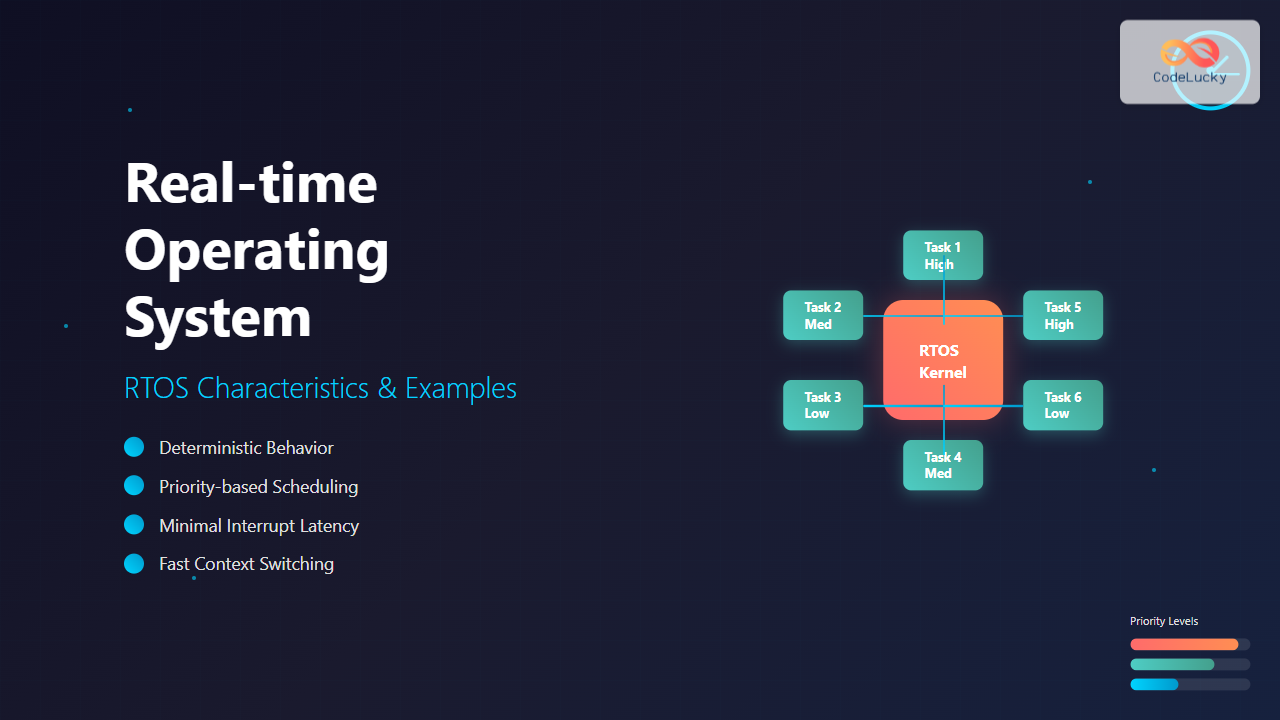
A Real-time Operating System (RTOS) is a specialized operating system designed to handle tasks with strict timing constraints. Unlike traditional operating systems that focus on throughput and user experience, RTOS prioritizes predictable response times and deterministic behavior.
What is a Real-time Operating System?
An RTOS is an operating system that guarantees a certain capability within a specified time constraint. The key distinguishing factor is not speed, but predictability. It ensures that critical tasks are completed within their deadlines, making it essential for time-sensitive applications.

Key Characteristics of RTOS
1. Deterministic Behavior
RTOS provides predictable response times for system calls and interrupts. The worst-case execution time can be calculated and guaranteed.
2. Priority-based Scheduling
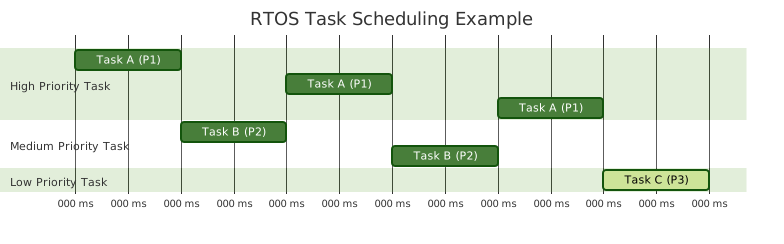
Tasks are assigned priorities, and the scheduler always runs the highest-priority ready task. This ensures critical tasks get immediate attention.
3. Minimal Interrupt Latency
RTOS minimizes the time between an interrupt occurrence and the start of interrupt service routine execution.
4. Fast Context Switching
The system can quickly switch between tasks with minimal overhead, typically in microseconds.
5. Memory Management
RTOS provides predictable memory allocation and deallocation without fragmentation issues that could cause delays.
6. Multitasking Capabilities
Support for concurrent execution of multiple tasks with proper synchronization mechanisms.

Types of Real-time Systems
Hard Real-time Systems
Hard real-time systems have absolute deadlines that must never be missed. Missing a deadline results in system failure or catastrophic consequences.
Examples:
- Nuclear reactor control systems
- Aircraft control systems
- Medical device controllers (pacemakers)
- Anti-lock braking systems (ABS)
Soft Real-time Systems
Soft real-time systems have deadlines that are desirable but not critical. Missing occasional deadlines degrades performance but doesn’t cause system failure.
Examples:
- Video streaming applications
- Online gaming systems
- Voice over IP (VoIP)
- Multimedia applications
Firm Real-time Systems
Firm real-time systems have deadlines where missing them makes the result useless, but doesn’t cause catastrophic failure.
Examples:
- Stock trading systems
- Robot control systems
- Assembly line control
RTOS Architecture
Kernel Components
Task Scheduler
The heart of RTOS that determines which task runs at any given time based on priority and scheduling algorithm.
Task Management
Handles task creation, deletion, suspension, and resumption. Maintains task control blocks (TCBs) for each task.
Inter-task Communication
Provides mechanisms for tasks to communicate and synchronize:
- Semaphores: Binary or counting semaphores for synchronization
- Mutexes: Mutual exclusion for protecting shared resources
- Message Queues: FIFO communication between tasks
- Event Flags: Signaling mechanisms between tasks
Memory Management
Provides predictable memory allocation with features like:
- Static memory allocation
- Dynamic memory pools
- Memory protection
RTOS Scheduling Algorithms
1. Rate Monotonic Scheduling (RMS)
Static priority assignment where tasks with shorter periods get higher priorities. Optimal for periodic tasks.
2. Earliest Deadline First (EDF)
Dynamic priority scheduling where the task with the earliest deadline gets the highest priority.
3. Priority-based Preemptive Scheduling
Tasks are assigned fixed priorities, and the highest priority ready task always runs.
Popular RTOS Examples
1. FreeRTOS
FreeRTOS is one of the most popular open-source RTOS solutions.
Key Features:
- Small memory footprint
- Preemptive scheduling
- Support for multiple architectures
- Rich set of APIs
Code Example – FreeRTOS Task Creation:
#include "FreeRTOS.h"
#include "task.h"

void vTaskFunction(void *pvParameters) {
    for(;;) {
        // Task code here
        printf("Task running\n");
        vTaskDelay(pdMS_TO_TICKS(1000)); // Delay for 1 second
    }
}

int main(void) {
    // Create a task
    xTaskCreate(
        vTaskFunction,     // Task function
        "Task1",           // Task name
        1000,              // Stack size
        NULL,              // Parameters
        1,                 // Priority
        NULL               // Task handle
    );

    // Start the scheduler
    vTaskStartScheduler();

    return 0;
}
2. VxWorks
VxWorks by Wind River is a commercial RTOS widely used in aerospace and defense.
Features:
- Hard real-time capabilities
- POSIX compliance
- Multicore support
- Advanced debugging tools
3. QNX
QNX is a commercial microkernel-based RTOS known for its reliability.
Features:
- Microkernel architecture
- Message-passing IPC
- Fault tolerance
- POSIX compliance
4. RT-Thread
RT-Thread is an open-source IoT RTOS from China.
Features:
- Modular design
- Rich components
- IoT protocols support
- GUI support
5. Zephyr
Zephyr is a Linux Foundation RTOS project for IoT devices.
Features:
- Small memory footprint
- Bluetooth mesh support
- Device tree support
- Security features
RTOS vs General Purpose OS
| Aspect | RTOS | General Purpose OS |
|---|---|---|
| Primary Goal | Predictable timing | Throughput and user experience |
| Response Time | Deterministic | Variable |
| Scheduling | Priority-based preemptive | Time-sharing, round-robin |
| Memory Footprint | Small (KB to MB) | Large (GB) |
| Interrupt Latency | Minimal and bounded | Variable |
| Applications | Embedded systems, control systems | Desktop, servers |
Applications of RTOS
Automotive Industry
- Engine control units (ECU)
- Anti-lock braking systems
- Airbag control systems
- Autonomous driving systems
Aerospace and Defense
- Flight control systems
- Radar systems
- Satellite control
- Missile guidance systems
Medical Devices
- Pacemakers
- Ventilators
- MRI machines
- Surgical robots
Industrial Automation
- Manufacturing robots
- Process control systems
- Quality control systems
- Assembly line controllers
Telecommunications
- Base station controllers
- Network switches
- VoIP systems
- 5G infrastructure
RTOS Programming Concepts
Task States
RTOS tasks can be in various states:

Synchronization Primitives
Semaphores Example
// Binary semaphore for synchronization
SemaphoreHandle_t xSemaphore;

void vProducerTask(void *pvParameters) {
    for(;;) {
        // Produce data
        produceData();

        // Signal consumer
        xSemaphoreGive(xSemaphore);

        vTaskDelay(pdMS_TO_TICKS(100));
    }
}

void vConsumerTask(void *pvParameters) {
    for(;;) {
        // Wait for data
        if(xSemaphoreTake(xSemaphore, portMAX_DELAY)) {
            // Consume data
            consumeData();
        }
    }
}
Message Queue Example
QueueHandle_t xQueue;

void vSenderTask(void *pvParameters) {
    int32_t valueToSend = 100;

    for(;;) {
        xQueueSend(xQueue, &valueToSend, 0);
        valueToSend++;
        vTaskDelay(pdMS_TO_TICKS(200));
    }
}

void vReceiverTask(void *pvParameters) {
    int32_t receivedValue;

    for(;;) {
        if(xQueueReceive(xQueue, &receivedValue, portMAX_DELAY)) {
            printf("Received: %d\n", receivedValue);
        }
    }
}
Performance Metrics
Key Metrics for RTOS Evaluation
| Metric | Description | Typical Values |
|---|---|---|
| Interrupt Latency | Time from interrupt to ISR execution | 1-10 microseconds |
| Context Switch Time | Time to switch between tasks | 1-5 microseconds |
| Memory Footprint | RAM and ROM usage | 2KB – 100KB |
| API Call Overhead | Time for system calls | 0.1-1 microsecond |
Choosing the Right RTOS
Factors to Consider
1. Timing Requirements
- Hard vs. soft real-time needs
- Deadline requirements
- Jitter tolerance
2. Hardware Constraints
- Available memory (RAM/Flash)
- Processing power
- Power consumption
3. Development Ecosystem
- IDE and tools support
- Documentation quality
- Community support
- Commercial support
4. Licensing and Cost
- Open source vs. commercial
- Licensing terms
- Support costs
Future of RTOS
Emerging Trends
IoT Integration
Modern RTOS solutions are increasingly focused on IoT applications with built-in connectivity protocols and cloud integration.
AI/ML Support
RTOS platforms are adding support for edge AI and machine learning frameworks to enable intelligent embedded systems.
Security Enhancements
With growing cybersecurity concerns, RTOS vendors are implementing advanced security features like secure boot, encryption, and trusted execution environments.
Multicore Support
As multicore processors become common in embedded systems, RTOS solutions are evolving to provide better multicore scheduling and load balancing.
Best Practices for RTOS Development
Design Guidelines
1. Task Design
- Keep tasks focused on single responsibilities
- Avoid blocking operations in high-priority tasks
- Use appropriate task priorities
- Design for predictable execution times
2. Resource Management
- Minimize shared resources
- Use priority inheritance for mutexes
- Avoid priority inversion
- Plan memory usage carefully
3. Testing and Debugging
- Use timing analysis tools
- Test worst-case scenarios
- Validate deadline compliance
- Monitor system behavior
Conclusion
Real-time Operating Systems are fundamental to modern embedded and time-critical applications. Understanding RTOS characteristics, architecture, and implementation is crucial for developing reliable systems that meet strict timing requirements.
The choice of RTOS depends on specific application requirements, including timing constraints, hardware limitations, and development ecosystem needs. Whether you choose an open-source solution like FreeRTOS or a commercial offering like VxWorks, the key is to understand your system’s requirements and select the most appropriate platform.
As technology evolves, RTOS solutions continue to adapt, incorporating new features for IoT, AI, and security while maintaining their core promise of predictable, deterministic behavior that makes them indispensable for time-critical applications.
Related Posts
Real-time Scheduling: Hard and Soft Real-time Systems in Operating Systems
Real-time scheduling is a critical component of operating systems that manage tasks with strict timing requirements. Unlike traditional scheduling systems...
Operating System Types: Real-time, Distributed, Mobile and Desktop Systems Explained
Operating systems serve as the crucial bridge between computer hardware and software applications, but not all operating systems are created...
Embedded Operating System: Complete Guide to Resource-Constrained Environments
Embedded operating systems form the backbone of countless devices we interact with daily, from smart home appliances to automotive control...
Operating System Functions: Core Components and System Responsibilities
An operating system (OS) serves as the fundamental software layer that manages computer hardware resources and provides essential services to...
Process Scheduling in Operating System: Algorithms, Types & Implementation Guide
Process scheduling is one of the most critical components of an operating system that determines how the CPU time is...
hwclock Command Linux: Complete Hardware Clock Management Guide
The hwclock command is a powerful Linux utility for managing your system's hardware clock, also known as the Real-Time Clock...
Preemptive vs Non-Preemptive Scheduling: Complete Guide to CPU Scheduling in Operating Systems
Understanding CPU Scheduling in Operating Systems CPU scheduling is one of the most critical functions of an operating system, determining...
Completely Fair Scheduler: Linux CFS Algorithm Deep Dive
The Linux Completely Fair Scheduler (CFS) revolutionized process scheduling in the Linux kernel when it was introduced in version 2.6.23....
Kernel in Operating System: Core Functions and Memory Management
The kernel stands as the fundamental cornerstone of any operating system, serving as the critical bridge between hardware components and...
Virtual CPU Scheduling: Complete Guide to Time-sharing Physical Processors
Virtual CPU scheduling is the cornerstone of modern operating systems, enabling multiple processes to share limited physical processors efficiently. This...
timedatectl Advanced Linux: Complete Time and Date Management Guide
The timedatectl command is a powerful Linux utility that provides comprehensive control over system time and date settings. As part...
Multilevel Queue Scheduling: Multiple Priority Levels in Operating Systems
Introduction to Multilevel Queue Scheduling Multilevel queue scheduling is a sophisticated CPU scheduling algorithm used in operating systems to manage...