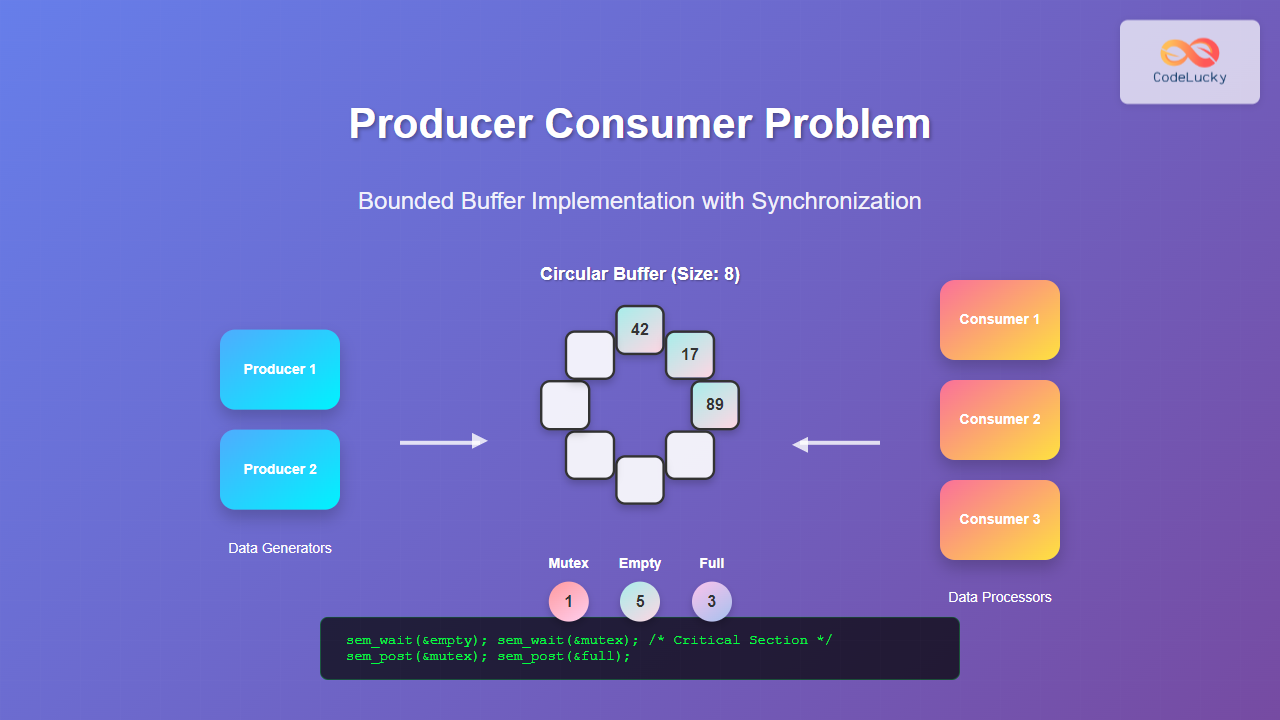
The Producer Consumer Problem, also known as the bounded buffer problem, is one of the most fundamental synchronization problems in operating systems and concurrent programming. This classic problem demonstrates the challenges of coordinating multiple processes that share a common resource – a bounded buffer.
In this comprehensive guide, we’ll explore the intricacies of the producer consumer problem, implement solutions using various synchronization mechanisms, and understand how this concept applies to real-world systems.
Understanding the Producer Consumer Problem
The producer consumer problem involves two types of processes:
- Producer Process: Generates data and places it into a shared buffer
- Consumer Process: Removes and processes data from the shared buffer
The challenge arises when multiple producers and consumers access the same bounded buffer concurrently. Without proper synchronization, this can lead to:
- Race conditions
- Data corruption
- Buffer overflow or underflow
- Deadlock situations

Key Components of Bounded Buffer
A bounded buffer implementation requires several essential components:
1. Buffer Structure
The buffer is typically implemented as a circular array with fixed size. Key attributes include:
- Size: Maximum number of items the buffer can hold
- In pointer: Points to the next empty slot for producers
- Out pointer: Points to the next item for consumers
- Count: Current number of items in the buffer
2. Synchronization Mechanisms
To ensure thread-safe operations, we need:
- Mutex (Mutual Exclusion): Ensures only one process accesses the buffer at a time
- Semaphores: Control access based on available resources
- Condition Variables: Allow processes to wait for specific conditions
Implementation Using Semaphores
Let’s implement the producer consumer problem using semaphores, which is one of the most elegant solutions:
C Implementation
#include <stdio.h>
#include <stdlib.h>
#include <pthread.h>
#include <semaphore.h>
#include <unistd.h>

#define BUFFER_SIZE 5
#define NUM_PRODUCERS 2
#define NUM_CONSUMERS 2
#define ITEMS_TO_PRODUCE 10

// Shared buffer
int buffer[BUFFER_SIZE];
int in = 0;  // Points to next empty slot
int out = 0; // Points to next item to consume

// Semaphores
sem_t empty;    // Count of empty slots
sem_t full;     // Count of filled slots
sem_t mutex;    // Mutual exclusion for buffer access

// Producer function
void* producer(void* arg) {
    int producer_id = *(int*)arg;

    for(int i = 0; i < ITEMS_TO_PRODUCE; i++) {
        int item = rand() % 100 + 1; // Generate random item

        // Wait for empty slot
        sem_wait(∅);

        // Acquire mutex for critical section
        sem_wait(&mutex);

        // Critical Section - Add item to buffer
        buffer[in] = item;
        printf("Producer %d produced item %d at position %d\n",
               producer_id, item, in);
        in = (in + 1) % BUFFER_SIZE;

        // Release mutex
        sem_post(&mutex);

        // Signal that buffer has one more item
        sem_post(&full);

        usleep(100000); // Simulate production time
    }

    return NULL;
}

// Consumer function
void* consumer(void* arg) {
    int consumer_id = *(int*)arg;

    for(int i = 0; i < ITEMS_TO_PRODUCE; i++) {
        // Wait for filled slot
        sem_wait(&full);

        // Acquire mutex for critical section
        sem_wait(&mutex);

        // Critical Section - Remove item from buffer
        int item = buffer[out];
        printf("Consumer %d consumed item %d from position %d\n",
               consumer_id, item, out);
        out = (out + 1) % BUFFER_SIZE;

        // Release mutex
        sem_post(&mutex);

        // Signal that buffer has one more empty slot
        sem_post(∅);

        usleep(150000); // Simulate consumption time
    }

    return NULL;
}

int main() {
    pthread_t producers[NUM_PRODUCERS];
    pthread_t consumers[NUM_CONSUMERS];

    // Initialize semaphores
    sem_init(∅, 0, BUFFER_SIZE); // Initially all slots are empty
    sem_init(&full, 0, 0);            // Initially no slots are full
    sem_init(&mutex, 0, 1);           // Binary semaphore for mutual exclusion

    // Create producer and consumer IDs
    int producer_ids[NUM_PRODUCERS];
    int consumer_ids[NUM_CONSUMERS];

    // Create producer threads
    for(int i = 0; i < NUM_PRODUCERS; i++) {
        producer_ids[i] = i + 1;
        pthread_create(&producers[i], NULL, producer, &producer_ids[i]);
    }

    // Create consumer threads
    for(int i = 0; i < NUM_CONSUMERS; i++) {
        consumer_ids[i] = i + 1;
        pthread_create(&consumers[i], NULL, consumer, &consumer_ids[i]);
    }

    // Wait for all threads to complete
    for(int i = 0; i < NUM_PRODUCERS; i++) {
        pthread_join(producers[i], NULL);
    }

    for(int i = 0; i < NUM_CONSUMERS; i++) {
        pthread_join(consumers[i], NULL);
    }

    // Destroy semaphores
    sem_destroy(∅);
    sem_destroy(&full);
    sem_destroy(&mutex);

    printf("All producers and consumers have finished.\n");
    return 0;
}
Sample Output
Producer 1 produced item 42 at position 0
Producer 2 produced item 67 at position 1
Consumer 1 consumed item 42 from position 0
Producer 1 produced item 23 at position 2
Consumer 2 consumed item 67 from position 1
Producer 2 produced item 89 at position 3
Consumer 1 consumed item 23 from position 2
...
All producers and consumers have finished.
Python Implementation with Threading
Here’s a Python implementation using threading and synchronization primitives:
import threading
import time
import random
from collections import deque

class BoundedBuffer:
    def __init__(self, size):
        self.buffer = deque(maxlen=size)
        self.size = size
        self.lock = threading.Lock()
        self.not_empty = threading.Condition(self.lock)
        self.not_full = threading.Condition(self.lock)

    def put(self, item, producer_id):
        with self.lock:
            # Wait while buffer is full
            while len(self.buffer) == self.size:
                print(f"Producer {producer_id} waiting - buffer full")
                self.not_full.wait()

            # Add item to buffer
            self.buffer.append(item)
            print(f"Producer {producer_id} produced item {item} - "
                  f"Buffer size: {len(self.buffer)}")

            # Notify consumers that buffer is not empty
            self.not_empty.notify()

    def get(self, consumer_id):
        with self.lock:
            # Wait while buffer is empty
            while len(self.buffer) == 0:
                print(f"Consumer {consumer_id} waiting - buffer empty")
                self.not_empty.wait()

            # Remove item from buffer
            item = self.buffer.popleft()
            print(f"Consumer {consumer_id} consumed item {item} - "
                  f"Buffer size: {len(self.buffer)}")

            # Notify producers that buffer is not full
            self.not_full.notify()
            return item

class Producer(threading.Thread):
    def __init__(self, buffer, producer_id, items_to_produce):
        super().__init__()
        self.buffer = buffer
        self.producer_id = producer_id
        self.items_to_produce = items_to_produce

    def run(self):
        for i in range(self.items_to_produce):
            item = random.randint(1, 100)
            self.buffer.put(item, self.producer_id)
            time.sleep(random.uniform(0.1, 0.5))  # Simulate production time

class Consumer(threading.Thread):
    def __init__(self, buffer, consumer_id, items_to_consume):
        super().__init__()
        self.buffer = buffer
        self.consumer_id = consumer_id
        self.items_to_consume = items_to_consume

    def run(self):
        for i in range(self.items_to_consume):
            item = self.buffer.get(self.consumer_id)
            time.sleep(random.uniform(0.2, 0.6))  # Simulate consumption time

# Main execution
if __name__ == "__main__":
    BUFFER_SIZE = 3
    NUM_PRODUCERS = 2
    NUM_CONSUMERS = 2
    ITEMS_PER_PRODUCER = 5

    # Create bounded buffer
    buffer = BoundedBuffer(BUFFER_SIZE)

    # Create and start producer threads
    producers = []
    for i in range(NUM_PRODUCERS):
        producer = Producer(buffer, i + 1, ITEMS_PER_PRODUCER)
        producers.append(producer)
        producer.start()

    # Create and start consumer threads
    consumers = []
    for i in range(NUM_CONSUMERS):
        consumer = Consumer(buffer, i + 1, ITEMS_PER_PRODUCER)
        consumers.append(consumer)
        consumer.start()

    # Wait for all threads to complete
    for producer in producers:
        producer.join()

    for consumer in consumers:
        consumer.join()

    print("All producers and consumers have finished.")
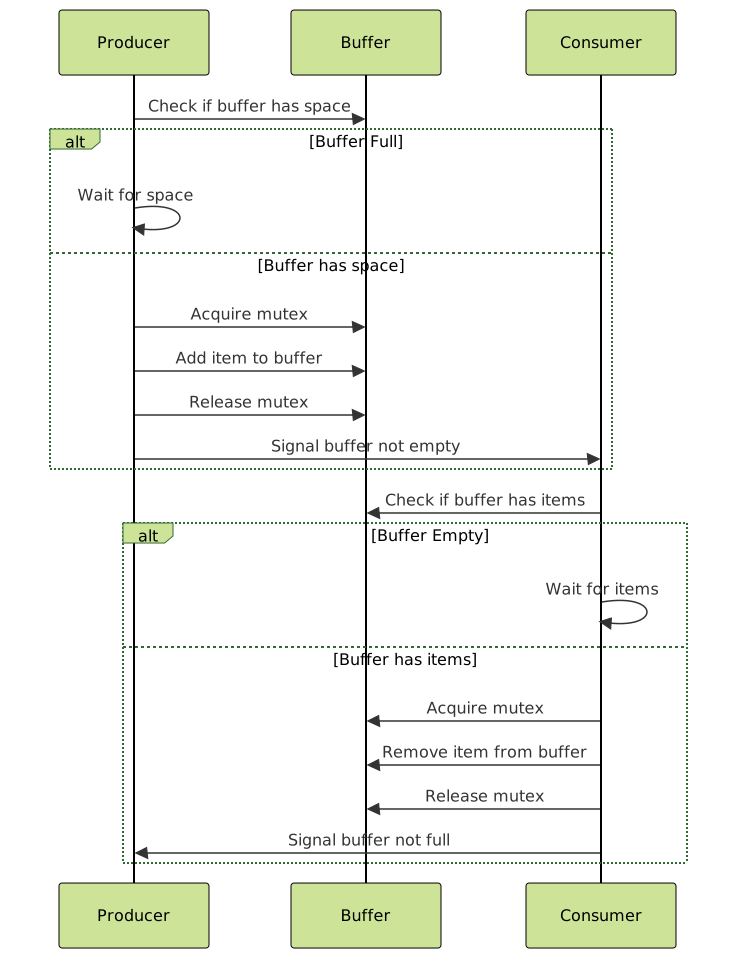
Synchronization Flow Visualization
Common Problems and Solutions
1. Race Conditions
Race conditions occur when multiple processes access shared resources simultaneously without proper synchronization.
Problem Example:
// Incorrect implementation - Race condition
void producer() {
    if (count < BUFFER_SIZE) {  // Check
        buffer[in] = item;      // Use - Another thread might modify count here
        count++;
        in = (in + 1) % BUFFER_SIZE;
    }
}
Solution:
Always use proper synchronization mechanisms like mutexes or semaphores to make operations atomic.
2. Deadlock Prevention
Deadlocks can occur when processes wait indefinitely for resources. In producer-consumer scenarios, careful design of semaphore operations prevents deadlocks.

3. Starvation Issues
Starvation occurs when a process is perpetually denied access to resources. Solutions include:
- Fair scheduling algorithms
- Priority-based access control
- Time-bounded waiting mechanisms
Advanced Implementations
Multiple Buffer Implementation
For high-throughput scenarios, multiple buffers can be used to reduce contention:
public class MultiBufferProducerConsumer {
    private final int BUFFER_COUNT = 3;
    private final Queue<Integer>[] buffers;
    private final ReentrantLock[] locks;
    private final Condition[] notEmpty;
    private final Condition[] notFull;
    private int currentProducerBuffer = 0;
    private int currentConsumerBuffer = 0;

    @SuppressWarnings("unchecked")
    public MultiBufferProducerConsumer(int bufferSize) {
        buffers = new Queue[BUFFER_COUNT];
        locks = new ReentrantLock[BUFFER_COUNT];
        notEmpty = new Condition[BUFFER_COUNT];
        notFull = new Condition[BUFFER_COUNT];

        for (int i = 0; i < BUFFER_COUNT; i++) {
            buffers[i] = new LinkedList<>();
            locks[i] = new ReentrantLock();
            notEmpty[i] = locks[i].newCondition();
            notFull[i] = locks[i].newCondition();
        }
    }

    public void produce(int item) throws InterruptedException {
        int bufferIndex = currentProducerBuffer;
        ReentrantLock lock = locks[bufferIndex];

        lock.lock();
        try {
            while (buffers[bufferIndex].size() == BUFFER_SIZE) {
                notFull[bufferIndex].await();
            }

            buffers[bufferIndex].offer(item);
            System.out.println("Produced " + item + " in buffer " + bufferIndex);
            notEmpty[bufferIndex].signal();

            // Switch to next buffer for load distribution
            currentProducerBuffer = (currentProducerBuffer + 1) % BUFFER_COUNT;
        } finally {
            lock.unlock();
        }
    }

    public int consume() throws InterruptedException {
        int bufferIndex = currentConsumerBuffer;
        ReentrantLock lock = locks[bufferIndex];

        lock.lock();
        try {
            while (buffers[bufferIndex].isEmpty()) {
                notEmpty[bufferIndex].await();
            }

            int item = buffers[bufferIndex].poll();
            System.out.println("Consumed " + item + " from buffer " + bufferIndex);
            notFull[bufferIndex].signal();

            // Switch to next buffer for load distribution
            currentConsumerBuffer = (currentConsumerBuffer + 1) % BUFFER_COUNT;
            return item;
        } finally {
            lock.unlock();
        }
    }
}
Real-World Applications
1. Operating System Kernel
- Pipe Implementation: Inter-process communication uses bounded buffers
- Device Drivers: Network and storage drivers implement producer-consumer patterns
- Print Spooling: Print jobs are queued in bounded buffers
2. Web Servers
- Request Processing: HTTP requests are buffered before processing
- Database Connections: Connection pools use bounded buffer concepts
- Logging Systems: Log messages are buffered before writing to disk
3. Multimedia Applications
- Audio/Video Streaming: Frame buffers for smooth playback
- Real-time Processing: Signal processing pipelines
- Gaming Engines: Render queues and input buffers
Performance Considerations
Buffer Size Selection
Choosing the right buffer size is crucial for optimal performance:
- Small Buffers: Lower memory usage but more frequent blocking
- Large Buffers: Better throughput but higher memory consumption
- Dynamic Sizing: Adaptive buffer sizes based on load

Lock Granularity
The level of locking affects performance:
- Coarse-grained Locking: Simple but may reduce concurrency
- Fine-grained Locking: Better concurrency but more complex
- Lock-free Algorithms: Highest performance but implementation complexity
Testing and Debugging
Common Test Scenarios
import unittest
import threading
import time

class TestProducerConsumer(unittest.TestCase):
    def setUp(self):
        self.buffer = BoundedBuffer(5)
        self.produced_items = []
        self.consumed_items = []
        self.lock = threading.Lock()

    def test_single_producer_consumer(self):
        """Test basic functionality with one producer and one consumer"""
        def producer():
            for i in range(10):
                self.buffer.put(i, 1)
                with self.lock:
                    self.produced_items.append(i)

        def consumer():
            for i in range(10):
                item = self.buffer.get(1)
                with self.lock:
                    self.consumed_items.append(item)

        producer_thread = threading.Thread(target=producer)
        consumer_thread = threading.Thread(target=consumer)

        producer_thread.start()
        consumer_thread.start()

        producer_thread.join()
        consumer_thread.join()

        self.assertEqual(len(self.produced_items), 10)
        self.assertEqual(len(self.consumed_items), 10)
        self.assertEqual(set(self.produced_items), set(self.consumed_items))

    def test_multiple_producers_consumers(self):
        """Test with multiple producers and consumers"""
        NUM_THREADS = 3
        ITEMS_PER_THREAD = 5

        def producer(producer_id):
            for i in range(ITEMS_PER_THREAD):
                item = producer_id * 100 + i
                self.buffer.put(item, producer_id)
                with self.lock:
                    self.produced_items.append(item)

        def consumer(consumer_id):
            for i in range(ITEMS_PER_THREAD):
                item = self.buffer.get(consumer_id)
                with self.lock:
                    self.consumed_items.append(item)

        threads = []

        # Create producer threads
        for i in range(NUM_THREADS):
            thread = threading.Thread(target=producer, args=(i,))
            threads.append(thread)
            thread.start()

        # Create consumer threads
        for i in range(NUM_THREADS):
            thread = threading.Thread(target=consumer, args=(i,))
            threads.append(thread)
            thread.start()

        # Wait for all threads
        for thread in threads:
            thread.join()

        self.assertEqual(len(self.produced_items), NUM_THREADS * ITEMS_PER_THREAD)
        self.assertEqual(len(self.consumed_items), NUM_THREADS * ITEMS_PER_THREAD)
        self.assertEqual(set(self.produced_items), set(self.consumed_items))

if __name__ == '__main__':
    unittest.main()
Best Practices and Guidelines
Design Principles
- Always use proper synchronization: Never access shared resources without appropriate locking mechanisms
- Minimize critical section size: Keep locked code sections as small as possible
- Avoid nested locks: Prevent deadlock by avoiding complex locking hierarchies
- Use timeout mechanisms: Implement timeouts to prevent infinite waiting
- Monitor and log: Add comprehensive logging for debugging and monitoring
Performance Optimization
- Batch Operations: Process multiple items in single critical sections
- Non-blocking Algorithms: Consider lock-free implementations for high-performance scenarios
- Buffer Partitioning: Use multiple smaller buffers instead of one large buffer
- Producer-Consumer Balancing: Adjust the number of producers and consumers based on workload
Conclusion
The Producer Consumer Problem with bounded buffer implementation is a cornerstone concept in concurrent programming and operating systems. Understanding its intricacies, implementation techniques, and real-world applications is essential for developing robust, scalable systems.
Key takeaways include:
- Proper synchronization is crucial for preventing race conditions and ensuring data integrity
- Different synchronization mechanisms (semaphores, mutexes, condition variables) offer various advantages
- Performance optimization requires careful consideration of buffer size, lock granularity, and algorithmic choices
- Real-world applications span from operating system kernels to web servers and multimedia applications
- Testing and debugging concurrent systems requires specialized techniques and comprehensive test scenarios
By mastering these concepts and implementations, you’ll be well-equipped to design and implement efficient concurrent systems that can handle the complexities of modern computing environments. The producer consumer problem serves as a foundation for understanding more complex synchronization challenges in distributed systems, parallel computing, and high-performance applications.
Related Posts

Process Synchronization: Critical Sections and Race Conditions in Operating Systems
Introduction to Process Synchronization Process synchronization is a fundamental concept in operating systems that ensures multiple processes can safely access...

Readers Writers Problem: Complete Guide to Database Synchronization
The Readers Writers Problem is one of the most fundamental synchronization challenges in operating systems and database management. This classic...

Critical Section Problem: Complete Guide to Mutual Exclusion Solutions in Operating Systems
What is the Critical Section Problem? The critical section problem is a fundamental challenge in operating systems where multiple processes...

Peterson’s Algorithm: Complete Guide to Two-Process Mutual Exclusion in Operating Systems
What is Peterson's Algorithm? Peterson's Algorithm is a classic solution for achieving mutual exclusion between two processes or threads in...

Buffering in Operating System: Complete Guide to Single, Double and Circular Buffer Implementation
What is Buffering in Operating System? Buffering in operating systems is a fundamental technique used to temporarily store data in...

Thread Synchronization: Mutexes, Semaphores and Deadlocks in Operating Systems
Introduction to Thread Synchronization Thread synchronization is a fundamental concept in operating systems that ensures multiple threads can safely access...

Lamport’s Bakery Algorithm: Complete Guide to N-Process Mutual Exclusion
Lamport's Bakery Algorithm stands as one of the most elegant solutions to the N-process mutual exclusion problem in concurrent programming....

Monitor in Operating System: High-level Synchronization for Process Coordination
What is a Monitor in Operating System? A monitor is a high-level synchronization construct in operating systems that provides a...

Thread vs Process: Complete Guide to Differences and When to Use Each
Understanding the fundamental differences between threads and processes is crucial for system programming, application design, and performance optimization. While both...

Deadlock Detection and Recovery: Graph-based Algorithms for Operating Systems
Introduction to Deadlock Detection and Recovery Deadlock is one of the most critical challenges in operating systems where multiple processes...
Thread in Operating System: Lightweight Processes and Multithreading Explained
What are Threads in Operating Systems? A thread is the smallest unit of execution within a process that can be...

C++ Thread Synchronization: Mutexes and Locks
In the world of modern C++ programming, multithreading has become an essential technique for improving application performance and responsiveness. However,...