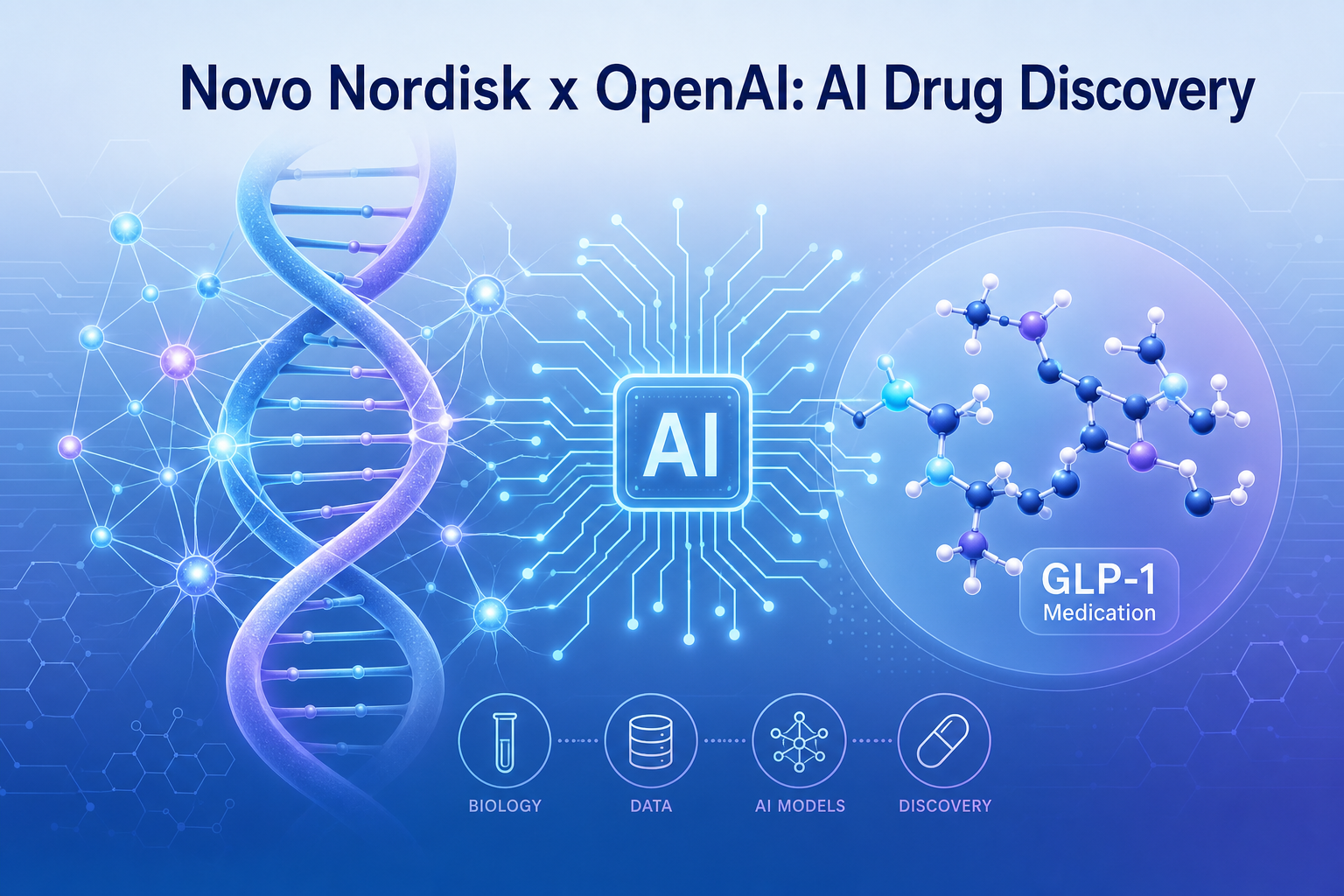
Imagine compressing a decade of pharmaceutical research into a few months. That’s the bet behind one of 2026’s most consequential pharma announcements: Novo Nordisk’s partnership with OpenAI to accelerate obesity and diabetes drug discovery. The Danish drugmaker behind Ozempic and Wegovy is now plugging frontier generative AI directly into the workflows that produce its next generation of metabolic medicines.
If you’ve been watching the intersection of AI and biotech, this collaboration is a milestone moment. It signals that large language models and multimodal foundation models are no longer just chatbots — they’re becoming research partners for one of the largest pharmaceutical companies on the planet. Below, you’ll get a clear breakdown of what this deal involves, why it matters technically, and what it means for the future of AI-assisted medicine.
What the Novo Nordisk and OpenAI Partnership Actually Covers
The collaboration centers on using OpenAI’s frontier models — including the GPT family and its reasoning successors — across several stages of drug discovery. Novo Nordisk and its parent foundation’s tech arm, Novo Holdings, are providing both deep biological data and clinical context, while OpenAI contributes model capacity, fine-tuning capability, and enterprise-grade tooling.
Drug discovery is the multi-year process of identifying biological targets, designing candidate molecules that interact with those targets, validating their behavior in cells and animals, and ultimately preparing them for human clinical trials. The Novo Nordisk and OpenAI partnership applies AI to nearly every step of this pipeline, with a heavy focus on metabolic diseases like obesity and type 2 diabetes.
The headline use cases include faster target identification, generative molecule design, automated literature synthesis, clinical trial protocol drafting, and regulatory document generation. Crucially, the agreement isn’t just access to the public ChatGPT API — it includes custom model work and tightly governed deployments that respect patient privacy and pharmaceutical compliance standards.
Why Obesity and Diabetes Are the Perfect Testbed
Obesity and type 2 diabetes are massive, interconnected global health crises. The World Health Organization estimates over a billion people live with obesity, and the figure climbs every year. Novo Nordisk already dominates the GLP-1 receptor agonist market with semaglutide-based products, but competition is fierce — Eli Lilly, Pfizer, and several biotechs are racing to launch next-generation treatments.
That competitive pressure makes speed a strategic asset. Every month shaved off the discovery timeline can translate into billions in lifecycle revenue and earlier access for patients. AI offers exactly that compression, especially in three areas:
- Target biology is well-mapped. Decades of metabolic research mean there is rich, structured data for AI to learn from — gene expression atlases, protein structures, and clinical outcomes.
- Molecules are tractable. GLP-1 analogs, dual agonists, and oral peptides have known scaffolds that generative models can iterate on without inventing chemistry from scratch.
- Trial endpoints are measurable. Body weight, HbA1c, and cardiovascular outcomes provide hard, quantitative training signals — far cleaner than the fuzzy endpoints in psychiatry or oncology.
That combination — abundant data, tractable chemistry, measurable outcomes — is why obesity and diabetes drug discovery is arguably the ideal proving ground for enterprise AI in pharma.
How Generative AI Fits Into a Drug Discovery Pipeline
To appreciate what this partnership is doing, it helps to see where AI plugs into the traditional pipeline. Below is a simplified comparison of the classical workflow versus an AI-augmented one.
| Stage | Classical Approach | AI-Augmented Approach |
|---|---|---|
| Target Identification | Literature review, biological hypothesis | LLM mines millions of papers, ranks targets |
| Hit Discovery | High-throughput screening of compound libraries | Generative models propose novel candidates |
| Lead Optimization | Iterative medicinal chemistry, months per cycle | Property-prediction models score thousands daily |
| Preclinical Design | Manual protocol drafting | AI drafts protocols from prior trial data |
| Regulatory Submission | Months of human document assembly | LLMs draft, scientists review and finalize |
Notice that AI doesn’t replace the scientists — it shortens the loops between hypothesis and feedback. Faster loops mean more shots on goal per fiscal year, which is the real economic engine behind the deal.
A Practical Look at AI Molecule Generation
One of the most exciting capabilities in modern generative chemistry is producing valid molecular structures conditioned on desired properties. Foundation models can be paired with chemistry-aware libraries like RDKit to generate, score, and filter candidates. Here is a minimal Python sketch showing how a developer might combine an LLM with a property filter — the same conceptual pattern used inside pharma R&D teams.
from rdkit import Chem
from rdkit.Chem import Descriptors, QED
from anthropic import Anthropic  # any LLM SDK works similarly

client = Anthropic()

def is_drug_like(smiles: str) -> bool:
    """Apply Lipinski-style filters to a candidate SMILES string."""
    mol = Chem.MolFromSmiles(smiles)
    if mol is None:
        return False
    mw = Descriptors.MolWt(mol)
    logp = Descriptors.MolLogP(mol)
    qed_score = QED.qed(mol)  # quantitative estimate of drug-likeness
    return mw < 500 and logp < 5 and qed_score > 0.5

prompt = (
    "Propose 10 SMILES strings for small-molecule GLP-1 receptor agonists "
    "with molecular weight under 500 Da. Output one SMILES per line."
)

response = client.messages.create(
    model="claude-opus-4-7",
    max_tokens=1024,
    messages=[{"role": "user", "content": prompt}],
)

candidates = response.content[0].text.strip().splitlines()
viable = [s for s in candidates if is_drug_like(s)]
print(f"{len(viable)} of {len(candidates)} candidates passed drug-likeness")
This snippet illustrates the pattern: an LLM proposes structures, and a deterministic chemistry library validates them. In production at a company like Novo Nordisk, the loop is far more sophisticated — incorporating docking simulations, ADMET predictions, and reinforcement learning — but the core idea of generate, score, filter, iterate remains identical.
What OpenAI Brings That Specialized Pharma AI Doesn’t
Pharma has used machine learning for years. Companies like Recursion, Insitro, and Isomorphic Labs have built specialized models for protein folding, microscopy, and chemistry. So why partner with OpenAI specifically?
The answer is reasoning and language. Drug discovery isn’t only about predicting molecular properties — it’s about synthesizing a vast, messy literature, drafting regulatory documents, summarizing clinical evidence, and orchestrating multi-step research workflows. Frontier general-purpose models excel at exactly those tasks.
- Long-context reasoning lets a single model digest thousands of pages of trial reports and prior art.
- Tool use means models can call docking simulators, query internal databases, and run statistical scripts as part of a research agent.
- Multimodal capabilities allow models to read figures, parse handwritten lab notes, and analyze gel images.
- Code generation accelerates internal tooling — biostatisticians can describe an analysis in plain English and get reproducible Python or R back.
The pharma value of frontier AI isn’t a single super-model that designs drugs end-to-end. It’s a thousand small frictions removed from the daily workflow of every scientist.
The Data Privacy and Compliance Backbone
Pharmaceutical companies operate under some of the strictest data regulations on Earth. Patient data falls under HIPAA in the United States and GDPR in Europe, and clinical trial data is governed by ICH-GCP guidelines from the International Council for Harmonisation. Any AI partnership must respect those guardrails.
That’s why this deal almost certainly relies on OpenAI’s enterprise tier rather than the consumer ChatGPT product. Enterprise deployments offer zero data retention, customer-managed encryption keys, dedicated compute, and contractual guarantees that prompts and outputs are not used to train future public models. You can read OpenAI’s enterprise privacy commitments on the official OpenAI enterprise privacy page.
Beyond contracts, Novo Nordisk’s data scientists almost certainly use techniques like de-identification, differential privacy, and on-premises retrieval layers so that proprietary chemistry and patient data never travels to model providers in raw form.
Real Risks and Honest Limitations
It would be irresponsible to frame this partnership as a guaranteed win. AI drug discovery has a humbling history of overpromising. Several first-wave AI biotechs have produced impressive papers and few clinical successes. There are real reasons to stay measured.
- Hallucinations matter more here. A confident-but-wrong protein binding claim could waste millions in wet-lab validation.
- Biological complexity outpaces models. Cellular systems involve emergent dynamics that no current model fully captures.
- Regulatory acceptance is conservative. The U.S. Food and Drug Administration requires reproducible evidence, and AI-generated content must be auditable.
- Talent bottlenecks persist. Translating an LLM output into a viable drug still requires medicinal chemists, clinicians, and statisticians — none of whom are abundant.
The realistic upside is incremental. Expect 20–40 percent reductions in certain timelines, not magical overnight cures. Even those gains, multiplied across a portfolio, justify enormous investment.
What This Means for the Broader AI and Pharma Industry
This deal will accelerate a pattern that’s already underway: frontier AI vendors striking deep enterprise alignments with regulated industries. Microsoft has done it with energy giants. Google has done it with hospital systems. Now OpenAI has a marquee pharma anchor.
For developers and AI engineers, three trends are worth watching:
- Domain-specific fine-tuning. Expect more pharma-specialized variants of frontier models, trained on chemistry, biology, and regulatory corpora.
- Agentic research workflows. Multi-step research agents that coordinate literature search, simulation, and experiment design will become standard in industrial labs.
- Open scientific datasets. Competitive pressure may push more pre-competitive consortia to release shared training data, similar to how UniProt and PDB transformed structural biology.
If you’re a software engineer who has been curious about applying your skills to healthcare or biotech, this is the clearest signal yet that the door is wide open.
Common Misconceptions About AI in Drug Discovery
The hype cycle has produced a lot of muddled thinking. A few corrections worth keeping in mind:
Misconception 1: AI will design drugs end-to-end. In reality, AI augments specific stages — usually generation, scoring, and document drafting. Validation remains stubbornly biological and human-driven.
Misconception 2: One model does everything. Production pipelines stitch together LLMs, graph neural networks, diffusion models for 3D structures, and classical cheminformatics. The architecture is heterogeneous by necessity.
Misconception 3: Faster discovery means cheaper drugs. Pricing is set by reimbursement systems, patent landscapes, and competition — not R&D cost. Faster pipelines may mean more drugs, not cheaper ones.
Misconception 4: This is unique to OpenAI. Anthropic, Google DeepMind, and open-weight communities have viable alternatives. Novo Nordisk’s choice is a vote of confidence, not a monopoly statement.
Frequently Asked Questions
Is OpenAI replacing Novo Nordisk’s scientists?
No. The collaboration augments human researchers rather than replacing them. Medicinal chemists, clinicians, and biostatisticians remain central to validating any AI-generated hypothesis. AI handles the tedious search, drafting, and ranking work so scientists can focus on judgment-heavy decisions.
Will this partnership lower the price of Ozempic or Wegovy?
Probably not directly. Drug pricing depends on payer negotiations, patent status, and competitive launches — not the cost of discovery. What this partnership may influence is the speed at which next-generation obesity drugs reach patients, expanding choice rather than cutting current prices.
How is this different from AlphaFold?
AlphaFold, from Google DeepMind, predicts the 3D structure of proteins from their amino acid sequences. The Novo Nordisk and OpenAI work focuses on broader research workflows — molecule generation, literature synthesis, protocol drafting, and clinical reasoning. The two approaches are complementary; in practice, Novo Nordisk almost certainly uses both.
Can independent developers build similar AI drug discovery tools?
Yes, at smaller scales. Open-source libraries like RDKit, DeepChem, and tools available on Hugging Face make it possible to prototype generative chemistry pipelines on a laptop. The bottleneck for individuals is access to proprietary biological datasets and wet-lab validation, not access to models.
What languages and frameworks do pharma AI teams typically use?
Python dominates, with libraries like RDKit, PyTorch, and scikit-learn forming the core stack. R is common for biostatistics. Workflow orchestration uses tools like Snakemake or Airflow, and increasingly Kubernetes-based platforms for scalable training and inference.
How soon will patients see drugs from this partnership?
Realistically, five to eight years for any drug whose discovery is meaningfully accelerated by this collaboration. Clinical trials still require multi-year safety and efficacy studies regardless of how quickly a candidate is identified. Faster obesity and diabetes drug discovery shows up first in earlier-stage indicators like more candidates entering Phase 1.
Conclusion
The Novo Nordisk and OpenAI partnership is a clear marker of where AI in pharma is heading — not toward magical autonomous drug design, but toward systematically faster, smarter, and better-documented research workflows. By focusing on obesity and diabetes drug discovery, both companies have picked a domain with rich data, measurable outcomes, and enormous patient demand.
For developers, scientists, and product builders, the takeaway is concrete. Frontier AI is now a load-bearing tool in regulated, high-stakes industries. Building skills around long-context reasoning, retrieval-augmented generation, and domain-aware tool use puts you on the right side of this shift. And if you’re a patient living with metabolic disease, this is genuinely good news — the pipeline that produces your future treatments just got more competitive, more iterative, and meaningfully faster.