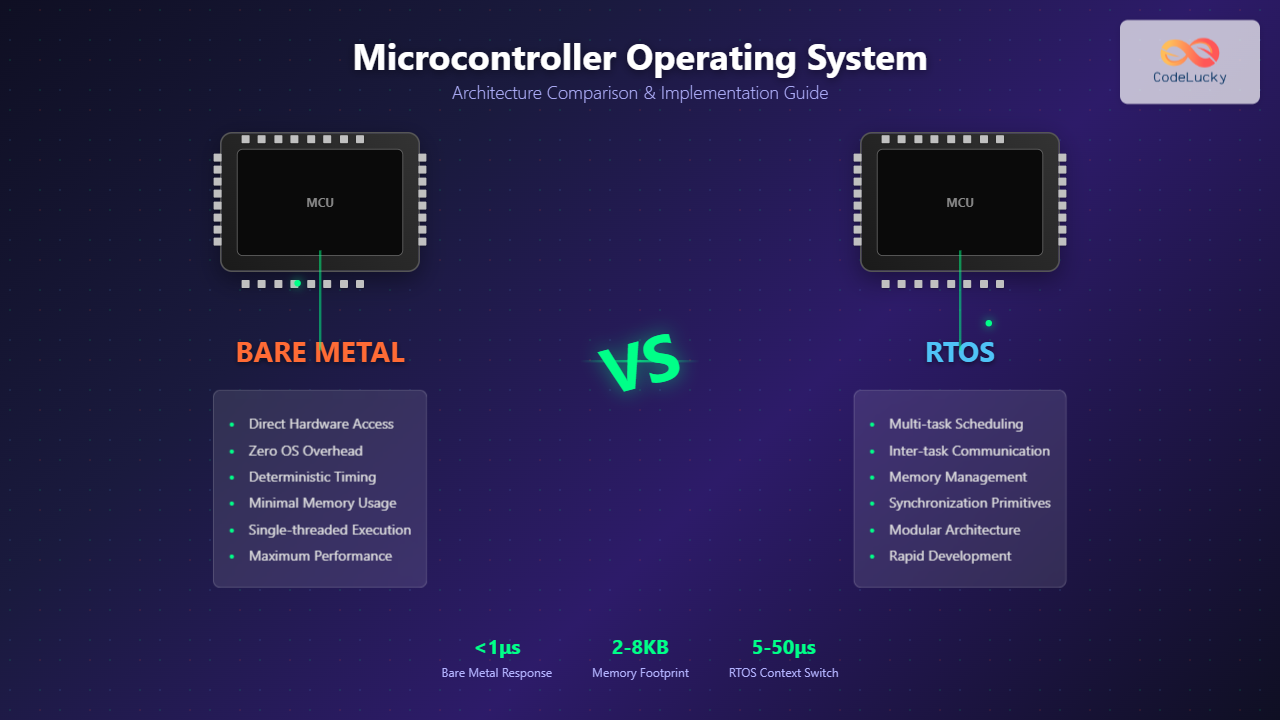
When developing embedded systems with microcontrollers, one of the most critical architectural decisions is choosing between bare metal programming and implementing a Real-Time Operating System (RTOS). This choice fundamentally impacts your system’s performance, complexity, scalability, and development approach.
Understanding the trade-offs between these approaches is essential for embedded systems engineers, as the wrong choice can lead to performance bottlenecks, increased development time, or unnecessary complexity.
What is Bare Metal Programming?
Bare metal programming refers to writing firmware that runs directly on the microcontroller hardware without any operating system layer. In this approach, your application code has direct access to all hardware resources including memory, peripherals, and CPU registers.

Characteristics of Bare Metal Systems
- Direct Hardware Control: Complete access to all microcontroller registers and peripherals
- Deterministic Timing: Predictable execution paths with no OS overhead
- Minimal Memory Footprint: No OS code consuming precious flash and RAM
- Single-threaded Execution: Code typically runs in a superloop or interrupt-driven model
Bare Metal Example: LED Blinking
// STM32 Bare Metal LED Blink Example
#include "stm32f4xx.h"

void delay(uint32_t count) {
    while(count--);
}

void gpio_init() {
    // Enable GPIOA clock
    RCC->AHB1ENR |= RCC_AHB1ENR_GPIOAEN;

    // Configure PA5 as output
    GPIOA->MODER |= GPIO_MODER_MODER5_0;
    GPIOA->OTYPER &= ~GPIO_OTYPER_OT_5;
    GPIOA->OSPEEDR |= GPIO_OSPEEDER_OSPEEDR5;
}

int main(void) {
    gpio_init();

    while(1) {
        GPIOA->BSRR = GPIO_BSRR_BS_5;  // Set PA5 high
        delay(500000);
        GPIOA->BSRR = GPIO_BSRR_BR_5;  // Set PA5 low
        delay(500000);
    }

    return 0;
}
Output: LED connected to PA5 blinks every second with precise timing control.
What is an RTOS (Real-Time Operating System)?
An RTOS is a specialized operating system designed for embedded systems that require deterministic response times. It provides task scheduling, inter-task communication, synchronization primitives, and memory management services while maintaining real-time guarantees.

Key RTOS Components
- Task Scheduler: Manages task execution based on priorities and scheduling algorithms
- Inter-Task Communication: Queues, semaphores, mutexes, and message passing
- Memory Management: Dynamic memory allocation and memory protection
- Interrupt Management: Efficient interrupt handling with task notification
RTOS Example: Multi-Task LED Control
// FreeRTOS LED Control Example
#include "FreeRTOS.h"
#include "task.h"
#include "queue.h"
#include "stm32f4xx.h"

QueueHandle_t ledQueue;

void led_task(void *pvParameters) {
    uint32_t ledState;

    while(1) {
        if(xQueueReceive(ledQueue, &ledState, portMAX_DELAY)) {
            if(ledState) {
                GPIOA->BSRR = GPIO_BSRR_BS_5;  // LED ON
            } else {
                GPIOA->BSRR = GPIO_BSRR_BR_5;  // LED OFF
            }
        }
    }
}

void sensor_task(void *pvParameters) {
    uint32_t sensorValue;
    uint32_t ledCommand;

    while(1) {
        // Simulate sensor reading
        sensorValue = read_sensor();

        ledCommand = (sensorValue > THRESHOLD) ? 1 : 0;
        xQueueSend(ledQueue, &ledCommand, 0);

        vTaskDelay(pdMS_TO_TICKS(100)); // 100ms delay
    }
}

int main(void) {
    gpio_init();

    // Create queue for LED commands
    ledQueue = xQueueCreate(5, sizeof(uint32_t));

    // Create tasks
    xTaskCreate(led_task, "LED", 128, NULL, 2, NULL);
    xTaskCreate(sensor_task, "SENSOR", 128, NULL, 1, NULL);

    // Start scheduler
    vTaskStartScheduler();

    return 0;
}
Output: LED responds to sensor readings with task-based coordination, allowing concurrent sensor monitoring and LED control.
Performance Comparison

Resource Utilization Analysis
| Aspect | Bare Metal | RTOS |
|---|---|---|
| Flash Memory | 2-8 KB | 8-64 KB |
| RAM Usage | 512B – 2KB | 4-16 KB |
| Context Switch Time | N/A | 5-50 microseconds |
| Interrupt Latency | 1-5 microseconds | 10-100 microseconds |
When to Choose Bare Metal
Bare metal programming is ideal for scenarios requiring maximum performance and minimal resource usage:
- Battery-powered devices: Ultra-low power consumption requirements
- High-speed control: Motor control, power electronics with microsecond timing
- Simple applications: Single-function devices with minimal complexity
- Resource-constrained systems: Microcontrollers with less than 32KB flash
Bare Metal Advantages
- Zero OS overhead
- Deterministic execution timing
- Maximum hardware utilization
- Lower power consumption
- Simplified debugging
When to Choose RTOS
RTOS is recommended for complex embedded systems with multiple concurrent requirements:
- Multi-tasking applications: Systems handling multiple simultaneous operations
- Communication protocols: TCP/IP stacks, wireless protocols
- User interfaces: Display management with touch input
- Scalable systems: Applications that may grow in complexity

RTOS Advantages
- Simplified multi-tasking development
- Built-in synchronization primitives
- Modular code architecture
- Reusable components and libraries
- Better code maintainability
Popular RTOS Options
FreeRTOS
The most widely used RTOS for microcontrollers, offering excellent documentation and broad hardware support.
// FreeRTOS Task Creation Example
void temperature_monitor_task(void *pvParameters) {
    float temperature;

    while(1) {
        temperature = read_temperature_sensor();

        if(temperature > MAX_TEMP) {
            xEventGroupSetBits(system_events, OVERHEAT_BIT);
        }

        vTaskDelay(pdMS_TO_TICKS(1000)); // 1 second delay
    }
}
Zephyr OS
A modern, scalable RTOS with advanced features like device drivers and networking stacks.
embOS
Commercial RTOS with deterministic behavior and extensive debugging tools.
Migration Strategies
From Bare Metal to RTOS
- Identify concurrent operations that could benefit from separate tasks
- Refactor interrupt handlers to use RTOS notifications
- Replace polling loops with task delays and queues
- Implement proper synchronization for shared resources
RTOS Task Design Example
// Converting bare metal polling to RTOS tasks
// Before (Bare Metal):
while(1) {
    if(uart_data_available()) {
        process_uart_data();
    }
    if(timer_expired()) {
        handle_periodic_task();
    }
    if(button_pressed()) {
        handle_button_event();
    }
}

// After (RTOS):
void uart_task(void *param) {
    while(1) {
        ulTaskNotifyTake(pdTRUE, portMAX_DELAY);
        process_uart_data();
    }
}

void periodic_task(void *param) {
    while(1) {
        handle_periodic_task();
        vTaskDelay(pdMS_TO_TICKS(100));
    }
}

void button_task(void *param) {
    while(1) {
        ulTaskNotifyTake(pdTRUE, portMAX_DELAY);
        handle_button_event();
    }
}
Development Best Practices
Bare Metal Best Practices
- Use state machines for complex logic instead of nested if-statements
- Implement efficient interrupt handling with minimal ISR code
- Optimize power consumption with sleep modes and peripheral gating
- Design for testability with hardware abstraction layers
RTOS Best Practices
- Design tasks with single responsibilities
- Use appropriate synchronization mechanisms (mutexes, semaphores, queues)
- Configure stack sizes correctly to prevent overflow
- Implement proper error handling and task monitoring
Debugging and Testing
Bare Metal Debugging
// Simple assertion macro for bare metal debugging
#ifdef DEBUG
#define ASSERT(condition) \
    do { \
        if (!(condition)) { \
            disable_interrupts(); \
            while(1); /* Halt execution */ \
        } \
    } while(0)
#else
#define ASSERT(condition)
#endif

// Usage example
void configure_timer(uint32_t period) {
    ASSERT(period > 0 && period < MAX_PERIOD);
    TIMER1->ARR = period;
}
RTOS Debugging
RTOS systems provide advanced debugging capabilities including task monitoring, stack overflow detection, and runtime statistics.

Conclusion
The choice between bare metal and RTOS programming depends on your specific project requirements, resource constraints, and complexity needs. Bare metal offers maximum performance and minimal resource usage, making it ideal for simple, resource-constrained applications. RTOS provides better code organization, easier multi-tasking, and faster development for complex systems.
Consider starting with bare metal for simple projects and migrating to an RTOS as complexity grows. Modern microcontrollers often have sufficient resources to support lightweight RTOS implementations, making the performance trade-offs less significant than in the past.
Ultimately, both approaches have their place in embedded systems development. Understanding the strengths and limitations of each will help you make informed architectural decisions that align with your project goals and constraints.