Understanding Memory Protection in Modern Computing
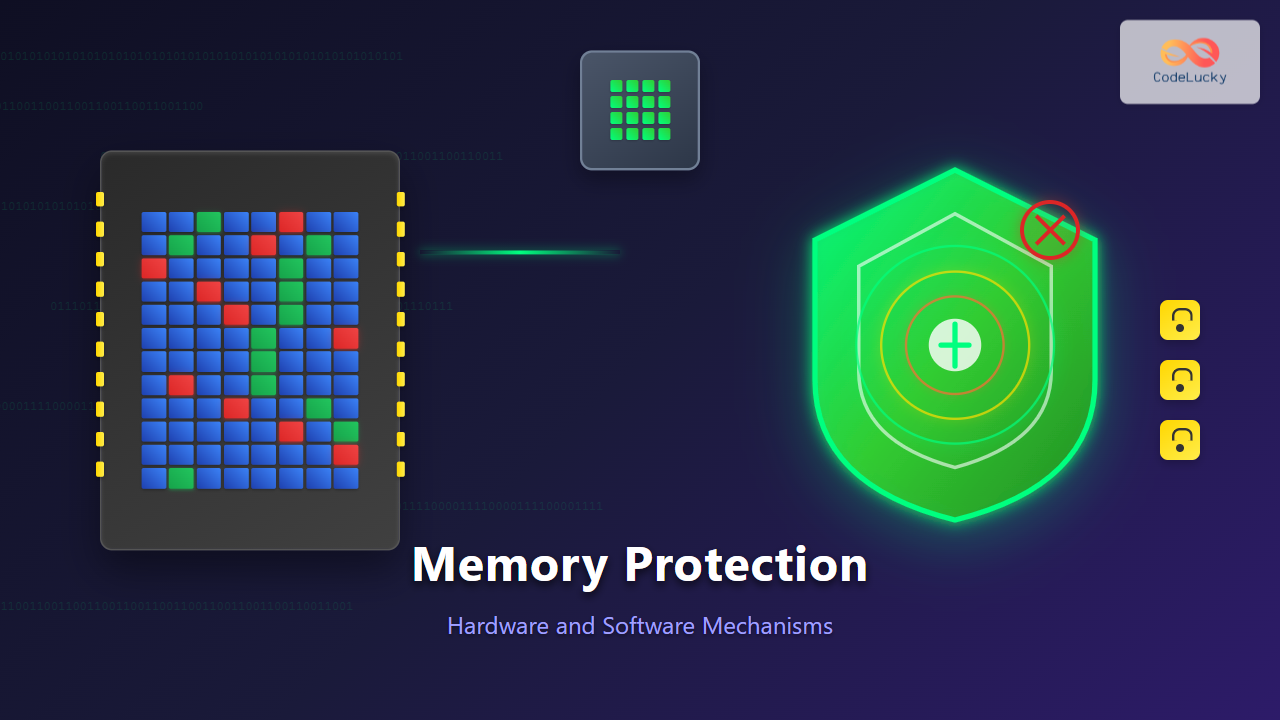
Memory protection is a fundamental security mechanism that prevents programs from accessing memory regions they shouldn’t touch. This critical system feature protects against both accidental bugs and malicious attacks, ensuring system stability and security. Modern operating systems implement memory protection through a combination of hardware features and software policies.
Without proper memory protection, a single faulty program could crash the entire system by overwriting critical operating system data or other applications’ memory spaces. This article explores the intricate mechanisms that prevent such scenarios.
Hardware-Based Memory Protection Mechanisms
Memory Management Unit (MMU)
The Memory Management Unit (MMU) serves as the primary hardware component responsible for memory protection. It sits between the CPU and physical memory, translating virtual addresses to physical addresses while enforcing access permissions.

Key MMU Functions:
- Address Translation: Converts virtual addresses to physical addresses
- Permission Checking: Validates read, write, and execute permissions
- Page Fault Generation: Triggers exceptions for invalid memory accesses
- TLB Management: Caches recent address translations for performance
Page Tables and Permission Bits
Page tables contain entries that map virtual pages to physical pages, with each entry containing permission bits that define allowed operations:
| Permission Bit | Description | Effect if Set |
|---|---|---|
| Present (P) | Page is in physical memory | Memory access allowed |
| Read/Write (R/W) | Write permission | Page can be modified |
| User/Supervisor (U/S) | User-level access | User programs can access |
| Execute Disable (XD/NX) | Execution prevention | Code execution blocked |
Example: x86-64 Page Table Entry
Bit Layout of Page Table Entry:
63    52 51    12 11  9 8 7 6 5 4 3 2 1 0
[Reserved] [Physical Address] [AVL] [G|P|C|W|U|R|P]

P = Present (1 = page in memory)
R = Read/Write (1 = writable)
U = User/Supervisor (1 = user accessible)
W = Write-Through caching
C = Cache Disable
G = Global page
Hardware Protection Rings
Modern processors implement protection rings (privilege levels) that create hierarchical access control. x86 processors provide four rings (0-3), though most operating systems use only two:

Software-Based Memory Protection Techniques
Virtual Memory Management
Operating systems implement sophisticated virtual memory systems that provide each process with its own isolated address space. This isolation is fundamental to memory protection.
Process Address Space Layout:
High Addresses (0xFFFFFFFF)
┌─────────────────────────┐
│      Kernel Space       │ ← Protected from user access
├─────────────────────────┤
│        Stack            │ ← Grows downward
│           ↓             │
│                         │
│        Heap             │ ← Grows upward
│           ↑             │
├─────────────────────────┤
│     Data Segment        │ ← Global variables
├─────────────────────────┤
│     Text Segment        │ ← Program code (read-only)
└─────────────────────────┘
Low Addresses (0x00000000)
Address Space Layout Randomization (ASLR)
ASLR randomizes the memory layout of processes, making it difficult for attackers to predict memory addresses. This technique significantly reduces the effectiveness of buffer overflow attacks.
ASLR Implementation Example:
# Check ASLR status on Linux
cat /proc/sys/kernel/randomize_va_space

# Output meanings:
# 0 = Disabled
# 1 = Conservative randomization
# 2 = Full randomization (recommended)

# Example memory layout without ASLR:
Process 1: Stack at 0x7fff12345000
Process 2: Stack at 0x7fff12345000  ← Predictable

# Example memory layout with ASLR:
Process 1: Stack at 0x7fff8a2b1000
Process 2: Stack at 0x7fff3f9c8000  ← Randomized
Stack Canaries and Buffer Overflow Protection
Stack canaries are random values placed between local variables and return addresses to detect buffer overflows:

Stack Canary Example:
// Vulnerable function without protection
void vulnerable_function(char *input) {
    char buffer[64];
    strcpy(buffer, input);  // Buffer overflow possible
    return;
}

// Protected function with stack canary
void protected_function(char *input) {
    // Compiler inserts canary here
    char buffer[64];
    strcpy(buffer, input);
    // Compiler checks canary before return
    return;  // Abort if canary corrupted
}
Memory Protection in Practice
Segmentation vs. Paging
Two primary approaches exist for implementing memory protection:
| Aspect | Segmentation | Paging |
|---|---|---|
| Granularity | Variable-sized segments | Fixed-sized pages (4KB typical) |
| Protection | Per-segment permissions | Per-page permissions |
| Fragmentation | External fragmentation | Internal fragmentation |
| Modern Usage | Limited (x86 legacy) | Dominant approach |
Copy-on-Write (COW) Protection
Copy-on-Write is an optimization technique that provides memory protection while reducing memory usage. When processes fork, they initially share the same physical memory pages marked as read-only.
COW Implementation Example:
# Demonstrating COW behavior
pid = fork()

if pid == 0:  # Child process
    # Initially shares parent's memory
    data = "shared_data"

    # This triggers COW - page copied
    data = "modified_data"

else:  # Parent process
    # Parent still has original data
    data = "shared_data"
Execute Disable (XD) and No-Execute (NX)
Modern processors support Execute Disable bits that prevent code execution from data pages, effectively blocking many code injection attacks:
// Memory region types and their typical permissions
Text Segment:    Read + Execute (no write)
Data Segment:    Read + Write (no execute)
Stack:           Read + Write (no execute with NX)
Heap:            Read + Write (no execute with NX)

// Example: Attempting to execute code from stack
void vulnerable() {
    char shellcode[] = "\x48\x31\xc0...";  // Machine code
    ((void(*)())shellcode)();  // Fails with NX bit set
}

// Result with NX protection:
// Segmentation fault (SIGSEGV) - attempted execution from non-executable page
Advanced Memory Protection Features
Control Flow Integrity (CFI)
CFI ensures that program execution follows legitimate control flow paths, preventing attacks that hijack program execution:
- Forward-Edge CFI: Protects function calls and jumps
- Backward-Edge CFI: Protects return addresses
- Hardware Support: Intel CET, ARM Pointer Authentication
Memory Tagging and Bounds Checking
Emerging technologies provide fine-grained memory safety:
| Technology | Description | Implementation |
|---|---|---|
| ARM MTE | Memory Tagging Extension | 4-bit tags per 16-byte granule |
| Intel MPX | Memory Protection Extensions | Hardware bounds checking |
| CHERI | Capability Hardware | Fine-grained capabilities |
Memory Tagging Example:
// Conceptual memory tagging
void *ptr = malloc(1024);        // Allocate with tag 0x5
*((char*)ptr + 1023) = 'A';      // Valid access (within bounds)
*((char*)ptr + 1024) = 'B';      // Tag mismatch - bounds violation detected

// Hardware automatically checks:
// - Pointer tag matches memory tag
// - Access within allocated bounds
// - Generates exception on violation
Memory Protection Violations and Handling
Common Protection Violations
Understanding common memory protection violations helps in debugging and security analysis:

Violation Examples:
// 1. Write to read-only memory
char *text = "Hello World";
text[0] = 'h';  // Segmentation fault - text segment is read-only

// 2. Execute data as code
char data[] = {0x90, 0x90, 0x90};  // NOP instructions
((void(*)())data)();  // Segmentation fault - data not executable

// 3. Access kernel memory from user space
char *kernel_addr = (char*)0xFFFFFFFF80000000;
*kernel_addr = 0x42;  // Segmentation fault - kernel space protected

// 4. Stack overflow
void recursive_function() {
    char large_array[1000000];
    recursive_function();  // Stack overflow - guard page violation
}
Debugging Memory Protection Issues
Tools and techniques for investigating memory protection violations:
# Using GDB to analyze segmentation faults
gdb ./program core
(gdb) bt                    # Show stack trace
(gdb) info registers        # Check register values
(gdb) x/10i $pc            # Examine instructions at crash

# Using valgrind for memory error detection
valgrind --tool=memcheck ./program

# Output example:
==12345== Invalid write of size 1
==12345==    at 0x40056B: main (test.c:10)
==12345==  Address 0x4008c0 is not stack'd, malloc'd or free'd

# Checking memory maps
cat /proc/PID/maps
# Shows virtual memory layout and permissions
Performance Impact and Optimization
TLB Performance Considerations
Memory protection mechanisms can impact performance, particularly through TLB (Translation Lookaside Buffer) misses:
- TLB Hit: Address translation cached, ~1 CPU cycle
- TLB Miss: Page table walk required, ~100+ CPU cycles
- Optimization: Large pages reduce TLB pressure
TLB Optimization Example:
# Check TLB statistics
perf stat -e dTLB-loads,dTLB-load-misses,iTLB-loads,iTLB-load-misses ./program

# Enable huge pages for better TLB efficiency
echo always > /sys/kernel/mm/transparent_hugepage/enabled

# Application can request huge pages
mmap(NULL, 2*1024*1024, PROT_READ|PROT_WRITE,
     MAP_PRIVATE|MAP_ANONYMOUS|MAP_HUGETLB, -1, 0);
Future of Memory Protection
Emerging trends in memory protection technology include:
- Hardware Capabilities: CHERI and similar capability-based systems
- AI-Assisted Protection: Machine learning for anomaly detection
- Quantum-Resistant Security: Post-quantum cryptographic protections
- Real-Time Protection: Low-latency security for embedded systems
Memory protection remains a cornerstone of system security, continuously evolving to address new threats while maintaining system performance. The combination of hardware features like MMUs and NX bits with software techniques like ASLR and stack canaries provides robust defense against memory-based attacks.
Understanding these mechanisms is crucial for system programmers, security researchers, and anyone working with low-level system software. As computing environments become more complex and security threats more sophisticated, memory protection mechanisms will continue to advance, providing stronger guarantees while minimizing performance overhead.
Related Posts
Memory Management in Operating System: Virtual and Physical Memory Fundamentals
Introduction to Memory Management Memory management is one of the most critical functions of an operating system, responsible for efficiently...

Virtual Memory in OS: Complete Guide to Paging, Segmentation and Address Translation
Virtual memory is one of the most fundamental concepts in modern operating systems, enabling efficient memory management and providing crucial...
Windows Memory Management: Virtual Memory Implementation and Optimization Guide
Introduction to Windows Virtual Memory Windows virtual memory is a sophisticated memory management system that allows programs to use more...
Security Vulnerabilities: Buffer Overflow and System Exploits – Complete Guide
Buffer overflow vulnerabilities represent one of the most critical and persistent security threats in modern computing systems. These memory-related exploits...
Garbage Collection in Operating System: Complete Guide to Automatic Memory Management
What is Garbage Collection in Operating Systems? Garbage collection is an automatic memory management technique used by operating systems and...

Memory Allocation Techniques: Contiguous vs Non-contiguous Management Strategies
Memory allocation is a fundamental aspect of operating system design that determines how programs and data are stored and accessed...
Kernel in Operating System: Core Functions and Memory Management
The kernel stands as the fundamental cornerstone of any operating system, serving as the critical bridge between hardware components and...
Virtual Memory in Virtualization: Memory Overcommitment Strategies and Implementation
Introduction to Memory Overcommitment Memory overcommitment is a fundamental virtualization technique that allows hypervisors to allocate more virtual memory to...
C Secure Coding: Preventing Common Vulnerabilities
In the world of software development, security is paramount. As C remains a popular language for system-level programming and performance-critical...

Page Replacement Algorithms: FIFO, LRU, Optimal – Complete Guide
Introduction to Page Replacement Algorithms Page replacement algorithms are fundamental components of virtual memory systems in modern operating systems. When...
Segmentation in OS: Memory Management Through Logical Address Space Division
Introduction to Segmentation in Operating Systems Segmentation is a fundamental memory management technique in operating systems that divides the logical...

Process in Operating System: Complete Guide to Definition, States and Lifecycle
What is a Process in Operating System? A process is a program in execution that consists of the program code...