Understanding int** – The Double Pointer
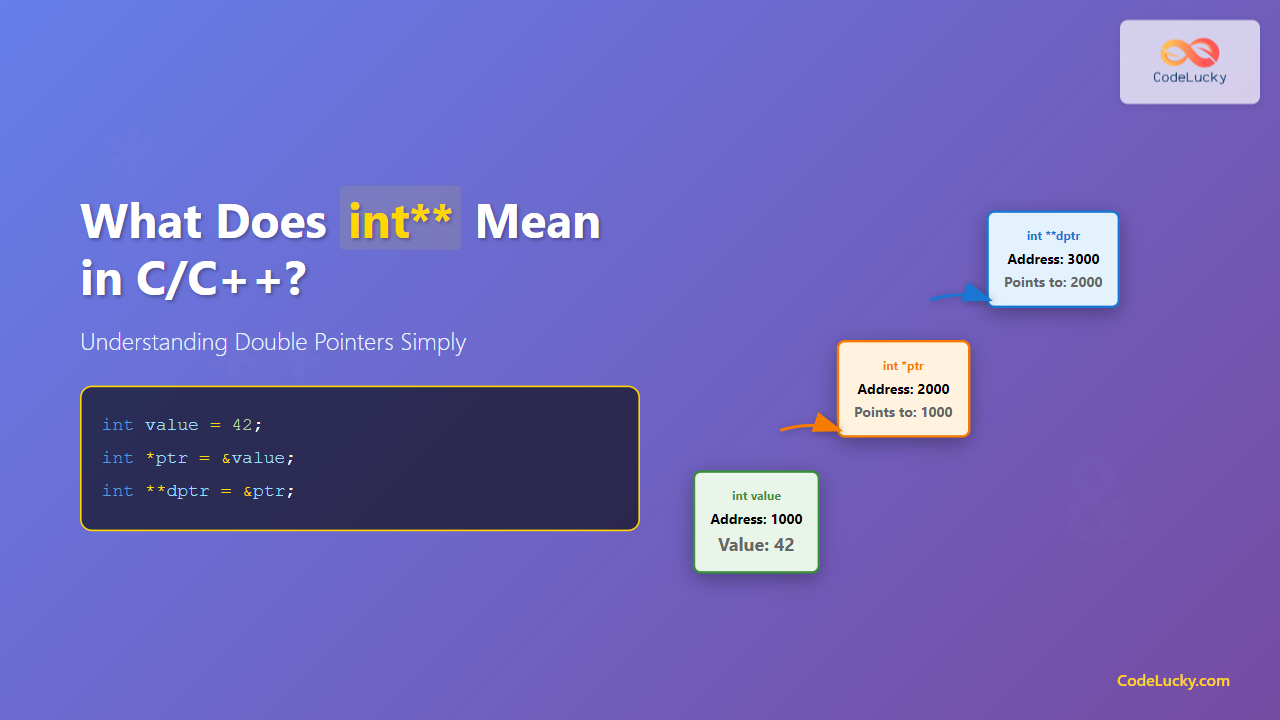
The syntax int** in C and C++ represents a pointer to a pointer to an integer, commonly called a “double pointer” or “pointer to pointer”. This powerful feature allows you to create multi-level indirection, enabling advanced memory management and data structure implementations.

Basic Syntax and Declaration
Here’s how you declare and use a double pointer:
#include <stdio.h>
#include <stdlib.h>

int main() {
    int value = 42;        // Regular integer
    int *ptr = &value     // Pointer to integer
    int **dptr = &ptr     // Pointer to pointer to integer

    printf("Value: %d\n", value);           // Output: 42
    printf("*ptr: %d\n", *ptr);             // Output: 42
    printf("**dptr: %d\n", **dptr);         // Output: 42

    return 0;
}
Output:
Value: 42
*ptr: 42
**dptr: 42
Memory Layout Visualization
Understanding how double pointers work in memory is crucial. Let’s visualize the memory layout:

Step-by-Step Access Process
When accessing values through double pointers, the dereferencing happens in stages:
#include <stdio.h>

int main() {
    int value = 100;
    int *ptr = &value
    int **dptr = &ptr

    // Different ways to access the value
    printf("Direct access: value = %d\n", value);
    printf("Single dereference: *ptr = %d\n", *ptr);
    printf("Double dereference: **dptr = %d\n", **dptr);

    // Address information
    printf("\nMemory addresses:\n");
    printf("Address of value: %p\n", (void*)&value);
    printf("Content of ptr: %p\n", (void*)ptr);
    printf("Content of dptr: %p\n", (void*)*dptr);

    return 0;
}
Practical Applications
1. Dynamic 2D Arrays
One of the most common uses of int** is creating dynamic 2D arrays:
#include <stdio.h>
#include <stdlib.h>

int** create2DArray(int rows, int cols) {
    // Allocate array of row pointers
    int **array = (int**)malloc(rows * sizeof(int*));

    // Allocate memory for each row
    for (int i = 0; i < rows; i++) {
        array[i] = (int*)malloc(cols * sizeof(int));
    }

    return array;
}

void fill2DArray(int **array, int rows, int cols) {
    for (int i = 0; i < rows; i++) {
        for (int j = 0; j < cols; j++) {
            array[i][j] = i * cols + j + 1;
        }
    }
}

void print2DArray(int **array, int rows, int cols) {
    for (int i = 0; i < rows; i++) {
        for (int j = 0; j < cols; j++) {
            printf("%3d ", array[i][j]);
        }
        printf("\n");
    }
}

int main() {
    int rows = 3, cols = 4;

    int **matrix = create2DArray(rows, cols);
    fill2DArray(matrix, rows, cols);

    printf("Dynamic 2D Array:\n");
    print2DArray(matrix, rows, cols);

    // Free memory
    for (int i = 0; i < rows; i++) {
        free(matrix[i]);
    }
    free(matrix);

    return 0;
}
Output:
Dynamic 2D Array:
  1   2   3   4
  5   6   7   8
  9  10  11  12

2. Function Parameters for Modification
Double pointers allow functions to modify pointer variables passed from the caller:
#include <stdio.h>
#include <stdlib.h>

void allocateMemory(int **ptr, int size) {
    // Modify the pointer itself
    *ptr = (int*)malloc(size * sizeof(int));

    // Initialize the allocated memory
    for (int i = 0; i < size; i++) {
        (*ptr)[i] = i * 2;
    }
}

int main() {
    int *numbers = NULL;  // Initially NULL
    int size = 5;

    printf("Before allocation: numbers = %p\n", (void*)numbers);

    // Pass address of pointer to modify it
    allocateMemory(&numbers, size);

    printf("After allocation: numbers = %p\n", (void*)numbers);

    // Print the allocated and initialized array
    printf("Array contents: ");
    for (int i = 0; i < size; i++) {
        printf("%d ", numbers[i]);
    }
    printf("\n");

    free(numbers);
    return 0;
}
3. Command Line Arguments
The main function’s argv parameter is actually char** (similar concept):
#include <stdio.h>

int main(int argc, char **argv) {
    printf("Program name: %s\n", argv[0]);
    printf("Number of arguments: %d\n", argc);

    for (int i = 1; i < argc; i++) {
        printf("Argument %d: %s\n", i, argv[i]);
    }

    return 0;
}
Common Pitfalls and Best Practices
Memory Management Issues
// ❌ Wrong: Memory leak
int** createMatrix(int rows, int cols) {
    int **matrix = malloc(rows * sizeof(int*));
    for (int i = 0; i < rows; i++) {
        matrix[i] = malloc(cols * sizeof(int));
    }
    // Missing error checking!
    return matrix;
}

// ✅ Correct: With proper error handling
int** createMatrixSafe(int rows, int cols) {
    int **matrix = malloc(rows * sizeof(int*));
    if (!matrix) return NULL;

    for (int i = 0; i < rows; i++) {
        matrix[i] = malloc(cols * sizeof(int));
        if (!matrix[i]) {
            // Clean up previously allocated memory
            for (int j = 0; j < i; j++) {
                free(matrix[j]);
            }
            free(matrix);
            return NULL;
        }
    }
    return matrix;
}
Null Pointer Checks
void safeAccess(int **dptr) {
    if (dptr == NULL) {
        printf("Double pointer is NULL\n");
        return;
    }

    if (*dptr == NULL) {
        printf("Single pointer is NULL\n");
        return;
    }

    printf("Value: %d\n", **dptr);
}

Advanced Example: Dynamic String Array
Here’s a comprehensive example showing how to work with an array of strings using char**:
#include <stdio.h>
#include <stdlib.h>
#include <string.h>

char** createStringArray(int count) {
    char **strings = malloc(count * sizeof(char*));
    return strings;
}

void addString(char **strings, int index, const char *str) {
    strings[index] = malloc((strlen(str) + 1) * sizeof(char));
    strcpy(strings[index], str);
}

void printStringArray(char **strings, int count) {
    for (int i = 0; i < count; i++) {
        printf("String %d: %s\n", i, strings[i]);
    }
}

void freeStringArray(char **strings, int count) {
    for (int i = 0; i < count; i++) {
        free(strings[i]);  // Free each string
    }
    free(strings);  // Free the array of pointers
}

int main() {
    int count = 3;
    char **languages = createStringArray(count);

    addString(languages, 0, "C Programming");
    addString(languages, 1, "C++ Programming");
    addString(languages, 2, "Python Programming");

    printStringArray(languages, count);

    freeStringArray(languages, count);
    return 0;
}
Performance Considerations
Advantages:
- Flexible memory allocation
- Efficient for sparse matrices
- Allows dynamic resizing of individual rows
Disadvantages:
- Additional memory overhead for storing pointers
- Non-contiguous memory layout affects cache performance
- More complex memory management
Debugging Tips
void debugDoublePointer(int **dptr, const char *name) {
    printf("=== Debugging %s ===\n", name);
    printf("Address of double pointer: %p\n", (void*)&dptr);
    printf("Value of double pointer: %p\n", (void*)dptr);

    if (dptr != NULL) {
        printf("Address pointed by dptr: %p\n", (void*)*dptr);
        if (*dptr != NULL) {
            printf("Value at final destination: %d\n", **dptr);
        } else {
            printf("Single pointer is NULL\n");
        }
    } else {
        printf("Double pointer is NULL\n");
    }
    printf("==================\n\n");
}
Key Takeaways
Understanding int** is essential for advanced C and C++ programming. Remember these key points:
int**creates two levels of indirection- Commonly used for dynamic 2D arrays and modifying pointers in functions
- Requires careful memory management to avoid leaks
- Always perform null pointer checks before dereferencing
- Free memory in reverse order of allocation
Mastering double pointers opens up powerful programming techniques and is fundamental for understanding more complex data structures like linked lists, trees, and graphs in C and C++.