Google Ranking Factors: What Really Matters for SEO in 2025
In the ever-evolving world of Search Engine Optimization (SEO), staying updated with Google’s ranking factors is crucial for maintaining and improving your website’s visibility. As we look towards 2025, certain factors will continue to be essential, while others may gain or lose importance. This guide delves into the ranking factors that will significantly impact SEO, helping you formulate effective strategies for the future.
Understanding Google’s Ranking System
Google’s ranking system analyzes various factors to provide relevant and high-quality search results. These factors are continuously updated and refined through algorithm updates. Optimizing your website based on these factors ensures better visibility and organic traffic.
Core Ranking Factors in 2025
Here are the key ranking factors expected to remain influential in 2025:
- High-Quality Content:
- Definition: Content that is informative, well-researched, engaging, and provides value to the user.
- Impact: Remains a foundational factor. Google prioritizes websites that offer in-depth, accurate, and comprehensive content.
- Strategy:
- Create detailed and unique articles, blog posts, and guides.
- Update existing content to ensure accuracy and relevance.
- Focus on answering user queries comprehensively.
- E-A-T (Expertise, Authoritativeness, Trustworthiness):
- Definition: Signals indicating the quality and reliability of the content creator and the website.
- Impact: Critical for websites in YMYL (Your Money or Your Life) categories.
- Strategy:
- Showcase author expertise with detailed bios and credentials.
- Obtain authoritative backlinks from reputable sources.
- Ensure website security with HTTPS and transparent privacy policies.
- Mobile-Friendliness:
- Definition: Ensuring your website is responsive and provides an optimal experience on mobile devices.
- Impact: Essential due to the increasing prevalence of mobile search.
- Strategy:
- Implement a responsive design that adapts to various screen sizes.
- Optimize page loading speed on mobile.
- Ensure touch elements are appropriately sized and spaced.
- Page Experience:
- Definition: Factors that influence the user’s perception of interacting with a web page.
- Impact: Direct ranking signal through Core Web Vitals.
- Strategy:
- Improve Largest Contentful Paint (LCP) by optimizing images and server response times.
- Reduce First Input Delay (FID) by minimizing JavaScript execution time.
- Enhance Cumulative Layout Shift (CLS) by specifying image and video dimensions.
- Ensure website security with HTTPS.
- Avoid intrusive interstitials that disrupt the user experience.
- Backlink Profile:
- Definition: The quantity and quality of backlinks pointing to your website.
- Impact: Signals authority and relevance. High-quality backlinks from reputable sites remain invaluable.
- Strategy:
- Earn backlinks through creating valuable and shareable content.
- Guest blogging on relevant websites.
- Monitor and disavow toxic backlinks.
- Keyword Optimization:
- Definition: Strategically incorporating relevant keywords into your content, meta descriptions, and URLs.
- Impact: Helps Google understand the topic and relevance of your content.
- Strategy:
- Conduct thorough keyword research to identify high-value keywords.
- Incorporate keywords naturally into headings, body text, and image alt tags.
- Avoid keyword stuffing, which can harm your rankings.
Evolving Ranking Factors
Certain ranking factors are expected to evolve and gain increased importance by 2025:
- User Intent:
- Definition: Understanding and satisfying the underlying goal of the user’s search query.
- Impact: Google’s algorithms are becoming more sophisticated in discerning user intent.
- Strategy:
- Create content that directly addresses user needs and questions.
- Optimize content for different types of search intent (informational, navigational, transactional).
- Use structured data markup to provide context to search engines.
- AI and Machine Learning:
- Definition: The use of AI and machine learning to analyze content and user behavior.
- Impact: Enhanced ability to understand the context, quality, and relevance of content.
- Strategy:
- Focus on natural language processing (NLP) when creating content.
- Leverage AI tools to analyze content performance and identify optimization opportunities.
- Video Content:
- Definition: The incorporation of video into your content strategy.
- Impact: Video content is becoming increasingly popular and can improve engagement and time on site.
- Strategy:
- Create informative and engaging videos related to your niche.
- Optimize video titles, descriptions, and tags with relevant keywords.
- Embed videos on your website and promote them on social media.
- Voice Search Optimization:
- Definition: Optimizing content to answer voice search queries.
- Impact: Voice search is growing in popularity, particularly with the rise of smart speakers.
- Strategy:
- Create content that answers common questions in a conversational tone.
- Use long-tail keywords and phrases that people use in spoken language.
- Ensure your website is mobile-friendly and loads quickly.
Factors Losing Importance
Some factors may become less critical as Google’s algorithms evolve:
- Exact Match Keywords:
- Definition: Relying heavily on exact match keywords in domain names and content.
- Impact: Google’s algorithms are becoming better at understanding context and semantic meaning.
- Strategy:
- Focus on creating content that is relevant to the user’s intent, rather than obsessing over exact match keywords.
- Use synonyms and related terms to broaden your keyword coverage.
- Keyword Density:
- Definition: Over-stuffing content with keywords to manipulate search rankings.
- Impact: Google’s algorithms can now detect and penalize keyword stuffing.
- Strategy:
- Write naturally and focus on providing value to the user.
- Incorporate keywords strategically and organically into your content.
Visualizing the Importance of Ranking Factors
To illustrate the relative importance of Google ranking factors in 2025, consider the following chart:
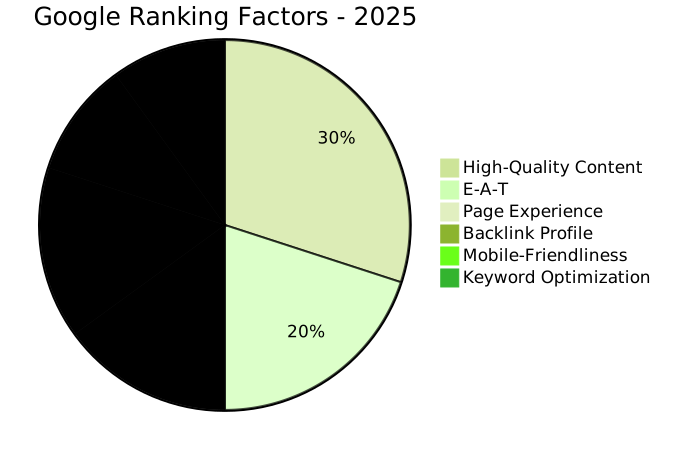
This pie chart provides a visual representation of the estimated importance of each ranking factor.
Practical Examples
Let’s explore practical examples of how to optimize for key ranking factors.
Example 1: Optimizing for Page Experience
Improving the page experience involves addressing Core Web Vitals. Here’s an example of optimizing images to improve Largest Contentful Paint (LCP):
<canvas id="lcpCanvas" width="200" height="150" style="border:1px solid #d3d3d3;">
Your browser does not support the HTML5 canvas tag.</canvas>

<script>
var c_lcp = document.getElementById("lcpCanvas");
var ctx_lcp = c_lcp.getContext("2d");
ctx_lcp.font = "20px Arial";
ctx_lcp.fillText("Loading...", 20, 75);

const img_lcp = new Image();
img_lcp.onload = function() {
    ctx_lcp.clearRect(0, 0, c_lcp.width, c_lcp.height);
    ctx_lcp.drawImage(img_lcp, 0, 0, 200, 150);
};
img_lcp.src = "optimized-image.jpg"; // Optimized image
</script>
Optimizing images involves compressing them without losing significant quality, using appropriate file formats (such as WebP), and ensuring they are properly sized for their display area.
Example 2: Enhancing E-A-T
Enhancing Expertise, Authoritativeness, and Trustworthiness (E-A-T) involves showcasing author credentials.
<canvas id="eatCanvas" width="300" height="100" style="border:1px solid #d3d3d3;">
Your browser does not support the HTML5 canvas tag.</canvas>

<script>
var c_eat = document.getElementById("eatCanvas");
var ctx_eat = c_eat.getContext("2d");
ctx_eat.font = "16px Arial";
ctx_eat.fillText("Author: Dr. Jane Smith", 20, 30);
ctx_eat.fillText("Credentials: Ph.D. in Biology", 20, 60);
</script>
Displaying the author’s credentials and expertise adds credibility to the content.
Example 3: Mobile-Friendliness
Ensuring a website is mobile-friendly involves using responsive design. Here’s a simple example using CSS:
<canvas id="mobileCanvas" width="300" height="150" style="border:1px solid #d3d3d3;">
Your browser does not support the HTML5 canvas tag.</canvas>

<style>
#mobileCanvas {
    width: 100%;
    max-width: 300px;
    height: auto;
}
</style>

<script>
var c_mobile = document.getElementById("mobileCanvas");
var ctx_mobile = c_mobile.getContext("2d");
ctx_mobile.font = "20px Arial";
ctx_mobile.fillText("Mobile-Friendly", 20, 75);
</script>
Using CSS media queries ensures that the website adapts to different screen sizes.
Tools for Monitoring and Optimization
To effectively monitor and optimize your website’s ranking factors, consider using the following tools:
- Google Search Console: Provides insights into your website’s performance, including Core Web Vitals, mobile usability, and crawl errors.
- Google Analytics: Tracks user behavior, engagement metrics, and traffic sources.
- PageSpeed Insights: Analyzes your website’s page speed and provides recommendations for improvement.
- SEMrush: Offers comprehensive SEO tools for keyword research, backlink analysis, and competitor analysis.
- Ahrefs: Provides detailed backlink data, keyword rankings, and site audit capabilities.
Staying Ahead of the Curve
The SEO landscape is constantly changing, and staying updated with the latest trends and algorithm updates is essential. Here are some tips for staying ahead of the curve:
- Follow Industry Blogs and Publications: Stay informed by reading reputable SEO blogs, publications, and industry news.
- Attend Conferences and Webinars: Participate in SEO conferences, webinars, and workshops to learn from industry experts.
- Experiment and Test: Continuously experiment with different optimization strategies and track their impact on your website’s rankings.
- Monitor Google’s Official Communications: Pay attention to Google’s official announcements and guidelines regarding algorithm updates and best practices.
Conclusion
Mastering Google ranking factors is an ongoing process that requires continuous learning, adaptation, and optimization. By focusing on high-quality content, E-A-T, mobile-friendliness, page experience, and other essential factors, you can improve your website’s visibility and attract more organic traffic in 2025 and beyond. Stay proactive, monitor your performance, and adapt your strategies as needed to remain competitive in the ever-evolving world of SEO.
Related Posts
Google Algorithm Updates: How They Impact Your Website’s Rankings
Google Algorithm Updates: How They Impact Your Website's Rankings Google's algorithm is the engine that drives search results, and it's...

How Search Engines Work: Understanding SEO Basics
How Search Engines Work: Understanding SEO Basics Search engines are the gatekeepers of the internet, connecting users with the information...

SEO vs SEM: What’s the Difference and Which One Should You Focus On?
SEO vs. SEM: Understanding the Key Differences and Choosing the Right Strategy In the world of digital marketing, Search Engine...
CSS Performance Metrics: Complete Guide to CLS, FCP, LCP Optimization
Website performance directly impacts user experience, search rankings, and conversion rates. CSS plays a crucial role in three critical performance...

SQL Performance Tuning: Optimizing Your Database Queries
In the world of database management, performance is king. As your database grows and your applications become more complex, the...

MySQL Query Optimization: Boost Performance with EXPLAIN, Indexes, and Rewriting
Slow queries can bring your application to a crawl, frustrating users and impacting your bottom line. Query optimization is the...

SQL CREATE INDEX Statement: Optimizing Queries with Indexes
In the world of database management, performance is king. As your database grows, so does the time it takes to...

HTML Headings: Mastering Structure and SEO with H1 to H6 Tags
Introduction Ever landed on a webpage and felt instantly overwhelmed by a wall of text? Or struggled to find the...
MySQL Performance: A Comprehensive Guide to Optimization
MySQL performance is crucial for any application relying on a database. Slow queries or sluggish database operations can lead to...

HTML h5 Tag: Defining Fifth Level Headings
HTML <h5> Tag The <h5> tag in HTML represents a fifth-level heading. It is used to create subheadings within sections...

MySQL Latest Features: What’s New and What to Expect
Staying up-to-date with the latest features in MySQL is crucial for any database professional. With each new release, MySQL introduces...
MySQL Upgrade: Planning, Execution, and Verification
Upgrading your MySQL database is a critical task that requires careful planning and execution. While it may seem daunting, a...