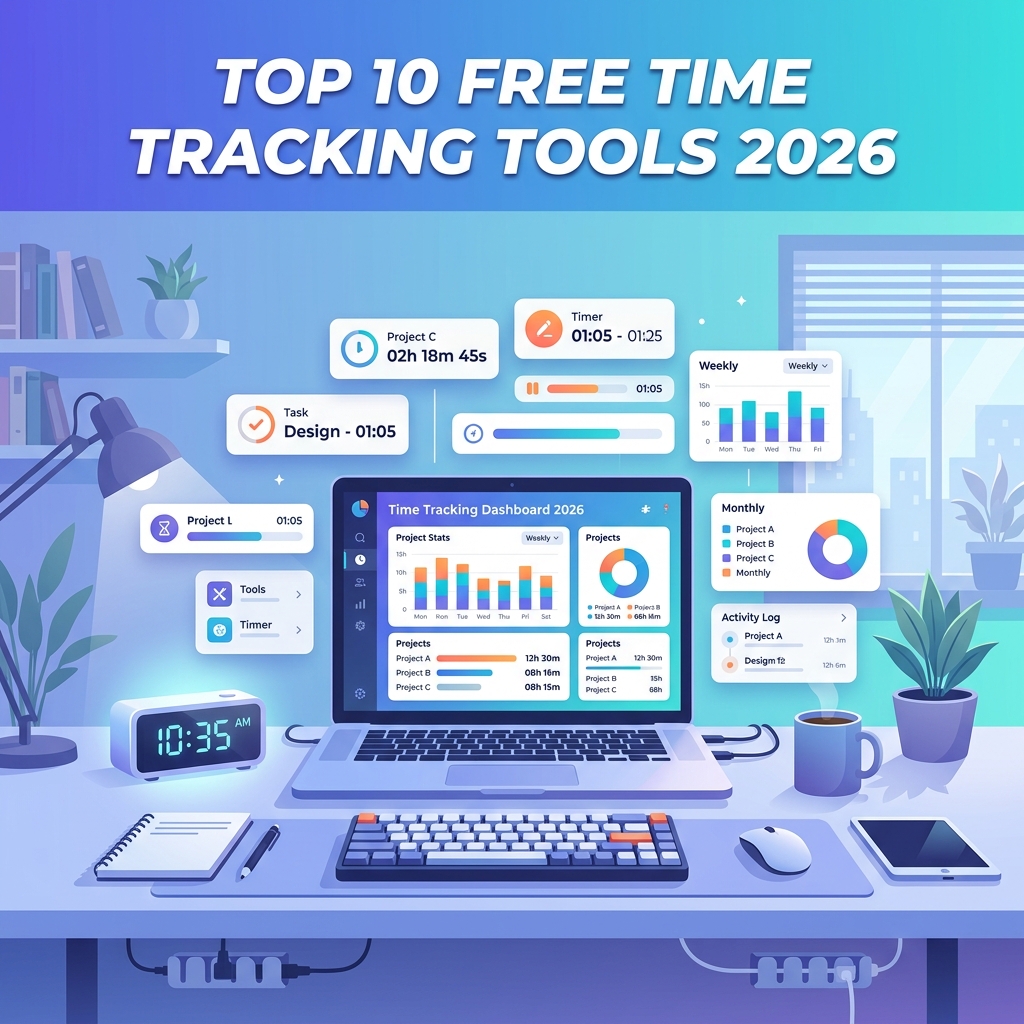
Ever finished a long workday and wondered where the hours actually went? For freelancers, that fuzzy memory of “I think I worked six hours on the client project” is the difference between getting paid fairly and silently donating your time. Reliable free time tracking software for freelancers turns that guesswork into precise data — data you can invoice from, plan around, and use to spot which clients are quietly burning your margins. The good news for 2026: the free tiers from the major players are more powerful than the paid plans of just a few years ago.
This guide walks through ten genuinely free time tracking tools that independent professionals actually use day to day. You’ll get a quick definition of what to look for, a head-to-head comparison, the honest limits of each free plan, and a short FAQ at the end to help you pick the right one for your workflow.
What Is Time Tracking Software (and Why Freelancers Need It)?
Time tracking software is an application that records how long you spend on tasks, projects, or clients, usually via a start/stop timer, manual entries, or automatic activity detection. For freelancers, it converts hours into invoiceable line items, surfaces unprofitable projects, and provides defensible proof of work if a client ever disputes a bill.
Beyond billing, modern trackers double as productivity tools. They help you spot context switching, batch similar work, and protect deep-focus blocks. If you bill hourly, value-bill, or just want to know how long that “quick logo tweak” really takes, a tracker is non-negotiable.
If you charge a flat rate, time tracking is even more important — it tells you your effective hourly rate, which is the only number that reveals whether a fixed-price gig is actually worth taking again.
How We Evaluated the Free Time Tracking Tools
Not every tool with a free tier is freelancer-friendly. Some cripple the free plan with three-project limits; others lock reporting behind a paywall. The picks below were scored on five criteria:
- True free tier — usable indefinitely, not a 14-day trial in disguise.
- Reports & exports — can you generate a client-ready PDF or CSV without upgrading?
- Cross-platform support — desktop, mobile, and browser extension at minimum.
- Invoicing or export workflow — does it play nicely with your billing process?
- Privacy and data ownership — can you export everything if you leave?
1. Toggl Track — Best Overall Free Plan
Toggl Track remains the default recommendation for solo freelancers, and the free plan is unusually generous: unlimited time tracking, unlimited projects, unlimited clients, and unlimited reports for up to five users. The one-click timer lives in your menu bar, browser, phone, and inside 100+ web apps via the browser extension.
The killer feature is the idle detection — if you walk away from your desk, Toggl asks whether to discard or keep that time when you return. That single behavior has saved freelancers from invoicing for lunch breaks more times than they’d like to admit.
Free plan limits: No billable rates, no project templates, no scheduled reports. You’ll still get rich summary, detailed, and weekly reports — enough to invoice from.
2. Clockify — Best Unlimited Free Tier
If “unlimited” is your love language, Clockify is hard to beat. The free plan supports unlimited users, projects, and tracking — plus it includes billable rates, which Toggl reserves for paid tiers. For freelancers who already invoice hourly, that single feature can be the deciding factor.
The interface feels closer to traditional project management software, with timesheets, a Pomodoro-style timer, and a kiosk mode if you ever bring on a subcontractor. Reports export to PDF, CSV, and Excel without restriction.
Watch out for: The free plan excludes the auto-tracker (the desktop app that silently watches which apps you use). That feature is locked behind a paid plan, which matters if you want passive tracking rather than manual start/stop.
3. Harvest — Best Free Plan for Single-Client Freelancers
Harvest’s free plan is intentionally narrow: one seat, two projects. For a freelancer with one or two anchor clients, that’s plenty. What you get in return is one of the smoothest invoice-from-timesheet flows in the industry, plus integrations with Stripe and PayPal so clients can pay directly from the invoice email.
If you typically juggle three or more active projects at once, Harvest’s free tier will frustrate you fast. But for a part-time consultant or a freelancer in a long-term retainer, it’s a quietly excellent choice.
4. TimeCamp — Best for Automatic Tracking
TimeCamp’s free plan includes unlimited users and projects, but the standout feature is genuine automatic time tracking. The desktop app categorizes the apps and websites you use throughout the day, then lets you drag those blocks onto projects retroactively. For freelancers who forget to start the timer (so, most of us), this is gold.
It also offers a basic invoicing module, productivity scoring, and integrations with project management tools like Trello, Asana, and Jira.
5. My Hours — Best Free Reporting
My Hours is built specifically for freelancers and small consultancies, and the free plan covers up to five team members with unlimited projects and clients. Where it shines is the reporting layer: you can build custom reports with logos, headers, and per-task notes that look like a finished deliverable rather than a raw export.
The free plan caps you at basic reports and manual time entry — bulk editing, billable rates, and invoicing live in the paid tier — but if your priority is sending clients a professional-looking timesheet, My Hours punches above its weight.
6. ActivityWatch — Best Open-Source & Privacy-First Option
For freelancers who refuse to send work data to a third-party server, ActivityWatch is the answer. It’s a free, open-source, cross-platform tracker that runs entirely on your machine. No accounts, no cloud, no telemetry. The codebase is on GitHub, audited by the community, and licensed under MPL-2.0.
It automatically logs window titles, active applications, and AFK (away-from-keyboard) time, then visualizes everything in a local web dashboard. You’ll need to layer your own categorization rules and reporting workflow on top, but the privacy guarantee is unmatched.
# Install ActivityWatch via the CLI on macOS using Homebrew
brew install --cask activitywatch

# Start the bundled server and watchers
aw-qt

# The local dashboard is now available at:
# http://localhost:5600
The commands above install ActivityWatch, launch its tray app (which starts the local server and the window/AFK watchers), and expose the dashboard on localhost. All data stays on your laptop — nothing leaves until you choose to export it.
7. Kimai — Best Self-Hosted Tracker
Kimai is another open-source choice, but with a different philosophy: you host it yourself on your own server (or a $5/month VPS) and get the full feature set — including invoicing, customer management, and detailed reporting — without ever paying a SaaS subscription. It’s PHP-based, runs on standard LAMP stacks, and supports multi-currency invoicing out of the box.
It’s the right pick if you’re technically comfortable, want full data ownership, and plan to scale into a small agency without per-seat pricing eating your margin.
8. Hubstaff — Best Free Plan for Solo Use with Screenshots
Hubstaff’s free plan is restricted to a single user, but it includes features that are usually paid: optional screenshots, activity levels, app and URL tracking, and basic payroll calculations. For freelancers who work with international clients and need to provide proof-of-work attachments, this is a useful safety net.
The trade-off: Hubstaff is built primarily for remote-team monitoring, so the UI assumes you’re managing people. As a solo freelancer, you’ll ignore most of the dashboard — but the timer itself is fast and reliable.
9. RescueTime Lite — Best for Focus & Habit Insights
RescueTime is less a timer and more a behavioral coach. The free Lite plan runs silently in the background, categorizes every app and site you visit, and gives you a weekly productivity score. It won’t generate invoices, but it will tell you that you spent 3.5 hours on Slack and 47 minutes in your IDE last Tuesday — uncomfortable, useful data.
Pair it with a billing-focused tracker like Toggl, and you get both sides of the picture: what you billed, and how you actually spent your day.
10. Google Calendar + a Smart Workflow — Best No-Install Option
Sometimes the best tool is the one you already use. If you live in Google Calendar, you can turn it into a lightweight time tracker by color-coding events per client, then exporting via the Calendar API and summing the durations. It’s free, requires no new account, and integrates with everything.
Here’s a minimal Python snippet that pulls last week’s events and totals time per client based on event color:
# Requires: pip install google-api-python-client google-auth-httplib2 google-auth-oauthlib
from datetime import datetime, timedelta, timezone
from googleapiclient.discovery import build
from google.oauth2.credentials import Credentials

# Load OAuth credentials you generated via the Google Cloud Console
creds = Credentials.from_authorized_user_file("token.json")
service = build("calendar", "v3", credentials=creds)

# Fetch events from the last 7 days
now = datetime.now(timezone.utc)
events = service.events().list(
    calendarId="primary",
    timeMin=(now - timedelta(days=7)).isoformat(),
    timeMax=now.isoformat(),
    singleEvents=True,
).execute().get("items", [])

# Total minutes per Google color ID (each ID = one client)
totals = {}
for e in events:
    start = datetime.fromisoformat(e["start"]["dateTime"])
    end = datetime.fromisoformat(e["end"]["dateTime"])
    color = e.get("colorId", "default")
    totals[color] = totals.get(color, 0) + (end - start).total_seconds() / 60

for color, minutes in totals.items():
    print(f"Client color {color}: {minutes / 60:.2f} hours")
This script authenticates with Google’s Calendar API, pulls the previous week of events, and aggregates total minutes per color ID — effectively a billable-hours report. Map each color to a client name and you have a homegrown tracker with zero subscription cost.
Feature Comparison: Free Plans at a Glance
| Tool | Unlimited Projects | Billable Rates | Auto-Tracking | Reports Export | Best For |
|---|---|---|---|---|---|
| Toggl Track | Yes | No | Idle detection only | PDF, CSV | Overall daily use |
| Clockify | Yes | Yes | Paid only | PDF, CSV, Excel | Hourly invoicing |
| Harvest | 2 projects | Yes | No | PDF, CSV | Anchor-client work |
| TimeCamp | Yes | Limited | Yes | PDF, CSV | Forgetful timer users |
| My Hours | Yes | Paid | No | Branded PDF | Polished client reports |
| ActivityWatch | Yes | Manual | Yes | JSON, CSV | Privacy-first users |
| Kimai | Yes | Yes | No | PDF, CSV, XML | Self-hosting fans |
| Hubstaff | 10 projects | Yes | Yes | PDF, CSV | Proof-of-work needs |
| RescueTime Lite | N/A | No | Yes | Limited | Focus auditing |
| Google Calendar | Yes | Manual | No | API / iCal | Calendar-driven workflows |
How to Choose the Right Free Time Tracker
Instead of installing all ten and getting decision fatigue, work backwards from your invoicing workflow:
- If you invoice hourly, prioritize billable rates and clean PDF exports — Clockify or Harvest.
- If you bill flat-rate, prioritize effortless tracking so you can audit your effective rate — Toggl or TimeCamp.
- If you handle sensitive client data, pick a local-only or self-hosted tool — ActivityWatch or Kimai.
- If you constantly forget to start the timer, lean on automatic tracking — TimeCamp or RescueTime.
- If clients ask for proof-of-work, use a tool with screenshots or activity levels — Hubstaff.
Common Mistakes Freelancers Make with Time Tracking
Even the best tool can’t fix a broken process. Watch out for these pitfalls:
- Tracking only “billable” time. If you don’t log admin, sales, and learning hours, you’ll never see your true effective rate and you’ll underprice every future quote.
- Rounding aggressively against yourself. Snapping every entry down to the nearest 15 minutes feels generous but compounds into thousands of unpaid hours per year. Round to the nearest minute, or use real start/stop data.
- Switching tools every quarter. Historical data is the most valuable output of any tracker. Pick one, commit for at least six months, then evaluate.
- Skipping weekly reviews. A tracker without a review cadence is just a clock. Block 15 minutes each Friday to read the report and spot drift.
- Forgetting to back up exports. Free tiers can change terms. Export your data monthly to a CSV you own — especially before any subscription change.
Frequently Asked Questions
Is free time tracking software really enough for a full-time freelancer?
For most solo freelancers, yes — the free tiers from Toggl, Clockify, and TimeCamp cover unlimited projects and produce client-ready reports. You typically only need to upgrade when you add team members, require advanced features like scheduled reports or QuickBooks integrations, or want stricter access controls.
Which free time tracking software works best offline?
ActivityWatch is fully offline by design, storing all data locally. Toggl Track and Clockify desktop apps queue entries while offline and sync once you reconnect, making them solid choices for freelancers who work on trains, planes, or in coffee shops with patchy Wi-Fi.
Can I use free time tracking software for tax purposes?
Yes. Most tools let you export detailed CSV or PDF reports that act as supporting documentation for invoices and self-employment tax filings. Keep monthly exports stored alongside your invoices for at least the retention period required by your tax authority — typically five to seven years.
How accurate is automatic time tracking compared to manual timers?
Automatic tracking is more accurate for measuring actual app usage, but it can over-count distractions and under-count thinking time spent away from the keyboard. A hybrid approach — automatic tracking for raw data plus a manual review at day’s end — gives the most defensible billing record.
Will clients accept invoices generated from free time tracking software?
Absolutely. Clients care that the invoice is itemized, dated, and matches the agreed scope — not which app produced it. Tools like Harvest, Clockify, and My Hours produce professional invoices on free tiers that are indistinguishable from paid-tier outputs.
What’s the difference between time tracking and project management software?
Time tracking software records duration; project management software organizes tasks, deadlines, and dependencies. Many freelancers pair the two — for example, Trello for tasks and Toggl for time — though all-in-one tools like Clockify and TimeCamp blur the line by including light project management.
Conclusion
Picking the right free time tracking software for freelancers in 2026 comes down to matching the tool to your billing style, your memory habits, and your privacy preferences. For most freelancers, Toggl Track and Clockify cover 90% of needs without ever asking for a credit card. If you’re privacy-conscious, ActivityWatch and Kimai give you full data ownership. And if your workflow already revolves around Google Calendar, a few lines of Python can turn it into a respectable tracker.
Whichever tool you pick, the real win isn’t the software — it’s the habit. Track every hour for a month, run the report, and you’ll likely discover one client paying you double your effective rate and another quietly draining your week. That single insight tends to pay for every paid upgrade you might ever need.