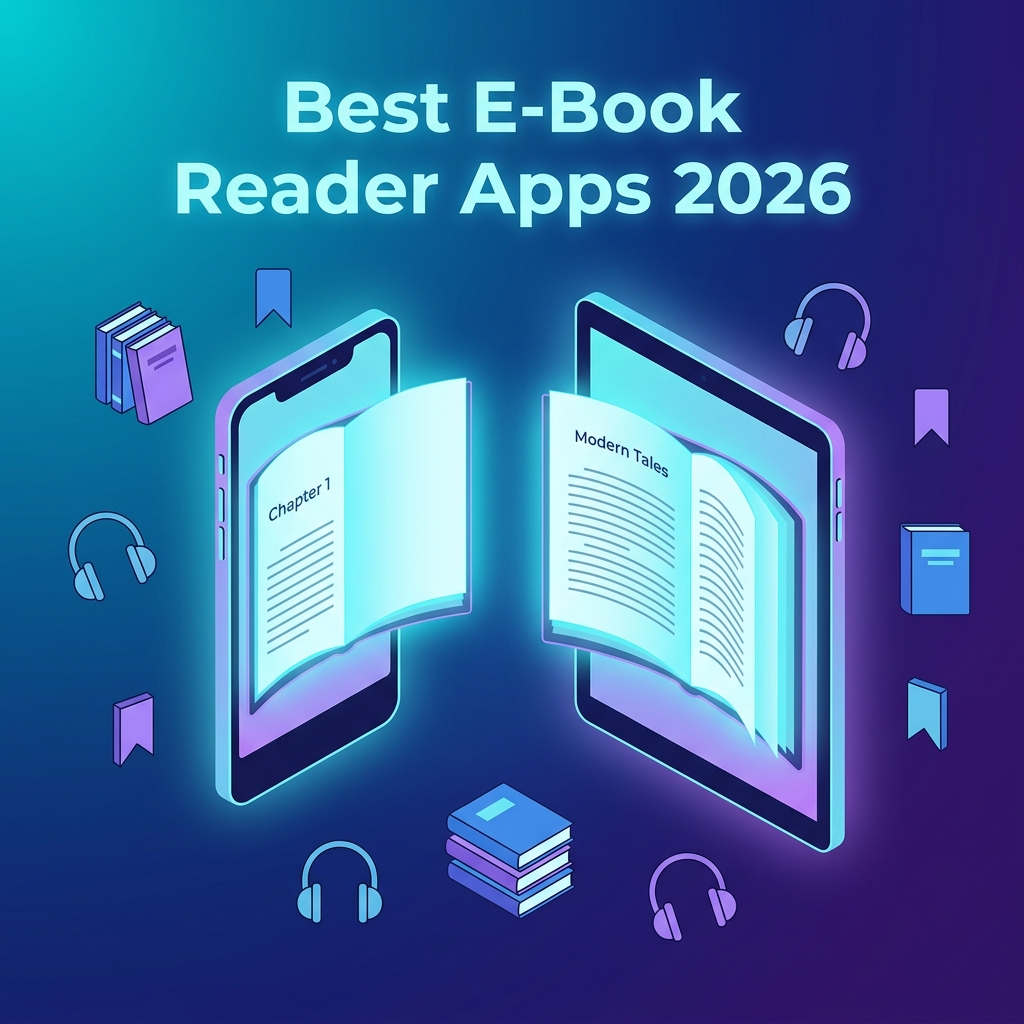
Your phone already carries your calendar, your camera, and your wallet — so why not your entire library? The right e-book reader app turns a five-minute wait at the coffee shop into a chapter of your favorite novel, or a commute into a focused study session. But with hundreds of options in the Play Store and App Store, choosing the best e-book reader apps for Android and iOS in 2026 can feel like browsing a library without a catalog.
This guide breaks down the top ten apps worth installing this year, what makes each one stand out, which formats they support, and which type of reader they’re actually built for. Whether you’re a textbook-highlighting student, a comic-binge fan, an audiobook switcher, or a sideloader who hoards .epub files, there’s an app on this list with your name on it.
What Makes a Great E-Book Reader App in 2026?
An e-book reader app is a mobile application that lets you read digital books, documents, comics, or magazines on your smartphone or tablet, typically supporting formats like EPUB, PDF, MOBI, CBZ, and increasingly DRM-protected store-bought titles. The best e-book reader apps in 2026 go beyond just rendering text — they sync your progress across devices, offer adjustable typography, support audiobooks alongside text, and respect your eyes with dark modes and dyslexia-friendly fonts.
When evaluating each app below, four factors mattered most:
- Format support — does it open the files you actually own?
- Reading experience — typography, page turns, scroll vs. paginated, customization
- Library and sync — cloud backup, cross-device progress, organization
- Cost and ecosystem lock-in — free vs. subscription, store-bound vs. open
1. Amazon Kindle — Best Overall Ecosystem
The Kindle app remains the gravitational center of digital reading in 2026, and for good reason. Its catalog is enormous, Whispersync keeps your place updated whether you switch from phone to tablet to a physical Kindle device, and the 2026 redesign finally fixed the cramped library view that frustrated power users for years.
Kindle now supports inline Wikipedia and dictionary lookups in 60+ languages, X-Ray for character tracking, and seamless switching between reading and Audible narration with Immersion Reading. The downside is the walled garden: sideloading .epub files requires emailing them to your Kindle address, and DRM is everywhere.
- Best for: Readers who buy from Amazon and own Kindle hardware
- Formats: AZW, AZW3, KFX, EPUB (via Send to Kindle), PDF
- Price: Free app; books sold individually or via Kindle Unlimited
2. Apple Books — Best Native iOS Experience
If you live inside the Apple ecosystem, Apple Books is hard to beat for sheer polish. Page-turn animations feel paper-like, EPUB rendering is excellent, and the app handles audiobooks natively without forcing you into a second app. iCloud sync keeps your library identical across iPhone, iPad, and Mac.
The 2026 version added AI-powered summaries for nonfiction titles and a “Listen Now” handoff that resumes audio from where your text reading paused. The catch: Apple Books is iOS and macOS only, so Android users are out of luck.
- Best for: iPhone and iPad readers who want zero setup
- Formats: EPUB, PDF, audiobooks (M4B)
- Price: Free app; per-title pricing
3. Google Play Books — Best Cross-Platform Default
Google Play Books is the default on most Android phones and works just as well on iOS through its app or in any browser. You can upload your own PDFs and EPUBs (up to 1,000 personal files), making it one of the most flexible cloud-based ebook reader apps for people who refuse to be locked in.
Its standout feature is Flowing Text for scanned PDFs, which uses on-device ML to reflow rigid PDF pages into responsive text you can resize on a phone screen. Pair that with Google Translate integration and you have a strong pick for international or academic readers.
4. Kobo — Best for Audiobook + E-Book Bundles
Kobo’s app punches well above its market share. The reading interface is genuinely beautiful, the store is competitive with Amazon’s, and Kobo Plus (the company’s subscription) bundles unlimited e-books and audiobooks in one price — a deal Amazon notably keeps separate.
Kobo also leans into Overdrive integration, letting you borrow library e-books directly inside the app in supported regions. For readers who want store flexibility without sacrificing experience, Kobo is the strongest Kindle alternative in 2026.
5. Moon+ Reader — Best Power User App for Android
If you sideload books, hoard formats, and want every knob tweakable, Moon+ Reader is the answer. It opens EPUB, PDF, MOBI, AZW3, FB2, TXT, RTF, HTML, CBR, CBZ — essentially anything. The Pro version unlocks PDF reflow, text-to-speech with offline voices, and theme customization that goes deeper than any mainstream app.
If your library is a folder of files you actually own — not a list of licenses you’ve rented — Moon+ Reader is the closest thing to a desktop e-reader on your phone.
It’s Android only, and the interface won’t win design awards, but for control freaks and digital librarians, nothing else comes close.
6. KyBook 3 — The iOS Answer to Moon+ Reader
iOS users who want Moon+ Reader-level flexibility should look at KyBook 3. It handles EPUB, PDF, DjVu, FB2, CBR, CBZ, and audiobooks, and connects to OPDS catalogs, cloud drives (Dropbox, Google Drive, iCloud, WebDAV), and even Calibre libraries running on your home computer.
The reading interface supports custom fonts, line spacing, margins, and color themes. Highlights and notes export cleanly to Markdown or plain text — a feature that turns the app into a serious research tool for students.
7. Libby by OverDrive — Best Free Library App
Libby is what happens when a public library decides to make its app delightful. Sign in with your library card and you get free access to thousands of e-books and audiobooks, all on loan, with automatic returns and a clean “tag” system to organize what you’re reading, want to read, and have finished.
It supports Send to Kindle for U.S. users, has excellent built-in audiobook playback, and works on both Android and iOS. The only friction is the library system itself — popular titles can have wait times measured in weeks.
8. ReadEra — Best Free, Ad-Free Reader
Most free reader apps either pile on ads or push you toward a subscription. ReadEra does neither. It’s genuinely free, has zero ads, and supports EPUB, PDF, MOBI, DOC, DOCX, RTF, TXT, FB2, CHM, and DJVU. You can organize books into custom collections, store quotes, and read across phones using ReadEra Premium for cross-device sync.
It’s the app I recommend to anyone who asks, “I just want to open the EPUB my friend sent me.” No account required, no nag screens, no clutter.
9. Audible — Best for Audiobook-First Readers
Yes, audiobooks count. Audible’s 2026 app added a long-requested “Reader View” feature that pairs the audio with a synced text transcript for select titles, blurring the line between listening and reading. Whispersync still bridges to Kindle if you own both formats.
Audible isn’t the cheapest option, but the production quality, exclusive titles, and aggressive sale pricing on credits make it the strongest pick if your “reading” mostly happens during runs, commutes, or chores.
10. Marvin 3 / KOReader — Best for Annotation-Heavy Reading
Two niche but exceptional apps split this last slot. On iOS, Marvin 3 offers the deepest annotation toolkit available — color-coded highlights, deep-linked notes, “Deep View” relationship maps between characters and concepts, and export to Evernote, Markdown, or email.
On Android (and Linux, Windows, and Kindle hardware via sideload), KOReader is an open-source powerhouse beloved by academics for its PDF reflow, dictionary stack, statistics, and Calibre/OPDS integration. Both are aimed at readers who treat books as study material, not entertainment.
Quick Comparison Table
| App | Platforms | Sideload EPUB? | Audiobooks? | Best For |
|---|---|---|---|---|
| Kindle | iOS, Android | Limited | Via Audible | Amazon buyers |
| Apple Books | iOS only | Yes | Yes | Apple users |
| Google Play Books | iOS, Android, Web | Yes (1,000 files) | Yes | Cross-platform |
| Kobo | iOS, Android | Yes (cable) | Yes | Subscription readers |
| Moon+ Reader | Android | Yes | TTS only | Power users |
| KyBook 3 | iOS | Yes | Yes | iOS power users |
| Libby | iOS, Android | No | Yes | Library borrowers |
| ReadEra | iOS, Android | Yes | No | Free, ad-free use |
| Audible | iOS, Android | No | Yes | Audio-first readers |
| Marvin / KOReader | iOS / Android | Yes | Limited | Annotation, study |
How to Choose the Right E-Book Reader App for You
The “best” app depends entirely on how you read. Use this quick decision flow to narrow it down:
- Do you buy books from a specific store? Use that store’s app (Kindle, Apple Books, Kobo, Google Play Books).
- Do you mostly borrow from a public library? Install Libby.
- Do you own a folder full of EPUBs or PDFs? Choose Moon+ Reader (Android), KyBook 3 (iOS), or ReadEra (both).
- Are audiobooks your main format? Audible, Kobo, or Apple Books.
- Do you annotate heavily for study? Marvin 3 or KOReader.
You can — and probably should — install two or three apps. A store app for purchased books, Libby for borrowed ones, and a flexible sideload reader for everything else is a balanced setup that most serious readers eventually settle into.
Tips to Get More Out of Your E-Book Reader App
- Convert formats before importing. Use Calibre on your desktop to convert MOBI to EPUB or strip metadata so apps display titles correctly.
- Enable warm-light night mode. Most apps now offer a warm-tinted dark theme that reduces blue light better than plain black-on-white inversion.
- Use a serif font on small screens. Serifs guide the eye on paragraph-heavy fiction; sans-serifs work better for technical or scanned material.
- Set page-turn taps to the edges only. Accidental swipes are the number-one annoyance new readers report — most apps let you remap tap zones.
- Back up your annotations. Export highlights to a notes app monthly. Cloud sync can fail, accounts can be lost, and your marginalia is the part you’ll miss most.
Common Pitfalls to Avoid
Picking the wrong app for your library is the most expensive mistake. If you commit to Kindle and then buy 300 books over five years, switching to Kobo means losing access to most of them because of DRM. Before you go deep on any store, decide whether you’re okay being locked into that ecosystem.
Other mistakes worth avoiding:
- Trusting “free” apps that aggressively monetize personal data — check the privacy label in the App Store or Play Store before installing
- Ignoring sync until you’ve already lost your reading progress across a phone upgrade
- Using PDF as your primary format on phones — it’s rarely reflowable and looks terrible on a 6-inch screen
- Downloading pirated EPUBs from unfamiliar sites; many contain malware or tracking scripts
Frequently Asked Questions
Which is the best free e-book reader app for Android?
For pure free-and-flexible use, ReadEra is the best choice — no ads, no account, supports nearly every format. If you want a deeper feature set and don’t mind a one-time purchase for Pro, Moon+ Reader is the most powerful Android option in 2026.
What’s the best e-book reader app for iPhone?
For most people, Apple Books is the smoothest option because it’s pre-installed and syncs across Apple devices. For sideloaded files and advanced customization, KyBook 3 is the strongest pick on iOS.
Can I read Kindle books on a non-Kindle app?
Not directly. Kindle books use Amazon’s DRM and only open in the Kindle app or on Kindle hardware. You can read DRM-free EPUBs you’ve sent to Kindle via the Send to Kindle service, but purchased Amazon titles are locked to Amazon’s ecosystem.
Are e-book reader apps safe for my eyes?
Modern apps include warm dark modes, adjustable brightness, and even matched-to-paper color profiles. Pair these with reasonable font sizes and 20-minute breaks, and reading on a phone is comparable to reading on paper for most adults. For long reading sessions, a dedicated e-ink device is still gentler on the eyes.
What format should I prefer when buying e-books?
Choose EPUB whenever possible. It’s an open standard supported by nearly every reader app, reflows on any screen size, and isn’t tied to a single store. PDFs are fine for textbooks with fixed layouts but should be a last resort for novels.
Do e-book reader apps work offline?
Yes, every app on this list lets you download books for offline reading. Sync features (progress, highlights, library) require an internet connection, but the reading itself works in airplane mode once books are downloaded locally.
Conclusion
The best e-book reader apps for Android and iOS in 2026 aren’t a single winner — they’re a stack tailored to how you actually read. Pick a store app if you live inside an ecosystem, add Libby to borrow from your library for free, and keep ReadEra, Moon+ Reader, or KyBook 3 around for the sideloaded files that don’t belong to anyone but you.
Whichever apps you choose, the real win is that thousands of books now live in your pocket. Install two or three from this list, point them at the books you already own, and you’ll be reading more within a week. That’s the only metric that matters.