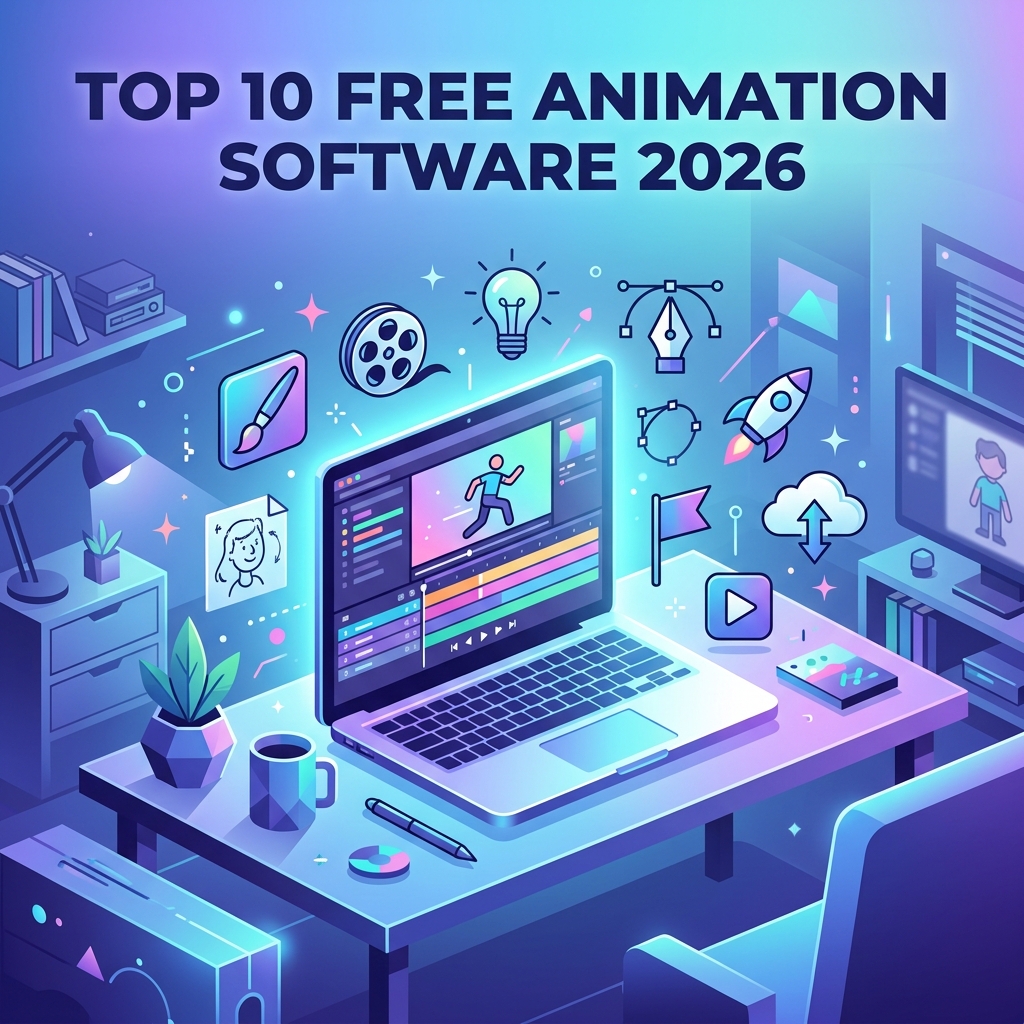
You have a story bouncing around in your head, a YouTube channel idea, or a side project that needs a slick explainer video — but every animation suite you click on demands a $300 license or a monthly subscription. The good news? In 2026, the gap between free and paid animation software has never been smaller. The bad news? There are dozens of free tools, and most “best of” lists recycle the same five names without telling you which one actually fits a beginner.
This guide cuts through that noise. You’ll get a hand-picked list of the top 10 free animation software for beginners in 2026, grouped by what they actually do well — 2D frame-by-frame, vector cutout, 3D modeling, stop motion, and motion graphics — plus the trade-offs nobody mentions until you’ve already spent a weekend learning the interface.
What Counts as “Free Animation Software” in 2026?
Free animation software refers to applications you can download and use to create animated content without paying a license fee, subscription, or watermark-removal upgrade. In 2026, the strongest options fall into three buckets: fully open-source tools (like Blender and Krita), community editions of commercial products (like Cascadeur), and free tiers of web-based platforms that remain genuinely usable without a paywall.
Before you download anything, it helps to know what kind of animation you actually want to make. Frame-by-frame hand-drawn animation, rigged character animation, 3D modeling, motion graphics, and stop motion all live in different software families. Picking the wrong family is the single biggest reason beginners quit in week two.
How We Picked the Best Free Animation Software for Beginners
Every tool on this list had to meet four criteria. First, it must be truly free — no time-limited trial, no exported watermark, no “free for personal use only if your project earns under $100.” Second, it must run on at least two of the three major platforms (Windows, macOS, Linux). Third, it must have an active community or recent updates in the last 12 months. Fourth, and most importantly, a motivated beginner should be able to produce a finished short clip within their first week.
The best free animation software isn’t the one with the most features. It’s the one you’ll actually open tomorrow morning.
1. Blender — The Open-Source 3D Powerhouse
Blender is the closest thing the animation world has to a miracle. It’s a fully open-source 3D suite that covers modeling, rigging, animation, simulation, rendering, compositing, and video editing — and it competes head-to-head with software costing thousands per seat. The 2026 release line continues to improve real-time rendering through Eevee Next and adds smoother Grease Pencil tools for hybrid 2D/3D workflows.
For beginners, the learning curve is real, but the payoff is enormous. You can learn the basics through the official Blender Manual and produce a finished animated short in a few weeks of focused practice.
Best for
- 3D character animation and short films
- Product visualization and motion graphics
- 2D animation via the Grease Pencil tool
Trade-offs
The interface, while greatly improved, still overwhelms first-time users. Plan on a few “I have no idea what I’m doing” hours before things click.
2. Krita — Frame-by-Frame 2D Animation Done Right
Krita started as a digital painting application and quietly grew into one of the best free tools for hand-drawn 2D animation. If you’ve ever wanted to make a Studio Ghibli-style flipbook on your laptop, Krita is where you start. Its onion-skinning, timeline, and brush stabilizers are tuned for traditional animators, not motion designers.
It runs comfortably on modest hardware and supports pressure-sensitive tablets out of the box, which makes it a natural pick for students with a basic drawing tablet.
Why beginners love it
- Clean, paint-focused workspace that doesn’t intimidate
- Built-in animation timeline with onion skins
- Export directly to GIF, MP4, or PNG sequences
3. OpenToonz — The Studio Ghibli Pipeline, Free
OpenToonz is the open-source descendant of the software Studio Ghibli used on classics like Princess Mononoke. It is purpose-built for 2D production animation, including vector and bitmap drawing, traditional inbetweening, and a node-based effects compositor. For a free tool, the feature depth is almost absurd.
The catch is the interface — it’s clearly designed for studio pipelines, not curious hobbyists. But if you’re serious about 2D animation as a craft, the effort pays off, and a thriving community on YouTube and Reddit will hold your hand through the rough spots.
4. Pencil2D — The Easiest On-Ramp to 2D Animation
If OpenToonz feels like flying a 747, Pencil2D is a paper airplane — and that’s a compliment. It’s a tiny, lightweight, cross-platform program with a four-panel interface (color, tools, timeline, canvas) and almost zero ceremony. You open it, pick a brush, and start drawing frames.
It supports both bitmap and vector layers, basic onion-skinning, and easy export to common formats. It is hands-down the friendliest entry point for someone who has never touched animation software before.
Quick start example
To create a simple bouncing-ball animation in Pencil2D:
- Open the app and create a new bitmap layer.
- Draw a circle on frame 1.
- Press
F6to insert a new keyframe, redraw the ball slightly lower. - Repeat for 8–12 frames, then hit play.
That four-step loop is the foundation of every animation principle you’ll ever learn. Pencil2D lets you focus on the craft instead of the menus.
5. Synfig Studio — Free Vector Cutout Animation
Synfig Studio is the go-to open-source alternative to commercial cutout animation tools. Instead of drawing every frame, you build rigged characters from vector shapes and animate them with bones and tweens — the same workflow used in countless YouTube explainer videos.
The 2026 builds have stabilized considerably, and the bone system finally feels predictable. You’ll want to follow a structured tutorial series before opening a blank project, but once you understand layer linking and waypoints, the workflow is fast.
6. Cascadeur — Physics-Based Character Animation
Cascadeur is one of the most exciting free animation tools to emerge in recent years. It uses AI-assisted physics to help you produce believable character motion — jumps, falls, fight scenes — without manually tweaking every keyframe. The Basic tier remains free for personal projects with reasonable render and export limits.
For a beginner who wants to animate humanoid characters without spending six months learning traditional rigging, Cascadeur is a genuine shortcut. Pair it with Blender for modeling and rendering and you have a full free pipeline.
7. Stop Motion Studio (Free Tier) — Mobile-First Stop Motion
Not every beginner wants to draw or model. If you have a smartphone and some clay or LEGO, Stop Motion Studio on Android and iOS gives you an excellent free tier with onion-skinning, frame capture, and simple editing. It’s how thousands of kids and adults make their first animated short on a kitchen table.
The free version watermarks high-resolution exports, but standard-definition output is clean — perfect for social media, school projects, or learning the principles of timing and spacing.
8. Wick Editor — Browser-Based Animation and Interactivity
Wick Editor runs entirely in your browser, which means there is nothing to install. It is the closest modern spiritual successor to the old Flash animation experience, supporting both drawn animation and interactive scripting. For teachers, students on locked-down school laptops, and anyone making web-friendly animations, it’s a quiet gem.
You can even add basic JavaScript to make clickable buttons and games, which makes it a fun bridge between animation and programming.
// Wick Editor script attached to a button object
// Plays a target animation clip when clicked
this.onEvent('mousedown', function () {
    project.objects.bounceClip.play();
});
The snippet above attaches a click handler to a button in your Wick project. When the user clicks it, the animation clip named bounceClip starts playing. Tiny scripts like this are why Wick is great for interactive storytelling, not just passive video.
9. DaVinci Resolve (Free) — Motion Graphics and Compositing
DaVinci Resolve is technically a video editor, but its built-in Fusion page is a full node-based motion graphics and compositing environment. The free version is staggeringly capable — you can build animated lower thirds, title sequences, particle effects, and tracked overlays without ever paying a cent.
If your goal is YouTube intros, podcast visualizers, or polished text animations rather than character animation, Resolve’s Fusion is one of the most underrated free animation environments in 2026.
10. Rive (Free Plan) — Interactive Animation for Apps and Web
Rive’s free plan gives individual creators access to a modern vector animation editor designed for interactive experiences. You design once, export a tiny runtime file, and play it in a website, mobile app, or game with real-time state changes. Designers and developers love it because the same animation reacts to code instead of being rendered to a static MP4.
For beginners who want their animations to do something — respond to clicks, scroll position, or game logic — Rive is a forward-looking choice that pairs beautifully with modern web stacks.
Quick Comparison Table
| Software | Best For | Platform | Difficulty |
|---|---|---|---|
| Blender | 3D & hybrid 2D/3D | Win, macOS, Linux | Medium-Hard |
| Krita | Hand-drawn 2D | Win, macOS, Linux | Easy-Medium |
| OpenToonz | Pro 2D pipelines | Win, macOS, Linux | Hard |
| Pencil2D | Absolute beginners | Win, macOS, Linux | Easy |
| Synfig Studio | Vector cutout | Win, macOS, Linux | Medium |
| Cascadeur | 3D character motion | Win, Linux | Medium |
| Stop Motion Studio | Stop motion on phones | iOS, Android | Easy |
| Wick Editor | Browser & interactive | Any browser | Easy |
| DaVinci Resolve | Motion graphics | Win, macOS, Linux | Medium |
| Rive | App & web animation | Web app | Medium |
A Beginner’s Learning Path
If you treat animation software like a buffet, you’ll never finish a project. Pick one tool aligned with the kind of animation you actually want to make, and stick with it for at least 30 days. A practical progression looks like this:
- Week 1: Install Pencil2D or Krita. Animate a bouncing ball, a walking blob, and a 5-second flag wave.
- Week 2: Learn the twelve basic principles of animation. Re-do your ball with squash and stretch.
- Week 3: Build a short 10-second scene with a character and background.
- Week 4: Choose your specialty — 3D in Blender, cutout in Synfig, or interactive in Rive — and start a small portfolio piece.
Common Pitfalls to Avoid
- Tool-hopping. Switching software every week resets your muscle memory. Commit for at least a month.
- Skipping fundamentals. The software doesn’t make your animation good. Timing, spacing, and weight do.
- Starting too big. A 30-second cinematic is not a beginner project. A 4-second loop is.
- Ignoring file backups. Free software occasionally crashes. Save versions like
scene_v01.blend,scene_v02.blend, and so on. - Animating on 1s for everything. Most professional 2D work is animated on 2s (12 drawings per second). It looks better and saves time.
Hardware and System Tips
Free animation software is generous to older hardware — with two exceptions. Blender’s rendering and Cascadeur’s physics solver both benefit massively from a recent GPU. If you’re on an integrated graphics laptop, stick to 2D tools like Pencil2D, Krita, or Wick until you can upgrade. A basic graphics tablet under $50 will improve your hand-drawn animation more than any software switch.
Frequently Asked Questions
What is the best free animation software for absolute beginners in 2026?
For someone who has never animated before, Pencil2D and Krita are the easiest entry points. They have shallow learning curves, friendly interfaces, and let you produce your first animated clip within a few hours. Once you’re comfortable, you can graduate to Blender, OpenToonz, or Synfig depending on the style you enjoy most.
Is Blender really free, even for commercial projects?
Yes. Blender is licensed under the GNU GPL, which means you can use it for personal, educational, and commercial work without paying anything. Anything you create with Blender belongs entirely to you, and you can sell it freely.
Can I make professional-quality animation with free software?
Absolutely. Blender has been used in feature films, OpenToonz has Studio Ghibli roots, and Cascadeur is showing up in indie game pipelines. The bottleneck for professional-quality work is your skill and consistency, not the price tag of the software.
Do I need a drawing tablet to use free animation software?
For 2D hand-drawn animation, a tablet helps enormously and dramatically improves line quality. For 3D animation in Blender or Cascadeur, vector animation in Synfig, or motion graphics in DaVinci Resolve, a mouse is completely sufficient. Start with what you have.
Which free animation software runs best on a low-end laptop?
Pencil2D, Krita, Synfig Studio, and Wick Editor all run comfortably on older or low-spec machines. Stop Motion Studio on a phone is another excellent low-resource option. Blender and Cascadeur are the most demanding picks on this list.
How long does it take to learn animation as a beginner?
You can produce a watchable 5-second clip in your first week. Reaching a portfolio-ready level usually takes 6 to 12 months of regular practice. The good news: the principles transfer between every tool on this list, so time spent learning fundamentals is never wasted.
Conclusion
The top 10 free animation software for beginners in 2026 prove that a tight budget is no longer an excuse to delay your first animated project. Whether you’re drawn to hand-drawn 2D with Krita, full 3D production in Blender, motion graphics in DaVinci Resolve, or interactive storytelling in Rive, there’s a free tool that will carry you from your first bouncing ball to a finished short.
Pick one based on the kind of work you actually want to create, give it at least 30 focused days, and treat tutorials as scaffolding rather than a destination. The animators you admire didn’t start with expensive software — they started with curiosity, a free download, and a willingness to make something ugly before making something great. Your turn.