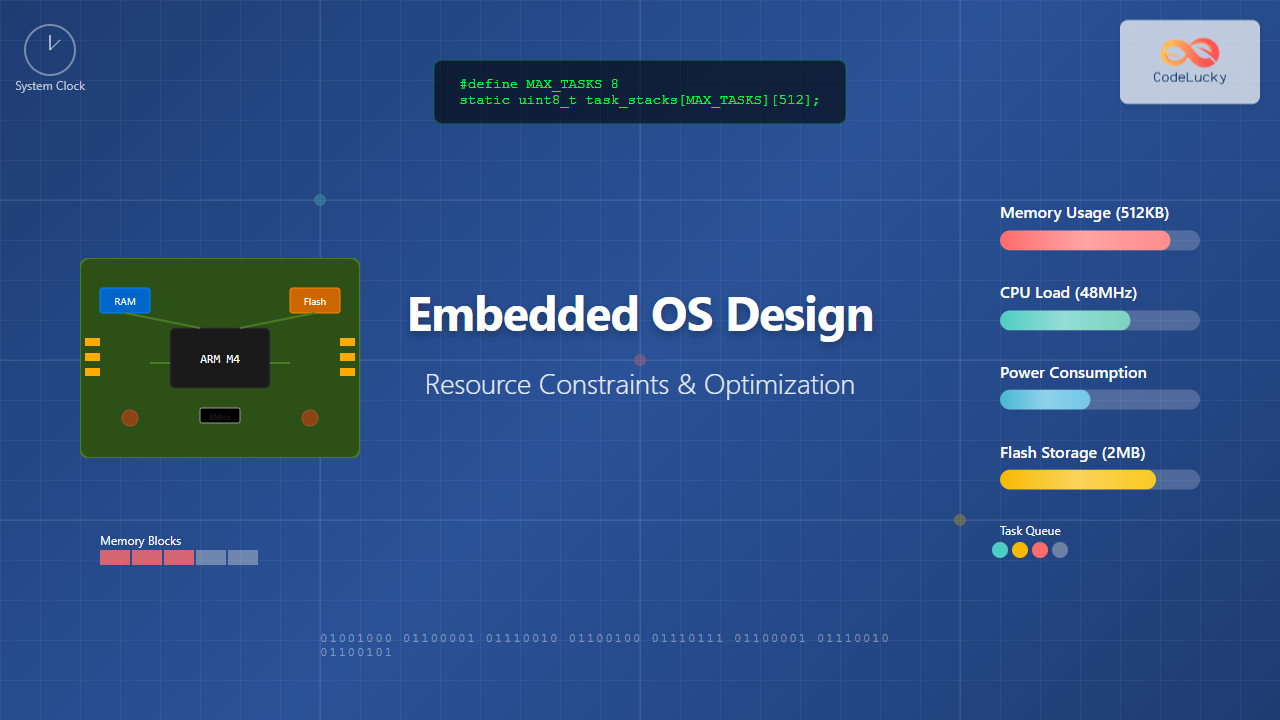
Embedded operating systems operate in a fundamentally different world than traditional desktop or server operating systems. With severe constraints on memory, processing power, storage, and energy consumption, designing an embedded OS requires careful consideration of every byte, every CPU cycle, and every milliwatt consumed. This comprehensive guide explores the critical aspects of resource-constrained embedded OS design.
Understanding Resource Constraints in Embedded Systems
Embedded systems face unique challenges that desktop systems rarely encounter. These constraints shape every design decision in embedded OS development:
Memory Constraints
RAM Limitations: Many embedded systems operate with as little as 1KB to 1MB of RAM, compared to gigabytes in desktop systems. This severely limits the number of concurrent processes, buffer sizes, and dynamic memory allocation strategies.
Flash/ROM Storage: Program storage is typically measured in kilobytes or megabytes, requiring careful code optimization and feature selection.

Processing Power Constraints
Embedded processors typically operate at frequencies ranging from 1MHz to 1GHz, with limited computational capabilities. Many lack advanced features like:
- Hardware floating-point units
- Complex instruction sets
- Multiple cores or threads
- Advanced cache hierarchies
Power Consumption Requirements
Battery-powered devices must optimize for energy efficiency, often requiring the system to enter various sleep modes and wake up only when necessary.
Memory Management Strategies
Static Memory Allocation
Unlike desktop systems that rely heavily on dynamic allocation, embedded systems often use static memory allocation to avoid fragmentation and provide predictable performance.
// Example: Static memory pool allocation
#define TASK_STACK_SIZE 512
#define MAX_TASKS 8

static uint8_t task_stacks[MAX_TASKS][TASK_STACK_SIZE];
static task_control_block_t tasks[MAX_TASKS];
static uint8_t task_count = 0;

// Allocate task with pre-defined stack
task_handle_t create_task(task_function_t func) {
    if (task_count >= MAX_TASKS) {
        return NULL;
    }

    tasks[task_count].stack_ptr = &task_stacks[task_count][TASK_STACK_SIZE - 1];
    tasks[task_count].function = func;
    tasks[task_count].state = TASK_READY;

    return &tasks[task_count++];
}
Memory Pool Management
Memory pools provide a middle ground between static and dynamic allocation, offering controlled memory management with predictable behavior.
// Memory pool implementation
typedef struct memory_pool {
    void* pool_start;
    size_t block_size;
    size_t block_count;
    uint32_t free_blocks_bitmap;
} memory_pool_t;

void* pool_alloc(memory_pool_t* pool) {
    // Find first free block using bit manipulation
    uint32_t free_bit = __builtin_ctz(pool->free_blocks_bitmap);

    if (free_bit >= pool->block_count) {
        return NULL; // No free blocks
    }

    // Mark block as used
    pool->free_blocks_bitmap &= ~(1U << free_bit);

    return (char*)pool->pool_start + (free_bit * pool->block_size);
}

void pool_free(memory_pool_t* pool, void* ptr) {
    size_t block_index = ((char*)ptr - (char*)pool->pool_start) / pool->block_size;
    pool->free_blocks_bitmap |= (1U << block_index);
}
Task Scheduling in Resource-Constrained Environments
Embedded OS schedulers must balance responsiveness with minimal overhead. Common approaches include:

Cooperative vs Preemptive Scheduling
Cooperative Scheduling: Tasks voluntarily yield control, reducing context switching overhead but potentially causing responsiveness issues.
// Cooperative scheduler example
void cooperative_scheduler(void) {
    static uint8_t current_task = 0;

    while (1) {
        if (tasks[current_task].state == TASK_READY) {
            // Execute task function
            tasks[current_task].function();

            // Task yields control by returning
            current_task = (current_task + 1) % active_task_count;
        }

        // Enter low-power mode if no tasks ready
        if (all_tasks_blocked()) {
            enter_sleep_mode();
        }
    }
}
Preemptive Scheduling: Higher overhead but guarantees responsiveness through timer-based task switching.
// Preemptive scheduler with timer interrupt
void timer_interrupt_handler(void) {
    // Save current task context
    save_context(&tasks[current_task]);

    // Select next task based on priority
    current_task = select_next_task();

    // Restore new task context
    restore_context(&tasks[current_task]);
}
Interrupt Handling and Real-Time Constraints
Embedded systems often require real-time responses to external events. Efficient interrupt handling is crucial for meeting timing constraints.
Interrupt Service Routine (ISR) Optimization
ISRs should be kept minimal to reduce interrupt latency and system jitter:
// Optimized ISR example
volatile uint8_t sensor_data_ready = 0;
volatile uint16_t sensor_raw_data;

void __attribute__((interrupt)) sensor_isr(void) {
    // Minimal processing in ISR
    sensor_raw_data = ADC_DATA_REG;
    sensor_data_ready = 1;

    // Clear interrupt flag
    ADC_CLEAR_FLAG();

    // Wake up processing task if needed
    wake_task(SENSOR_PROCESSING_TASK);
}

// Processing in task context
void sensor_processing_task(void) {
    while (1) {
        if (sensor_data_ready) {
            // Process data in task context
            float processed_value = process_sensor_data(sensor_raw_data);
            update_control_system(processed_value);
            sensor_data_ready = 0;
        }
        task_yield();
    }
}
Power Management Techniques
Power management is critical in battery-powered embedded systems. Effective strategies include:

Dynamic Frequency Scaling
Adjusting CPU frequency based on workload requirements can significantly reduce power consumption:
typedef enum {
    FREQ_LOW = 1000000,    // 1 MHz
    FREQ_MEDIUM = 8000000, // 8 MHz
    FREQ_HIGH = 48000000   // 48 MHz
} cpu_frequency_t;

void adjust_cpu_frequency(cpu_frequency_t freq) {
    switch (freq) {
        case FREQ_LOW:
            // Configure for low power operation
            CLOCK_CONFIG_LOW();
            current_tick_rate = TICK_RATE_LOW;
            break;
        case FREQ_MEDIUM:
            CLOCK_CONFIG_MEDIUM();
            current_tick_rate = TICK_RATE_MEDIUM;
            break;
        case FREQ_HIGH:
            CLOCK_CONFIG_HIGH();
            current_tick_rate = TICK_RATE_HIGH;
            break;
    }
}
Sleep Mode Management
Implementing effective sleep modes can extend battery life dramatically:
void power_manager_task(void) {
    static uint32_t idle_counter = 0;

    while (1) {
        if (no_active_tasks()) {
            idle_counter++;

            if (idle_counter > SLEEP_THRESHOLD) {
                // Enter deep sleep mode
                configure_wake_sources();
                enter_deep_sleep();
                idle_counter = 0;
            } else if (idle_counter > IDLE_THRESHOLD) {
                // Enter light sleep mode
                enter_light_sleep();
            }
        } else {
            idle_counter = 0;
        }

        task_delay(POWER_MANAGER_PERIOD);
    }
}
Code Size Optimization Techniques
Minimizing code footprint is essential in resource-constrained systems:
Compiler Optimizations
- Size optimization flags: Use -Os instead of -O2 to prioritize size over speed
- Dead code elimination: Enable linker garbage collection with -ffunction-sections and -fdata-sections
- Link-time optimization: Use -flto for better cross-module optimization
Architecture-Specific Optimizations
// Use bit manipulation for efficient operations
#define SET_BIT(reg, bit)     ((reg) |= (1U << (bit)))
#define CLEAR_BIT(reg, bit)   ((reg) &= ~(1U << (bit)))
#define TOGGLE_BIT(reg, bit)  ((reg) ^= (1U << (bit)))
#define CHECK_BIT(reg, bit)   (((reg) >> (bit)) & 1U)

// Pack structures to minimize memory usage
typedef struct __attribute__((packed)) {
    uint8_t status : 3;
    uint8_t priority : 3;
    uint8_t flags : 2;
    uint16_t timer_value;
    uint32_t next_wake_time;
} task_control_block_t;
Device Driver Architecture
Efficient device drivers are crucial in embedded systems where hardware interaction is frequent and must be optimized for both performance and resource usage.

DMA-Based I/O
Direct Memory Access reduces CPU overhead for data transfers:
// DMA-based UART transmission
typedef struct {
    uint8_t* buffer;
    size_t length;
    volatile uint8_t complete;
} dma_transfer_t;

dma_transfer_t uart_tx_transfer;

void uart_send_dma(uint8_t* data, size_t length) {
    uart_tx_transfer.buffer = data;
    uart_tx_transfer.length = length;
    uart_tx_transfer.complete = 0;

    // Configure DMA channel
    DMA_CH0_SRC = (uint32_t)data;
    DMA_CH0_DST = (uint32_t)&UART_TX_REG;
    DMA_CH0_LEN = length;
    DMA_CH0_CTRL = DMA_ENABLE | DMA_MEM_TO_PERIPH;
}

void dma_interrupt_handler(void) {
    if (DMA_CH0_STATUS & DMA_COMPLETE) {
        uart_tx_transfer.complete = 1;
        DMA_CH0_STATUS |= DMA_COMPLETE; // Clear flag

        // Wake up waiting task
        signal_semaphore(&uart_tx_semaphore);
    }
}
Communication Protocols and Networking
Embedded systems often require communication capabilities while maintaining resource efficiency:
Lightweight Protocol Stacks
Instead of full TCP/IP stacks, embedded systems often use lightweight alternatives:
// Simple packet protocol for embedded communication
typedef struct __attribute__((packed)) {
    uint8_t start_marker;     // 0xAA
    uint8_t packet_type;      // Command, data, ack, etc.
    uint8_t sequence_number;  // For reliability
    uint8_t payload_length;   // 0-252 bytes
    uint8_t payload[252];     // Variable payload
    uint16_t checksum;        // CRC-16
    uint8_t end_marker;       // 0x55
} simple_packet_t;

uint8_t send_packet(simple_packet_t* packet) {
    packet->start_marker = 0xAA;
    packet->end_marker = 0x55;
    packet->checksum = calculate_crc16(packet->payload, packet->payload_length);

    return transmit_bytes((uint8_t*)packet,
                         sizeof(simple_packet_t) - sizeof(packet->payload) + packet->payload_length);
}
Real-World Implementation Example
Let’s examine a complete example of a resource-constrained embedded OS for a temperature monitoring system:
// Complete embedded OS example for temperature monitoring
#include
#include

// System configuration
#define MAX_TASKS 4
#define STACK_SIZE 256
#define TICK_RATE_MS 10

// Task priorities
typedef enum {
    PRIORITY_IDLE = 0,
    PRIORITY_LOW = 1,
    PRIORITY_NORMAL = 2,
    PRIORITY_HIGH = 3
} task_priority_t;

// Task control block
typedef struct {
    uint32_t* stack_ptr;
    uint8_t stack[STACK_SIZE];
    task_priority_t priority;
    uint32_t wake_time;
    bool active;
} tcb_t;

// Global system state
static tcb_t tasks[MAX_TASKS];
static uint8_t current_task = 0;
static uint32_t system_tick = 0;

// Temperature monitoring task
void temperature_task(void) {
    static uint32_t last_reading = 0;

    while (1) {
        if ((system_tick - last_reading) >= 1000) { // Every 10 seconds
            uint16_t temp_raw = read_adc_channel(TEMP_CHANNEL);
            int16_t temperature = convert_to_celsius(temp_raw);

            if (temperature > TEMP_THRESHOLD) {
                signal_alarm();
            }

            store_temperature_reading(temperature);
            last_reading = system_tick;
        }

        task_yield();
    }
}

// Communication task
void comm_task(void) {
    while (1) {
        if (uart_data_available()) {
            process_incoming_data();
        }

        if (pending_transmissions()) {
            send_pending_data();
        }

        task_delay(50); // 500ms
    }
}

// Simple round-robin scheduler
void scheduler(void) {
    while (1) {
        // Find next ready task
        uint8_t next_task = (current_task + 1) % MAX_TASKS;

        while (!tasks[next_task].active ||
               (tasks[next_task].wake_time > system_tick)) {
            next_task = (next_task + 1) % MAX_TASKS;

            if (next_task == current_task) {
                // No tasks ready, enter idle mode
                enter_idle_mode();
                break;
            }
        }

        if (next_task != current_task) {
            context_switch(current_task, next_task);
            current_task = next_task;
        }
    }
}
Performance Monitoring and Debug Strategies
Resource-constrained systems require careful monitoring to ensure optimal performance:
Runtime Memory Usage Tracking
// Memory usage monitoring
typedef struct {
    size_t total_ram;
    size_t used_ram;
    size_t free_ram;
    size_t largest_free_block;
    uint32_t fragmentation_percent;
} memory_stats_t;

memory_stats_t get_memory_statistics(void) {
    memory_stats_t stats = {0};

    stats.total_ram = TOTAL_RAM_SIZE;
    stats.used_ram = calculate_used_memory();
    stats.free_ram = stats.total_ram - stats.used_ram;
    stats.largest_free_block = find_largest_free_block();
    stats.fragmentation_percent = calculate_fragmentation();

    return stats;
}

// Stack usage monitoring
uint16_t get_stack_usage(uint8_t task_id) {
    uint32_t* stack_bottom = (uint32_t*)tasks[task_id].stack;
    uint32_t* current_sp = tasks[task_id].stack_ptr;

    return (uint8_t*)stack_bottom - (uint8_t*)current_sp;
}
Best Practices and Common Pitfalls
Design Guidelines
- Plan memory usage statically: Avoid dynamic allocation when possible
- Use interrupt-driven I/O: Minimize CPU polling overhead
- Implement watchdog timers: Ensure system reliability
- Profile early and often: Monitor resource usage throughout development
- Design for power efficiency: Consider sleep modes from the beginning
Common Mistakes to Avoid
- Excessive interrupt nesting leading to stack overflow
- Blocking operations in time-critical tasks
- Inadequate stack size allocation
- Memory leaks in long-running systems
- Priority inversion problems
Future Trends in Embedded OS Design
The embedded systems landscape continues evolving with new challenges and opportunities:
- Edge AI Integration: Incorporating machine learning capabilities within resource constraints
- Security Enhancement: Implementing robust security measures without compromising performance
- Wireless Connectivity: Supporting IoT protocols while maintaining low power consumption
- Containerization: Exploring lightweight containerization for embedded applications
Mastering embedded OS design for resource-constrained environments requires a deep understanding of hardware limitations, careful architectural decisions, and continuous optimization. By applying the strategies and techniques outlined in this guide, developers can create efficient, reliable embedded systems that maximize performance within strict resource constraints.
The key to success lies in embracing the constraints rather than fighting them – using limitations as design drivers to create elegant, efficient solutions that would be impossible in resource-abundant environments.